Introduction
Let me start with a confession: when I first studied 1857, I found it boring. A bunch of dates, names, and events that seemed disconnected. Then one evening, while preparing notes for my students, I realized something that completely changed how I teach this topic.
1857 isn't just a revolt. It's India waking up. It's the moment when Indians—across castes, religions, and regions—said "enough" to foreign rule. And what fascinates me most? This single year set the tone for everything that followed, right up to 1947.
If you're preparing for SSC CGL or UPSC, understanding 1857 deeply is non-negotiable. But here's the good news: once you see the *why* behind the events, you'll never forget them. So grab your chai, and let's decode this together.
The Road to Rebellion: Why 1857 Happened
You know how a pressure cooker builds steam until it explodes? India in the early 19th century was exactly that.
Economic Exploitation: The Silent Killer
The British East India Company wasn't just governing India—they were systematically draining it. Think about it this way: in 1700, India contributed about 23% of the world's GDP. By 1850, that had crashed to less than 2%. This wasn't accidental; it was policy.
The Company introduced the Permanent Settlement (1793) in Bengal, which devastated traditional landowners. They forced Indians into growing cash crops like indigo and opium instead of food grains. Local artisans and weavers were systematically ruined through taxes and competition from British machine-made goods. A weaver in Bengal who once earned well found himself begging on the streets. This created a massive pool of angry, jobless people—the perfect fuel for rebellion.
Here's a trick I tell my students: remember "CROP" for the economic pressures—Cash crops forced, Revenue extracted, Oppressive taxes, Poor artisans destroyed.
Cultural and Religious Resentment
But it wasn't just money. The British didn't just want to rule India; they wanted to "civilize" it. And that's where they made a critical mistake.
Christian missionaries were increasingly active. The government introduced Western education and seemed to openly mock Indian traditions. For a society deeply rooted in Hindu and Islamic traditions, this felt like an assault on their very identity. The introduction of the Enfield rifle, which used cartridges greased with animal fat (cow and pig lard), was the spark that ignited the powder keg. Imagine being told that to serve your country, you must violate your most sacred beliefs. That's what Indian soldiers (sepoys) faced.
Now here's the interesting part: the British underestimated how unified Indian society could become when their core values were threatened. They thought Indians were divided, and they were right—but a threat to religion could still unite them.
Administrative Oppression and the Doctrine of Lapse
The East India Company's expansion policy under Lord Dalhousie was brutal and short-sighted. Using something called the "Doctrine of Lapse," any princely state without a direct male heir was annexed. Imagine being a prince for centuries, and suddenly a foreign power decides your kingdom is theirs because you don't have a son. This directly affected leaders like the Rani of Jhansi (Laxmibai), whose adopted son wasn't recognized as a valid heir.
Old soldiers (pensioners) also faced cuts in their allowances. Zamindars lost their status. The entire traditional power structure felt threatened. These people had the resources, the respect, and the grievances—they became the leaders of 1857.
The Revolt Unfolds: Who, Where, and How
Key Centers and Leaders
One mistake students make is treating 1857 as a single, unified national movement. It wasn't. It was multiple revolts that happened simultaneously. But that's what makes it significant—it shows how widespread the discontent was.
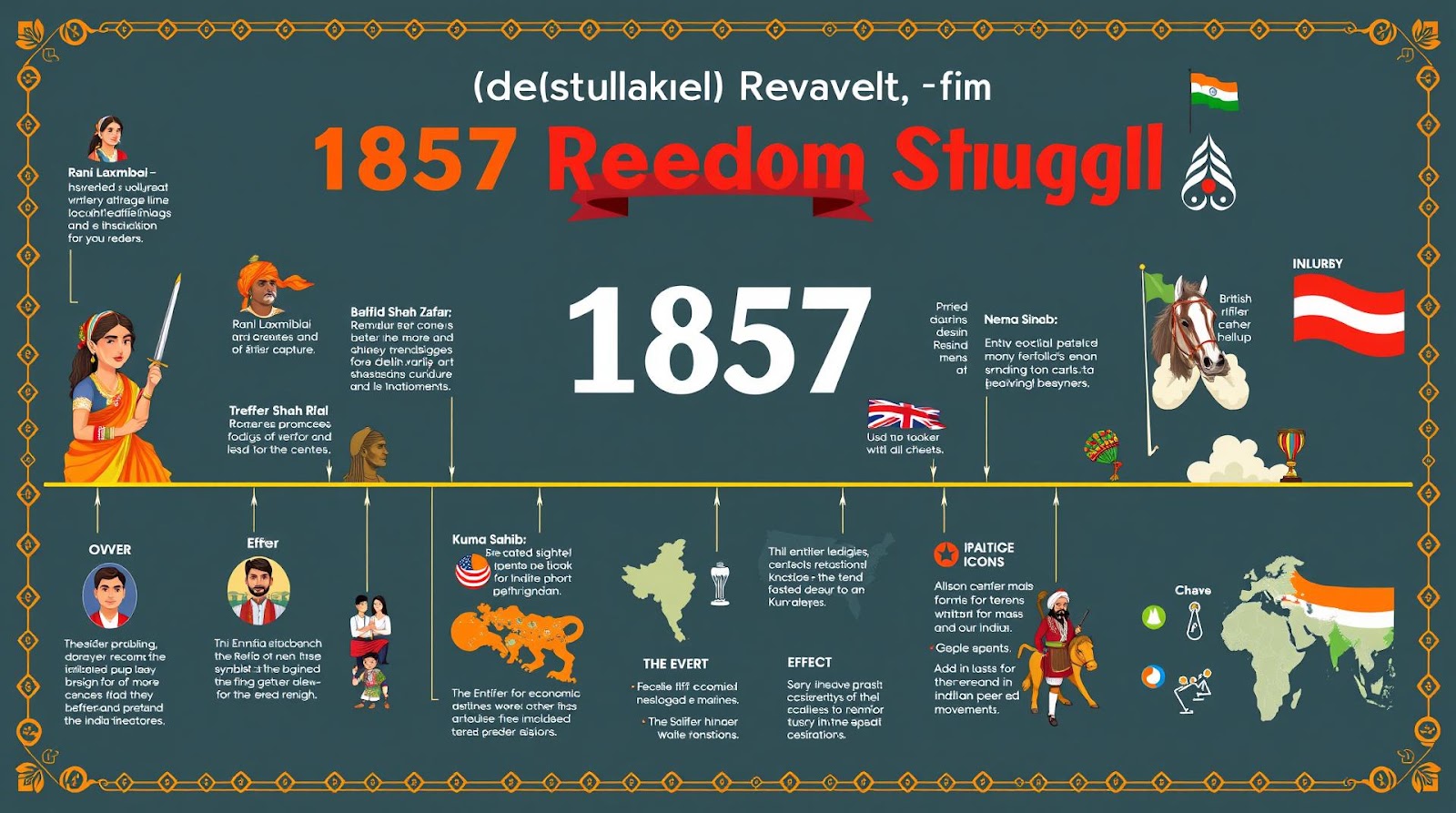
Delhi became the symbolic center. The rebels captured it within days and proclaimed Bahadur Shah Zafar (the last Mughal emperor) as their leader. Now, Bahadur Shah was in his 80s and never wanted this responsibility. But his name gave the rebellion legitimacy. It wasn't just about sepoys; it was a restoration of the old order.
Kanpur saw Nana Sahib (Dhondu Pant), the adopted son of the last Peshwa, organize fierce resistance. He was educated in Western ways but deeply angered by the Doctrine of Lapse. The British under General Henry Havelock eventually brutalized the city in retaliation.
Jhansi had the Rani Laxmibai—perhaps the most iconic figure of 1857. Young, intelligent, and trained in martial arts, she fought the British tooth and nail. Her famous last words, "May India be free," became a rallying cry. She didn't die in battle; she died preparing for freedom. That's the poetic justice of history.
Awadh (Lucknow) was perhaps where the most brutal fighting happened. The capital, Lucknow, withstood a 87-day siege. The Begum of Awadh supported the rebels, and the region became a stronghold. The British finally recaptured it, but at tremendous cost.
Bareilly, Allahabad, Varanasi, Gwalior all had significant uprisings. In fact, more than half of northern India was in rebellion. The British were genuinely frightened. They thought they'd lost India.
Who Participated?
Here's what teachers often miss when teaching 1857: it wasn't just sepoys. Yes, the rebellion started with soldiers, but it quickly became a people's movement. Peasants joined because of revenue pressures. Zamindars joined because of lost power. Unemployed artisans joined because they had nothing to lose. Even some British-educated Indians, who understood British oppression most keenly, supported the cause.
But here's the catch—and this is crucial for understanding why it ultimately failed—there was no single leader, no unified command structure, and frankly, no shared vision of what independent India should look like. Some wanted to restore the Mughal empire. Others wanted local kingdoms. Some had social reform agendas that conflicted with others' interests. The unity was born of hatred for the British, not a shared positive goal.
| Leader/Region | Territory | Fate |
|---|---|---|
| Bahadur Shah Zafar | Delhi | Exiled to Rangoon; died in captivity |
| Rani Laxmibai | Jhansi & Gwalior | Killed in battle (June 1858) |
| Nana Sahib | Kanpur | Escaped; fate unknown |
| Kunwar Singh | Arrah (Bihar) | Fought until 1858; died of wounds |
| Begum Hazrat Mahal | Lucknow | Escaped to Nepal; lived in exile |
Why the Revolt Failed (And This Matters for Understanding Later Movements)
I always tell my students: learning why something failed is sometimes more valuable than learning why it succeeded. Because 1857 teaches us the blueprint for what worked later.
The British had superior military organization, better weapons, and crucially, they controlled the railways. They could move troops faster than rebel messages could spread. The southern princely states, except for a few, didn't join the rebellion. Scindia of Gwalior, for instance, actually helped the British suppress the revolt in his own territory. Foolish? Maybe. But that's the reality of Indian feudalism—local interests often trumped national consciousness.
The rebels also lacked a common political objective. They were united against the British but divided on what should replace British rule. A Mughal restoration? A Hindu kingdom? Local kingdoms? These internal contradictions weakened their cause.
Finally, and this is often overlooked, the British responded with calculated brutality that terrorized the population into submission. Executions were public and gruesome. Entire villages suspected of supporting rebels were destroyed. Within two years, the rebellion was crushed.
The Aftermath: How 1857 Changed Everything
Immediate Political Changes
The British learned a lesson: direct company rule was too unstable. In 1858, the East India Company was formally dissolved, and India came under direct Crown rule. Queen Victoria became the Empress of India. On paper, this was just a change in administration. In reality, it was a shift in approach.
The British adopted what I call "controlled decentralization." They gave some autonomy to princely states to prevent future rebellions. They also reorganized the Indian Civil Service, bringing more British officials directly into governance. They couldn't afford another 1857.
The Birth of Indian Nationalism
Now here's where it gets interesting. The British thought 1857 would crush any dreams of Indian independence. Instead, it inspired something far more dangerous (from their perspective): organized nationalism.
The Indian National Congress was founded in 1885—just 28 years after 1857 ended. It wasn't a coincidence. A new generation of Indians, many educated in British universities, studied the 1857 Revolt and learned what didn't work. They realized that spontaneous rebellion without unified organization would always fail. They needed political platforms, newspapers, sustained campaigns, and mass participation.
They also learned that the class divisions that fractured 1857 needed to be overcome. This is why leaders like Dadabhai Naoroji, Bal Gangadhar Tilak, and later Gandhi understood that independence had to be a movement that included peasants, workers, and the middle class simultaneously.
Cultural and Psychological Impact
Let me share something personal. When I was a student, my grandfather told me about his grandfather—a freedom fighter—and how 1857 was discussed in hushed tones in their household. It was mythologized. It was inspirational. Even though it failed militarily, it won in the hearts of Indians.
The Rani of Jhansi became a legend. Bahadur Shah Zafar's poetry became immortal. These weren't just historical figures anymore; they were symbols of resistance. Every generation of independence fighters drew inspiration from 1857. When you study the Indian independence movement, you realize it's essentially the story of how Indians learned from 1857's failures and built a successful movement on those lessons.
Connecting 1857 to the Broader Freedom Struggle
Here's a memory trick I use in class: "RCRF" for the evolution of the independence movement after 1857: Radical nationalism (1880s-1900s), Congress formation (1885), Revolutionary terrorism (1900s-1920s), Freedom struggle (1920s-1947).
Each phase learned from 1857. The Radical nationalists understood that peaceful petitions weren't enough but also that armed revolt without political organization was futile. So they used newspapers and public opinion. The Revolutionaries like Bhagat Singh studied 1857 intensely and realized that martyrdom, when coupled with a clear political message, could become powerful. Finally, Gandhi understood that mass participation was key—and that's why the Non-Cooperation Movement (1920) and Salt March (1930) succeeded where 1857 failed.
In essence, the 90-year journey from 1857 to 1947 is the story of Indians perfecting the art of resistance. And it all started with the mistakes and lessons of 1857.
Final Thoughts: Why This Matters
I often ask my students: why does your government still celebrate 1857? Why are there statues of Laxmibai in every Indian city? Because 1857 marks the moment India stopped asking for freedom and started demanding it. It failed militarily, yes. But it succeeded in creating a psychological shift. It showed that Indians could fight the mighty British Empire. It shattered the myth of British invincibility.
For your exams, remember this: 1857 isn't just a list of events to memorize. It's a turning point. It's the moment when modern Indian history truly begins. Everything after 1857—the Congress, the freedom struggle, the constitution we wrote ourselves—traces back to the lessons learned in 1857.
Now, let's test your understanding with some practice questions.
A) Economic exploitation of zamindars B) Introduction of greased cartridges in Enfield rifles C) Doctrine of Lapse affecting princely states D) Suppression of local industries
Answer: B) Introduction of greased cartridges in Enfield rifles. While economic issues were important, the immediate trigger was the religious offense caused by the cartridges.
A) Nana Sahib B) Rani Laxmibai C) Bahadur Shah Zafar D) Kunwar Singh
Answer: C) Bahadur Shah Zafar. Though reluctant, the last Mughal emperor lent legitimacy to the rebellion by accepting the leadership.
A) Warren Hastings B) Lord Dalhousie C) Lord Curzon D) Lord Ripon
Answer: B) Lord Dalhousie. His aggressive expansionist policies directly contributed to the grievances that led to 1857.
A) Lack of military training B) Absence of unified leadership and political objectives C) Lack of public support D) Limited weapons
Answer: B) Absence of unified leadership and political objectives. While military factors mattered, the lack of a cohesive plan and shared vision was fatal.
A) Formation of the Indian National Congress B) Dissolution of the East India Company and establishment of Crown rule C) Implementation of the Mountbatten Plan D) Adoption of a federal structure in India
Answer: B) Dissolution of the East India Company and establishment of Crown rule. In 1858, direct British Crown rule replaced company governance.
Published by BlogBot • 14 April 2026
.jpg)
.png)


.png)
.png)

.png)


0 Comments