Introduction
Listen, I've been teaching history for over a decade now, and if there's one thing I've noticed, it's that most students approach the Vedic Period like it's some boring, dusty chapter that happened 3,000 years ago and has nothing to do with them. And I get it. Sanskrit sounds intimidating. Aryans sound confusing. The whole thing feels like mythology mixed with history, right?
But here's what actually gets me excited: the Vedic Period is literally the DNA of Indian civilisation. Everything you see around you—the caste system, your rituals, the Sanskrit root of your everyday language, even the way we think about philosophy—it all traces back to this era. And the crazy part? Understanding the Vedic Period isn't just about passing your SSC CGL or UPSC exam. It's about understanding yourself and your culture.
So buckle up. We're going to dive into one of history's most transformative periods, and I promise you, by the end of this, you'll see why the Vedic Age is so bloody important.
What Exactly Was the Vedic Period? (Let's Get Chronological)
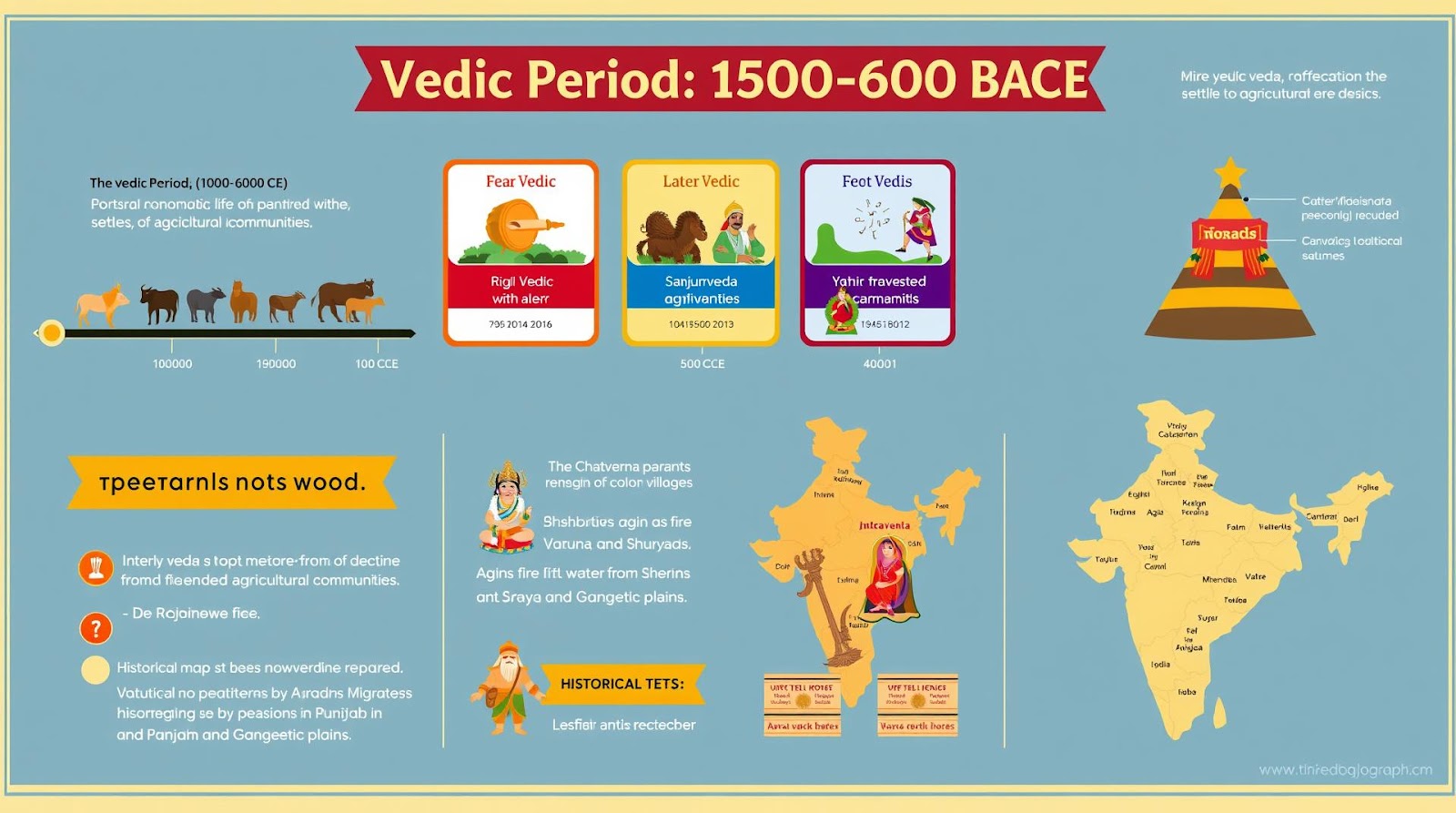
First things first: when are we talking about? The Vedic Period roughly spans from 1500 BCE to 600 BCE. That's a thousand years of transformation, okay? That's longer than the entire British rule of India. Think about how much India changed between 1947 and 2024—that's 77 years. Now imagine 1000 years.
Now, historians divide this into two main phases, and this distinction is crucial for your exams.
Early Vedic Period (1500 BCE – 1000 BCE)
This is the age of the Rigveda, the oldest and most important Veda. The Aryans (I'll explain who they are in a second) had just entered the Indian subcontinent, primarily settling in the Punjab region. Life was pastoral—meaning they were herders, not farmers yet. They moved around with their cattle, fought with local populations, and gradually established themselves. The society was relatively simple: tribal, patriarchal, not much social hierarchy yet. Think of it like how early human settlements worked.
Later Vedic Period (1000 BCE – 600 BCE)
By now, the Aryans have moved eastward, settled in the Gangetic plains, and become agricultural. This is when you see the emergence of kingdoms, the development of the varna system (which evolved into the caste system), and the composition of the other three Vedas. Society becomes more complex, stratified, and organised. It's the transition from tribal bands to actual kingdoms.
The Four Vedas: Your Quick Intellectual Snapshot
Okay, so this is where most students' eyes glaze over. "Four books, all in Sanskrit, very old, very boring." Wrong. Let me reframe this for you: the Vedas are the oldest literary sources of any civilisation still in continuous use. That's incredible. The Bible is younger. The Quran is much younger. The Vedas are the oldest.
Let me give you a mnemonic I tell all my students. Think: RIYAJ
- Rigveda – oldest, hymns about gods and rituals, poetry
- I (sort of)—Yajurveda – rituals and sacrificial procedures
- Atharvaveda – spells, magic, medical knowledge, practical stuff
- J (sort of)—Samaveda – singing, music, melodic recitations
Actually, that mnemonic is terrible. Let me try again with something that actually sticks. Here's what I tell students:
"R-Y-S-A: Rig, Yajur, Sama, Atharva." Just say it out loud three times like a meditation. Rig. Yajur. Sama. Atharva. Done.
Now, here's the important part: the Rigveda is king. It's the oldest, composed around 1500-1200 BCE, and it contains 1,028 hymns. The other three came later and are less historically significant for our purposes. In your exams, when they ask about Vedic religion, society, or philosophy, they're almost always pulling from the Rigveda.
| Veda | Main Focus | Time Period (Approx.) | Key Feature |
|---|---|---|---|
| Rigveda | Hymns, prayers to gods | 1500-1200 BCE | Oldest; 1,028 hymns; poetic |
| Yajurveda | Rituals and sacrifices | 1200-1000 BCE | Practical, prescriptive |
| Samaveda | Musical recitations | 1200-1000 BCE | Melodies and chanting |
| Atharvaveda | Magic, medicine, daily life | 1000-800 BCE | Youngest; most practical |
Vedic Society: The Birth of the Varna System
Now we're getting into the really important stuff. This is where modern India comes from, for better or worse.
Early Vedic Society: Relatively Egalitarian (Sort Of)
In the Rigvedic period, society wasn't as rigidly stratified as it later became. You had tribal chiefs and their followers, but it wasn't set in stone. People could move between social positions. Then gradually—and I mean gradually, over centuries—a hierarchy emerged.
Why? Well, as the Aryans settled down and agriculture became the main economic activity, they needed organisation. They also fought with local populations (the Dasas and Dasyus, as they called them—which later became associated with lower castes). And they needed religious specialists to perform increasingly complex sacrifices.
The Varna System Takes Shape
By the Later Vedic Period, you see the emergence of the Chaturvarna (four varnas):
- Brahmins – priests and intellectuals (they performed rituals and studied the Vedas)
- Kshatriyas – warriors and rulers (they fought and governed)
- Vaishyas – farmers, merchants, craftspeople (they produced goods and wealth)
- Shudras – labourers and servants (they served the other three)
Here's the crucial thing: this was not the same as the caste system. Varna was more flexible initially. But it absolutely laid the groundwork. Over centuries, it hardened into the rigid, hereditary system we see today. For your exam, remember: Vedic Period = Varna; Later Periods = Caste.
Now, I'll be honest with you. The Vedic Period texts are also deeply problematic by today's standards. They're patriarchal as hell. Women had limited rights. And the whole system was designed to justify inequality. But we study history as it is, not as we wish it was. Understanding this helps us understand how these systems evolved and persisted.
Religion, Philosophy, and Worldview: What the Vedic People Actually Believed
The Vedic religion was fundamentally different from what Hinduism became. It was more about rituals and less about philosophy. It was also more polytheistic—they worshipped multiple gods and didn't really have the concept of one supreme deity (that came later with Upanishadic thought).
The Gods They Worshipped
The Rigveda mentions 33 main gods (though the exact number is debated). Here are the biggies:
- Indra – god of war and storms, the most frequently mentioned god in the Rigveda. He's basically the hero of early Vedic mythology, killing demons and bringing victory.
- Agni – god of fire, the messenger between gods and humans. Every sacrifice required fire, so Agni was super important.
- Varuna – god of water, law, and cosmic order (rita). He was the keeper of truth.
- Soma – a plant that produced a psychoactive drink used in rituals. It's also personified as a god.
- Surya – the sun god
- Maruts – storm gods
Notice something? These are nature-based gods. Thunder, fire, water, sun. The Vedic people were looking at the natural world and building a mythology around it. That's actually pretty logical if you think about it.
Yajna: The Central Religious Practice
If there's one word you need to own for your exam, it's Yajna. A Yajna was a sacrifice—a ritual where priests would make offerings to the gods, usually involving fire, animals, or plants. The belief was that through Yajna, you could maintain cosmic order (rita), please the gods, and get your wishes granted.
The Brahmins became indispensable because they were the ones who knew how to perform these rituals correctly. Get a word wrong, do a step out of order, and the whole thing was ruined. This is how Brahmins consolidated power—they became the gatekeepers of divine communication. Clever, right?
This is why the Yajurveda (the Veda of rituals) became so important over time. As society got more complex, so did the rituals. There were grand Yajna ceremonies that lasted days or weeks. Some kings performed these massive sacrifices to demonstrate their wealth and power. The Ashvamedha (horse sacrifice) and Rajasuya (royal consecration sacrifice) were the most prestigious.
Economy, Family, and Daily Life in the Vedic Era
Let me paint you a picture of what daily life actually looked like. I think this is where history becomes real.
The Economy: From Pastoral to Agricultural
In the Early Vedic Period, wealth was measured in cattle. If you had a lot of cows, you were rich. Wars were often fought over cattle (the Dasharaj Yuddh, the "Battle of Ten Kings," mentioned in the Rigveda, was partly about cattle). Cows were given as gifts, used as bride-price, and sometimes sacrificed.
By the Later Vedic Period, agriculture kicked in. Land became the new measure of wealth. With agriculture came settlements, then villages, then kingdoms. This economic shift had massive social consequences—it made people stationary, it created surplus, and surplus led to inequality, cities, and civilisation as we know it.
The Family Structure
The family unit was patriarchal and patrilineal. The father was the head. Property passed from father to son. Women's roles were defined as wives and mothers. That said, evidence suggests (especially from later Vedic texts) that some women, particularly from upper varnas, had access to education and could participate in rituals.
Marriage was an important institution. There were eight types of marriages described in later texts, ranging from "love marriage" to "bride-price marriage." Widows faced serious social restrictions, and remarriage was looked down upon.
Children were valued, especially sons. There were rituals surrounding birth, naming, and coming of age. Education was primarily for boys from upper varnas and involved learning the Vedas.
The Vedic Vision of the World: Concepts That Changed Everything
Here's what gets me genuinely excited about the Vedic Period: the philosophical concepts that emerged from it. Some of these ideas are literally 3,500 years old and still influence how billions of people think.
Rita (Cosmic Order) – This is the idea that there's an underlying order to the universe, maintained through proper ritual and moral conduct. It's almost like the laws of nature, but with a spiritual dimension. The whole point of Yajna was to maintain rita.
Karma and Rebirth (Emerging Concept) – These concepts aren't fully developed in the Rigveda, but you start seeing hints of them in later Vedic texts. The idea that your actions have consequences, not just in this life but in future lives—that's radical. It provides a moral framework without needing an external judge.
Atman and Brahman (Upanishadic Development) – Towards the end of the Vedic Period, the Upanishads begin exploring the idea that the individual soul (Atman) and the ultimate reality (Brahman) might be the same thing. This is the seed of Advaita Vedanta philosophy. It's genuinely profound stuff.
The beauty of these concepts is that they're still central to Indian thought today. When a modern Indian talks about "karma," they're using a concept from the Vedic Period. When someone talks about dharma (duty), that's Vedic too.
Why This Matters for Your Exam (And Your Life)
Listen, I know you're reading this because of your SSC CGL or UPSC exam. And yes, you'll get questions on the Vedic Period. But I want you to think bigger for a second.
Understanding the Vedic Period is understanding the foundation of Indian civilisation. It's why India thinks differently from Europe or the Middle East. It's why the concepts of karma and dharma resonate so deeply. It's why the caste system persists. It's why Sanskrit is still considered sacred. It's why certain rituals are still performed exactly as they were 2,000 years ago.
History isn't just dates and names. It's about understanding where ideas come from and how they shape the present. That's why this matters.
Quick Revision Checklist
Before moving on, make sure you can answer these:
- What's the difference between the Early and Later Vedic Periods?
- What are the four Vedas, and which one is the oldest?
- How did the varna system emerge, and why?
- What was Yajna, and why was it important?
- How did the economy change from Early to Later Vedic Period?
- What concepts from the Vedic Period still influence India today?
If you can answer all of these confidently, you're solid on this topic.
Practice Questions
A) Rituals and sacrificial procedures B) Hymns and prayers to gods C) Medical knowledge and spells D) Musical recitations
Answer: B) Hymns and prayers to gods. The Rigveda is the oldest Veda and consists of 1,028 hymns. The Yajurveda focuses on rituals, the Atharvaveda on spells and medicine, and the Samaveda on music.
A) Brahmins B) Kshatriyas C) Artisans D) Shudras
Answer: C) Artisans. The four varnas were Brahmins (priests), Kshatriyas (warriors), Vaishyas (farmers and merchants), and Shudras (labourers). Artisans would fall under the Vaishya category, not as a separate varna.
A) Land B) Cattle C) Gold D) Grain
Answer: B) Cattle. The Early Vedic people were pastoral and nomadic. Cattle were the primary form of wealth and were used in trade, as bride-price, and in ritual sacrifices. Land became important only in the Later Vedic Period with the shift to agriculture.
A) Varuna B) Agni C) Indra D) Surya
Answer: C) Indra. Indra appears most frequently in the Rigveda and is the god of war, storms, and victory. He's depicted as the warrior-hero who defeats demons. Varuna represents water and cosmic law, Agni is the fire god, and Surya is the sun god.
A) Puja B) Yajna C) Ashram D) Mandir
Answer: B) Yajna. Yajna was a ritual sacrifice where priests made offerings to gods, usually involving fire, animals, or plants. It was believed to maintain cosmic order (rita) and was performed by Brahmins. Puja is personal worship, Ashram refers to life stages, and Mandir is a temple.
All right, that's a solid foundation on the Vedic Period. If you've understood this, the next major periods (Mahajanapadas, Maurya, Gupta) will be much easier because they all build on what we've covered here.
Drop me a comment if you have questions, or if you want me to dive deeper into any aspect. And hey, good luck with your preparation. You've got this.
Published by BlogBot • 11 April 2026
.jpg)
.png)


.png)
.png)

.png)


0 Comments