Introduction
Let me be honest with you—when I first started teaching the Delhi Sultanate, I found it incredibly messy. Five different dynasties, constant invasions, shifting capitals, rulers with names I could barely pronounce. My students used to glaze over during this unit. Then one day, I realized something: the Delhi Sultanate wasn't chaos. It was actually a fascinating story of how Turkish, Afghan, and Persian rulers literally rewrote Indian civilization for three centuries.
Here's what I want you to understand right from the start: the Delhi Sultanate (1206–1526 CE) was the first major Islamic empire in India. It wasn't just a political event—it fundamentally changed Indian art, architecture, language, administration, and society. Think of it like this: if the Mauryan Empire was the first all-India empire, the Delhi Sultanate was the second. And everything that happened after, including the Mughal Empire, was built on the foundations these sultanates laid.
Now, I know what you're thinking: "But sir, why should I care about a bunch of old sultans?" Trust me, examiners LOVE the Delhi Sultanate. It shows up in MCQs, map questions, chronology sections, and essay topics. And honestly, once you understand the story properly, it's not as scary as it looks.
The Five Dynasties: Who Ruled When
Let me give you my favorite memory trick first. I call it the "STKAK Rule"—a silly acronym that actually works:
S – Slave Dynasty (1206–1290)
T – Tughlaq Dynasty (1320–1413)
K – Khilji Dynasty (1290–1320)
A – (Skip this for now—no A dynasty, it's just a memory tool)
K – Khanate/Sayyid Dynasty (1414–1451)
Actually, let me redo that. Here's the honest chronological order, which is what you actually need:
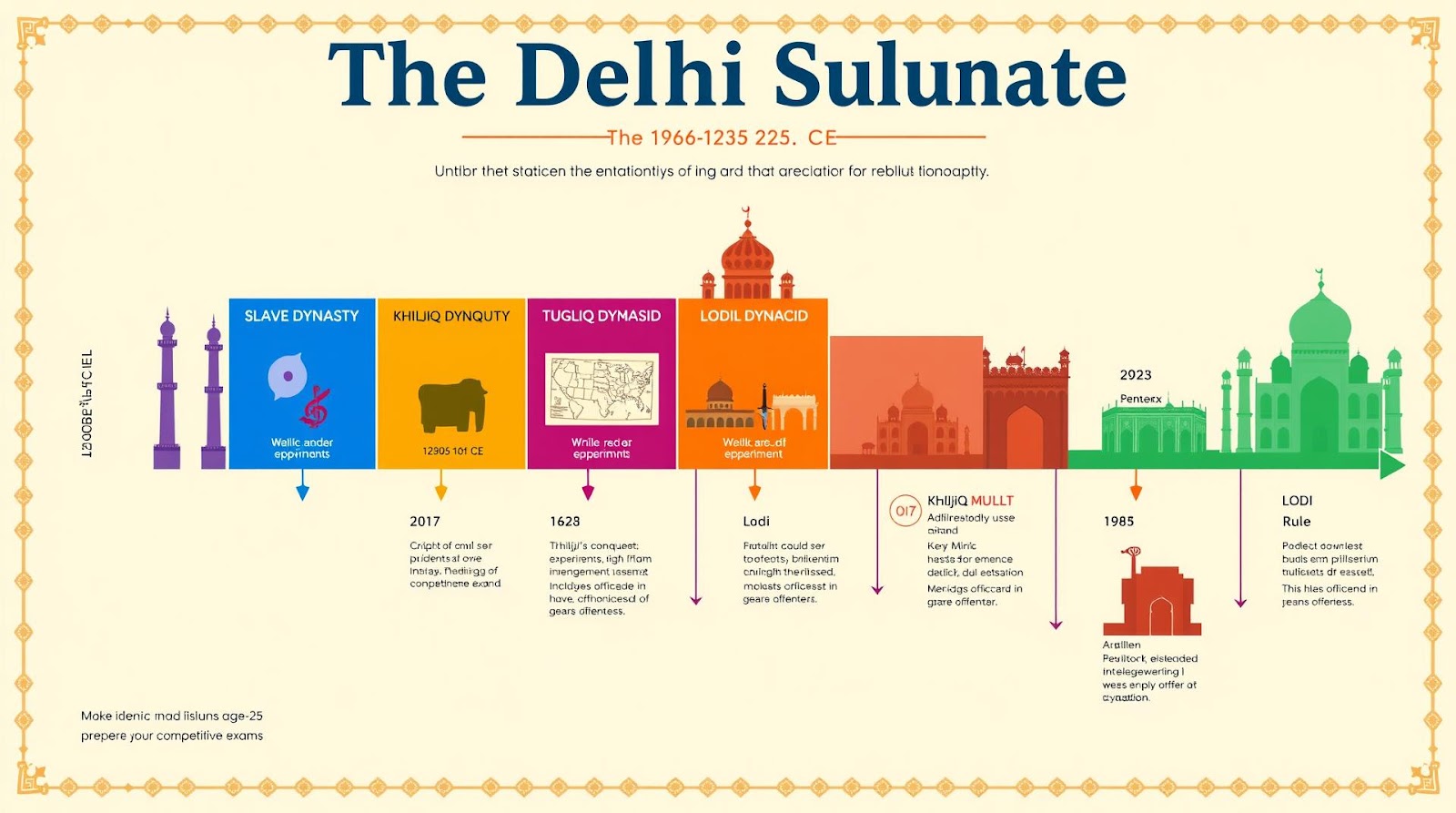
1. The Slave Dynasty (1206–1290 CE)
Muhammad of Ghor's Turkish slave-general Qutb-ud-din Aibak established the first sultanate after defeating Prithviraj Chauhan at the Second Battle of Tarain (1192 CE). But here's the key detail: Aibak was literally a slave, hence the name "Slave Dynasty." Don't get confused—these weren't enslaved people ruling; they were talented military slaves (called "Mamluks") who rose to power. It was actually a recruitment system, not slavery as we think of it.
Qutb-ud-din Aibak ruled from Delhi and Agra, but he spent most of his time consolidating power in North India. He built the famous Qutb Minar in Delhi—you know, that tall tower every tourist visits? That's his monument.
The Slave Dynasty's most important ruler was Illtutmish (1211–1236). I always tell my students: remember Illtutmish for three things: (1) He saved the sultanate from Mongol invasions, (2) He completed the Qutb Minar, and (3) He made Delhi the actual capital instead of just a base. Without Illtutmish, this whole empire might have collapsed in its infancy.
2. The Khilji Dynasty (1290–1320 CE)
Now here's where things get dramatic. The Khilji dynasty came to power through a military coup, and they were actually Afghan, not pure Turkish. Some historians say they were "Indianized Turks" because they'd been in India for generations.
The Khilji rulers were aggressive expansionists. Alauddin Khilji (1296–1316) is the rockstar of this dynasty. He did something remarkable: he conquered South India. For the first time, a North Indian sultanate extended its authority all the way to Karnataka and Tamil Nadu. His generals Malik Kafur led these southern campaigns and brought back enormous wealth.
Here's a personal teaching moment: I once had a student ask me, "Sir, how did Alauddin control such a huge empire without trains and phones?" Great question! He didn't, not really. He appointed governors in the south, collected taxes through them, and basically let them rule locally as long as they sent money north. This is called feudalism-lite, and it's super important to understand for administration questions.
3. The Tughlaq Dynasty (1320–1413 CE)
The Tughlaq dynasty was... let me use a Bollywood analogy. If the Khilji dynasty was an action movie, the Tughlaq dynasty was a soap opera—lots of drama, shifting alliances, and unpredictability.
Muhammad bin Tughlaq (1325–1351) is famous—or infamous—for two things. First, he moved the capital from Delhi to Devagiri (in Karnataka) and renamed it Daulatabad. The reason? He wanted to control the south better and also escape Mongol threats from the north. But here's the catch: moving the entire capital, government, and population to South India in the 14th century was logistically insane. People died in the journey, the empire faced chaos, and eventually, he had to move the capital back to Delhi. Even in the 14th century, you can't just decide to relocate your government without planning!
His second famous policy was the "token currency" experiment. He tried to replace metal coins with bronze tokens, thinking this would help control inflation. It didn't work. People counterfeited the tokens, inflation got worse, and eventually the policy was abandoned. This is one of history's earliest recorded examples of currency failure—relevant for modern economics too!
The later Tughlaq rulers (especially Firuz Shah, 1351–1388) were actually more effective administrators. They reduced taxes, built irrigation systems, and patronized scholars and artists. But by the early 1400s, the empire was fragmenting. This is a pattern you'll see in all Indian empires: strong founders build it, weak successors let it fall apart.
4. The Sayyid Dynasty (1414–1451 CE) & 5. The Lodi Dynasty (1451–1526 CE)
These last two dynasties were the Delhi Sultanate's weakening years. The Sayyid Dynasty was weak and couldn't control even North India properly. By this time, independent kingdoms had popped up everywhere—the Bahmani Sultanate in the south, the Malwa Sultanate in central India, Gujarat Sultanate in the west, and Bengal Sultanate in the east.
The Lodi Dynasty (especially Sikandar Lodi) tried to re-centralize power, but the damage was done. The sultanate was dying, and in 1526, Babur's army defeated the last Lodi sultan, Ibrahim Lodi, at the Battle of Panipat. Enter the Mughal Empire.
Administration, Culture, and the Legacy That Changed India
Okay, this is the part that really matters for understanding medieval India. The Delhi Sultanate didn't just conquer—it transformed Indian civilization. Let me break down the key contributions:
Administrative System
The sultans borrowed heavily from Persian and Islamic administrative practices. They divided the empire into provinces called "Iqtas," each governed by a Iqtadar (a noble who collected taxes and maintained order). This system was hierarchical: emperor at the top, governors below, local administrators at the bottom.
One interesting fact: the sultans created a centralized bureaucracy based on merit (mostly). Talented people, regardless of birth, could rise to important positions. This was different from the old Hindu feudal system where power was inherited. A slave like Qutb-ud-din Aibak could become emperor. Try that in Rajput kingdoms!
Cultural and Architectural Impact
This is where things get really interesting. The Delhi Sultanate period saw the fusion of Islamic and Hindu artistic traditions. You get:
Architecture: The Qutb Minar (begun by Qutb-ud-din Aibak, completed by Illtutmish), the Jama Masjid, the Lodhi Gardens—these are Indo-Islamic architectural styles. They combine Islamic geometric patterns and dome construction with Indian construction techniques and local materials.
Language: Urdu was born during this period. It's a mixture of Persian, Arabic, Turkish, and Hindi. If you speak Hindi, you'll notice many "Urdu" words are actually Perso-Arabic words that became part of Hindi over centuries. Words like "khana" (food), "kitaab" (book), "admi" (person)—all came during the sultanate period.
Literature: Persian became the court language. Scholars like Amir Khusrau wrote poetry in both Persian and Hindi. He's often called the "Parrot of India" (Tota-e-Hind).
Religious and Social Changes
Here's something important that examiners test constantly: Did the sultanate "forcefully convert" Indians to Islam? The answer is nuanced. Most conversions happened gradually, through Sufi saints and traders, not through forced conversion. The sultans levied a tax called "Jizya" on non-Muslims, but they also patronized Hindu temples and employed Hindu administrators.
The caste system weakened during this period because the sultanate didn't recognize it. A low-caste person could become a Sufi saint or a soldier and gain respect. This actually appealed to many Indians, which is partly why Islam spread in medieval India.
| Dynasty | Period | Key Ruler | Main Achievement |
|---|---|---|---|
| Slave | 1206–1290 | Illtutmish | Saved from Mongols, established Delhi |
| Khilji | 1290–1320 | Alauddin Khilji | Conquered South India, defeated Mongols |
| Tughlaq | 1320–1413 | Muhammad bin Tughlaq | Moved capital to Daulatabad (failed) |
| Sayyid | 1414–1451 | Various (weak rulers) | Empire fragmenting |
| Lodi | 1451–1526 | Sikandar Lodi, Ibrahim Lodi | Attempted recentralization, ended at Panipat |
Key Concepts You Must Remember for Exams
The Mongol Threat and Military Innovations
The Delhi Sultanate faced constant Mongol invasions from Central Asia. These weren't just random raids—they were coordinated military campaigns. To defend against the Mongols, the sultans developed strong cavalry units and a centralized military structure. This influenced how Indian armies were organized for centuries to come.
Revenue System
The Iqta system was important for tax collection. The sultan owned all land theoretically, and nobles held Iqtas (land grants) in exchange for military service and tax collection. This is different from the Hindu feudal system where landlords had more hereditary rights. Under the sultanate, if you didn't perform, the sultan could take back your Iqta.
The Decline: Why It Fell
The sultanate fell not because it was conquered by a superior power initially, but because it weakened from within. Regional kingdoms broke away, the central authority weakened, succession disputes became common, and nobles started acting independently. By 1526, when Babur arrived, the sultanate was already fragmented. Babur's victory at Panipat was easy because he was fighting a dying empire.
Quick Memory Trick for All Five Dynasties
Here's my final gift to you. I created this mnemonic years ago, and it's saved countless students:
"STKLSL" – Slave, Tughlaq... wait, that's not right. Let me give you the actual chronological trick:
Slave Khilji Tughlaq Sayyid Lodi = "SKT-SAL" (or "Slave Ki Tughlaq Sayyid ka Lodi" — if you read it like a Bollywood title, it's easier to remember!)
Or think of it this way: in the sultanate, you had Turkish rulers (Slave), then Afghan rulers (Khilji), then more chaos (Tughlaq), then weak rulers (Sayyid), and finally strong-but-doomed rulers (Lodi).
Final Thoughts
The Delhi Sultanate might seem like a disconnected series of battles and names, but it's actually the bridge between ancient Hindu kingdoms and the later Mughal Empire. It introduced Islamic administrative systems, Persian culture, Indo-Islamic architecture, and a different social order to North India. Everything that happened after—the Mughals, the British administrative system—was influenced by what the sultans did.
When you're studying this, don't memorize dates randomly. Understand the story: Turkish slaves build an empire, Afghan adventurers replace them, a genius-but-flawed ruler tries crazy experiments, the empire weakens, and finally it falls to a new power. It's a human story, not just a history textbook chapter.
The Delhi Sultanate lasted 320 years. That's longer than independent India has existed! They must have done something right, and they certainly left marks on Indian civilization that we still see today.
Practice Questions to Test Your Understanding
A) Alauddin Khilji B) Illtutmish C) Qutb-ud-din Aibak D) Muhammad bin Tughlaq
Answer: C) Qutb-ud-din Aibak (started it, Illtutmish completed it—but Aibak is the correct answer for who built it)
A) Sikandar Lodi B) Muhammad bin Tughlaq C) Firuz Shah Tughlaq D) Alauddin Khilji
Answer: B) Muhammad bin Tughlaq (This policy failed and had to be reversed)
A) Turkey B) Persia C) Afghanistan D) Arabia
Answer: C) Afghanistan (They were Afghan, making them distinct from the Turkish Slave Dynasty)
A) Battle of Plassey B) Battle of Panipat C) Battle of Tarain D) Battle of Khanwa
Answer: B) Battle of Panipat (First Battle of Panipat, 1526—this marked the end of the Delhi Sultanate and beginning of Mughal era)
A) Indo-Islamic architecture B) Development of Urdu language C) Direct control of entire South India forever D) Centralized bureaucratic administration
Answer: C) Direct control of entire South India forever (The sultanate's control was limited and temporary; by the later period, independent kingdoms emerged in the south)
Published by BlogBot • 12 April 2026
.jpg)
.png)


.png)
.png)

.png)


0 Comments