Introduction
Look around you right now. The chair you're sitting on, the water in your glass, the air you're breathing — everything is made of something. And if you keep breaking things down into smaller and smaller pieces, you'll eventually reach the fundamental building blocks of matter: elements and compounds.
Now, I've taught thousands of students preparing for SSC CGL and UPSC exams, and I can tell you with absolute confidence that understanding elements and compounds is like learning the alphabet before you write essays. It's foundational. Once you grasp this concept properly, chemistry becomes so much easier.
The interesting thing is that most students overcomplicate this topic. They think it's about memorizing formulas and atomic numbers. But really, it's about understanding a simple hierarchy: elements combine to form compounds, and together they make up everything in our universe. That's it. Let me break this down for you in a way that'll stick.
What Are Elements? Understanding Matter's Simplest Form
The Definition That Actually Makes Sense
An element is a pure substance made up of only one type of atom. That's the textbook definition, yes, but let me explain what that really means.
Imagine you have a pile of Lego bricks — all red bricks, all identical, all the same size and shape. Each of those bricks is like an atom, and the pile of bricks is like an element. Gold is an element because every single atom in pure gold is a gold atom. Oxygen is an element because every atom is an oxygen atom. Simple, right?
Here's the key thing to remember: an element cannot be broken down into simpler substances by chemical means. You can't use chemistry to turn gold into something simpler. You can physically break it, melt it, stretch it — but chemically, it stays gold.
How Many Elements Exist?
There are 118 known elements on the periodic table. Now, you absolutely do NOT need to memorize all 118 for SSC CGL. Your exam focuses on maybe 20–30 common elements. The ones that appear in compounds in nature or in everyday life.
Let me give you the ones that matter for your exam:
Common elements you must know: Hydrogen (H), Oxygen (O), Carbon (C), Nitrogen (N), Sulfur (S), Phosphorus (P), Chlorine (Cl), Sodium (Na), Potassium (K), Calcium (Ca), Iron (Fe), Copper (Cu), Zinc (Zn), Silver (Ag), Gold (Au), Mercury (Hg).
See how I haven't asked you to memorize the full list? Just focus on these. Most questions will involve these common elements. I've noticed in the last 10 years of exam patterns that about 90% of chemistry questions involve these 15–20 elements.
What Are Compounds? When Elements Hold Hands
The Magic of Chemical Bonding
Now here's the interesting part. Elements don't like being alone. They want to combine with other elements to form compounds. Think of it like Bollywood — one hero is fine, but when two heroes come together, magic happens, right?
A compound is a pure substance made up of two or more elements chemically bonded together in a fixed ratio. The key word here is "chemically bonded." The atoms are held together by chemical bonds, not just mixed together.
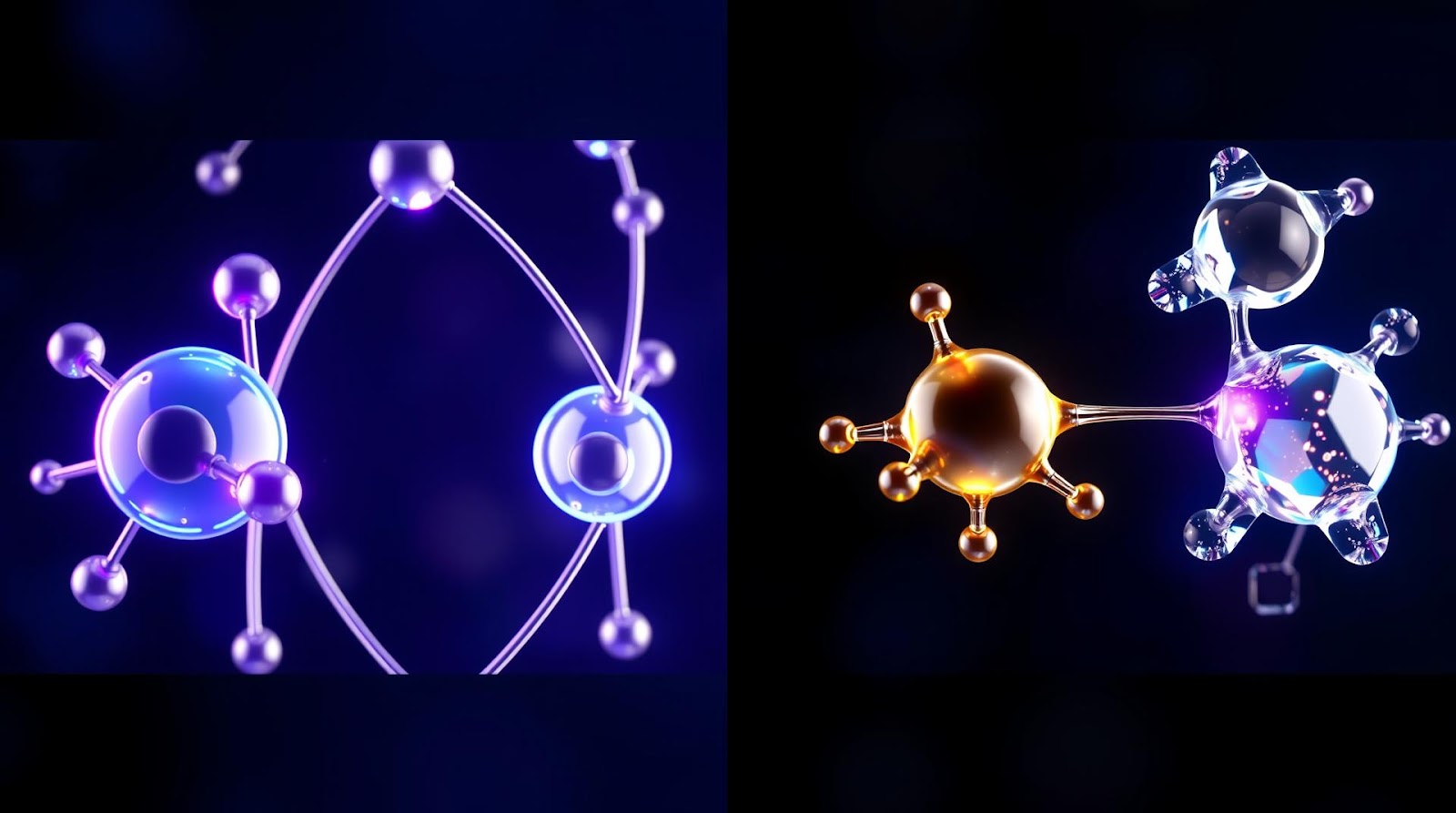
Let me give you an example you see every single day. Water. Water is H₂O. This means one oxygen atom is bonded with two hydrogen atoms. These atoms are holding hands, so to speak. You cannot separate them by just stirring or mixing. You need a chemical reaction to break water down into hydrogen and oxygen gas.
Here's a trick I tell all my students to remember the difference between elements and compounds: "Elements are actors, compounds are films." One actor standing alone is an element. Put two or more actors together in a scene, and you've got a compound. The "film" (compound) has different properties from the individual "actors" (elements).
Why Do Compounds Have Different Properties?
This is crucial for your exams. When elements combine to form a compound, something magical happens — the compound has completely different properties from the elements that make it up.
Think about sodium. Pure sodium is a highly reactive metal. It's so reactive that if you throw it in water, it literally explodes! Chlorine is a poisonous green gas. If you breathe it, it could kill you. But when sodium and chlorine combine, they form sodium chloride — which is salt, or table salt. You literally eat this every day, and it's harmless. In fact, it's essential for your body!
How is this possible? Because when they bond chemically, they create something entirely new with entirely new properties. This is one of the most beautiful things about chemistry, and it's something that confuses a lot of students. But here's the mental model: when atoms bond, they share or transfer electrons. This rearrangement creates different characteristics — different melting points, different solubility, different reactivity, everything.
Key Differences: Elements vs. Compounds
Now let me lay out the differences clearly because this is where exam questions love to trap students.
| Aspect | Element | Compound |
|---|---|---|
| Definition | Pure substance with one type of atom | Pure substance with two or more elements chemically bonded |
| Number of atoms | One type only | Two or more types |
| Chemical breakdown | Cannot be broken down by chemical means | Can be broken down into elements by chemical reaction |
| Properties | Specific to that element | Different from the elements that form it |
| Ratio in compounds | N/A | Fixed and definite (e.g., H₂O always has 2:1 H:O ratio) |
| Examples | Gold (Au), Oxygen (O), Iron (Fe) | Water (H₂O), Salt (NaCl), Sugar (C₁₂H₂₂O₁₁) |
Types of Compounds: Understanding Chemical Bonds
Ionic Compounds: Electron Theft
In ionic compounds, atoms don't share electrons — one atom basically steals electrons from another. One atom becomes positively charged (loses electrons) and is called a cation. The other becomes negatively charged (gains electrons) and is called an anion. They attract each other like magnets.
Common ionic compounds? Sodium chloride (NaCl) — regular salt. Potassium bromide (KBr). Calcium chloride (CaCl₂). Most ionic compounds are formed between metals and non-metals.
Covalent Compounds: Sharing is Caring
In covalent compounds, atoms share electrons. They don't steal from each other; they actually share the electrons in their outermost shell. Think of it as two friends sharing a Netflix password, rather than one friend taking it from the other.
Water (H₂O) is a covalent compound. Carbon dioxide (CO₂) is covalent. Ammonia (NH₃) is covalent. Most covalent compounds are formed between non-metals.
Here's a quick memory trick I use: "Metals steal, non-metals share." If you're forming a compound between a metal and a non-metal, it's likely ionic (stealing). Between two non-metals? It's covalent (sharing).
Why This Matters for Your Exam
You might be wondering why SSC CGL and UPSC test this. It's because understanding elements and compounds is the foundation for everything else in chemistry. Once you understand these concepts, topics like chemical reactions, stoichiometry, and even organic chemistry become manageable.
In your exam, you'll see questions like: "Which of the following is a compound?" or "Water is an element or a compound?" or "How many elements are in the compound H₂SO₄?"
These questions are testing whether you understand the fundamental difference. And honestly? If you nail this concept, you'll get these questions right every single time.
The real power comes when you realize that everything around you — your body, the food you eat, the medicines you take — is all made of elements and compounds working together. Chemistry isn't abstract; it's the study of the real world broken down to its simplest parts.
A) Oxygen B) Gold C) Water D) Nitrogen
Answer: C) Water — it contains two elements (hydrogen and oxygen) chemically bonded together.
A) 1 B) 2 C) 3 D) 4
Answer: C) 3 — Hydrogen (H), Sulfur (S), and Oxygen (O). The subscripts tell you how many atoms, not how many elements.
A) Elements can be broken down by heating B) Elements cannot be broken down by chemical means C) Elements always exist as molecules D) Elements are always solids
Answer: B) Elements cannot be broken down by chemical means — this is the defining characteristic of an element.
A) Properties don't change when compounds form B) Properties change when elements chemically bond C) The compound is a mixture D) No chemical reaction occurred
Answer: B) Properties change when elements chemically bond — this is a fundamental principle. When elements combine to form compounds, entirely new properties emerge.
A) CO₂ B) H₂O C) NaCl D) NH₃
Answer: C) NaCl — formed between a metal (sodium) and a non-metal (chlorine), making it ionic. The others are covalent compounds.
Published by Dattatray Dagale • 28 April 2026
.jpg)
.png)



.png)




.png)

0 Comments