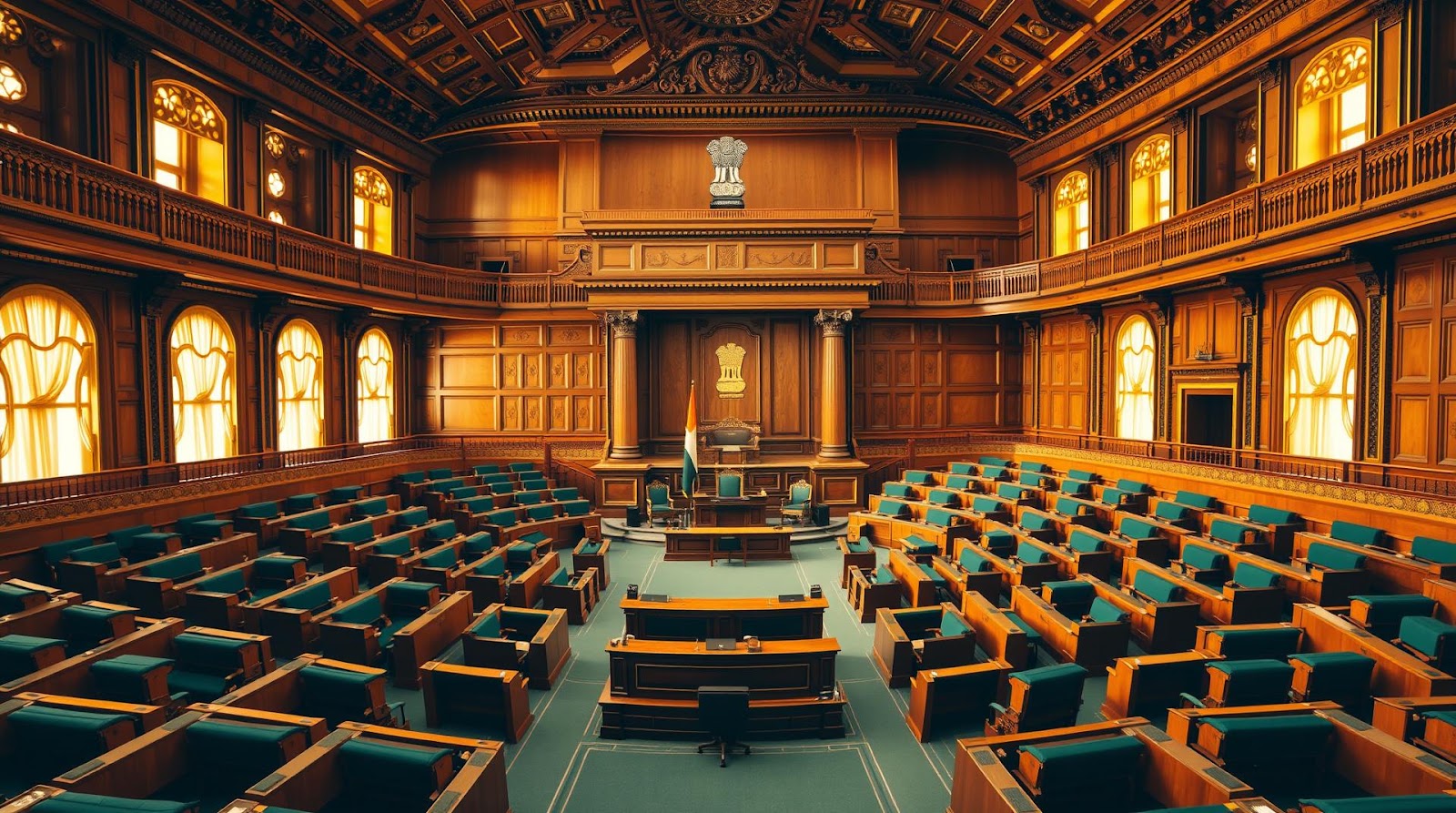
Introduction
Let me start with a confession: when I first started teaching, I thought Parliament was just a bunch of politicians shouting at each other. And honestly? That's not entirely wrong. But there's so much more happening behind those chamber doors than what you see on news channels.
Here's the thing about Parliament that I've realized over 10+ years of teaching – it's not some abstract, distant institution. It directly affects your life. The fee structure of your college, whether you get a passport, the standards of drinking water in your village, your parents' retirement benefits – all of this flows from decisions made in Parliament. So when you're studying this for SSC CGL or UPSC, you're not just memorizing facts. You're understanding the machinery that runs India.
Now, I've seen thousands of students memorize definitions and forget them within a week. But once they understand *why* Parliament is structured this way, *why* we have two houses instead of one, and *how* a bill actually becomes a law – it clicks. And that's what I want to do today: help you genuinely understand Parliament, not just cram it.
Parliament: The Architecture of Indian Democracy
Two Houses, One Purpose
India has a bicameral Parliament – that's a fancy way of saying we have two houses. Let me explain why we need two and not just one.
Imagine you're in a school and the principal makes decisions alone. Sometimes they're brilliant. Sometimes they're absolutely bonkers. Now imagine if every decision had to be reviewed by another committee before implementation. It would be slower, but it would catch mistakes, right? That's the basic idea.
We have the Lok Sabha (House of the People) and the Rajya Sabha (Council of States). The Lok Sabha is directly elected by you – the citizens. It has 545 members maximum (530 from states, 13 from union territories, and 2 nominated from the Anglo-Indian community). It's the popular chamber, the one that represents the immediate voice of the people.
The Rajya Sabha is different. It has 245 members maximum. These aren't all directly elected by citizens. 12 are nominated by the President (people like athletes, scientists, artists), and the rest are elected by state assemblies. Why? Because the founding fathers wanted to ensure that smaller states and experienced people had a voice, even if they couldn't win a direct popular election. It's like having both speed and caution built into the system.
Let me give you a trick I tell all my students: "LS is LIVE, RS is REVIEW." Lok Sabha is live, direct, immediate. Rajya Sabha is about review, reflection, and ensuring federalism works properly.
Powers and Limitations of Each House
Here's where it gets interesting. Not all powers are equal in Parliament.
The Lok Sabha has the real executive control. When you want to remove a Prime Minister, when you want to pass a crucial budget, the Lok Sabha is where it matters most. Money bills – bills dealing with taxes, government spending, and revenue – must originate in the Lok Sabha. The Rajya Sabha can't even amend money bills; they can only make recommendations. If the Lok Sabha rejects those recommendations, tough luck for the Rajya Sabha.
But the Rajya Sabha isn't powerless. For ordinary bills, both houses have equal say. For constitutional amendments, you need two-thirds majority in both houses. For impeaching a President, both houses vote, but the process starts in one and proceeds in another. The Rajya Sabha also has some exclusive powers – like creating new all-India services (like the IAS, IPS) and removing the Vice President.
Why does all this matter? Because the exam loves to test your understanding of which house can do what. I've seen students lose marks because they confused "money bill" with "ordinary bill." Don't be that student.
The Legislative Process: How a Bill Becomes a Law
The Journey of a Bill
Okay, this is the part where most students' eyes glaze over. But I'm going to make it stick, I promise.
A bill goes through several stages. Let me break it down with a real-world analogy. Think of it like making biryani – there are specific steps you can't skip, or the dish turns into a mess.
Stage 1: Introduction – Someone introduces a bill. Usually a minister, but technically any MP can introduce a bill (except money bills – those must come from a minister). This is like deciding you're going to make biryani today.
Stage 2: First Reading – The bill is formally introduced. No discussion yet, just acknowledgment that it exists. Like laying out your ingredients.
Stage 3: Second Reading – This is where the real action happens. MPs discuss the bill clause by clause. Amendments are proposed, debated, voted on. This can take days or even weeks for important bills. This is where you're actually cooking – where people argue about whether the masala is right.
Stage 4: Third Reading – Final discussion and voting. Once passed here, the bill moves to the other house and repeats the same process. If both houses pass it, it goes to the President.
Stage 5: Presidential Assent – The President signs it, and it becomes law.
Now here's the trick I've shared with every batch: "1-2-3-P" – First Reading, Second Reading, Third Reading, Presidential Assent. Easy to remember, hard to forget.
When Houses Disagree: The Deadlock Mechanism
You might be wondering: what happens if the Lok Sabha passes a bill and the Rajya Sabha rejects it? Or if one house keeps amending it in ways the other doesn't like?
The Constitution provides for a joint sitting. Both houses meet together, and the bill is voted on with a simple majority. Since the Lok Sabha has more members than the Rajya Sabha, the Lok Sabha usually wins. This ensures that the directly elected body's will eventually prevails, but not without giving the Rajya Sabha a fair hearing.
This happened most famously with the 99th Constitutional Amendment (GST) and several other major bills. It's not the norm, but it's in the rulebook for when things get stuck.
Types of Bills and Budget Cycles
The Bill Categories You Must Know
Not all bills are created equal. The Constitution distinguishes between several types:
Ordinary Bills – These deal with general matters. Both houses have equal power. Education reform bill, new traffic regulations, whatever. Both houses discuss and vote.
Money Bills – These deal with government revenue, taxes, spending. Only the Lok Sabha can introduce them. The Rajya Sabha gets 14 days to make recommendations, but the Lok Sabha can simply ignore them. This is why governments protect their budget like it's a Bollywood script – losing money bill votes means losing control.
Constitutional Amendment Bills – These require two-thirds majority in both houses and the President's assent. Also need ratification by half the state legislatures. This is intentionally difficult because you don't want to casually change the Constitution.
Private Member Bills – These are introduced by MPs who aren't ministers. Statistically, very few pass because the government usually controls the numbers. But every MP gets the right to introduce them. It's democracy in its purest form – even a single voice can be heard.
The Budget Process
I always tell students: if you understand the budget process, you understand how India runs.
The finance minister presents the budget, usually in February (though this can vary). It outlines the government's revenue and expenditure for the next financial year (April to March). The budget is broken into sections: revenue budget (taxes and revenue) and capital budget (borrowing and lending).
For about two weeks after the budget is presented, MPs discuss it extensively. This is called the "budget debate." Then comes the "demand for grants" – the Lok Sabha votes on various ministry allocations. Only the Lok Sabha votes on these demands because it's a money matter. The Rajya Sabha watches from the sidelines.
After all approvals, the Finance Bill is passed (which contains the tax changes), and then the Appropriation Bill is passed (which authorizes actual spending). Think of it as: "Here's the new tax structure" followed by "Here's how much money each ministry can spend."
| Aspect | Lok Sabha | Rajya Sabha |
|---|---|---|
| Members | Max 545 | Max 245 |
| Term | 5 years (can dissolve early) | 6 years (continuing) |
| Money Bills | Can introduce and pass (final) | Can only recommend changes |
| Ordinary Bills | Equal power | Equal power |
| PM Accountability | Must have majority | No direct accountability |
Parliament in Practice: What You Actually Need to Know for Exams
I've taught enough students to know exactly which topics come up again and again in exams. Let me give you the real, practical stuff.
First, questions about budget powers. Examiners love asking which house can do what with money bills. Remember: Lok Sabha introduces, passes, and that's final. Rajya Sabha can suggest, but it's not binding.
Second, bills vs. acts. A bill is a proposal. An act is the law after the President assents. Simple distinction, but students mess this up constantly.
Third, special majorities. For constitutional amendments, you need two-thirds. For removing the President, you need a specific majority in both houses. For ordinary bills, just a simple majority in both houses. These numbers get tested every year.
Fourth, the difference between dissolution and adjournment. When the Lok Sabha is dissolved, all pending bills die (except those in Rajya Sabha). When it's adjourned, bills stay pending. People confuse these constantly.
Finally, understand that Parliament is bicameral by design to balance speed with caution. The Lok Sabha gives speed and democratic representation. The Rajya Sabha gives caution, federalism, and expertise. This is the philosophical heart of the system.
One last thing before you go – when you're studying this, don't just memorize the procedures. Try to understand *why* they exist. Why does a bill go through three readings? So that a hasty decision doesn't become law. Why do we have two houses? So that smaller states aren't bulldozed by larger ones. Why does the President have assent power? So that the executive can serve as a check on the legislature. Once you see the logic, you'll remember everything.
This is democracy at work – slow, sometimes frustrating, but carefully designed to prevent abuse of power. Pretty remarkable, isn't it?
A) The bill dies and must be reintroduced in the next session B) The Lok Sabha can pass it again with a simple majority, and the President can assent C) A joint sitting is automatically called D) The President must send it back for reconsideration
Answer: B) The Lok Sabha's decision on money bills is final. The Rajya Sabha can only recommend changes for 14 days, which the Lok Sabha can ignore.
A) It dissolves every 5 years B) It has the power to remove the Vice President C) It can introduce money bills D) It must approve the Prime Minister
Answer: B) The Rajya Sabha has exclusive powers including removal of the Vice President and creating all-India services. The Lok Sabha must approve the PM.
A) It cannot become law without Rajya Sabha approval B) Through a joint sitting where the bill is voted on by both houses C) The President can directly assent to it D) It must be reintroduced in the next session
Answer: B) A joint sitting resolves deadlocks on ordinary bills. The bill with a simple majority in the joint sitting becomes law. Money bills don't need this since the Rajya Sabha can't reject them.
A) The bill is formally introduced with no discussion B) Clause-by-clause discussion and amendments are made C) The President reviews the bill D) State assemblies ratify the bill
Answer: B) The second reading is where the substantive debate occurs. Amendments are proposed, discussed, and voted on. This is the most intensive stage of deliberation.
A) 530 B) 250 C) 245 D) 275
Answer: C) The Rajya Sabha has a maximum of 245 members – 12 nominated by the President and 233 elected by state assemblies (based on population proportionality).
Published by Dattatray Dagale • 18 April 2026
.jpg)
.png)



.png)



.png)



0 Comments