Why Should You Care About Environment and Ecology?
Let me start with a confession: when I was teaching my first batch of SSC students about ecosystems, I remember one girl raising her hand and asking, "Sir, will this actually come in the exam?" I laughed and said, "Yes, but more importantly, it's happening in your backyard right now."
See, here's what most textbooks don't tell you — ecology isn't just an exam topic. It's the reason your air quality index shoots up in winter, why the monsoon arrives late some years, and why your vegetable prices triple during certain seasons. Understanding environment and ecology is understanding the invisible rules that run our planet.
Now, I know what you're thinking: "Sir, this sounds complicated." Trust me, it's not. Once you see the pattern, everything clicks. And that's exactly what we're going to do today — break down this massive topic into digestible, memorable pieces.
The Ecosystem: Your Living Neighbourhood
What Exactly Is An Ecosystem?
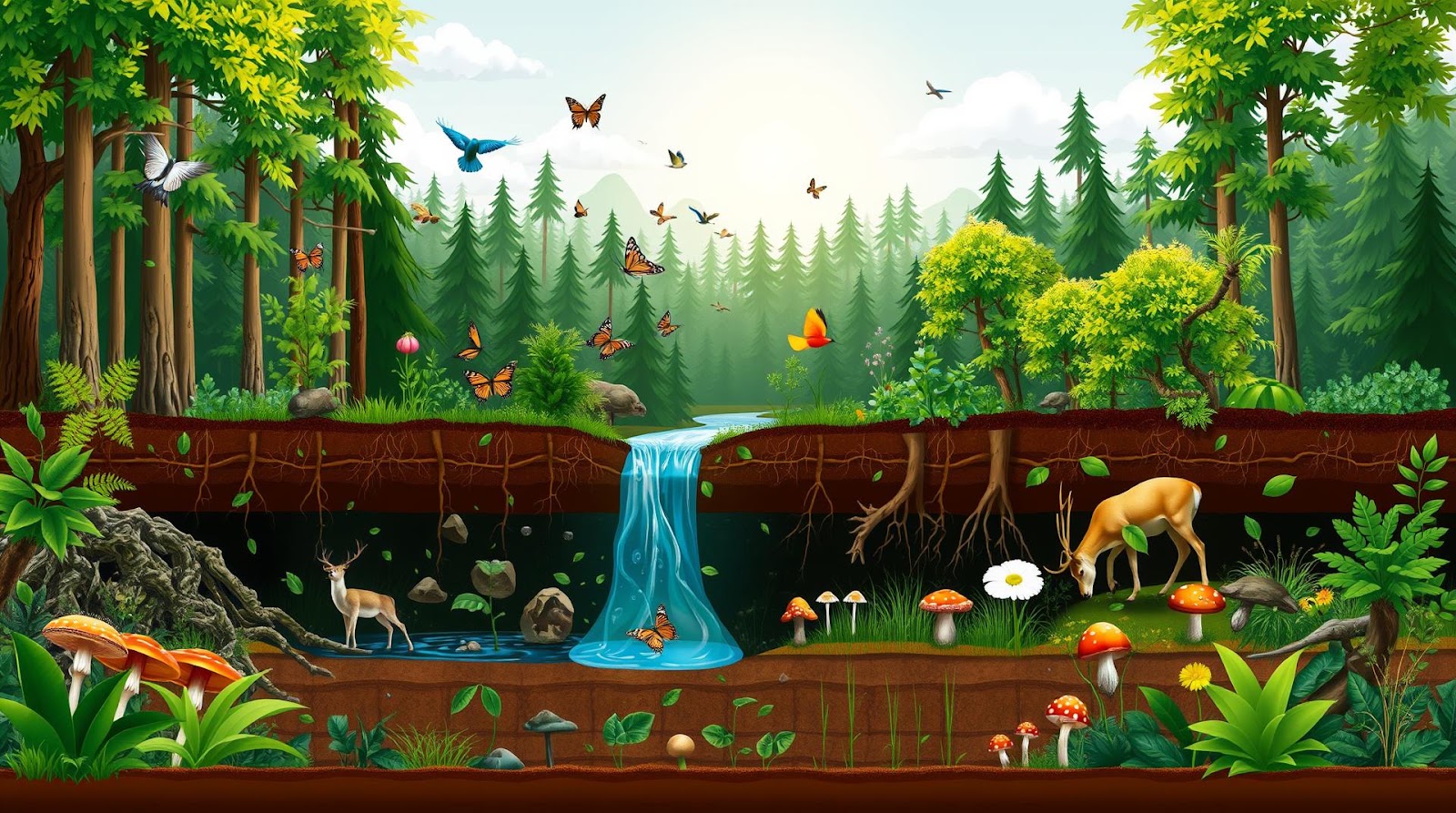
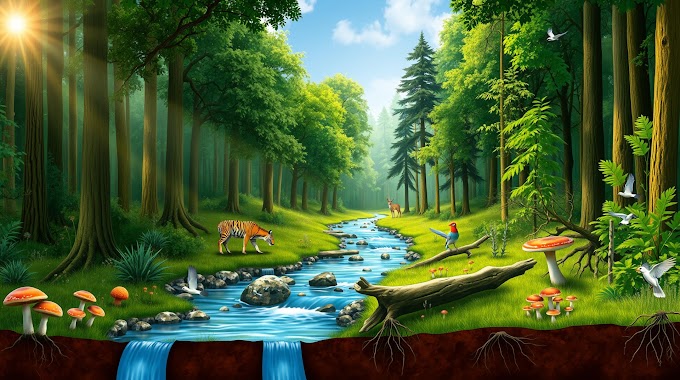
An ecosystem is basically a community of organisms living together with their non-living environment. Think of it like your apartment building — you've got people (organisms), the walls and pipes (non-living environment), and everyone's constantly interacting and exchanging things. Simple as that.
Every ecosystem has two main components:
1. Biotic Components: All the living things — plants, animals, microorganisms, humans. Everything with life.
2. Abiotic Components: The non-living stuff — soil, water, air, sunlight, temperature, humidity. The stage on which life performs.
Here's a memory trick I tell all my students: BIO = Living, A-biotic = Not living. The "A" is your killer. "A-" means "without," so abiotic = without life.
Energy Flow: Follow the Food Chain
Now here's where it gets interesting. Every single ecosystem runs on solar energy, like a giant solar-powered circuit. The sun's energy enters through producers (plants), flows through consumers (animals), and exits through decomposers.
Let me explain with an Indian example you'll relate to instantly. Imagine a paddy field during harvest season:
The rice plant (producer) captures sunlight and converts it to chemical energy through photosynthesis. A grasshopper eats the rice (primary consumer — herbivore). A sparrow eats the grasshopper (secondary consumer — carnivore). A hawk eats the sparrow (tertiary consumer). When the hawk dies, bacteria and fungi break it down (decomposers). The nutrients return to the soil. Cycle complete.
This is called a food chain. And when you connect multiple food chains together? That's a food web — much more realistic because animals don't follow a single diet plan.
Here's a trick for remembering energy percentage loss: At each level, about 90% of energy is lost and only 10% is passed to the next level. So if a plant has 10,000 joules, the herbivore gets roughly 1,000 joules, the carnivore gets about 100 joules. This is why vegetarian diets are more sustainable — you're eating directly from producers, losing less energy in the chain.
The Big Picture: Biogeochemical Cycles
You know what amazes me? The very oxygen you're breathing right now might have been exhaled by a tree in Kashmir or a phytoplankton in the Arabian Sea. We're all literally connected through invisible cycles. Let me show you the main ones you need to know.
The Carbon Cycle: The Breath of Earth
Carbon is the backbone of life. Every living thing is made of carbon compounds. The carbon cycle is how this element moves between the atmosphere, organisms, and soil.
Here's how it works: Plants take CO₂ from the air through photosynthesis. Animals eat plants and animals. Both release CO₂ through respiration. When organisms die, decomposers break them down, releasing more CO₂. Humans accelerate this by burning fossil fuels (coal, oil, gas) — essentially releasing carbon that was trapped underground for millions of years. This is why CO₂ levels keep rising.
The problem? We're adding more carbon to the atmosphere than the planet can handle. Result: global warming. You've probably felt this — April in Delhi used to end monsoon season, now it's peak summer.
The Nitrogen Cycle: Essential for Life
Nitrogen makes up 78% of our atmosphere, yet most organisms can't use it directly. It needs a middleman. Enter: nitrogen-fixing bacteria.
Here's the simplified version: Atmospheric N₂ → Nitrogen-fixing bacteria convert it → Available nitrogen in soil → Plants absorb it → Animals eat plants → Nitrogen returns to soil through decomposition. Repeat.
Why does this matter for exams? Because it explains why farmers rotate crops with legumes (peas, beans). These plants have nitrogen-fixing bacteria in their roots, naturally replenishing soil nitrogen. Smart, right?
The Water Cycle: The Eternal Journey
This one's simpler and you've probably seen diagrams since class 6. Evaporation → Condensation → Precipitation → Collection. But here's what I always emphasize to students: humans have disrupted this cycle massively through deforestation, dam construction, and groundwater depletion.
In many Indian cities, we're extracting groundwater faster than rain can replenish it. That's unsustainable. The water cycle reminds us that water isn't infinite.
| Cycle | Key Element | Main Role | Human Impact |
|---|---|---|---|
| Carbon Cycle | Carbon (C) | Photosynthesis & Respiration | Increased atmospheric CO₂ |
| Nitrogen Cycle | Nitrogen (N) | Protein synthesis in organisms | Excess fertilizer → water pollution |
| Water Cycle | Water (H₂O) | Transport of nutrients & temperature regulation | Groundwater depletion, altered rainfall |
| Phosphorus Cycle | Phosphorus (P) | Energy transfer in cells | Mining disrupts natural cycle |
Succession and Biodiversity: Nature's Healing Power
One of my favorite topics to teach is ecological succession. It's proof that nature is stubborn and resilient — it always tries to heal itself.
What Is Ecological Succession?
Succession is the gradual replacement of one community by another. Think of an abandoned field. In year one, you get weeds and grasses. By year five, shrubs appear. By year twenty, small trees. Eventually, a full forest. This isn't random — it follows a predictable pattern.
There are two types you need to know:
Primary Succession: Starts from bare rock or lava flows where no soil exists. It's the slowest kind because the community must literally create soil. Example: the islands that emerged from underwater volcanic activity.
Secondary Succession: Happens on disturbed land that still has soil. Faster because the foundation is already there. Example: the forests regenerating in areas affected by forest fires or deforestation.
Here's something that blows students' minds: if we stopped cutting a forest today, it would gradually return to its original state through secondary succession. This gives me hope, honestly.
Biodiversity: The More, The Better
Biodiversity is simply the variety of life — species, genes, ecosystems. The more diverse an ecosystem, the more stable it is. Here's why: if one species fails, others can compensate. If a forest has only one tree species and a disease hits it, the entire ecosystem collapses. But if it has fifty species, the ecosystem adapts.
India is a biodiversity hotspot. We have only 2.4% of Earth's land but 8% of all species. The Western Ghats, the Sundarbans, the Himalayas — these are global treasures. And we're losing them at an alarming rate through habitat destruction.
Let me give you a memory trick for the three levels of biodiversity: GES = Genetic, Ecosystem, Species. Genetic diversity (different genes within a species), Species diversity (different species in an area), Ecosystem diversity (different habitats).
Environmental Issues and Conservation
Now let's talk about the real-world problems. These come up constantly in exams because they directly affect governance and policy.
Climate Change and Global Warming
I'll be direct: this is happening. Global average temperature has risen about 1.1°C since pre-industrial times. For context, that tiny increase has already changed rainfall patterns, increased extreme weather events, and melted glaciers that billions depend on for water.
The main culprit? Greenhouse gases — primarily CO₂ from burning fossil fuels, but also methane from agriculture and landfills, and nitrous oxide from fertilizers. These gases trap heat in the atmosphere like a blanket.
India is particularly vulnerable because we're an agricultural economy and we have 1.4 billion mouths to feed. Erratic monsoons directly hurt crop output and food security.
Pollution: The Silent Killer
Air pollution kills more Indians annually than any infectious disease. Water pollution makes rivers toxic. Soil pollution reduces agricultural productivity. Noise pollution affects mental health. It's not separate issues — it's interconnected degradation.
What makes this topic tricky in exams is that questions often blend causes and effects. A factory emits pollutants (cause) → air quality drops (effect) → respiratory diseases increase (secondary effect) → healthcare costs rise (tertiary effect). The question might ask about any part of this chain.
Conservation Strategies
Here's the hopeful part — we know what works. Protected areas (national parks, sanctuaries) preserve habitats. Sustainable agriculture reduces chemical use. Renewable energy replaces fossil fuels. Afforestation restores forests.
India has made genuine progress. Project Tiger saved the Bengal tiger from near-extinction. The Indian Elephant Project protects migration corridors. Solar capacity is expanding rapidly. But we need exponentially more effort.
Quick Revision Table
| Concept | Definition | Example |
|---|---|---|
| Producer | Organism that makes its own food (autotroph) | Rice plant, grass, algae |
| Consumer | Organism that eats other organisms (heterotroph) | Grasshopper (primary), sparrow (secondary) |
| Decomposer | Breaks down dead organic matter | Bacteria, fungi, earthworms |
| Niche | Role an organism plays in its environment | Honeybee's niche is pollination |
| Habitat | Physical place where organism lives | Forest, ocean, desert |
| Carrying Capacity | Maximum population an environment can support | A lake can support only X fish given food/space |
Final Tips for Exam Success
After teaching thousands of students, I've noticed that questions on environment and ecology test two things: (1) conceptual understanding, and (2) ability to link concepts together. Don't just memorize definitions — understand the "why" behind everything.
When you see a question about pollution, ask yourself: what's the source? How does it move through the ecosystem? Who's affected? What's the solution? This holistic thinking is what separates average answers from excellent ones.
One last thing: this subject isn't abstract. When you read about climate change, think about your grandparents' farming struggles. When you read about biodiversity loss, think about your last trek. When you read about water cycles, think about the water shortage during summer in your city. Make it personal. Make it real. That's when it sticks.
All the best for your exams. You've got this!
Practice MCQs
A) 5000 joules B) 500 joules C) 50 joules D) 5 joules
Answer: C) 50 joules. Each trophic level retains ~10% of energy, so primary consumer gets ~500J, secondary consumer gets ~50J.
A) Regeneration of forest after fire B) Colonization of bare rock by lichens C) Grass taking over an abandoned field D) Shrubs replacing grass in a meadow
Answer: B) Colonization of bare rock by lichens. Primary succession starts on bare substrate with no soil, while secondary succession happens on disturbed land with existing soil.
A) Oxygen B) Nitrogen C) Carbon Dioxide D) Argon
Answer: C) Carbon Dioxide. CO₂ traps infrared radiation and prevents heat from escaping Earth's atmosphere, leading to global warming.
A) In the atmosphere B) In the roots of leguminous plants C) In oceans only D) In decomposing matter only
Answer: B) In the roots of leguminous plants. These bacteria convert atmospheric N₂ into usable nitrates that plants can absorb. This is why crop rotation with legumes is beneficial.
A) India has the highest temperature among all countries B) India has high species diversity but is facing habitat loss C) India has more biodiversity than its land area would suggest D) Both B and C
Answer: D) Both B and C. India has only 2.4% of Earth's land but 8% of all species. It's biodiverse AND facing serious conservation challenges.
Published by Dattatray Dagale • 24 May 2026
.jpg)
.png)



.png)


.png)

0 Comments