Introduction
Let me be honest with you—when I first started teaching, I dreaded the environment and ecology section. Not because it's difficult, but because most students treated it like a punishment. "Sir, it's just trees and animals," I'd hear. Then one day, I realized something: these topics aren't about memorizing Latin names or drawing food chains. They're about understanding the world you're living in, right now, today.
Three years ago, one of my students—Priya from Mumbai—came to me completely stressed. She'd scored 14/20 on environment questions in a mock test. Know what changed? When I stopped teaching her facts and started asking her to notice things. Notice how the monsoon affects the air quality in your city. Notice why the Sundarbans are shrinking. Notice why your vegetable prices spike in winter. Suddenly, ecology wasn't abstract anymore. She scored 19/20 in her final attempt.
Here's what I've learned from a decade of teaching: environment and ecology questions aren't trick questions. They reward genuine understanding. And that's what we're going to build today—real, exam-winning understanding that sticks with you long after you've cleared your exam.
The Fundamentals: What Ecology Really Is
Let's start with a confession: most textbooks define ecology as "the study of organisms and their environment." Technically correct, absolutely boring. Here's how I explain it to students:
Ecology is basically the story of who eats whom, who lives where, and why everything matters to everything else.
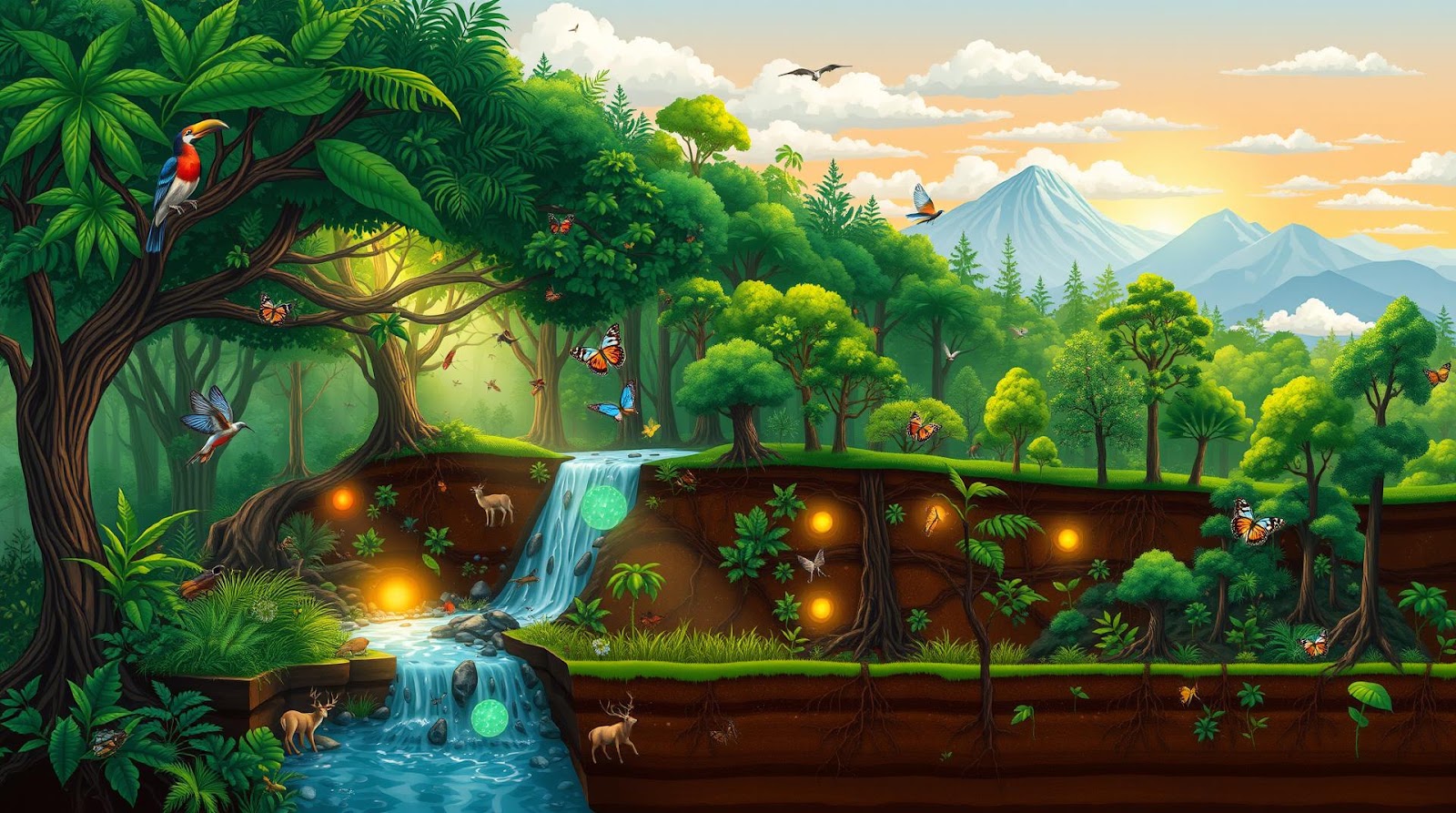
Think of it like Bollywood. A single scene in a movie depends on so many things—the actor's mood, the music, the lighting, the weather, the location. Change one thing, and the entire scene changes. That's ecology. You can't change one organism without affecting others. You can't pollute one river without affecting the people downstream. Everything is connected.
The Ecosystem: Understanding the Basic Unit
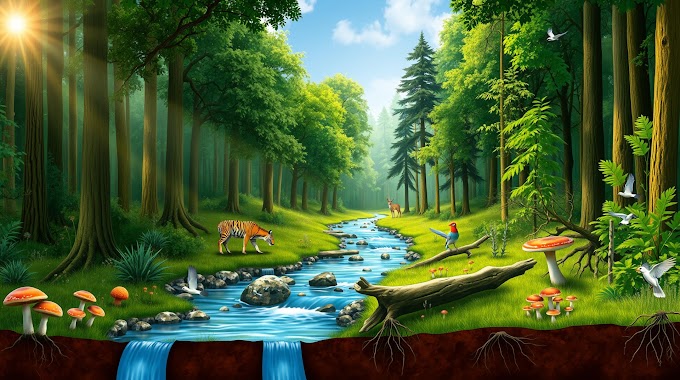
An ecosystem is the smallest working unit we study in ecology. It has two main parts that I want you to remember using this simple trick: "BLOP" – Biotic and Abiotic, Living and Physical.
Biotic components: All the living things—plants (producers), animals (consumers), and bacteria/fungi (decomposers). Notice I used that word "producers" and "consumers"? That's not random. It's based on what organisms *do* in the ecosystem.
Abiotic components: Non-living things like sunlight, water, temperature, soil, air. These are actually MORE important than students realize. I once had a student ask, "Sir, why does temperature matter in ecology?" I said, "Why does temperature matter for your exam preparation? You study better in 22°C than 42°C, right? Same logic."
Now here's where most students slip up: they think of an ecosystem as a forest or a lake. But actually, your school's garden is an ecosystem. A fish tank is an ecosystem. Even your stomach (with all the bacteria) is kind of an ecosystem. Once you realize this, every concept suddenly becomes relatable.
Energy Flow: The Currency of Life
This is crucial for SSC and UPSC exams, and I'm going to make it stick in your head forever.
Energy enters an ecosystem through the sun. The sun doesn't get eaten—it gets captured. Plants capture sunlight through photosynthesis and convert it into chemical energy (glucose). When you eat that plant, you get some of that energy. When a lion eats you... well, you get the point.
But here's the key insight that changes everything: energy flows one way—sun → plants → animals → decomposers. It never cycles back. This is different from matter (like carbon or nitrogen), which DOES cycle. Energy just gets used up as heat. This is why food chains only have 3-4 levels maximum. By the fourth level, there's barely any energy left.
Let me give you a memory trick I tell all my students: "Energy is like cash, matter is like jewelry." Cash you spend once and it's gone. Jewelry you can recycle endlessly. In an ecosystem, energy is spent (one-way flow), but matter like carbon, nitrogen, and water gets recycled through biogeochemical cycles.
Succession and Biodiversity: When Ecosystems Change
You know how nature isn't static? A bare rock eventually becomes a forest. A pond eventually becomes a meadow. This process is called succession, and it's absolutely critical for your exams.
Primary vs Secondary Succession: The Key Difference
I'll explain this with an Indian example that resonates. After the 2004 tsunami, some areas in Tamil Nadu were completely stripped bare. Other areas were just damaged. The recovery process in both places was different—that's the difference between primary and secondary succession.
Primary succession: Starts from bare, lifeless substrate (rock, sand, newly formed volcanic island). No soil exists. Lichens and mosses arrive first (pioneers), slowly breaking down rock into soil. Eventually, grasses, then shrubs, then trees. It can take 200+ years. Example: the islands formed after volcanic eruptions.
Secondary succession: Starts from disturbed land where soil still exists. A forest that burned down, a field abandoned for farming. Recovery is faster—maybe 50-100 years—because the soil is already there. Example: what happened in many tsunami-affected areas where soil remained.
For your exam, remember this: Primary = Pioneer species arrive first. Secondary = Soil already present.
Biodiversity: Why Your Exam Cares So Much
Biodiversity isn't just about how many species exist. It's about genetic diversity (variations within a species), species diversity (different species), and ecosystem diversity (different ecosystem types). This distinction matters in exams, so pay attention.
India has incredible biodiversity—we're one of 17 megadiverse countries. We have about 8% of the world's species despite having only 2.4% of Earth's land area. Why? Because we have everything—rainforests, grasslands, deserts, mountains, coastlines. Different habitats = more species.
Now, biodiversity loss isn't just sad for nature. It creates real problems: less crop diversity means less food security, less genetic variation in crops means vulnerability to diseases, fewer pollinators means agricultural collapse. This is why conservation biology is booming in India right now.
| Type of Succession | Starting Condition | First Species | Timeline |
|---|---|---|---|
| Primary | Bare rock/sand, no soil | Lichens & Mosses | 200+ years |
| Secondary | Disturbed land, soil present | Grasses & Herbs | 50-100 years |
Biogeochemical Cycles: The Juggling Act of Nature
Remember when I said matter gets recycled? This is where. Biogeochemical cycles are how elements (carbon, nitrogen, phosphorus, water) move between the atmosphere, living organisms, and the Earth's crust. This is absolutely tested in both SSC and UPSC.
The Carbon Cycle: From Air to Life to Air Again
Carbon dioxide in the air → plants photosynthesize and capture it → animals eat plants → animals respire and release it back to air → decomposers break down dead matter and release it → plants use it again. Simple loop, right?
But here's where humans messed it up: we're burning fossil fuels (which is ancient carbon stored underground) and releasing it into the atmosphere. The cycle can't absorb this extra carbon fast enough, so CO₂ accumulates. More CO₂ = more heat trapped = climate change. This is why climate change is fundamentally about breaking the carbon cycle.
The Nitrogen Cycle: The Invisible Miracle
Here's something that'll blow your mind: 78% of the air is nitrogen gas (N₂), yet plants can't use it directly. Why? Because N₂ is very stable. It needs to be "fixed" into compounds like nitrates (NO₃⁻) or ammonia (NH₃). Bacteria do this. Literally, without nitrogen-fixing bacteria, there'd be no life on Earth.
I give students this mnemonic to remember the process: "DARN"—Denitrification, Ammonification, nitrification (two steps), Nitrogen fixation. These are the main processes that keep nitrogen cycling.
Why does this matter for your exam? Because agricultural science, soil management, and pollution questions all hang on understanding the nitrogen cycle. When farmers add nitrogen fertilizers, they're trying to give plants the bioavailable nitrogen that nature struggles to provide.
Environmental Challenges and Conservation: The Urgent Part
Now let's talk about what's actually happening to our planet, because these topics dominate SSC and UPSC exams right now.
Climate Change: Beyond the Buzz Words
Climate change isn't one problem—it's several connected problems amplifying each other. Rising temperatures → melting ice caps → rising sea levels → extreme weather events → ecosystem collapse → food and water insecurity → human migration and conflict.
In India specifically, we're seeing erratic monsoons, increasing heat waves, water stress in semi-arid regions, and coral bleaching in coastal areas. The Sundarbans (our largest mangrove forest) are literally sinking while sea levels rise—a catastrophic squeeze for tigers, fishing communities, and countless species.
For your exam: understand that climate change is caused by greenhouse gases (CO₂, CH₄, N₂O, CFCs) but amplified by feedback loops. Melting ice means less reflection of sunlight, so more warming, so more melting. It's not linear—it's exponential.
Pollution: The Three Main Types
Air, water, and soil pollution aren't separate—they're connected. When factories release emissions, they pollute air AND rain carries pollutants to water AND soil. When industries dump waste in rivers, fish die AND crops downstream are contaminated AND drinking water becomes toxic.
Air pollution in India is catastrophic. Delhi's winter pollution is tragic but it's symptomatic of a larger problem: burning crop residue, vehicle emissions, coal power plants, and construction dust. The solution isn't one thing—it's everything (cleaner vehicles, solar power, better farming practices, pollution controls on industries).
Water pollution is personal for me. Growing up, my grandparents' village had a river that was once clean. Now, it's basically an open sewer from factories upstream. Young people won't farm anymore because groundwater is contaminated with heavy metals. This isn't academic—this is millions of Indians' realities.
Deforestation and Habitat Loss: The Silent Crisis
We lose about 2,000 trees per minute globally. India's forest cover is still concerning despite some recent improvements. Deforestation isn't just about trees—it's about displacement of indigenous communities, loss of carbon sinks, soil erosion, and species extinction.
The Amazon is called the "lungs of the planet," but the Sundarbans, Western Ghats, and Northeast India's forests are equally crucial for us. And they're equally threatened by development, agriculture, and illegal logging.
Conservation Strategies: What's Actually Working
Don't just memorize national parks and sanctuaries—understand the logic behind them. Protected areas work because they create space for ecosystems to function. Project Tiger, Project Elephant, and wetland conservation programs in India have shown that when we invest in conservation, populations can recover.
But here's the reality: conservation can't just happen in forests. It has to happen alongside human communities. Indigenous peoples in the Northeast manage forests sustainably for centuries. Fishing communities understand marine ecosystems better than any scientist. Real conservation is about integrating human needs with ecological needs.
Sustainable development is the buzz word, but what does it mean? It means meeting today's needs without compromising future generations' ability to meet theirs. This applies to agriculture, energy, fishing, logging—everything.
Quick Revision and Exam Tips
Before you practice questions, let me give you a strategy I share with top performers:
Understand the "why" not just the "what." Don't memorize that the nitrogen cycle has five stages. Understand that plants need nitrogen, Earth's atmosphere has nitrogen, but plants can't access atmospheric nitrogen, so bacteria have to help. Once you know the problem, the solution (the cycle) makes sense.
Connect concepts. Energy flow explains why food chains have limits. Succession explains why conservation takes time. Cycles explain why pollution persists. These aren't isolated topics—they're chapters of one story.
Use Indian examples. Exams love Indian context. Know about the Sundarbans, Western Ghats, Chipko movement, Project Tiger, and recent environmental crises. It shows you understand, not just memorized.
Practice with previous years' papers. Once you've built understanding, practice old questions. You'll notice patterns. Same concepts, different wording. That's how you get consistent scores.
A) Sunlight B) Decomposer bacteria C) Soil pH D) Temperature
Answer: B) Decomposer bacteria – Biotic means living. Bacteria are living organisms.
A) 1,000 units B) 100 units C) 10 units D) 1 unit
Answer: B) 100 units – Energy transfer efficiency is ~10% per level. Producer (10,000) → Primary consumer (1,000) → Secondary consumer (100).
A) Carbon dioxide B) Methane C) Nitrogen gas D) Nitrous oxide
Answer: C) Nitrogen gas – While 78% of air is nitrogen, it's not a greenhouse gas. CO₂, CH₄, N₂O, and CFCs are greenhouse gases.
A) Disturbed soil, bare rock B) Bare rock, disturbed soil C) Grassland, forest D) Forest, grassland
Answer: B) Bare rock, disturbed soil – Primary has NO soil initially (rock/sand). Secondary has soil already present from previous ecosystem.
A) Carbon cycle B) Nitrogen cycle C) Phosphorus cycle D) Water cycle
Answer: C) Phosphorus cycle – Phosphorus doesn't have a gaseous phase. It cycles through rocks, soil, water, and organisms only.
There you have it—environment and ecology explained like we're having a real conversation. The secret to mastering this is to see these concepts not as abstract theory, but as explanations of the world you live in. Every time you see pollution, think about cycles and energy flow. Every time you hear about endangered species, think about habitat loss and biodiversity. That's when it clicks.
You've got this. Now go ace those questions. I believe in you.
Published by Dattatray Dagale • 29 April 2026
.jpg)
.png)



.png)


.png)

0 Comments