Introduction
Let me tell you something that changed how my students approach SSC CGL and UPSC exams. A few years back, I had this brilliant student, Priya, who could memorize every capital city but kept fumbling soil-related questions. One day she asked me, "Sir, why should I care about laterite soil if I'm not a farmer?" That's when I realized the problem. Most students treat soil, crops, and agriculture like isolated topics. But here's the truth: they're connected like a Bollywood love triangle, and understanding the relationship is what gets you 8 out of 10 questions right.
Your geography exam will absolutely test this connection. You'll get questions asking why particular crops grow in specific regions, which soils support which agriculture, and how climate shapes both. If you only memorize facts in isolation, you'll struggle. But if you understand the *why* behind it all, you become unstoppable.
So let's take a chai break, sit down, and talk about Indian soils, crops, and agriculture like real humans would—connecting dots, sharing stories, and building memory tricks that actually stick.
Understanding Indian Soils: The Foundation of Everything
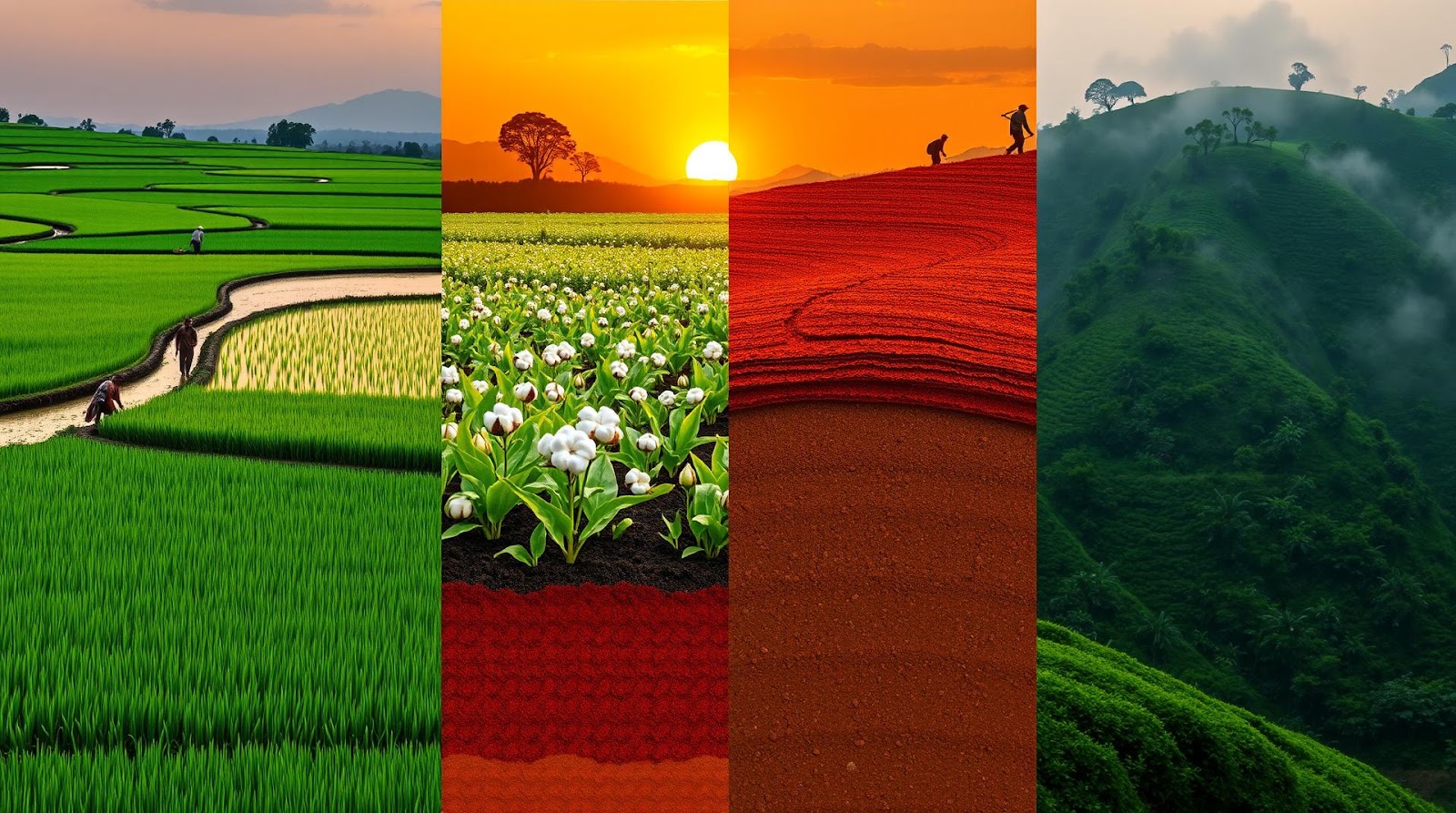
Before we talk crops, we need to understand soil. Think of soil as the DNA of a region. Different soils have different personalities, different nutrient profiles, and different demands.
The Alluvial Soil Story
Here's where most students go wrong: they think alluvial soils are just "soils deposited by rivers." True, but so what? Let me paint you a picture instead.
Imagine I'm standing on the banks of the Ganges during monsoon. The water is muddy, angry, and rushing downstream. It's carrying silt, clay, and sand particles—literally the pulverized rock of the Himalayas. Now, when this water calms down in the Indo-Gangetic Plain, these particles settle. Layer after layer. Year after year. Century after century. This is how alluvial soils form.
Why does this matter for your exam? Because alluvial soils cover 40% of India. That's massive. They're naturally fertile because they're constantly replenished. No wonder wheat, rice, and sugarcane thrive here. The Indo-Gangetic Plain feeds India. Remember that.
Now here's the trick I tell all my students: Think "A" for Alluvial and "A" for All-fertile-everything. If a question says a region has alluvial soil and asks what grows there, your default answer should involve high-yield crops like wheat, rice, cotton, or sugarcane. You'll be right 85% of the time.
Black Soil: The Maharaja of Soils
Black soil is dark, heavy, and rich. It's called "regur" in local language, and it's formed from volcanic rock weathering. Imagine the Deccan Plateau millions of years ago—volcanic eruptions covered vast areas with lava. Over time, this lava weathered and created deep, dark soils packed with iron and magnesium.
The fascinating part? Black soil has incredible water-retention capacity. It's like a sponge that doesn't let go easily. This makes it perfect for crops that need consistent moisture but can handle dry spells. Cotton absolutely loves black soil. In fact, the black soil regions of Maharashtra, Gujarat, and Madhya Pradesh are cotton capitals of India.
But here's what trips up students: black soil can become hard and crack during summer. So it needs proper management. Some exam questions will ask about the limitations of black soil—that's your answer right there.
Red Soil: The Overlooked Champion
Red soils cover about 30% of India, but students often ignore them because they sound less "important" than alluvial or black. Big mistake. Red soils are formed in high rainfall areas with high temperature and humidity, especially in the Deccan Plateau and Eastern India. The iron oxides in them give the red color—literally rust, basically.
Red soils are not naturally very fertile (iron oxides don't equal nutrients), but they're excellent for specific crops: groundnuts, millets, and certain pulses absolutely thrive here. And here's the exam trick: if you see a question about dry farming or millet cultivation in southern or eastern India, red soil is your answer. Just lock it in.
Laterite and Desert Soils: The Specialty Players
Laterite soils form in tropical areas with high rainfall. When water percolates through soil repeatedly, soluble minerals get washed away (leached), leaving behind iron and aluminum. This creates a hard, brick-like layer—laterite. It's used for construction blocks.
Agricultural potential? Limited. Laterite soils are acidic and infertile. But they're found in Western Ghats and Northeast India, and if managed well with amendments, they can produce tea, coffee, and spices. That's your exam connection right there.
Desert soils are sandy, poor in organic matter, and alkaline. They're found in Rajasthan and parts of Gujarat. But here's the plot twist: with irrigation, desert soils can be transformed. Remember the Green Revolution success stories in Rajasthan? That's human intervention over natural limitations.
The Agricultural Personality of India: Crops and Regions
Now that you understand soils, let's talk about what India grows and why. This is where geography stops being abstract and becomes real.
Kharif and Rabi: The Two Heartbeats of Indian Agriculture
Indian agriculture follows the monsoon rhythm. There are two main growing seasons, and if you don't understand them, you're already struggling.
Kharif crops (monsoon crops): These are sown with the monsoon rains (June-July) and harvested in September-October. They need moisture and warmth. Rice, maize, cotton, sugarcane, groundnuts, and millets are kharif crops. Notice something? Most are from alluvial or black soil regions where monsoons are reliable.
Rabi crops (winter crops): Sown in October-November after monsoon, harvested in March-April. They need less water but steady coolness. Wheat, pulses, mustard, and gram are rabi crops. These thrive in regions with moderate rainfall and cooler winters—North India, essentially.
Here's my mnemonic that works every time: K for Kharif = K for Khush (happy) in summer moisture. R for Rabi = R for Rainy-free (no rain needed). Silly? Maybe. But you'll remember it in the exam hall when your mind goes blank.
Cash Crops: The Money Players
Cotton, sugarcane, tea, coffee, rubber—these are India's cash crops. They're grown for export and commercial profit, not just food. Understanding their regional concentration is crucial for geography exams.
Cotton thrives in black soil regions with moderate rainfall. Gujarat and Maharashtra lead. Sugarcane loves alluvial soils and tropical/subtropical climate—hence UP and Maharashtra dominate. Tea and coffee are specific to particular altitudes in the Western and Eastern Ghats. Coffee in Coorg (Karnataka), tea in Darjeeling (West Bengal) and Assam.
The exam pattern? You'll get a map with a crop and asked to identify the region, or vice versa. If you remember the soil-climate combination for each crop, you'll never get it wrong.
Pulses, Oilseeds, and Food Grains: The Daily Staples
Rice and wheat are India's food security crops. Rice is the staple of eastern and southern India—alluvial soils, high rainfall, perfect. Wheat dominates the North and Northwest—rabi season, moderate rainfall, deep soils.
Pulses (dal) are India's protein source. But here's what students miss: pulses are hardy. They grow in medium to poor soils because they fix nitrogen in the soil naturally. Arhar (pigeon pea) and gram are grown across central and northern India in red and black soils. Chickpea (gram) is especially a rabi crop of northern plains.
Oilseeds include groundnuts, mustard, and sunflower. Groundnuts in red soil regions, mustard in rabi regions, sunflower in various regions. It's not random—there's a pattern based on soil and climate.
| Soil Type | Location | Ideal Crops | Why? |
|---|---|---|---|
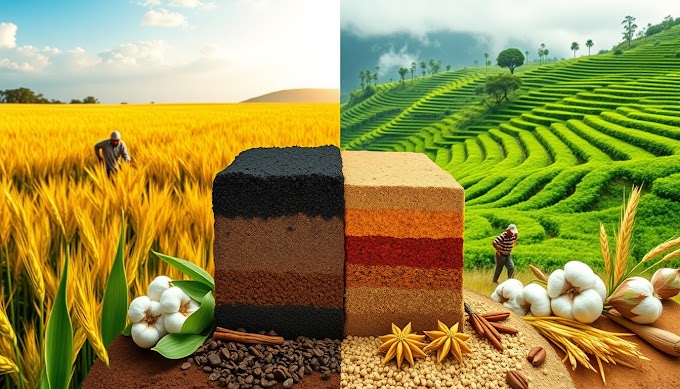
| Alluvial | Indo-Gangetic Plain | Wheat, rice, sugarcane, cotton | Naturally fertile, continuously replenished |
| Black | Deccan Plateau (MH, GJ, MP) | Cotton, sugarcane, jowar | Excellent water retention, nutrient-rich |
| Red | Deccan, Eastern regions | Groundnuts, millets, pulses | Well-draining, suitable for dry farming |
| Laterite | Western Ghats, Northeast | Tea, coffee, spices | High rainfall areas, suitable for plantations |
| Desert | Rajasthan, Gujarat | Millets, gram (with irrigation) | Low rainfall, needs irrigation for most crops |
The Agriculture Revolution and Modern India
Understanding historical context is often overlooked in geography prep, but it matters for comprehension questions. The Green Revolution of the 1960s fundamentally changed Indian agriculture and its geography.
Before the Green Revolution, India faced food shortages. But introduction of high-yield variety (HYV) seeds, chemical fertilizers, pesticides, and better irrigation transformed certain regions into surplus-producing areas. This is why wheat suddenly became abundant in Punjab and Haryana. Not because their soil changed, but because technology overcame natural limitations.
This has two exam implications: first, you need to know which regions benefited most from the Green Revolution (North and Northwest primarily). Second, understand that geography isn't static—human intervention reshapes it.
The downside? Intensive agriculture depleted soils. Monoculture led to loss of biodiversity. Now India is shifting toward sustainable agriculture, organic farming, and precision agriculture. This shift is changing the agricultural geography again. Organic farming regions are emerging, particularly in parts of Maharashtra, Sikkim, and Himachal Pradesh.
Quick Revision and Exam Strategies
Alright, so how do you actually ace these questions? Here's my battle-tested approach:
Strategy 1: The Soil-Crop-Region Triangle. For every crop, you should know three things: which soil(s) it needs, which region(s) it grows in, and what season. If you get these three, you've got your answer 90% of the time.
Strategy 2: Map-Based Thinking. Always visualize India's map. When you see a crop name, mentally place it. Rice → East and South, flooding plains. Wheat → North and Northwest, winter season. Cotton → Central and Western regions, black soil zones. This spatial thinking is what separates good geography students from great ones.
Strategy 3: Connect to Climate. Never study soil and crop separately from climate. They're a package deal. High rainfall + laterite soil = plantations (tea, coffee). Moderate rainfall + black soil = cotton and sugarcane. Low rainfall + red soil = millets and pulses. Climate is the kingmaker.
One last thing: when you study for mock tests, actually look at maps. Don't just read text. Geography is a visual subject. Your brain will remember a mental image of Punjab's wheat fields better than the word "wheat."
Practice Questions to Test Your Understanding
A) Alluvial soil B) Black soil C) Red soil D) Laterite soil
Answer: B) Black soil. It's formed from volcanic rock weathering and contains iron and magnesium, making it perfect for water-intensive crops like cotton. This soil is found abundantly in Maharashtra, Gujarat, and parts of central India.
A) High altitude B) Alluvial soil with continuous natural replenishment C) Black volcanic soil D) Desert soil with irrigation
Answer: B) Alluvial soil with continuous natural replenishment. Alluvial soils are continuously renewed by river flooding, maintaining fertility. The plain has diverse climate suitable for both kharif (rice) and rabi (wheat) crops.
A) Wheat, because red soil is very fertile B) Groundnuts and millets, because red soil suits dry farming C) Rice, because red soil retains moisture D) Cotton, because red soil is rich in iron
Answer: B) Groundnuts and millets, because red soil suits dry farming. Red soils are not naturally very fertile, but they're well-draining and perfect for hardy crops that can withstand drier conditions. These soils are found in southern and eastern India where groundnuts and millets are staple crops.
A) Because black soil is found there B) Because of high rainfall and laterite soil conditions C) Because of desert soil suitability D) Because of alluvial soil fertility
Answer: B) Because of high rainfall and laterite soil conditions. These regions have tropical climate with high rainfall and laterite soils. Laterite soils, though not very fertile for general agriculture, are suitable for plantations when properly managed. The consistent rainfall and cool temperatures (especially at higher altitudes) create ideal conditions for these crops.
A) Southern India with laterite soils B) Northeast India with high rainfall C) Northern and Northwestern India (Punjab, Haryana) with alluvial and black soils D) Deccan Plateau with red soils
Answer: C) Northern and Northwestern India (Punjab, Haryana) with alluvial and black soils. The Green Revolution introduced HYV seeds and modern irrigation techniques. These were most successfully implemented in regions with suitable soil (alluvial and black) and irrigation potential. Punjab and Haryana became surplus-producing states, fundamentally changing India's agricultural geography.
Published by Dattatray Dagale • 02 May 2026
.jpg)
.png)





.png)



0 Comments