Introduction
Let me start with a confession. When I was teaching chemistry for the first time, I realized that most of my students could memorize that H₂O is a compound, but couldn't actually *explain* why salt and iron are different things. And that's when it hit me — chemistry isn't about memorization. It's about understanding the fundamental building blocks of everything around us.
You know how Virat Kohli is made up of atoms, your smartphone is made of atoms, even that cup of chai you're drinking right now is made of atoms? Well, atoms combine in different ways to create literally everything. Sometimes they form elements — pure, single substances. Sometimes they form compounds — beautiful combinations that create entirely new properties. This distinction between elements and compounds is not just important for your SSC CGL or UPSC exam. It's fundamental to understanding how the universe actually works.
I've been teaching this for over a decade, and I've seen thousands of students struggle with this concept. But here's what I've learned: once you get this right, the rest of chemistry becomes SO much easier. So let's dive in together, and I promise by the end of this, you'll never confuse an element with a compound again.
What Exactly Are Elements? The Unbreakable Building Blocks
An element is the simplest form of matter. It's pure substance made of only one type of atom. That's it. Just one type of atom. Nothing else.
Think of it like this: if atoms are LEGO bricks, then an element is a pile of identical LEGO bricks. All the same color, all the same shape. When you have a pile of only red bricks, you have an element. You can't break it down into anything simpler without changing its fundamental nature.
The Periodic Table: A Map of All Elements
There are 118 known elements in the universe (well, as of our last count). They're all arranged in something called the Periodic Table — and no, you don't need to memorize all 118. Honestly, for SSC and UPSC, you need to know maybe 20-30 important ones really well.
Every element is represented by a chemical symbol — usually one or two letters. Hydrogen is H. Oxygen is O. Iron is Fe (that's from its Latin name, ferrum). Gold is Au (from the Latin, aurum). Carbon is C. These symbols are like the ID cards of elements.
Here's something I tell all my students: elements cannot be broken down into simpler substances by chemical means. If you try to heat iron, burn it, dissolve it in acid — you'll get iron compounds, but you won't get anything simpler than iron atoms. That's what makes it an element.
Types of Elements: Metals, Non-metals, and Metalloids
Now, not all elements are the same. They're divided into three broad categories based on their properties.
Metals are shiny, conduct electricity, are generally solid at room temperature (except mercury), and are malleable and ductile. Think iron, copper, gold, aluminum. These are the show-offs of the periodic table — they're everywhere in practical applications.
Non-metals are usually poor conductors, often exist as gases or liquids at room temperature, and are brittle if solid. Oxygen, nitrogen, chlorine, carbon — these are the quieter elements but just as important. Fun fact: carbon is in your body, in diamonds, in coal, in pencil leads. Same element, completely different properties depending on how the atoms are arranged. (We'll talk about that when we discuss allotropes later.)
Metalloids are the middle children — they have properties of both metals and non-metals. Silicon is a famous one. You'll hear about them occasionally in exams but don't stress too much about memorizing them.
Understanding Compounds: When Elements Hold Hands
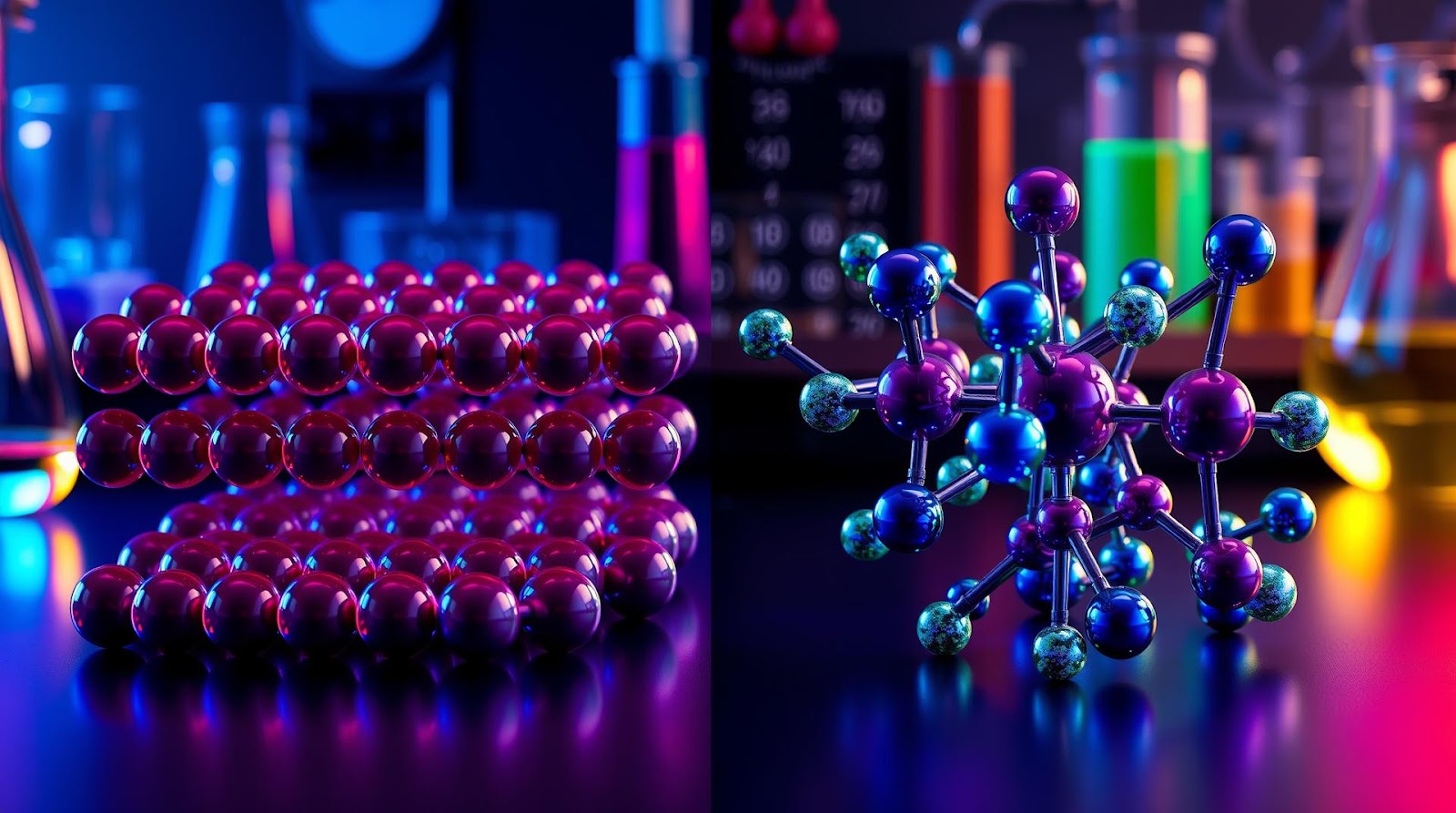
Now here's where things get interesting. A compound is a pure substance made of two or more elements chemically bonded together in a fixed ratio. This is the key difference from elements.
Let me give you an example that always sticks with students. Water — H₂O. This is a compound. It's made of hydrogen (H) and oxygen (O) in a ratio of 2:1. Always. Every single water molecule has exactly 2 hydrogen atoms and 1 oxygen atom. That's the definition of a compound — a fixed ratio.
Here's what fascinates me about compounds: when you combine elements, you don't just get a mixture. You create something entirely new with completely different properties. Hydrogen is a gas that burns. Oxygen is a gas that lets things burn. But combine them and you get... water. A liquid. Something that extinguishes fire. The properties are completely different. That's the magic of chemistry.
I once had a student ask me: "Sir, but isn't a mixture of hydrogen and oxygen still containing those two elements?" Brilliant question. The answer is no — a mixture is not a compound. In a mixture, elements keep their individual properties and can be separated by physical means. In a compound, elements are chemically bonded and can only be separated by chemical means.
Ionic vs Covalent Compounds: How Elements Actually Bond
When elements form compounds, they bond in different ways. The two main ways are ionic and covalent bonding.
Ionic compounds form when one element (usually a metal) donates electrons to another element (usually a non-metal). Think of it as a transaction — one atom gives electrons, the other receives them. This creates charged particles called ions. Common table salt, NaCl (sodium chloride), is an ionic compound. Sodium gives an electron to chlorine, creating Na⁺ and Cl⁻ ions. These oppositely charged ions attract each other strongly.
Covalent compounds form when elements share electrons. They hold hands and walk together, sharing the electrons in the middle. Water (H₂O) is a covalent compound. The hydrogen atoms and oxygen atom share electrons. Most organic compounds (compounds with carbon) are covalent.
Here's a mnemonic I've been teaching for years, and it works brilliantly: "IONIC = ION + IC" — meaning it involves IONs and is Ionic. Covalent? It involves "co-valent" — sharing equally. Corny, I know, but it works.
Properties That Make Compounds Unique
Compounds have their own unique properties that are completely different from their component elements. This is crucial to understand for exams.
Take sugar (C₁₂H₂₂O₁₁). It's made of carbon, hydrogen, and oxygen. Carbon is a black solid. Hydrogen is a colorless gas that burns. Oxygen is a gas that makes things burn. But sugar? It's a white crystalline solid that dissolves in water and tastes sweet. None of those properties belong to the individual elements.
Or ammonia (NH₃). It has a pungent smell, is alkaline, and is used in fertilizers. But nitrogen by itself has almost no smell and is inert (doesn't react easily). Hydrogen is a gas. Combine them? Completely different story.
| Property | Elements | Compounds |
|---|---|---|
| Composition | One type of atom only | Two or more elements chemically bonded |
| Fixed Ratio | N/A (single atom type) | Always fixed (e.g., H₂O always 2:1) |
| Chemical Bonds | No bonds (single element) | Ionic, covalent, or metallic bonds |
| Properties | Characteristic of that element | Completely different from component elements |
| Separation | Cannot be separated by chemical means | Can be separated only by chemical means |
| Examples | H, O, C, N, Fe, Au, Cu | H₂O, NaCl, CO₂, NH₃, CH₄ |
Elements vs Compounds vs Mixtures: The Complete Picture
Okay, so now that we understand elements and compounds, let me clarify something that confuses a lot of students. What about mixtures?
A mixture is a physical combination of two or more substances where each substance retains its own properties. The key word is "physical" — not chemical. In a mixture, there are no chemical bonds between the substances.
Think of it like this: if I pour salt into a glass of water, I have a mixture. The salt dissolves, but it's still salt (NaCl) and the water is still water (H₂O). They're just mixed together. I could theoretically separate them by evaporating the water, which would leave the salt behind. That's a physical separation.
But if I chemically react hydrogen and oxygen together, I get water. To separate water back into hydrogen and oxygen, I need to do something chemical, like electrolysis. That's a chemical separation.
Here's the hierarchy that always helps students: ATOMS → ELEMENTS → COMPOUNDS → MIXTURES
Atoms are the smallest units. Group identical atoms and you get elements. Chemically combine different elements and you get compounds. Physically combine any substances (elements, compounds, or both) and you get mixtures.
Common Elements and Compounds You Need to Know for Exams
Let me be practical here. For SSC CGL, UPSC, and most competitive exams, there are certain elements and compounds that appear repeatedly. You should know these inside out.
Important Elements: Oxygen (O), Hydrogen (H), Carbon (C), Nitrogen (N), Phosphorus (P), Sulfur (S), Chlorine (Cl), Sodium (Na), Potassium (K), Calcium (Ca), Iron (Fe), Copper (Cu), Gold (Au), Silver (Ag), Mercury (Hg).
Important Compounds: Water (H₂O), Carbon dioxide (CO₂), Ammonia (NH₃), Table salt (NaCl), Sugar (C₁₂H₂₂O₁₁), Sulfuric acid (H₂SO₄), Nitric acid (HNO₃), Hydrochloric acid (HCl), Calcium carbonate (CaCO₃), Iron oxide (Fe₂O₃ or Fe₃O₄).
These appear in questions about industrial processes, environmental chemistry, and biochemistry. If you understand these deeply — their formulas, their properties, where they're found, and how they're made — you'll crack a significant portion of the chemistry section.
I always tell students: don't just memorize that ammonia is NH₃. Know that it's made from nitrogen and hydrogen, that it's alkaline, that it's used in fertilizers, that it has a pungent smell. When you know the "why" behind these facts, you'll remember them forever. When you just memorize, you'll forget them in two weeks.
Quick Tricks to Remember the Difference
Over my teaching career, I've developed a few tricks that students absolutely love. Let me share them:
Trick #1 — The "Simplicity Test": Ask yourself: "Can I break this down into something simpler?" If the answer is no, it's an element. If yes, it's a compound. Oxygen can't be broken down. Water can be broken down into hydrogen and oxygen. Simple.
Trick #2 — The "Symbol Rule": Elements have one or two letter symbols (H, O, C, Fe, Cu). Compounds have formulas with multiple elements (H₂O, NaCl, CO₂). If you see a formula, it's a compound. If you see a simple symbol, it's an element.
Trick #3 — The "Property Check": Do the properties match what you'd expect? Iron is black and magnetic. But iron oxide (rust) is red-brown and not magnetic. Same elements, different compound, different properties. This tells you they're chemically bonded, not just mixed.
These tricks have saved countless students during exams when they panic and forget everything. The mind works with associations, and these simple checks give you something to hold onto.
Final Thoughts: Why This Matters Beyond the Exam
Here's what I really want you to understand: this isn't just exam knowledge. Understanding elements and compounds is understanding how reality works. Every medicine you take is a compound. Every metal object you use is either an element or an alloy. The food you eat is a complex mixture of compounds. Climate change is happening because of a specific compound — CO₂ — accumulating in the atmosphere.
When you understand the difference between elements and compounds, you're not just preparing for an exam. You're developing a lens to understand the physical world. And that's genuine knowledge, the kind that sticks with you for life.
So next time someone asks you what an element is, don't just say "it's one type of atom." Explain it with enthusiasm. Help them understand why water is a compound and not just a mixture of hydrogen and oxygen. Be the person who actually understands chemistry, not just memorizes it. That's what'll make you an ace in these exams.
Now, let's test your understanding with some questions. These are the types you'll see in actual exams, so take them seriously:
A) Salt and water mixture B) Oxygen and nitrogen mixture C) Water (H₂O) D) Oil and water mixture
Answer: C) Water (H₂O) — It's a compound and requires chemical means (like electrolysis) to separate into its elements.
A) Elements are always solids, compounds are always liquids B) Elements contain one type of atom, compounds contain two or more types chemically bonded C) Elements are heavier than compounds D) Compounds are simpler than elements
Answer: B) Elements contain one type of atom, compounds contain two or more types chemically bonded — This is the fundamental definition.
A) It is a gas at room temperature B) It is formed by the chemical combination of nitrogen and hydrogen in a fixed ratio C) It dissolves in water D) It has a pungent smell
Answer: B) It is formed by the chemical combination of nitrogen and hydrogen in a fixed ratio — This is what makes something a compound.
A) Only the state of matter changes B) Only the color changes C) Chemical bonds form between iron and sulfur atoms, creating a compound with new properties D) The atoms are destroyed and new ones created
Answer: C) Chemical bonds form between iron and sulfur atoms, creating a compound with new properties — This is the transition from mixture to compound.
A) CO₂ B) H₂O C) NaCl D) O₂
Answer: D) O₂ — This is oxygen in its molecular form, still representing the element oxygen. The others are compounds with chemical formulas showing multiple elements.
Published by Dattatray Dagale • 17 June 2026
.jpg)
.png)



.png)




.png)

0 Comments