Introduction
Let me start with a confession. When I first started teaching ten years ago, I thought environment and ecology were boring topics that students memorized and forgot by evening. But then something changed. A student asked me, "Sir, why are we losing tigers in India when we have Project Tiger?" That single question made me realize these aren't just textbook topics—they're about the world we're literally living in right now.
Here's what I've learned: environment and ecology questions appear in almost every competitive exam—SSC CGL, UPSC, banking exams, state PSCs. They test not just your memory, but your ability to understand cause-and-effect relationships. Why does deforestation lead to drought? What happens when we introduce an invasive species? These are the kinds of questions that separate candidates who score 95 from those who score 75.
In this post, I'm going to break down environment and ecology the way I teach it in my live sessions—no jargon, real examples from India, and memory tricks that actually stick. By the end, you'll understand these concepts so well that when you see an ecology question, you won't freeze; you'll smile.
What's the Difference Between Environment and Ecology?
This is where students often get confused, and I blame the textbooks for making it sound more complicated than it is. Let me simplify it over chai-time logic.
Environment is everything around you. The air, water, soil, sunlight, animals, plants—everything. It's like the stage in a theatre production. The environment is physical, chemical, and biological components combined.
Ecology is the study of relationships—how organisms interact with each other and with the environment. It's like studying the plot and character dynamics in that theatre production, not just the stage. Ecology focuses on connections: predator-prey relationships, food chains, competition, symbiosis.
Here's a memory trick I tell students: Environment = Things (noun). Ecology = Relationships (verb). Environment is static; ecology is dynamic.
Why This Distinction Matters for Your Exam
When a question asks, "Which of the following is an environmental factor?" you're looking for things like temperature, humidity, pH, light. But when it asks about "ecological succession" or "predator-prey relationships," you're talking about interactions. This one distinction helps you eliminate 50% of wrong answers automatically.
The Ecosystem: Nature's Perfect Balancing Act
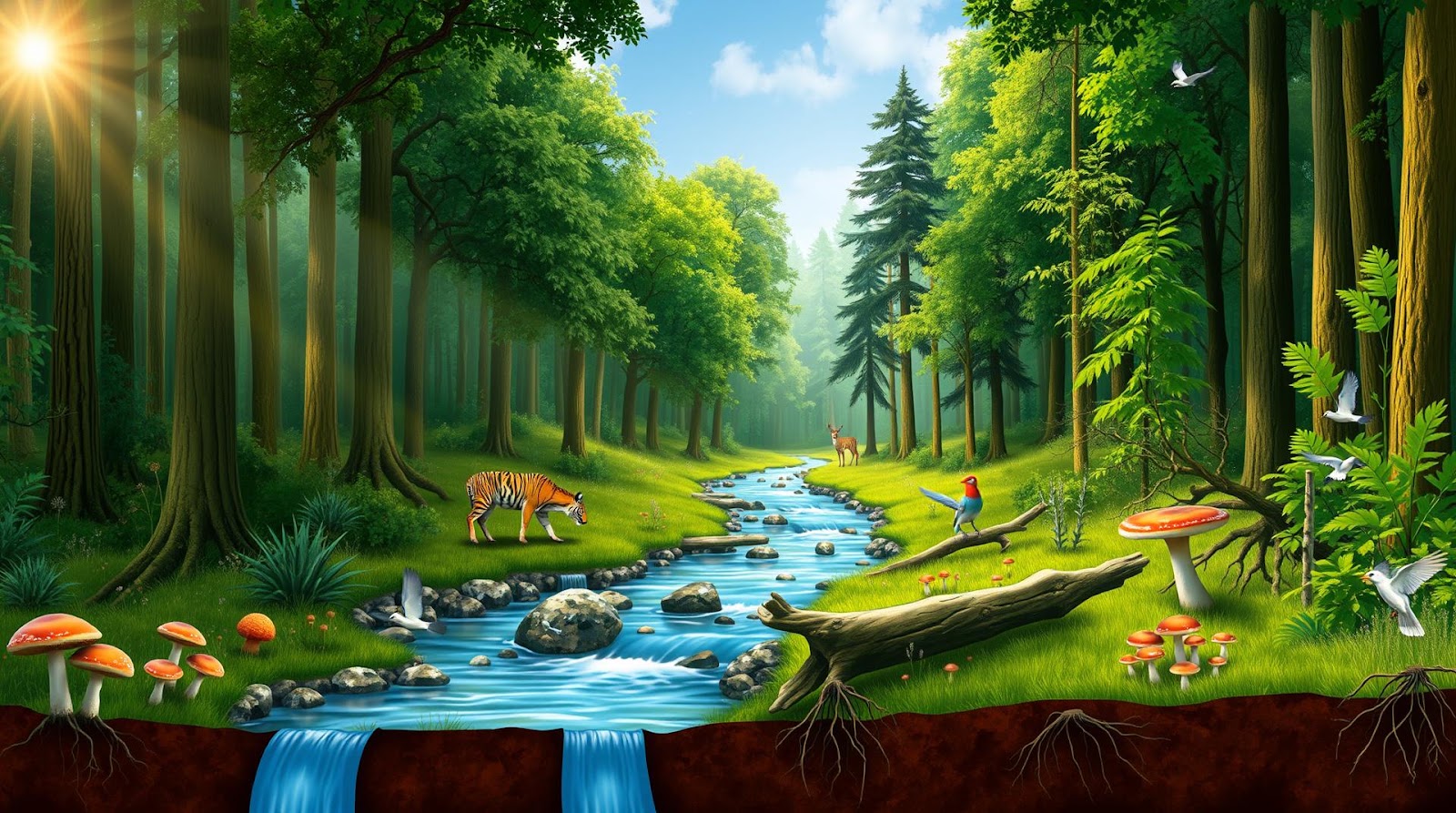
Now here's the interesting part. An ecosystem is basically a self-contained unit where living organisms (biotic) and non-living things (abiotic) interact together. Think of it like a joint family. Just as the family needs the right balance of income, expenses, food, and members to function smoothly, an ecosystem needs the same balance.
Biotic and Abiotic Components
Let me explain this with a forest ecosystem—something we see across India.
Biotic factors are all living things: trees, animals, microorganisms, humans. In a forest, you have producers (trees), consumers (herbivores, carnivores, omnivores), and decomposers (bacteria, fungi).
Abiotic factors are non-living: sunlight, temperature, rainfall, soil quality, atmospheric pressure, pH level. If the monsoon fails in a region, that's an abiotic factor affecting the entire ecosystem.
I once taught a lesson during the 2019 Kerala floods, and a student raised his hand: "Sir, the floods are increasing animals in the forest, right?" Wrong assumption! While water is necessary, excessive water (abiotic disruption) destroys the ecosystem balance just as much as drought does. Both extremes kill.
The Energy Flow: From Sun to You
This is where ecology gets genuinely beautiful. Every living thing on Earth runs on solar energy. The sun's energy flows through an ecosystem in one direction—it never cycles back. This is crucial to understand.
Producers (plants) capture sunlight through photosynthesis and convert it to chemical energy. When a deer eats the plant, it transfers about 10% of that energy to itself. When a tiger eats the deer, it gets 10% of what the deer had. By the time energy reaches the top predator, it's drastically reduced.
Let me give you a memory hack: TEN-PERCENT RULE = Energy Transfer Every Nutrition Tier. Every trophic level gets only 10% of the previous level's energy. This is why you never see ecosystems with more tigers than deer—the energy pyramid doesn't allow it.
| Trophic Level | Example | Energy Available |
|---|---|---|
| Producer (Level 1) | Grass, crops, plants | 100% |
| Primary Consumer (Level 2) | Herbivores (deer, rabbits) | 10% |
| Secondary Consumer (Level 3) | Carnivores (tigers, eagles) | 1% |
| Tertiary Consumer (Level 4) | Top predators | 0.1% |
Biodiversity and Ecological Balance: Why One Species Matters
You've probably heard about "Save the Tigers" or "Save the Polar Bears." But have you wondered why we care so much about one animal? Let me explain why biodiversity isn't just a feel-good concept—it's actual survival economics.
Biodiversity refers to the variety of species in an ecosystem. A biodiverse ecosystem is like a well-diversified stock portfolio—if one investment fails, your money doesn't disappear entirely. But a low-diversity ecosystem is like putting everything in one stock. One crash, and everything collapses.
Why Biodiversity Matters: The Keystone Species Concept
Some species are like the keystone in an arch. Remove it, and the entire structure collapses. These are called keystone species. A classic example is the sea otter. You might think, "What's so special about an otter?" But sea otters eat sea urchins. When sea otters were hunted to near extinction, sea urchin populations exploded, they ate all the kelp forests, and entire marine ecosystems collapsed. One "cute" animal species, one massive ecological crash.
In India, tigers are a keystone species. They control herbivore populations, which prevents overgrazing. Without tigers, deer and wild boar populations would explode, destroying vegetation, which would lead to soil erosion and completely different landscapes. This is why Project Tiger isn't just about saving tigers—it's about saving entire forest ecosystems.
Habitat Loss: The Silent Killer
Habitat loss causes about 68% of species extinctions globally. You want to know why? Because you can't separate an organism from its home. A tiger needs forests. A dolphin needs rivers. A polar bear needs ice. When we destroy forests, dam rivers, or melt ice caps, we're not just removing landscapes—we're removing species.
In India, we've lost massive chunks of the Western Ghats forests to infrastructure projects. The result? Increased human-animal conflict, soil erosion in the region, reduced water cycling, and species extinction. All connected.
Succession, Pollution, and the Big Picture
Ecological Succession: Nature's Reset Button
After a forest fire, what happens? Does it stay barren forever? No. Slowly, grasses come, then shrubs, then trees return. This process is called ecological succession, and it's nature's way of healing.
Primary succession starts where no life existed before—bare rock after a volcanic eruption. Secondary succession happens where life existed before but was destroyed—like a forest after a fire. Secondary succession is faster because seeds are already in the soil.
The final stage is the climax community—a stable ecosystem where species composition doesn't change much anymore. A mature forest is a climax community. A cricket pitch maintained by humans? Not a natural climax community because humans prevent succession by constant management.
Biogeochemical Cycles: The Circle of Life (Literally)
Remember I said energy flows one direction? Well, matter (elements like carbon, nitrogen, water) cycles. Carbon goes from atmosphere to plants to animals back to atmosphere (or soil). Nitrogen cycles through soil, plants, animals, and back. Water evaporates, precipitates, and cycles endlessly.
When we burn fossil fuels, we're accelerating the carbon cycle—releasing carbon that took millions of years to bury. The result? Climate change. This is why climate change is fundamentally an ecological problem, not just an environmental one.
Pollution: Breaking the Natural Cycles
Pollution introduces substances into ecosystems that don't naturally belong. Plastic doesn't have a natural decomposer. Pesticides accumulate in organisms. Heavy metals concentrate as they move up the food chain (called biomagnification).
Here's a real-world Indian example: DDT was sprayed for malaria control. Fish ate contaminated organisms. Birds ate the fish. Peregrine falcon eggs became so thin-shelled they broke during incubation. The pesticide meant to save humans nearly killed an entire bird species. That's biomagnification—the concentration effect increases as you go up the food chain.
A memory trick for pollution types: PBH = Point source (factories, pipes), Broad/Diffuse (agricultural runoff), Human activity-based (vehicles, construction).
A) 1,000 units B) 100 units C) 10 units D) 1 unit
Answer: C) 10 units. Producers have 1,000. Primary consumers get 10% = 100. Secondary consumers get 10% of that = 10 units.
A) The largest predator in an ecosystem B) A species whose impact is disproportionate to its abundance C) The most abundant species in an ecosystem D) Any top predator
Answer: B) A species whose impact is disproportionate to its abundance. Keystone species have outsized importance—often small in number but critical to ecosystem stability.
A) Primary succession is faster B) Secondary succession starts on bare rock C) Primary succession starts where life never existed; secondary starts where it existed before D) They are identical processes
Answer: C) Primary succession starts on bare rock or areas with no prior life; secondary succession starts on areas where life existed but was destroyed.
A) Pollutants increase in concentration as they move up the food chain B) Pollutants decrease in concentration at higher trophic levels C) All organisms have equal pollutant levels D) Decomposers eliminate pollutants
Answer: A) Biomagnification means pollutants concentrate more at higher trophic levels because organisms accumulate toxins from consuming many contaminated organisms below them.
A) Biotic factors are living; abiotic factors are non-living B) Both are always living organisms C) Abiotic factors determine biotic factors but never vice versa D) Biotic factors cannot be affected by abiotic changes
Answer: A) Biotic = living organisms and their interactions; abiotic = non-living components like temperature, light, water, soil. Both interact continuously.
Final thought: Environment and ecology aren't separate from your life—they're the foundation of it. Every breath you take, every glass of water you drink, every meal you eat depends on these balances. When you understand these concepts deeply, you don't just pass exams; you understand your own existence better. That's the real power of studying ecology.
Now go ace that section. And if you have questions, you know where to find me!
Published by Dattatray Dagale • 18 June 2026
.jpg)
.png)



.png)


.png)

0 Comments