Introduction
Let me start with a confession: when I first started teaching geography, I used to skip over soil and agriculture topics because I thought they were "boring." Big mistake. Then one day, a student asked me during an exam prep session, "Sir, why do farmers in Punjab grow different crops than farmers in Karnataka?" And that's when it clicked for me. The answer wasn't just about climate or tradition—it was fundamentally about soil.
See, here's what most students get wrong: they think Indian agriculture is just about monsoons and monsoon failures. But the real story? The real story is underground. It's in the soil. The type of soil determines which crops you can grow, how productive your farm will be, and ultimately, whether a region thrives or struggles. And in SSC CGL and UPSC exams, soil and agriculture questions aren't random—they test whether you actually understand how India works.
Over the last decade, I've watched thousands of students breeze through political history but stumble when asked about the distribution of black soil or why cotton doesn't grow in the Northeast. It's not because they're unprepared—it's because they never connected the dots. That's exactly what we're doing today.
Understanding India's Soil Landscape
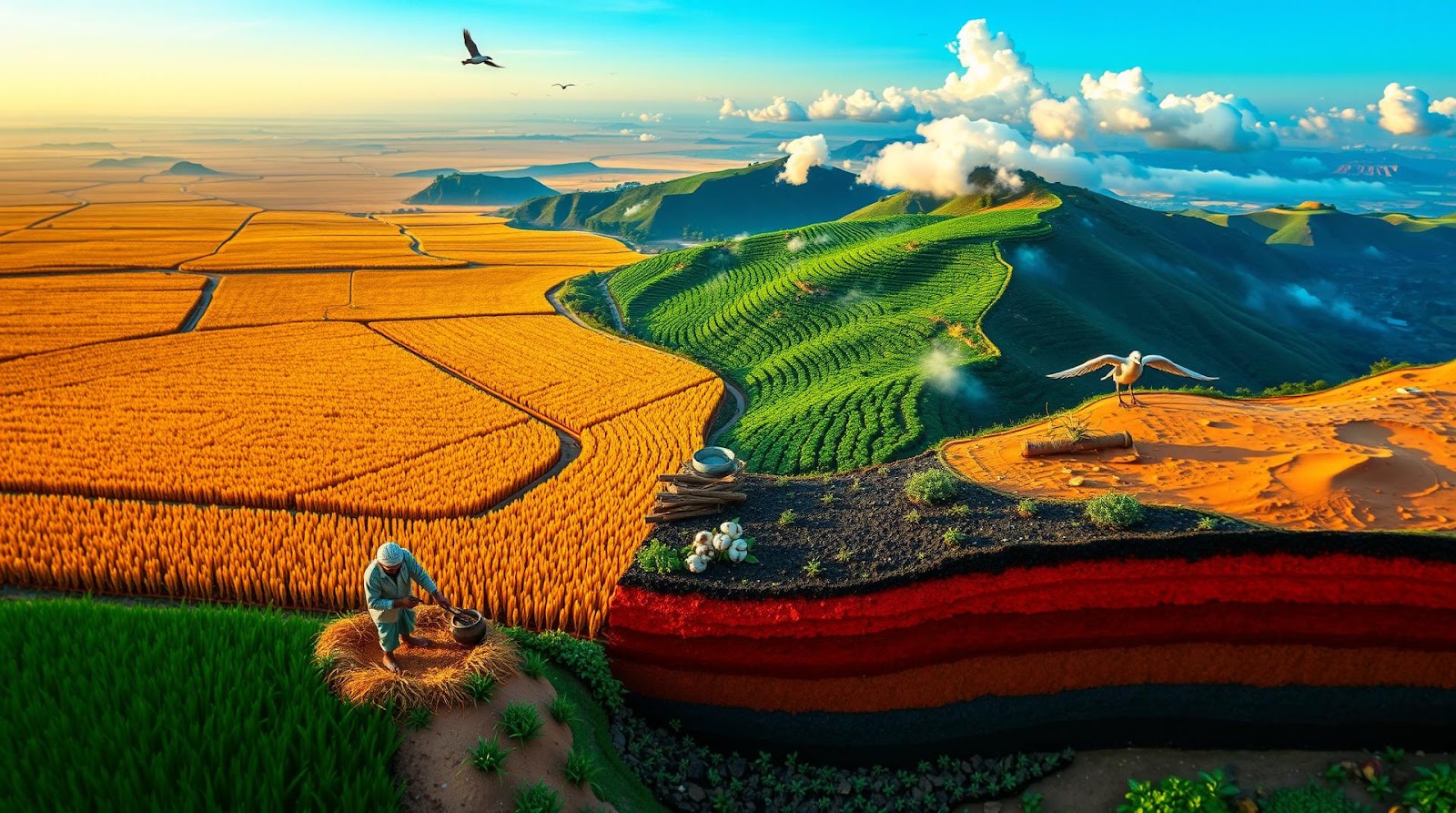
India has six major soil types, and I want you to think of them as six different personalities. Each has its own characteristics, preferences, and challenges. Get to know them, and half your agriculture questions will solve themselves.
Alluvial Soils: The Golden Child of Indian Agriculture
This is the hero of our story. Alluvial soils are found in the Indo-Gangetic Plains, the Brahmaputra Valley, and coastal areas. They're formed by river deposits over thousands of years—basically, rivers have been delivering nutrient-rich sediment like a faithful servant for millennia.
Here's why they're so precious: alluvial soils are incredibly fertile. They're rich in potassium, nitrogen, and phosphorus—basically, they're the fertilizer that keeps on giving. The particle size is perfect for water retention without waterlogging. You can grow anything here—wheat, rice, sugarcane, cotton, all of it. The Indo-Gangetic Plain? That's alluvial heaven, and it's why that region produces nearly 40% of India's food grains.
Now, here's a trick I tell all my students: remember "Indo-Ganga" when you think of alluvial soils. That phrase alone covers most of your alluvial soil coverage. Punjab, Haryana, Uttar Pradesh, Bihar, West Bengal—all alluvial. When an exam question asks about the most fertile soil in India, your first answer should always be alluvial.
Black Soil: The Cotton King's Domain
Black soil is my personal favorite because it's genuinely fascinating. It's formed from the weathering of basaltic lava flows, mainly found in the Deccan Plateau. The dark color comes from iron oxide and manganese oxide—literally, the mineral composition makes it dark.
Black soil has incredible water retention capacity. I mean, it genuinely holds water like nobody's business. During the monsoon, it's soggy and sticky (which is why farmers sometimes call it "sticky soil"). But during the dry season? It cracks—and I mean it cracks dramatically, like a dried-up riverbed. These cracks are actually beneficial because they allow air to penetrate and improve soil aeration.
Cotton loves black soil. Sugarcane loves it. Jowar and other pulses thrive here. States like Maharashtra, Karnataka, Madhya Pradesh, and parts of Gujarat are black soil regions, and they're cotton-producing powerhouses. If you see a question about the "Black Soil Region" or "Deccan Traps Soil," think cotton, think Deccan Plateau, and you're golden.
Red and Yellow Soils: The Misunderstood Siblings
Red soils are found in older crystalline rocks, particularly in the Deccan and in parts of South India. The red color comes from iron oxide deposits. Yellow soils are basically red soils that have undergone more weathering and leaching—the iron has been oxidized further, giving them a yellowish tint.
Now, here's what surprises students: red and yellow soils are less fertile than alluvial or black soils. They're acidic, they've lost minerals through leaching, and they require more fertilizer inputs. But that doesn't mean they're useless. They grow millets, pulses, oilseeds, and various fruits quite well. Tamil Nadu, Karnataka, Andhra Pradesh—these regions have plenty of red soil, and they've adapted their agriculture accordingly.
Laterite Soils: The Forest Floor's Gift
Laterite soils form in high rainfall areas with alternating wet and dry seasons. You'll find them abundantly in the Western Ghats, the Northeast, and the Nilgiris. They're formed through intense weathering in tropical climates.
Here's the challenge: laterite soils are naturally acidic and deficient in nitrogen and phosphorus. But here's the interesting part: they're actually excellent for growing plantation crops like coffee, tea, and rubber. The Western Ghats produce India's best coffee—and you guessed it, those plantations sit on laterite soil. Once you add the right amendments and manage the pH carefully, laterite becomes productive, especially for specialized crops.
Desert and Mountain Soils: The Challengers
Desert soils in Rajasthan and parts of Gujarat are sandy, low in organic matter, and seriously deficient in nutrients. Mountain soils in the Himalayas are shallow and often mixed with stones. Both are challenging for traditional agriculture, but modern irrigation (in deserts) and terrace farming (in mountains) have made them productive in specific ways.
Crops and Climate: The Perfect Match
Okay, so now that you understand the soils, let's talk about crops. Here's the thing that blew my mind when I started researching properly: crop distribution in India isn't random. It's not like farmers wake up and think, "Let me grow rice in Rajasthan today." No. Crops follow a pattern—soil type, rainfall, temperature, and season all play a role.
Kharif and Rabi: The Seasonal Rhythm
Most Indian agriculture revolves around two seasons. Kharif crops are monsoon crops—planted when the monsoon arrives (June-July) and harvested by October-November. Rice, cotton, sugarcane, maize, and jowar are typical kharif crops. They need that summer monsoon rain.
Rabi crops are winter crops—planted after the monsoon recedes (October-November) and harvested in February-March. Wheat, barley, mustard, and pulses are rabi stars. They love the cool winter weather and rely on residual soil moisture or irrigation.
Here's my memory trick for you: Think "K for Kharif = Kitchen (when things grow hot and wet), R for Rabi = Rest season (cool, winter)". It sounds silly, but it sticks with students.
Cash Crops vs. Food Crops: The Economic Divide
This is where geography meets economics, and it's genuinely important for understanding India's farming challenges. Cash crops like cotton, sugarcane, tobacco, and jute are grown for commercial purposes—they make farmers money, but you can't eat them directly. Food crops like wheat, rice, pulses, and millets keep us fed.
The irony? A farmer growing cotton might earn more per hectare than a farmer growing wheat. But if cotton prices crash (which they do, regularly), that farmer is in trouble. Whereas wheat, being essential food, has more stable demand and often government support through MSP (Minimum Support Price).
This tension between cash crop cultivation and food security is something exam setters absolutely love to ask about. When you see a question about agricultural policy or farmer distress in Maharashtra or Punjab, this dynamic is usually at play.
Regional Agriculture Patterns You Actually Need to Know
Let me give you a practical breakdown because regional specificity is where many students trip up.
Punjab and Haryana: The breadbasket. Alluvial soils, abundant irrigation from canal systems, and the Green Revolution legacy. Wheat and rice dominate. These states produce massive grain surpluses and supply the PDS (Public Distribution System).
Maharashtra and Gujarat: Cotton belt. Black soils, monsoon-dependent, but profitable. Cotton is king here. Sugarcane also thrives because it loves black soil and the region's climate.
Tamil Nadu and Karnataka: Plantation crops, spices, and coffee. Red and laterite soils. More diversified agriculture. You'll find coffee, tea, cardamom, and various millets here.
West Bengal: Rice and tea. Alluvial soils in the plains, laterite in the Darjeeling region. The Darjeeling tea gardens are world-famous, and they sit on laterite-rich foothills.
Assam: Tea heaven. Laterite soils, high rainfall, cool temperatures. The Northeast is India's tea basket. Over 50% of India's tea comes from Assam.
Rajasthan: Millets and pulses, despite desert soils. Low rainfall means limited irrigation. Farmers here are adaptation masters—they've learned to grow drought-resistant crops.
| Soil Type | Main Regions | Best Crops | Key Characteristics |
|---|---|---|---|
| Alluvial | Indo-Gangetic Plains, Brahmaputra Valley | Wheat, Rice, Sugarcane, Cotton | Most fertile, excellent water retention, nitrogen-rich |
| Black | Deccan Plateau (Maharashtra, Karnataka, MP, Gujarat) | Cotton, Sugarcane, Jowar, Pulses | High water retention, cracks in dry season, iron-oxide rich |
| Red & Yellow | Deccan, South India (Tamil Nadu, Karnataka, AP) | Millets, Pulses, Oilseeds, Groundnut | Acidic, leached, less fertile, requires fertilizer |
| Laterite | Western Ghats, Northeast, Nilgiris | Tea, Coffee, Rubber, Spices | High rainfall areas, tropical weathering, acidic |
| Desert | Rajasthan, parts of Gujarat | Millets, Pulses (with irrigation) | Sandy, low organic matter, needs irrigation |
| Mountain | Himalayas, Hill Stations | Apples, Tea, Potatoes, Vegetables | Shallow, mixed with stones, cool climate crops |
Modern Challenges and Agricultural Evolution
You know what I love about teaching current topics in history and geography? Everything connects to the present day. Our soil and agricultural patterns aren't just historical facts—they're living, breathing realities that shape policy and farmer livelihoods today.
Soil degradation is a massive issue. Overuse of chemical fertilizers has depleted soil organic matter. Continuous monoculture (growing the same crop year after year) has exhausted nutrients. Waterlogging in some canal-irrigated regions and salinization in others have made millions of acres less productive.
That's why you see government initiatives like the Soil Health Card scheme, which tests soil conditions and recommends specific amendments. Or the PM Krishi Sinchayee Yojana, which focuses on efficient irrigation to prevent salinization. Or organic farming promotion. These aren't random policies—they're responses to real, tangible soil challenges.
Here's something that genuinely fascinates me: young farmers are now going back to studying soil science seriously. Climate change has made our traditional crop-planting schedules unreliable. Erratic monsoons mean farmers need to understand their soil's water-holding capacity better than ever before. Soil type now determines not just what you can grow, but whether you can survive a bad monsoon year.
S = Sandy/Saline (deserts, poor fertility)
O = Organic-rich (laterite, plantation areas)
I = Indo-Gangetic (alluvial, most fertile)
L = Laterite/Lava-origin (black soil, Deccan)
This covers all major soil categories in sequence from least to most productive.
When you're preparing for exams, remember this: soil questions aren't trivia. They're testing whether you understand why India's agriculture looks the way it does. Why Punjab is different from Assam. Why cotton doesn't grow in Kerala. Why tea grows where it does. If you understand soil, agriculture stops being random facts and becomes a coherent story.
Practice Questions for You
A) Alluvial soil B) Black soil C) Red soil D) Laterite soil
Answer: B) Black soil — Formed from basaltic lava, found in the Deccan, excellent water retention for cotton.
A) Alluvial soil B) Black soil C) Laterite soil D) Desert soil
Answer: C) Laterite soil — Found in high rainfall areas like Darjeeling and Assam, ideal for tea with proper management.
A) Wheat B) Barley C) Rice D) Mustard
Answer: C) Rice — Monsoon crop planted in June-July, harvested by October-November.
A) Black soil availability B) Alluvial soil formation C) Desert soil irrigation D) Laterite soil richness
Answer: B) Alluvial soil formation — River deposits over millennia have created naturally fertile, nutrient-rich soil in this region.
A) Punjab B) Tamil Nadu C) Maharashtra D) Haryana
Answer: C) Maharashtra — Black soils of the Deccan, monsoon conditions, and established cotton-growing traditions make it the cotton production leader.
Published by Dattatray Dagale • 27 May 2026
.jpg)
.png)



.png)




.png)

0 Comments