Introduction
Let me be honest with you. When I first started teaching geography fifteen years ago, soil seemed boring. Just dirt, right? Wrong. Completely wrong.
One day, a student asked me why rice grows in Kerala but not in Rajasthan, even though both get sunlight and water. I couldn't give him a proper answer back then. Now I can—and it's fascinating. It all comes down to soil, soil microorganisms, rainfall patterns, and agriculture. These three things are so interconnected that understanding one without the others is like watching a Bollywood film with the sound off. You're missing half the story.
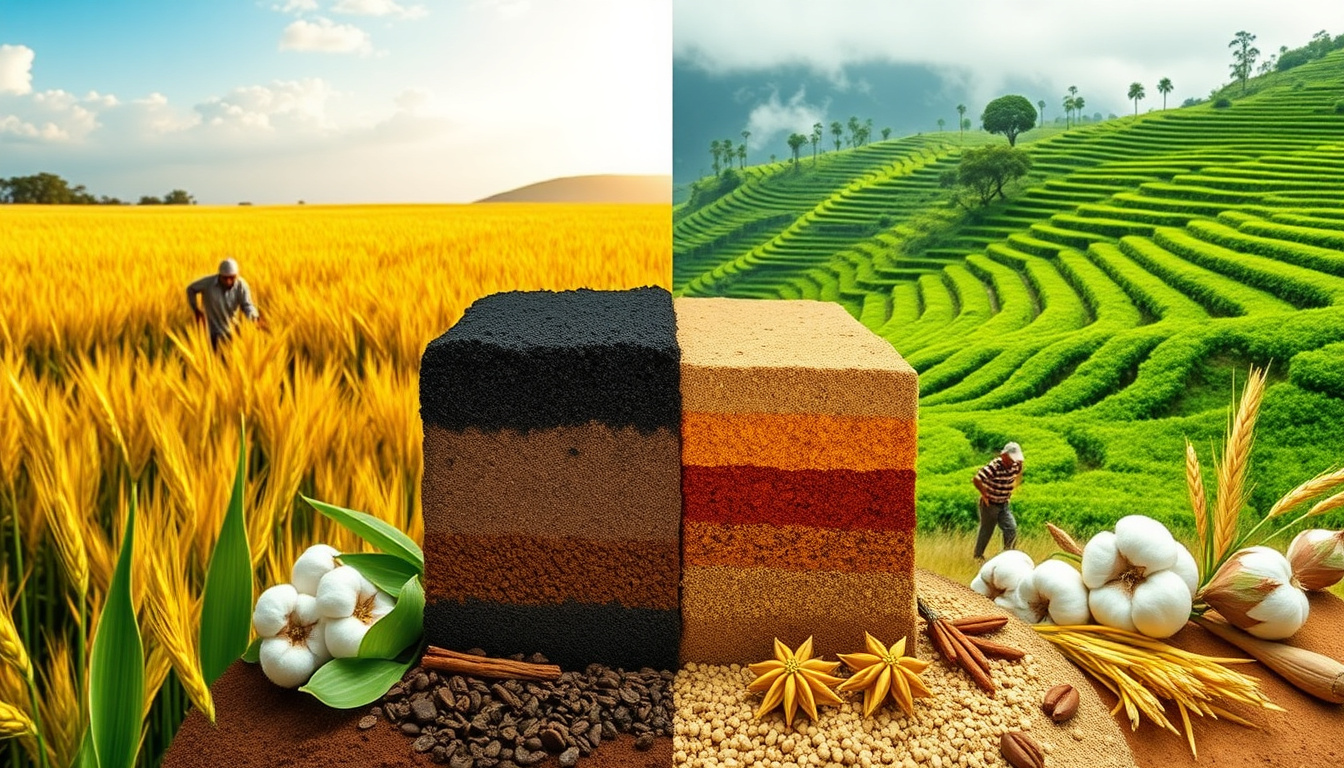
Here's what I've learned: Indian soil is as diverse as Indian culture itself. We have black soil in the Deccan, alluvial soil in the plains, laterite in the Western Ghats, and desert soil in Rajasthan. Each one tells a story about India's geography, climate, and history. And if you want to crack your SSC CGL or UPSC exam, you absolutely need to understand these stories because soil questions come up every single year.
So let's dig in (pun intended) and make this topic stick in your brain forever.
The Five Major Soil Types of India: Know Them Like Your Own Family
India has five major soil types, and I'm going to give you a trick to remember them instantly. Ready? Here it is:
"BAL-LD" — Black, Alluvial, Laterite, Lithosol, Desert.
Now let me explain each one the way I tell my students during our Saturday revision sessions.
Black Soil (Regur Soil)
Black soil is the rockstar of Indian agriculture. It's dark, it's fertile, and it's got character. Literally.
Here's what makes it black: it's rich in iron oxide and magnesium, which give it that distinctive dark color. You'll find it in the Deccan Plateau—Maharashtra, Karnataka, Madhya Pradesh, and parts of Andhra Pradesh. The Godavari and Krishna river basins are absolute black soil goldmines.
Now here's the clever part about black soil that nobody talks about until exam time: it was formed from volcanic rocks. That's why it's so nutrient-dense. Imagine ancient volcanoes giving their mineral blessing to the soil thousands of years ago. Beautiful, isn't it?
Cotton loves black soil. No, I mean absolutely adores it. That's why the Deccan is called the "Cotton Belt of India." Black soil also grows wonderful sugarcane, jowar (sorghum), and pulses. The soil has excellent water retention too, which means it doesn't dry out quickly—a huge advantage in Indian summers.
One thing students always ask me: "Why does black soil crack in summer?" Because it shrinks when it dries. That's actually a sign of its high clay content. The cracks can get so deep that you could literally stick your arm in them. I once visited a farm in rural Maharashtra where the soil cracks were like mini crevasses. Nature's own air conditioning system, but for soil.
Alluvial Soil
Alluvial soil is like the gift that keeps giving. Every monsoon, rivers deposit fresh sediment across the Indo-Gangetic Plain, and boom—you get naturally enriched soil year after year.
This soil covers the largest area in India. The Ganges, Brahmaputra, and other river plains are alluvial heaven. That's why the Indo-Gangetic Plain is called the "Granary of India." We produce roughly 40% of India's food grains from just this region.
What's special about alluvial soil? It's young, it's fine-grained, and it drains well—which makes it perfect for multiple crops per year. A farmer can grow wheat in winter, rice in monsoon, and vegetables in between. This is why I always say alluvial soil is the most "hardworking" soil in India.
The only catch? The soil composition varies depending on how far you are from the river. Near the river, you get coarser particles. Away from it, you get finer clay particles. This affects how much water the soil can hold.
Laterite Soil
Laterite soil is what happens when intense heat and humidity go to a soil's head. It's found in the Western Ghats, the Nilgiris, and other high-rainfall areas. Kerala, parts of Karnataka, and bits of Northeastern India have laterite soils in abundance.
Here's why laterite looks the way it does: heavy rainfall leaches away silica and other soluble minerals, leaving behind iron oxide and aluminum oxide. This makes the soil look reddish or yellowish—think of rust, and you're picturing laterite.
Now, I want you to remember this because it always comes up in exams: laterite soil was historically mined and used to make bricks and tiles. If you visit old forts or colonial-era buildings in places like Goa or Kerala, the red bricks? Often laterite. This soil is also excellent for plantation crops like coffee, tea, coconut, and spices. The Western Ghats produce some of the world's finest pepper, cardamom, and cinnamon, and laterite soil is part of the reason why.
But here's the trade-off that exam questions love to ask: laterite soil is naturally acidic and has low fertility if left untreated. Farmers need to add lime to neutralize the acidity. Without proper management, laterite soils can become hard and brick-like, which is why they're called "laterite"—from the Latin "later," meaning brick.
Lithosol (Mountain Soil)
Lithosol is thin, young, and immature. You find it on mountain slopes where weathering hasn't had much time to do its work. The Himalayas, the Nilgiris, the Aravallis—all have lithosol patches.
The soil is shallow, rocky, and often unsuitable for conventional agriculture. But farmers in hilly regions have learned to work with it through terracing, which you've definitely heard about. Lithosol is also important because of its role in soil conservation and preventing landslides.
Desert Soil
Desert soil is dry, alkaline, and low in organic matter. It's found in Rajasthan, parts of Gujarat, and other arid regions. The soil lacks humus and nutrients, which is why desert areas have traditionally been unsuitable for intensive agriculture.
However—and this is the exciting part for modern India—with irrigation, desert soil can be made productive. The Indira Gandhi Canal project in Rajasthan has transformed vast stretches of desert into agricultural land. It just shows that even the most challenging soil can be managed with the right technology and water.
The Crops India Grows: A Geography of What We Eat
Now that you understand soil types, let's talk about crops. Because soil and crops are like best friends—you can't understand one without understanding the other.
India grows over 50 types of crops commercially, but let me break down the major ones for you in a way that actually makes sense.
Cereals (Foodgrains)
Cereals are the backbone of Indian agriculture. Rice and wheat alone account for over 90% of India's grain production.
Rice: The king of crops in Eastern India. It needs three things: warmth, moisture, and alluvial or clay soil. That's why the Indo-Gangetic Plain, Coastal Orissa, coastal Andhra Pradesh, and the Brahmaputra valley are rice powerhouses. West Bengal alone produces about 15% of India's rice. The water buffalo you see in Bengali villages? They're partly there because rice farming is water-intensive, and buffalo love water.
Wheat: The hero of Northern India. It's a winter crop (rabi) that thrives in the cool season. Punjab, Haryana, Uttar Pradesh, and Madhya Pradesh are India's wheat belt. Wheat needs less water than rice, which makes it suitable for areas with lower rainfall. Remember this for your exam: wheat is a **rabi crop**, rice is a **kharif crop**. These terms describe the season they're grown in.
Jowar and Bajra: These are coarse cereals grown in semi-arid regions. Jowar dominates Maharashtra and Karnataka. Bajra is huge in Rajasthan and Gujarat. Both are drought-resistant and perfect for regions where water is scarce.
Cash Crops
Cash crops are grown for sale, not for the farmer's own consumption. They're economically important and often very soil-specific.
Cotton: I mentioned this earlier. The Deccan Plateau, with its black soil, produces about 60% of India's cotton. Gujarat is also a major cotton producer. Cotton needs well-drained soil and moderate water—too much rain and the crop fails.
Sugarcane: This is a tropical crop that needs plenty of water and warmth. Uttar Pradesh, Maharashtra, and Karnataka are the big three sugarcane producers. The crop stays in the soil for 12-18 months, which is longer than most crops. That's why sugarcane farmers rotate their fields carefully.
Tea and Coffee: These are plantation crops grown in hilly regions with laterite soil. Assam produces about 50% of India's tea. Coffee comes mainly from Karnataka's Western Ghats. Both need specific temperature and humidity ranges, plus good drainage.
Spices: India is the spice capital of the world. Pepper from Kerala, cardamom from the Nilgiris, turmeric from Telangana—each has its own preferred soil and climate. These crops are incredibly valuable in international markets.
Pulses
Pulses are protein sources and they're incredibly important in Indian diets and cuisine. Gram (chickpea), arhar (pigeon pea), and masoor (lentil) are the big ones. Madhya Pradesh is the pulse capital of India, producing over a quarter of the nation's pulses. Black soil is ideal for pulses because it's nitrogen-rich naturally.
| Soil Type | Main Crops | Key Regions | Main Characteristic |
|---|---|---|---|
| Black Soil | Cotton, Sugarcane, Jowar | Deccan Plateau (MH, KA, MP) | Volcanic origin, high clay, water-retentive |
| Alluvial Soil | Wheat, Rice, Vegetables | Indo-Gangetic Plain, River deltas | Young, fertile, self-renewing |
| Laterite Soil | Tea, Coffee, Coconut, Spices | Western Ghats, Nilgiris, Kerala | Acidic, requires lime, reddish color |
| Lithosol | Tea (on terraces), Horticulture | Himalayan foothills, hill stations | Shallow, rocky, immature |
| Desert Soil | Bajra, Mustard, Gram (with irrigation) | Rajasthan, parts of Gujarat | Alkaline, low organic matter, dry |
How Agriculture Works in India: The Seasonal Dance
Here's something that really helped my students understand Indian agriculture better. Indian farming isn't random—it follows the monsoon like a dancer follows music.
We have three main agricultural seasons:
Kharif (Southwest Monsoon, June to October): This is the rainy season. Crops that love water grow now—rice, cotton, maize, sugarcane. The monsoon brings moisture, so farmers don't need to irrigate as much. It's the season when the fields turn green and look like something out of a poetry book.
Rabi (Winter, October to March): This is the dry season, but paradoxically, it's when we grow water-conscious crops using stored moisture. Wheat, gram, barley, mustard—these are rabi crops. They need cool temperatures and less water. Northern India absolutely dominates in rabi crop production.
Zaid (Summer, March to June): This is the small season, the in-between time. It's when farmers grow vegetables, melons, and other quick-growing crops using irrigation or leftover moisture from winter rains.
Now here's the thing that makes Indian agriculture beautiful and complex: a farmer needs to understand their soil type, the local rainfall pattern, the season, and the market demand—all at once. If a farmer in Madhya Pradesh plants sugarcane (a kharif crop) in the wrong area with wrong soil, the entire investment can be lost. This is why soil knowledge is literally life-and-death important for Indian farmers.
The Modern Challenge: Soil Degradation and Sustainable Agriculture
I have to tell you something that's not always in textbooks but is crucial for understanding modern India.
Our soils are under stress. Overuse of chemical fertilizers, monoculture, and poor water management have degraded about 120 million hectares of land in India. Soil salinity is increasing in Punjab and Haryana. Laterite soils are being mined away for brick-making. It's a real problem.
But—and this is the hopeful part—India is waking up to this. Farmers are increasingly adopting sustainable practices:
Crop rotation: Growing different crops in the same field in succession to maintain soil fertility.
Terracing: On hillsides, creating step-like fields to prevent soil erosion—you see this beautifully in the Himalayas and Western Ghats.
Use of organic manure: Cow dung, compost, and green manuring are making a comeback. Many farmers are returning to traditional practices because they work.
Drip irrigation: Using water more efficiently so that soils don't get waterlogged or depleted.
For your exam, understand this: sustainable agriculture is not just about environment—it's about soil conservation and long-term food security. Questions on this topic are becoming more common, especially in UPSC.
A) Alluvial soil B) Black soil C) Laterite soil D) Desert soil
Answer: B) Black soil — Volcanic origin and excellent for cotton in the Deccan Plateau
A) Deccan Plateau B) Indo-Gangetic Plain C) Western Ghats D) Thar Desert
Answer: B) Indo-Gangetic Plain — Alluvial soils deposited by major rivers make it highly fertile
A) Punjab B) Rajasthan C) Western Ghats D) Uttar Pradesh
Answer: C) Western Ghats — High rainfall and humidity in this region create ideal conditions for laterite formation
A) Rice B) Cotton C) Wheat D) Sugarcane
Answer: C) Wheat — Rabi crops are grown in winter (October to March) and wheat is the primary winter cereal
A) Uttar Pradesh B) Madhya Pradesh C) Maharashtra D) Karnataka
Answer: B) Madhya Pradesh — Often called the "Pulse Capital of India" with black soil ideal for pulses
Final thoughts: Soil, crops, and agriculture are deeply interconnected with India's geography, climate, and economy. When you're revising, don't memorize in isolation. Think about the why. Why does the Deccan grow cotton? Because of black soil. Why does the Assam valley grow tea? Because of tropical climate and laterite soil. When you understand the "why," these facts will stick with you for life—and for your exam hall too. Good luck, and feel free to share your exam results with me in the comments!
Published by Dattatray Dagale • 10 August 2026
.jpg)
.png)



.png)



.png)

0 Comments