Introduction
Let me tell you something I've noticed after teaching thousands of SSC and UPSC aspirants. When the geography section comes up, students freeze. They think, "Oh no, I have to memorize soil types, crop zones, rainfall patterns..." and their eyes glaze over. But here's the secret I'm going to share with you: Indian agriculture and soils aren't random facts to memorize. They're a story. A story about how water, rocks, and human ingenuity shaped an entire civilization.
I had a student named Priya last year who scored just 4/15 in her geography mock exam. She was ready to give up, thinking she wasn't "cut out" for geography. Then one evening, while explaining soils over a video call, I asked her: "Have you ever seen the dark, sticky earth in Maharashtra after monsoon rains?" Her face lit up. "Yes! It's so tough to walk in!" Exactly. That's black soil. And suddenly, everything clicked. Within three months, she was scoring 13/15.
The point? When you understand the "why" behind soil types and crops, you stop struggling. So let's do exactly that together. No boring lists. Just real understanding.
The Five Major Soil Types of India: More Than Just Dirt
India has five distinct soil types, and here's the trick I tell every student: each soil type tells you where it came from, what grows there, and which region has it. Once you see that connection, you've cracked half the geography syllabus.
Black Soil (Regur Soil)
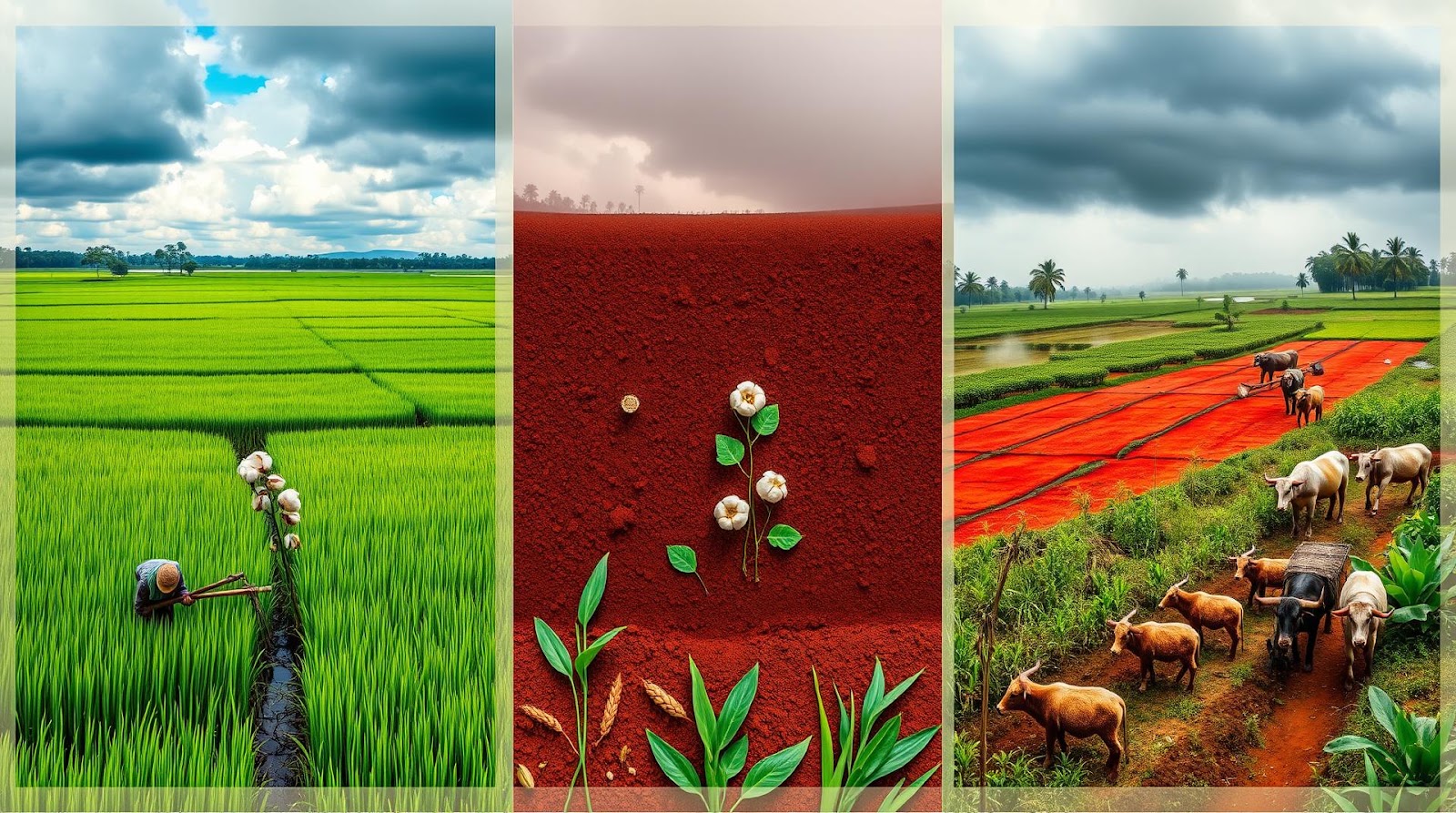
Black soil is like the celebrity of Indian agriculture. It's deep, dark, sticky when wet, and extremely fertile. You'll find it across Maharashtra, Gujarat, Madhya Pradesh, and parts of Karnataka — basically, the Deccan Plateau region.
Now, why is it black? This soil forms from the weathering of basaltic lava rocks (ancient volcanic activity). It's rich in iron oxide and clay minerals, which give it that characteristic dark color. During monsoon, it becomes incredibly sticky and difficult to walk through. During summer? It cracks into massive chunks. Farmers hate harvesting in these cracks because tools get stuck, but the soil's water-retention capacity is phenomenal.
Best for: Cotton (which is why it's called "cotton soil"), sugarcane, soybean, and pulses. Remember this and you've got 90% of Maharashtra-Gujarat agriculture covered.
Red Soil
Red soil covers nearly 40% of India's land area. It's the second-most dominant soil type, found in the Deccan Plateau, Eastern Ghats, and Southern India (Tamil Nadu, Andhra Pradesh, Karnataka). The color comes from iron oxide, which gives it that rusty, reddish appearance.
Red soil is less fertile than black soil and has poor water-retention capacity. It tends to be acidic and leaches nutrients easily (meaning nutrients wash away with rainfall). But here's the clever part: when treated with lime and proper fertilization, it becomes quite productive.
Best for: Millets, groundnut, cotton, sugarcane, and tobacco. If you see a question asking "Which soil is found in South India but is less fertile than black soil?" — you're thinking of red soil.
Alluvial Soil
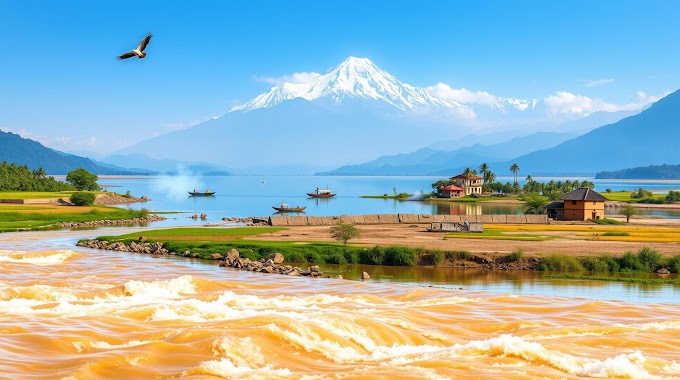
This is the darling of Indian agriculture — and for a good reason. Alluvial soil is deposited by rivers and covers the Indo-Gangetic Plain, Brahmaputra Valley, and coastal plains. It's relatively young (geologically speaking), fertile, and easy to work with.
Alluvial soil comes in two varieties: old alluvium (called "bangar") and new alluvium (called "khadar"). The new alluvium, deposited annually by flood waters, is the most fertile and is why the Ganges Plain is called the "bread basket of India."
Best for: Rice, wheat, sugarcane, jute, and vegetables. The Indo-Gangetic Plain produces nearly 50% of India's food grains — all because of alluvial soil. Quite literally, this soil feeds India.
Laterite and Lateritic Soil
Laterite soil forms in regions with high temperature and high rainfall. You'll find it in Kerala, Karnataka, Western Ghats, and Northeast India. The word "laterite" comes from the Latin "later" meaning brick — because traditionally, these soils were used to make bricks.
The issue? Laterite soil is highly weathered, acidic, and low in nutrients. Phosphate and potassium get leached away. But it's excellent for certain crops and, importantly, laterite regions have high biodiversity. In exams, remember: laterite soil = Kerala, Western Ghats, and NE India.
Best for: Coconut, arecanut, cashew, spices, and plantations.
Desert and Mountain Soil
Desert soil (found in Rajasthan) is sandy, lacks humus, and has poor moisture retention. Mountain soil is shallow, prone to erosion, and varies by altitude. Neither is particularly productive, which is why these regions have lower agricultural output. But understanding their limitations is crucial for questions about soil conservation and why certain regions struggle with agriculture.
Major Crops and Their Geographical Distribution
Here's where everything connects. Once you know the soil type and rainfall pattern of a region, you can predict which crops grow there. It's not magic — it's geography.
Cereals: Rice and Wheat
Rice is a kharif crop (monsoon crop) that requires high rainfall and standing water. It grows in the Indo-Gangetic Plain, Brahmaputra Valley, Coastal Andhra Pradesh, and Kerala. Alluvial and laterite soils suit rice well. Top producers: West Bengal, Uttar Pradesh, Andhra Pradesh.
Wheat is a rabi crop (winter crop) grown in cooler, drier regions. The Indo-Gangetic Plain (particularly Punjab, Haryana, UP) is wheat country. Black soil regions with good irrigation also support wheat. Top producers: Punjab, Haryana, Uttar Pradesh.
Cash Crops: Cotton and Sugarcane
Cotton loves black soil and the Deccan climate. Gujarat, Maharashtra, Andhra Pradesh, and Madhya Pradesh are cotton country. The crop needs moderate rainfall and well-drained soil — black soil is perfect.
Sugarcane needs alluvial soil, high water supply, and tropical climate. It's grown in Uttar Pradesh (the largest producer), Maharashtra, Karnataka, and Tamil Nadu. Fun fact: sugarcane fields are often irrigated extensively, and India uses nearly 40% of its irrigation water for sugarcane.
Millets and Pulses
Millets (jowar, bajra) are drought-resistant and grow in low-rainfall areas with red soil. Rajasthan, Gujarat, Maharashtra, and Karnataka are millet zones. Pulses (lentils, chickpeas) grow in black and red soil regions, particularly Madhya Pradesh, Maharashtra, and Rajasthan.
Let me give you a memory trick here: "JCBM for Jowar" — Gujarat, central India (MP, Maharashtra), Badlands (Rajasthan), Maharashtra. This covers 80% of millet production.
Plantation Crops
Tea grows in high-altitude, high-rainfall areas with laterite soil. Assam, Darjeeling, and Tamil Nadu (Nilgiris) are famous tea regions. Coffee grows in the Western Ghats. Coconut, spices, and arecanut thrive in Kerala and the coastal Deccan.
| Crop Type | Preferred Soil | Season | Top Producing States |
|---|---|---|---|
| Rice | Alluvial, Laterite | Kharif | West Bengal, AP, UP |
| Wheat | Alluvial, Black | Rabi | Punjab, Haryana, UP |
| Cotton | Black | Kharif | Gujarat, Maharashtra, AP |
| Sugarcane | Alluvial | Year-round | UP, Maharashtra, Karnataka |
| Tea | Laterite | Year-round | Assam, Darjeeling, TN |
| Millets | Red | Kharif | Rajasthan, Gujarat, Maharashtra |
The Rainfall-Soil-Crop Triangle: Your Exam Secret Weapon
Now here's the interesting part. Questions about Indian agriculture almost always hinge on one simple relationship: rainfall pattern + soil type = crop suitability.
High rainfall regions (above 200 cm annually) with laterite soil → Tea, coffee, spices (Kerala, Assam, Western Ghats)
Moderate rainfall (100-200 cm) with black soil → Cotton, sugarcane, pulses (Maharashtra, Gujarat, MP)
Low rainfall (below 100 cm) with red/desert soil → Millets, groundnut, pulses (Rajasthan, parts of Gujarat, AP)
Very high rainfall with alluvial soil → Rice and jute (Bengal, Assam, coastal regions)
Once you internalize this triangle, you can answer almost any question about crop distribution. A question asks: "Why is tea not grown in Punjab?" Because Punjab has low rainfall, alluvial soil, and winters — exactly opposite of what tea needs.
I had a student who memorized 50 crop facts and still scored poorly. Then I taught her this triangle, and suddenly she was deriving answers instead of memorizing them. That's the shift from studying to understanding.
Soil Degradation and Conservation: The Modern Problem
The exam isn't just about knowing where crops grow. It's also about understanding why agricultural land is under threat. Soil degradation is real, and questions about it are increasingly common.
Soil erosion happens in hilly regions and where rainfall is high. The Northeast and Western Ghats face severe erosion. Salinization occurs in irrigated areas (particularly Punjab, Haryana) where excessive irrigation deposits salts in topsoil. Waterlogging is an issue in the Indo-Gangetic Plain where drainage is poor.
Conservation methods? Terracing in hilly areas, contour plowing, bunding, crop rotation (especially alternating with nitrogen-fixing crops like legumes), and organic farming to maintain soil structure and nutrients.
Exams love questions like: "Which of these is a method of soil conservation in sloping terrain?" If you understand that terrace farming reduces runoff and erosion on slopes, you've got it.
A) Gangetic Plain B) Deccan Plateau C) Western Ghats D) Rajasthan
Answer: B) Deccan Plateau — Black soil forms from weathered basaltic lava and is characteristic of the Deccan region.
A) Wheat B) Cotton C) Coconut D) Sugarcane
Answer: C) Coconut — Laterite soil with high rainfall is perfect for plantation crops like coconut, arecanut, and spices.
A) Red soil B) Laterite soil C) Alluvial soil D) Black soil
Answer: C) Alluvial soil — Deposited by the Ganges and Brahmaputra rivers, alluvial soil makes this region India's agricultural heartland.
A) Kerala B) Assam C) Tamil Nadu D) Himachal Pradesh
Answer: B) Assam — Assam's high rainfall, cool climate, and laterite soil make it ideal for tea cultivation. It accounts for over 50% of Indian tea production.
A) Eastern Ghats B) Punjab and Haryana C) Western Ghats D) Northeast India
Answer: B) Punjab and Haryana — Excessive irrigation in these states deposits salts in the topsoil, reducing fertility over time.
Final Thought: Geography isn't about memorizing facts scattered across a map. It's about seeing connections. When you understand that black soil + tropical rainfall + flat terrain = cotton in Maharashtra, you're not memorizing anymore. You're thinking like a geographer. And that's when exam questions stop being scary and start becoming solvable.
Take an evening, grab a map of India, and trace which soils are where, which crops grow there, and what the rainfall is like. You'll see patterns emerge. That's when geography shifts from "something I need to study" to "something I actually understand."
Published by Dattatray Dagale • 16 July 2026
.jpg)
.png)


.png)


.png)

0 Comments