Introduction
Let me start with a confession: when I first started teaching, I used to skip the ecology chapters. Not because they weren't important, but because I honestly found them boring to teach. Too much memorization, too many Latin names, too disconnected from real life. Then one day, a student asked me a simple question during a mock test: "Sir, why should I care about carbon cycles if I'm just trying to pass SSC CGL?"
That question changed everything for me. Because suddenly, I realized — ecology isn't some abstract textbook concept. It's literally the reason you're breathing right now. It's why your city has water shortages. It's why your parents worry about your health. And yes, it's also 4-5 guaranteed marks in every competitive exam you'll take.
I've been teaching this for over a decade now, and I can tell you with absolute certainty: students who understand environment and ecology don't just score better — they become the kind of citizens who actually read about climate change and make informed decisions. But more importantly for your exam right now, this is perhaps the easiest topic in General Science to master if you approach it correctly.
So let's do this together. I'm going to break down ecology in a way that'll stick with you — not just for your exam, but for life.
Ecosystem Basics: Understanding the World's Living Networks
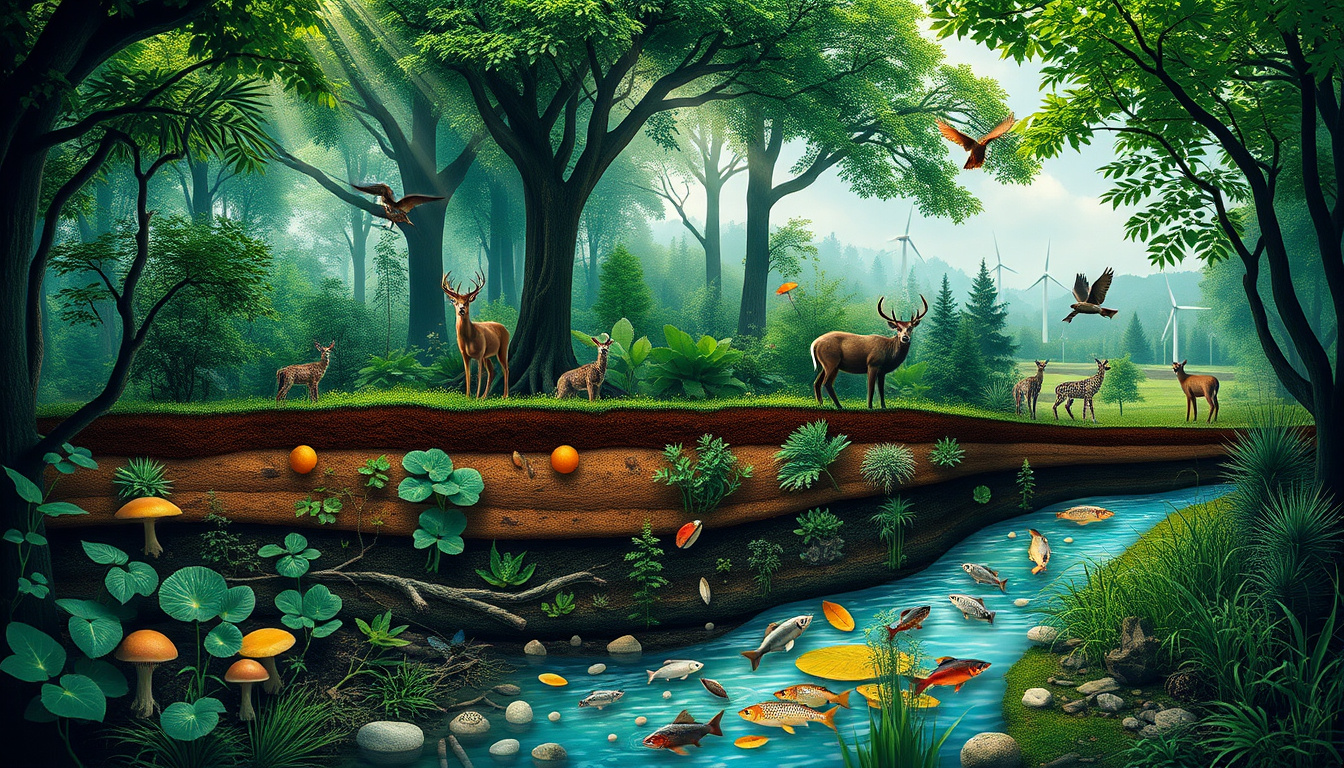
Here's something I always tell my students: think of an ecosystem like a Bollywood movie production. You've got producers (plants), heroes and supporting actors (animals), villains (decomposers breaking things down), and thousands of crew members working behind the scenes (microorganisms). Each has a role. Remove any one of them, and the whole production collapses.
An ecosystem is simply a community of living organisms (biotic factors) interacting with their physical environment (abiotic factors). In your exam, they'll test three main things about ecosystems: the structure, the function, and the food chains/webs that hold them together.
The Cast of Every Ecosystem
Let me give you the memory trick I use with all my students — I call it the "PPD Rule":
P = Producers — These are plants and photosynthetic organisms. They're the only ones who can make their own food using sunlight. In a forest, that's trees. In an ocean, that's algae and phytoplankton. No producers, no ecosystem. Done.
P = Primary Consumers — These are herbivores. Deer, rabbits, cows, fish that eat algae. They eat the producers.
D = Decomposers — Bacteria, fungi, earthworms. These are the cleanup crew. They break down dead organic matter and recycle nutrients back into the soil. Without decomposers, our planet would literally be buried under dead organisms.
Now, I know what you're thinking: "Sir, what about secondary and tertiary consumers?" Yes, they exist — those are carnivores that eat other consumers. But here's the exam trick: focus on the energy flow. About 10% of energy transfers from one level to the next. So a grassland with 1000 units of grass energy can only support 100 units of herbivore energy, which can only support 10 units of carnivore energy. This is why there are fewer lions than zebras in the savanna.
Abiotic Factors: The Stage Where Everything Happens
These are the non-living factors that determine what can and cannot survive in an ecosystem. Temperature, rainfall, sunlight, soil pH, dissolved oxygen in water — all of these limit what organisms can live there.
I always use this example from Indian geography: why can't you grow rice in the Thar Desert the way you do in Punjab? Same soil type, same country, but different temperature and rainfall. That's abiotic factors at play. For your exam, remember that abiotic factors set the physical "address" where an ecosystem exists.
Energy Flow and Nutrient Cycles: The Invisible Rivers of Life
This is where ecology gets genuinely beautiful, and I mean that literally. The way energy and nutrients move through ecosystems is like a perfectly choreographed dance. Miss this section in your exam, and you'll lose 2-3 easy marks. Master it, and you'll understand how literally everything is connected.
The Energy Flow: One-Way Street
Energy enters an ecosystem in only one way: sunlight. Plants trap it through photosynthesis (usually 1-2% of available sunlight). Animals eat plants, animals eat other animals. At every step, energy is lost as heat through respiration. This is why you can never have a stable ecosystem without continuous energy input from the sun. It's one-way. Unlike nutrients, which cycle.
Here's a question I've seen in real exams: "Why are food chains never longer than 5-6 organisms?" Answer: because by the time energy reaches the 5th or 6th level, there's barely any left due to the 10% rule. Your body uses energy to move, think, and maintain temperature — that's all energy lost from the ecosystem's perspective.
The Carbon Cycle: How Your Breath Connects You to Dinosaurs
Now here's something that'll blow your mind. The carbon atom you breathe out has been breathed out by billions of organisms for 4 billion years. It was in dinosaurs. It might have been in the Buddha. It's currently in trees, in your neighbor's dog, in clouds. This is the carbon cycle, and honestly, it's less a cycle and more a beautiful story of constant transformation.
Let me break it down simply:
Atmospheric CO₂ → Plants (photosynthesis) → Animals (eating plants) → Back to atmosphere (respiration and decomposition) → And it keeps going.
The "problem," as you've probably heard, is that humans are adding extra CO₂ through burning fossil fuels. We're basically pulling ancient carbon (coal, oil) that was locked away for millions of years and dumping it into the atmosphere. The cycle itself is ancient and perfect — we're just overloading it. This is crucial for understanding climate change questions in your exam.
The Nitrogen Cycle: The Invisible Farmer
Only 3 types of organisms can actually convert atmospheric nitrogen (N₂) into a usable form:
1. Lightning (creates nitrogen oxides — nature's way)
2. Nitrogen-fixing bacteria (like Rhizobium in legume roots — agriculture's best friend)
3. Industrial processes (the Haber-Bosch process — humans learned to do it too)
Once nitrogen becomes ammonia or nitrate, plants can use it to make proteins. Animals eat those plants. When organisms die, decomposers break down proteins back into ammonia, and denitrifying bacteria convert it back to N₂, which returns to the atmosphere. Beautiful cycle.
Here's what I tell students: "Without nitrogen-fixing bacteria in your rice fields, you'd never have had the green revolution. Without them, India would have starved. That tiny Rhizobium bacterium is more important to your country than you realize."
The Water Cycle: The Eternal Journey
Evaporation → Condensation → Precipitation → Percolation → Back to evaporation. Simple, but exams love asking about it. When plants release water through leaves (transpiration), it's called evapotranspiration. When water evaporates from oceans and lakes, it's just evaporation. Remember that distinction.
| Biogeochemical Cycle | Main Reservoir | Key Process | Living Role |
|---|---|---|---|
| Carbon | Atmosphere (CO₂) | Photosynthesis & Respiration | Plants absorb, all respire |
| Nitrogen | Atmosphere (N₂) | Nitrogen Fixation | Bacteria fix it, plants use it |
| Water | Oceans (97%) | Evaporation & Precipitation | Transpiration (plants) |
| Phosphorus | Rocks & Sediments | Weathering | Plants uptake from soil |
Biodiversity and Conservation: Why We Can't Afford to Lose Species
I want to be honest with you here. This section of ecology isn't just about passing exams — it's about understanding why your grandchildren might not see the Bengal Tiger or the Indian Rhinoceros if we don't act now.
Biodiversity simply means the variety of living organisms in an area. Genetic diversity (variations within a species), species diversity (different species), and ecosystem diversity (different types of ecosystems) all matter. When we lose biodiversity, we don't just lose a pretty animal — we lose an entire network of relationships and functions.
Threats to Biodiversity: The Four Horsemen
There's an acronym I teach every batch of students — CHOP:
C = Habitat loss — This is the #1 killer of species globally. When we cut forests for cities or farmland, we're literally destroying homes. The Indian pangolin is critically endangered mainly because of habitat loss, not hunting.
H = Hunting and poaching — Too obvious to explain, but remember: overexploitation leads to extinction. The Dodo bird isn't coming back.
O = Overexploitation of resources — Fishing too much, chopping too many trees. When you take more than nature can replenish, it collapses.
P = Pollution and invasive species — Chemicals in water kill aquatic life. Invasive species compete with native species for resources. The water hyacinth in Indian lakes? Invasive species destroying native ecosystems.
Conservation Strategies: What Works
In-situ conservation means protecting species in their natural habitat (national parks, wildlife sanctuaries). Ex-situ conservation means protecting them outside their natural habitat (zoos, seed banks). India has Project Tiger, Project Elephant, Project Rhino — all in-situ conservation efforts that actually work when done properly.
The Red Data Book and Red List maintain information about endangered species. In India, we have four categories: extinct, endangered, vulnerable, and rare. Each has different protection levels under the Wildlife Protection Act, 1972.
Here's what I want you to remember for your exam: Conservation isn't optional. It's mathematics. If we lose pollinators, we lose food crops. If we lose forests, we lose water and air quality. If we lose soil organisms, we lose agriculture itself.
Climate Change and Environmental Issues: The Big Picture
Last section, and this is where everything connects. Climate change is essentially what happens when you overload the carbon cycle (and other cycles) with human activities. It's not separate from ecology — it's ecology gone wrong.
Global warming happens because greenhouse gases (CO₂, methane, nitrous oxide) trap heat in the atmosphere. We've increased atmospheric CO₂ by 50% since pre-industrial times. This causes rising temperatures, which causes melting ice caps, rising sea levels, and destabilized weather patterns.
But here's what exam questions actually ask you: What are the sources? What are the effects? What are the solutions?
Sources: Burning fossil fuels (coal, oil, gas), deforestation (less CO₂ absorption), agriculture (methane from cattle), industrial processes.
Effects: Rising temperatures, changing rainfall patterns, more extreme weather events, agricultural disruption, health issues, biodiversity loss.
Solutions: Renewable energy, reforestation, sustainable agriculture, circular economy principles, international agreements like Paris Agreement.
Other major environmental issues include acid rain (sulfur dioxide from coal combustion), ozone depletion (CFCs), eutrophication (excess nutrients causing algal blooms), and plastic pollution. Each has a cause-and-effect relationship you need to understand clearly.
Let me end with something personal. I've been teaching this for over a decade, and I've watched students go from viewing ecology as "boring memorization" to genuinely understanding why it matters. Some of my students are now working in environmental conservation. Others simply became more conscious citizens.
Your exam is important, yes. But more important is understanding that you're not just an individual living in isolation. You're part of an ecosystem, part of these cycles, part of the solution to environmental problems. When you ace this section, you're not just getting marks — you're becoming an informed global citizen.
Now, let's test what you've learned:
A) 5000 kcal B) 500 kcal C) 50 kcal D) 5 kcal
Answer: B) 500 kcal (The 10% law states only 10% of energy transfers to the next trophic level)
A) Fungi B) Decomposer bacteria C) Rhizobium bacteria D) Herbivores
Answer: C) Rhizobium bacteria (along with some cyanobacteria and lightning, these are the only natural nitrogen fixers)
A) Condensation → Evaporation → Precipitation → Percolation
B) Evaporation → Condensation → Precipitation → Percolation
C) Precipitation → Evaporation → Condensation → Percolation
D) Percolation → Evaporation → Condensation → Precipitation
Answer: B) Evaporation → Condensation → Precipitation → Percolation (This is the correct natural sequence)
A) Seed bank B) Zoo C) National Park D) Botanical Garden
Answer: C) National Park (In-situ means conservation in natural habitat; seed banks and zoos are ex-situ)
A) Carbon Dioxide B) Methane C) Chlorofluorocarbons (CFCs) D) Nitrogen Oxide
Answer: C) Chlorofluorocarbons (CFCs) (These were used in refrigerants and aerosols before being banned internationally)
Published by Dattatray Dagale • 07 August 2026
.jpg)
.png)



.png)



.png)
0 Comments