Introduction
Let me start with a confession: when I first began teaching medieval Indian history, I used to bore my students to death with dates and names. "Akbar ruled from 1556 to 1605," I'd drone on. Nobody cared. Then one day, a bright-eyed 12th-grader asked me, "Sir, why should I care about dead emperors?" And that's when something clicked.
Because here's the truth—the Mughal Empire isn't just a collection of dates and dusty facts. It's the story of how a bunch of outsiders came to India, fell in love with it, and built something so magnificent that 500 years later, we're still talking about them. We're still visiting their monuments. We're still eating their food. The Mughal Empire is modern India, in so many ways.
Now, if you're preparing for SSC CGL or UPSC, you need to understand the Mughals properly. Not just memorize them. And I promise you, by the end of this post, you'll see them not as mysterious foreigners, but as the brilliant, flawed, visionary rulers who literally shaped the subcontinent.
So grab a cup of chai, get comfortable, and let's travel back 500 years.
When Did It Start? The Foundation and Babur
The Mughal Empire officially began in 1526, but the story starts earlier with a man named Babur. Now, Babur wasn't actually trying to invade India. Wild, right? He was a Central Asian warrior who'd been kicked out of his homeland (modern-day Uzbekistan) and was pretty much homeless and bitter about it. He had this small kingdom in Kabul, and frankly, he was bored.
Then one day, an Indian prince (Sultan Ibrahim Lodi) actually invited him to invade India. I know, I know—terrible decision-making. Ibrahim and his uncle had a dispute, and the uncle thought bringing in Babur would help settle things. Spoiler alert: it didn't. It ended with the entire sultanate changing hands.
Babur defeated Ibrahim Lodi at the Battle of Panipat in 1526. This is one of those "turning point" moments in Indian history that every exam loves. One battle. One victory. And suddenly, a new empire was born.
Why "Mughal"? A Quick Etymology
The word "Mughal" comes from "Mongol"—Babur was a descendant of Timur (Tamerlane) and Genghis Khan. But here's where it gets interesting: the Mughals themselves didn't use this term much. They called their empire the "Timurid Empire" or just referred to themselves as emperors. "Mughal" was more of a term people started using later. Think of it like how we call someone's ancestors by titles they never used themselves!
The Six Great Mughals: Who Were They?
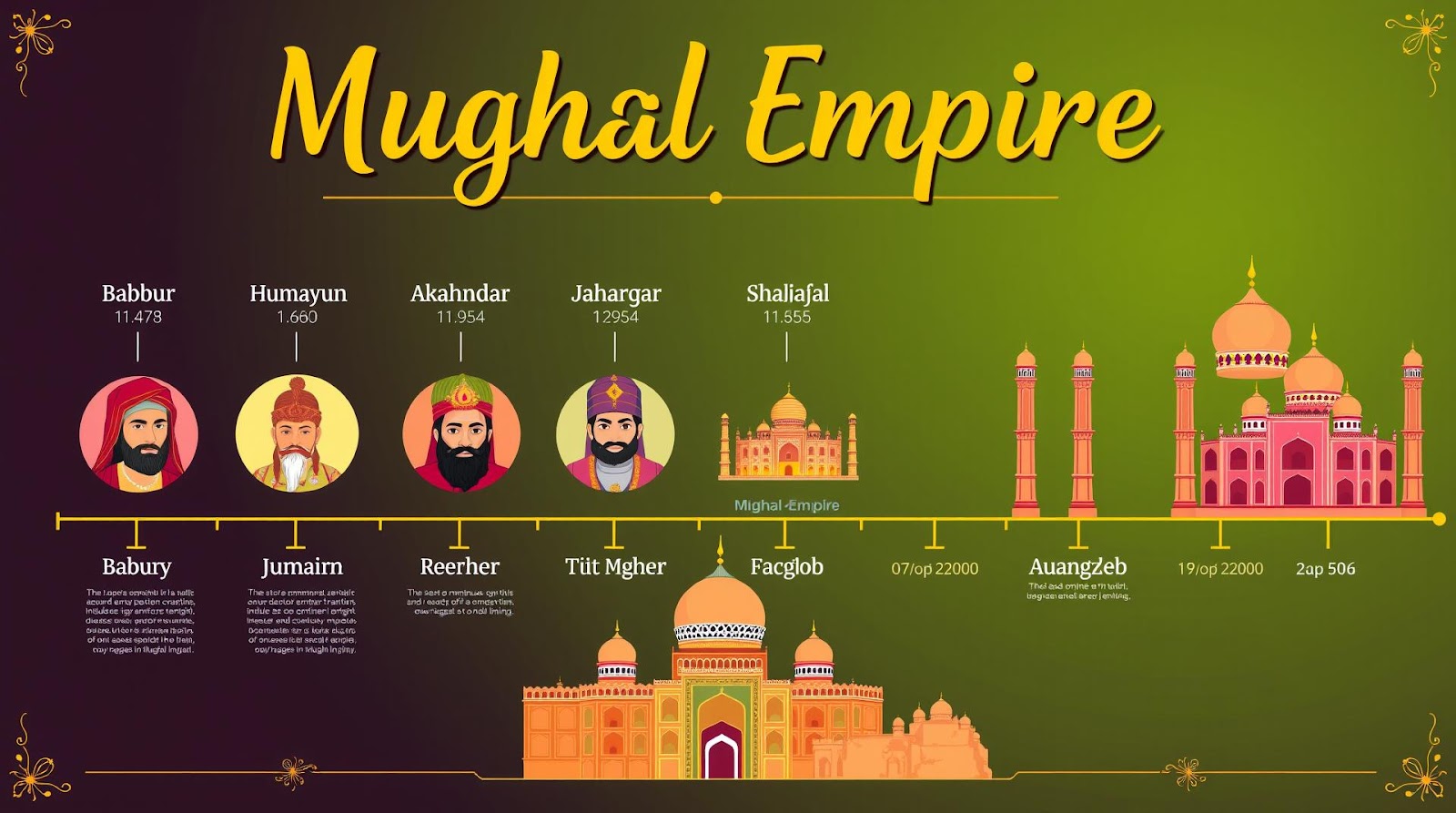
Here's where most students go wrong. They try to memorize all 18 Mughal emperors. Don't. Honestly, forget that. What you need to know are the Big Six—the ones who actually mattered, who actually built the empire and shaped history. Let me introduce them to you like I'd introduce friends:
1. Babur (1526–1530): The Founder
Think of Babur as the scrappy entrepreneur who started the company. He had ambition but not much else. He spent his entire four-year reign fighting to consolidate power and establish legitimacy. He died in 1530, probably from exhaustion. His contribution? He showed that it was possible. That's it. But that's everything.
2. Humayun (1530–1556): The Failure Who Wasn't
Now here's a guy who had the worst PR in history. Humayun is often called a failure because he lost his empire and had to flee to Persia. But get this—he had an absolutely legitimate claim to a massive territory, and he fought through incredible odds. He just... wasn't as militarily sharp as his father. He did, however, develop a taste for Persian culture and administration—things that would define the Mughal Empire later.
3. Akbar (1556–1605): The Visionary Genius
If there's a Mount Rushmore for Indian emperors, Akbar's face is front and center. This man took his father's empire and expanded it. But more importantly, he reformed it. Akbar did something revolutionary for his time: he treated Hindus as equals. His court was a mixture of Hindu and Muslim nobles. He married a Hindu princess (Jodha Bai from Amber). He abolished the jizya tax (a tax on non-Muslims). He created a syncretic philosophy called "Din-i-Ilahi" (the Religion of God), which blended Hindu and Islamic thought.
Was it perfect? No. Would modern people have issues with it? Absolutely. But in 1580? Revolutionary.
Akbar's greatest contribution? His Mansabdari System. Imagine a civil service ranking system where every official had a rank, salary, and clear responsibilities. It was like the Indian Administrative Service (IAS) of its time. Genius.
4. Jahangir (1605–1627): The Patron of Arts
Jahangir was Akbar's son, and while he wasn't his father's equal as an administrator, he was something else: a patron. He loved art, gardens, paintings, and poetry. The Mughal miniature paintings you see in museums? Most of them are from Jahangir's era. He also wrote an autobiography called Tuzuk-i-Jahangiri—one of the most fascinating historical documents you'll read.
One more thing: Jahangir married the Persian-born Nur Jahan, who basically ran the empire from behind the scenes. She was probably the most powerful woman in medieval India. Exams love asking about her.
5. Shah Jahan (1628–1658): The Builder
If Jahangir was the art lover, Shah Jahan was the architect. This man spent money like water on buildings. The Taj Mahal? Him. The Red Fort? Him. The Jama Masjid? Also him. He shifted the capital from Agra to a new city he built called Shahjahanabad (modern-day Old Delhi).
Shah Jahan was militarily strong, but here's the tragedy: his later life was consumed with fighting his sons over the throne. His youngest son, Aurangzeb, won. Then Aurangzeb kept his own father imprisoned in Agra Fort for the last eight years of his life. Not exactly a feel-good story.
6. Aurangzeb (1658–1707): The Controversial Conservative
This is where opinions diverge wildly. Aurangzeb was undoubtedly a brilliant administrator and military commander. He expanded the empire to its absolute largest—covering almost all of the Indian subcontinent. But he was also deeply religious in a way his predecessors weren't. He abolished many Hindu traditions, re-implemented the jizya tax, and destroyed temples.
From an exam perspective: Hindu historians criticized him heavily. Muslim historians defended him. The truth? He was both—a genius administrator who also had religious policies that alienated a huge population. His reign marked the beginning of the Mughal decline.
The Administrative Genius and Cultural Contributions
How Did They Actually Govern?
You might be wondering: how did a few thousand Mughal nobles control an entire subcontinent of hundreds of millions? The answer is brilliant administration. Let me break it down:
The Mansabdari System: I mentioned this earlier with Akbar. Essentially, every noble (mansabdar) held a rank with a specific salary. The higher the rank, the more you earned and the more territory you controlled. But here's the clever bit: the emperor could promote or demote you anytime. So everyone stayed loyal because their salary and status depended on the emperor's goodwill. It's like having a corporate hierarchy, but with swords.
The Jagirdari System: Okay, so mansabdars weren't just getting cash. They got land grants (jaguirs) to manage. But these jaguirs weren't hereditary (not usually). This meant nobles couldn't build their own power bases. They were constantly moved around. It was like musical chairs, but with territories worth millions of rupees. Brilliant.
The Central Administration: At the top was the Emperor. Below him was a Diwan (Prime Minister). Then you had the Bakhshi (Chief of Army), the Sadr (Head of Religious Affairs), and the Mir Bakshi (Controller of Mansabdaris). Each had clearly defined roles. Each checked the others' power. It was a system designed to prevent any single person (except the emperor) from becoming too powerful.
What Did They Actually Build?
The Mughals left behind architecture that still makes us stop and stare. The Taj Mahal isn't just beautiful—it's a testament to their resources and vision. But it's not just about the monuments. They built cities. They built roads. They built an infrastructure network that connected India like it had never been connected before.
Shah Jahan's road from Agra to Delhi? Parts of it still exist. The Grand Trunk Road that connected Delhi to the east? Started by Sher Shah Suri (not a Mughal, but adopted by them)—it still exists and is still one of India's major highways.
| Emperor | Period | Known For | Key Achievement |
|---|---|---|---|
| Babur | 1526–1530 | Founder | Battle of Panipat (1526) |
| Humayun | 1530–1556 | Survival & Persian Influence | Restored empire after exile |
| Akbar | 1556–1605 | Visionary & Administrator | Mansabdari System, Din-i-Ilahi |
| Jahangir | 1605–1627 | Patron of Arts | Mughal miniature paintings |
| Shah Jahan | 1628–1658 | Builder of Monuments | Taj Mahal, Red Fort, Jama Masjid |
| Aurangzeb | 1658–1707 | Expansion & Consolidation | Largest territorial extent |
Culture, Religion, and the Syncretic Legacy
Here's something that blows my students' minds: the Mughal Empire wasn't some monolithic Islamic state that suppressed Hinduism. The reality was far more complex and interesting.
Akbar was genuinely curious about Hindu philosophy. He'd have philosophers from different faiths debate in his court. Jahangir married a Hindu princess. Mughal emperors visited Hindu temples (though Aurangzeb, again, broke this tradition). The result? A genuinely syncretic culture emerged.
Think about Hindustani classical music. The raag system existed before Mughals, but the Mughal period gave it a standardized form and patronage. The great musicians of the era—like Tansen—were Hindu and Muslim working together. Hindi literature flourished. Persian literature flourished. They influenced each other.
Food is another brilliant example. The Mughal cuisine we know today—biryani, tandoori, many of the gravies—these emerged from Persian, Central Asian, and Indian traditions mixing. It's like... have you ever eaten butter chicken and wondered where it came from? That's a Mughal-era synthesis. They took Persian cooking techniques, Indian spices, and created something entirely new.
Let me give you a memory trick I use: Remember the Mughals this way: "BAA-HAS" - Babur (Founder) - Akbar (Administrator) - A second A for nothing (Jahangir doesn't fit alphabetically, but remember: Humayun's son) - Humayun (in sequence) - Akbar (Second A, remember Akbar's greatness) - Shah Jahan (Builder) Actually, that's terrible. Let me give you a better one: **"AHA! JAS is Great"** - **A**kbar - **H**umayun's son - **A**gain great - **J**ahangir - **A**nd **S**hah Jahan You know what, forget mnemonics. Just remember: Akbar > Jahangir > Shah Jahan are the star three. Babur started it. Humayun maintained it. Aurangzeb expanded it but broke something inside it. That's the story.
The Decline: What Happened After Aurangzeb?
Here's the tragedy of history: empires that seem unshakeable can crumble in a generation. After Aurangzeb died in 1707, the Mughal Empire didn't fall immediately. It lingered for another 150 years. But the empire? It was basically done.
Weak emperors followed. Aurangzeb's religious policies had created alienation. Powerful regional kingdoms (like the Marathas, the Sikhs, the Bengalis) started breaking away. By the time the British arrived in the 1750s, the Mughal Empire was a shadow of its former self. The last emperor, Bahadur Shah Zafar II, was basically a figurehead in Delhi.
By 1857, the British ended even the pretense of Mughal rule. But here's what's important: the Mughal legacy didn't die with the empire. It transformed. It became Indian. The administrative systems influenced British rule. The language (Urdu) shaped how India communicates. The architecture inspired generations. The syncretic culture became part of India's DNA.
That's why the Mughals matter. They're not ancient history. They're the foundation upon which modern India was built.
A) 1521 at Battle of Tallikota B) 1526 at Battle of Panipat C) 1530 at Battle of Kanwah D) 1540 at Battle of Chausa
Answer: B) 1526 at Battle of Panipat. This is when Babur defeated Ibrahim Lodi and established the empire.
A) Babur B) Humayun C) Akbar D) Jahangir
Answer: C) Akbar. The Mansabdari System was Akbar's brilliant administrative innovation that helped him control the vast empire through ranked positions with specific salaries and territories.
A) Jahangir B) Shah Jahan C) Akbar D) Aurangzeb
Answer: B) Shah Jahan. He built the Taj Mahal as a mausoleum for his wife Mumtaz Mahal (1632–1653) and it's considered one of the greatest architectural achievements in history.
A) A tax introduced by Akbar B) A syncretic religion created by Akbar C) A military ranking system D) A code of laws created by Shah Jahan
Answer: B) A syncretic religion created by Akbar. Din-i-Ilahi (Religion of God) blended Hindu and Islamic philosophical traditions and represented Akbar's vision of religious tolerance.
A) He lost military battles B) He had strict religious policies that alienated Hindu populations and regional kingdoms rebelled C) He abolished the Mansabdari System D) He moved the capital three times
Answer: B) He had strict religious policies that alienated Hindu populations and regional kingdoms rebelled. His re-implementation of the jizya tax and destruction of temples, along with his expansion efforts, stretched resources and created discontent that weakened central authority after his death.
Published by BlogBot • 13 April 2026
.jpg)
.png)


.png)
.png)

.png)


0 Comments