Introduction
Let me start with a question that blew my mind when I first learned about it as a student: what if I told you there was a civilisation in India older than the pyramids of Egypt, more advanced than the contemporary Mesopotamian cities, and yet we still don't fully understand it? Welcome to the world of the Indus Valley Civilisation—or as some scholars call it, the Harappan Civilisation.
I remember sitting in my college history class when our professor casually mentioned that we can't even read the Indus script properly, yet this civilisation thrived for nearly 1,000 years. One student asked, "So basically, it's like the ultimate unsolved mystery?" and our professor smiled and said, "Exactly." That's the magic of this topic. It's fascinating, somewhat mysterious, and absolutely essential for anyone serious about cracking SSC CGL or UPSC exams.
Now, before you think this is just another dusty history lesson, let me tell you—understanding the Indus Valley Civilisation actually helps you appreciate how India's urban planning has ancient roots. The drainage systems, the brick standardisation, the trade networks—it's all ancestor to the India we see today.
When Did It All Begin? Timeline and Geography
The Chronology You Need to Remember
The Indus Valley Civilisation flourished roughly between 2300 BCE and 1750 BCE, though some scholars push it back to 3300 BCE for the earlier phase. For your exam purposes, remember the middle and mature phases—that's where most questions come from.
The civilisation is divided into phases, and here's a trick I tell all my students to remember them: "Early birds are more mature in the morning." Early Indus (older) → Mature Indus (peak) → Late Indus (decline). Simple, right?
The geographical spread was absolutely mind-blowing for that era. Imagine: the Indus Valley covered an area of roughly 1.26 million square kilometres—that's bigger than the combined area of Mesopotamia and Egypt! Sites have been found from the Sutlej Valley in the north (modern Punjab) down to the Gulf of Cambay in the south, and from the Arabian Sea in the west to the Yamuna in the east. It was basically the entire northwest and western part of the Indian subcontinent.
Major Sites and the Discovery Story
The story of how we discovered the Indus Valley Civilisation is honestly better than any thriller. In the 1920s, archaeologists like R.D. Banerjee and Sir John Marshall were excavating in the Indus regions of modern-day Pakistan when they stumbled upon massive mounds. They had no idea they were about to uncover an entirely lost civilisation!
The major sites you absolutely need to know are:
Harappa – discovered in 1921 in Punjab, Pakistan. It's actually the site that gave the alternative name "Harappan Civilisation" to the entire culture. Fun fact: before excavation, locals had actually destroyed much of Harappa by using bricks from the ancient site for railway construction. Imagine if they'd realised what they were destroying!
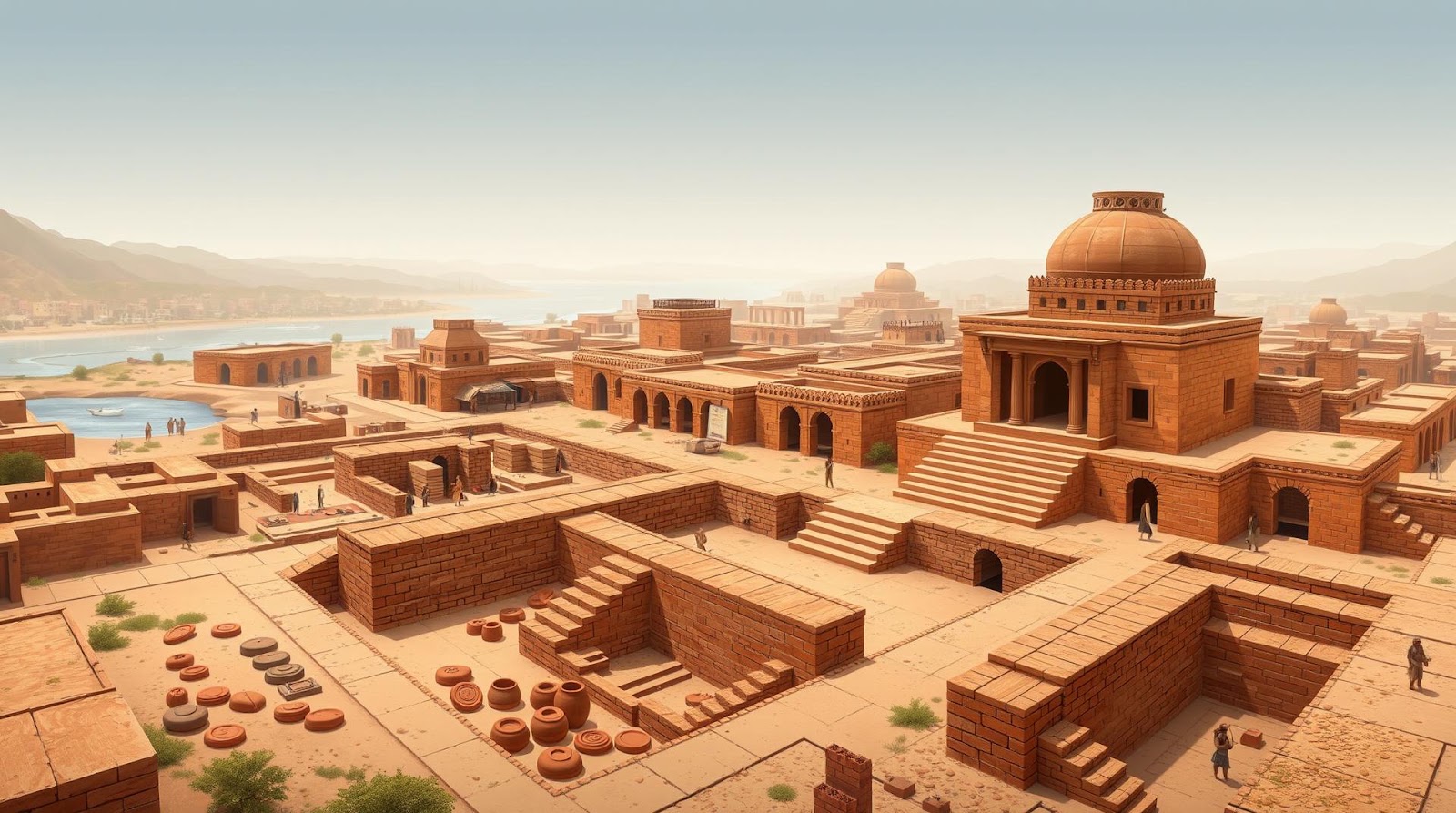
Mohenjo-daro – this is the "Mound of the Dead" in Sindhi, and it's the largest excavated city of the civilisation. The street layout, the bathrooms, the standardised weights—everything is so perfectly planned that you'll wonder if aliens designed it. Located in modern-day Sindh, Pakistan, it's genuinely one of the most impressive ancient sites I've ever learned about.
Dholavira – in Gujarat, India. This one's special because it has a unique diamond-shaped fortified layout, completely different from the rectangular grids of Harappa and Mohenjo-daro. If you're studying for UPSC, Dholavira always appears because it shows the diversity within the civilisation.
Kalibangan – in Rajasthan, showing the eastern extent of the civilisation. And then there are hundreds of smaller sites scattered across the region.
The Urban Marvels: What Made Them So Advanced?
Town Planning That Still Impresses
Here's where I usually stop and ask my students: "What do you think the people of Indus Valley prioritised?" Most say "defence" or "religion." Wrong—they prioritised sanitation and planning.
The streets in Harappa and Mohenjo-daro were laid out in a perfect grid pattern, like modern city streets. The main streets were 10-34 meters wide, and smaller streets branched off at right angles. This wasn't accidental. This was intentional urban planning at a scale rarely seen even in ancient Mesopotamia.
But the real genius? The drainage system. Every house had its own brick-lined drains that connected to the main sewer system running beneath the streets. These drains had inspection shafts—can you imagine? An inspection shaft! As if they were thinking, "Hey, when this gets blocked, we should be able to check it." This level of planning for maintenance is something you'd expect from modern-day municipal corporations, not from a 4,500-year-old civilisation.
Standardisation: The Corporate Culture of 2300 BCE
The Indus people were obsessed with standardisation. And I mean obsessed. Bricks were standardised at a ratio of 1:2:4 across hundreds of sites. Weights and measures were standardised. Even the size of agricultural fields seems to have been planned.
Let me give you a memory trick for this: "Standards = Prosperity". When everything is standardised, trade becomes easier, construction becomes easier, and you can maintain quality control. This is exactly why modern countries have standards boards! The Indus civilisation understood this 4,500 years ago.
Archaeologists have found standardised weights and measures—often made of stone—suggesting a sophisticated system of commerce. The fact that these standards were consistent across such a vast area (over 1,000 km) proves there was either central authority or at least strong cultural cohesion.
Society, Economy, and the Great Mystery of the Seals
What We Know About Social Structure
One of the most interesting things about the Indus Valley Civilisation is how egalitarian it seems. Unlike Egypt with its visible pharaohs or Mesopotamia with its god-kings, the Indus Valley shows no obvious signs of extreme class hierarchy.
Houses were varied in size—sure, there were larger houses, probably for wealthier merchants—but there's no massive royal palace like those found in other ancient civilisations. No grand temple complexes dominating the skyline. No colossal statues of rulers. This has led scholars to theorise that the Indus society might have been more mercantile in nature, with traders being the elite rather than kings or priests.
For your exam, remember: Indus = Merchant class dominated, not priest or king class. This is unique in the ancient world and keeps coming up in questions.
The Mysterious Seals and the Undeciphered Script
Now, here's the plot twist that makes Indus Valley so fascinating: we still can't read their script. Over 4,000 seals and inscribed objects have been found, but the script remains largely undeciphered. It's like having someone's diary but not knowing the language.
The seals are small, usually made of steatite (soapstone), and contain both script and images. The images show animals—mainly the famous "unicorn," though it might have been a humped bull shown in profile. There are also images of tigers, rhinoceros, and elephants. Scholars believe these seals were used for trade purposes, like a merchant's stamp.
Some scholars think the script might be logographic (like Chinese characters) combined with phonetic elements, but honestly, it's still mostly speculation. Every few years, someone claims to have deciphered it, but the academic consensus remains: we don't know what it says.
I always tell students: "This is why archaeology is still exciting. The Indus Valley Civilisation still has secrets." And frankly, that uncertainty makes it more memorable for exams—examiners love asking about what we DON'T know as much as what we do.
Trade and Economy
The Indus people were merchants par excellence. Evidence of trade has been found across an incredibly wide area. Indus seals have been discovered in Mesopotamian sites like Ur and Lagash, proving that trade networks connected these distant civilisations. Can you imagine? Trade across thousands of kilometres with no modern transportation!
They traded in raw materials: cotton (perhaps the world's first major cotton producers), lapis lazuli from Afghanistan, jade, turquoise, and timber. They also manufactured items like beads, weights, and pottery. The standardised weights I mentioned earlier? They were essential for this far-reaching trade.
| Aspect | Key Features |
|---|---|
| Extent | 1.26 million sq km (roughly 2300-1750 BCE) |
| Major Cities | Harappa, Mohenjo-daro, Dholavira, Kalibangan |
| Urban Features | Grid street layout, advanced drainage, standardised bricks |
| Script | Undeciphered, found on ~4,000 seals |
| Economy | Trade-based, standardised weights, crafts |
| Social Structure | Merchant-dominated, relatively egalitarian |
The Decline: What Happened?
Here's a question I ask every batch of students, and they never get it right: "Why did the Indus Valley Civilisation collapse?" The honest answer is: we're not entirely sure, and that's part of what makes it fascinating.
Theories abound. Some scholars suggest a massive flood caused by a shift in the Indus River. Others point to environmental degradation—perhaps deforestation for brick-making depleted resources. Some archaeologists propose a drying climate that forced people to migrate eastward toward the Ganges valley. A few even suggest seismic activity disrupted the natural water flow.
The most recent evidence suggests it was probably a combination of factors: environmental stress (climate change, river shifting, deforestation), combined with possibly some conflict. It wasn't a sudden catastrophic collapse but rather a gradual decline over several centuries. By around 1750 BCE, the great cities were abandoned, and the civilisation faded away.
Here's what's important for your exam: there's no archaeological evidence of massive destruction or warfare. The decline seems to have been gradual and primarily caused by environmental and climatic factors, not invasion. This actually contradicts some older theories that blamed the Aryans for destroying it—there's no evidence for that.
Many scholars believe the surviving populations migrated eastward into the Ganges valley, where they potentially contributed to the development of later Indian cultures. Some elements of Indus culture—like the seal-making tradition—seem to have influenced later Vedic culture, suggesting continuity rather than complete replacement.
For your revision, remember: Gradual decline due to environmental factors, not invasion. This is crucial for differentiating the Indus story from popular myths about "Aryans destroying civilisations."
Legacy and Why It Still Matters
The Indus Valley Civilisation didn't disappear without leaving a mark. Some scholars see continuities between Indus religious symbols (like the proto-Shiva figurines) and later Hindu iconography. The emphasis on water and cleanliness in Indus sites might have influenced later Indian traditions around ritual purity. Cotton cultivation, which likely originated or was perfected in this region, became central to Indian economy.
More broadly, the Indus Valley Civilisation teaches us about urban planning, trade networks, and how complex societies can thrive without obvious centralised authority. It's a lesson that still resonates in modern times.
For SSC and UPSC exams, this civilisation appears across multiple sections: Ancient Indian History (obviously), but also in archaeology, economy, and even general awareness. The key is understanding not just the facts but the interconnections—how urban planning enabled trade, how standardisation supported commerce, how environmental factors can reshape entire civilisations.
I always end my classes on the Indus with this thought: "We're living in one of the world's oldest continuous civilisations. The Indus people built cities that lasted for centuries, created one of the first urban drainage systems, and engaged in international trade. And yet, we still don't know what their inscriptions say. That's humbling. That's also why history never gets boring."
Practice Questions
A) Grid-pattern street layout B) Advanced underground drainage systems C) Large royal palaces with monumental architecture D) Standardised brick sizes
Answer: C) Large royal palaces with monumental architecture. The Indus Valley Civilisation notably lacked the grandiose royal architecture seen in Egypt or Mesopotamia, suggesting a merchant-dominated rather than monarch-dominated society.
A) Harappa B) Kalibangan C) Mohenjo-daro D) Dholavira
Answer: C) Mohenjo-daro. Located in modern-day Sindh, Pakistan, Mohenjo-daro is the largest excavated city and is famous for its well-planned layout and advanced infrastructure.
A) Early Indus (3300-2600 BCE) B) Mature Indus (2600-1900 BCE) C) Late Indus (1900-1300 BCE) D) Post-Indus (1300-600 BCE)
Answer: B) Mature Indus (2600-1900 BCE). This phase saw the maximum territorial expansion and urban development.
A) Discovery of Egyptian mummies in Indus sites B) Indus seals and artefacts found in Mesopotamian sites like Ur and Lagash C) Written records mentioning trade agreements D) Archaeological remains of horses and caravans
Answer: B) Indus seals and artefacts found in Mesopotamian sites like Ur and Lagash. These discoveries prove direct contact and trade between the Indus Valley and Mesopotamian civilisations.
A) Sudden invasion by Aryan tribes B) A single catastrophic flood C) Gradual environmental degradation and climate change leading to migration D) Complete extinction due to disease
Answer: C) Gradual environmental degradation and climate change leading to migration. Modern archaeology suggests a combination of environmental factors rather than invasion or sudden catastrophe.
Published by Dattatray Dagale • 30 May 2026
.jpg)
.png)



.png)



.png)


0 Comments