Introduction
I still remember the day one of my students asked me: "Sir, when a bill becomes a law, does it just happen overnight?" The classroom laughed, but it was actually a brilliant question. Because honestly, most of us have no idea what happens between the moment a bill is introduced in Parliament and the day it becomes the law of the land.
After teaching Indian Polity for over a decade, I've realized that Parliament isn't some mysterious institution shrouded in complex jargon. It's actually fascinating — like watching a perfectly choreographed dance where every step has a purpose. The legislative process is the heartbeat of Indian democracy, and if you're preparing for SSC CGL or UPSC, understanding how bills move through Parliament isn't just about scoring marks. It's about understanding how India actually governs itself.
So grab some chai, get comfortable, and let me walk you through this journey. By the end of this post, you'll not only understand Parliament but actually appreciate the genius of our constitutional design.
What Is Parliament? The Foundation You Need
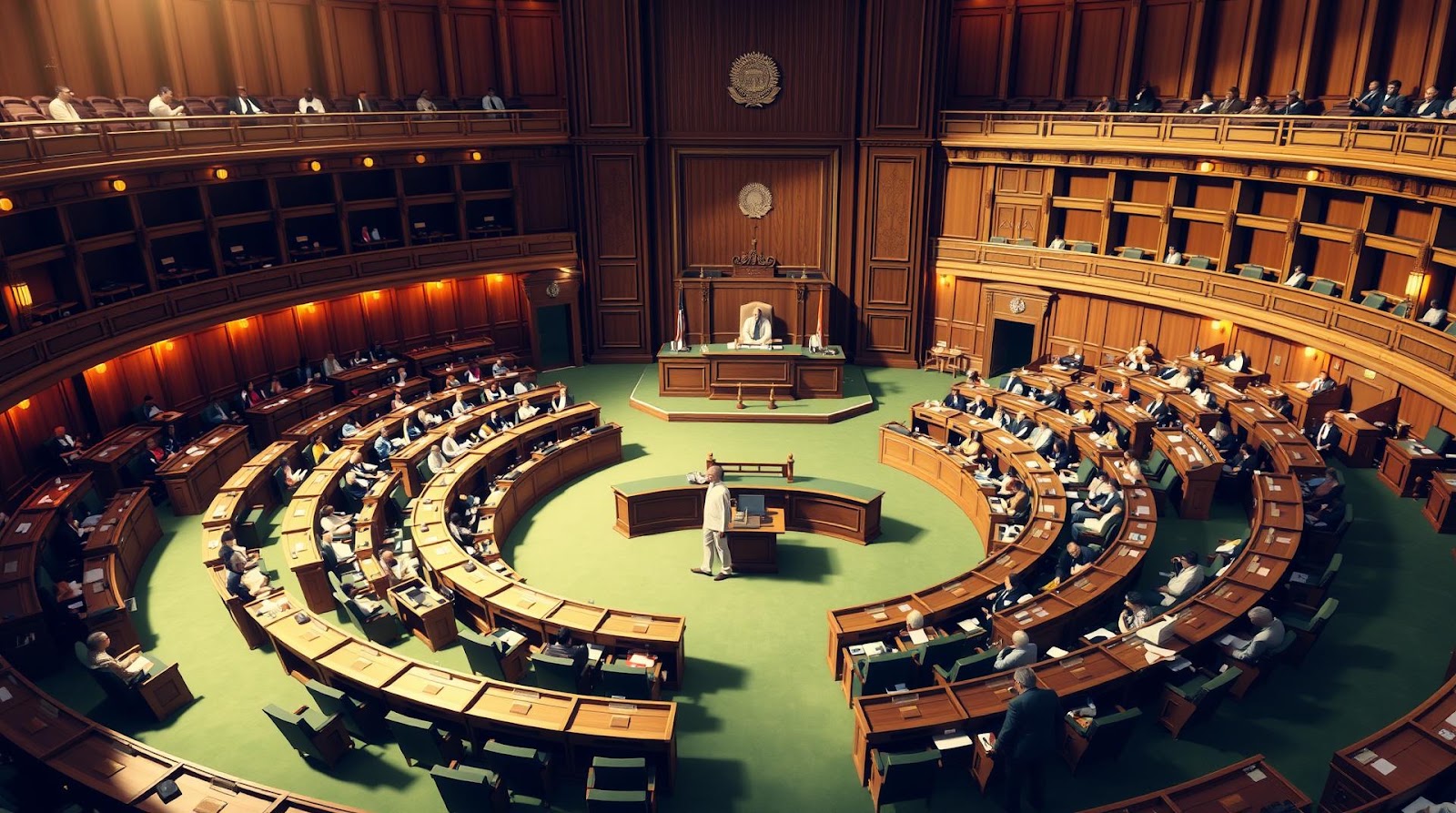
Before we dive into the legislative process, let's clarify what Parliament actually is. Think of it like the captain of a cricket team — it's the supreme legislative body of India, responsible for making laws that govern 1.4 billion people. That's enormous responsibility.
Our Parliament is bicameral, meaning it has two houses:
The Lok Sabha (House of the People) — This is the directly elected house. All 543 members are elected by the people every five years. It's the more powerful house, the one that controls money and confidence of the government. When you vote in national elections, you're voting for your Lok Sabha representative.
The Rajya Sabha (Council of States) — This has 245 members (233 elected, 12 nominated). Members serve six-year terms, and one-third retire every two years. It's often called the upper house, more stable, more reflective of state interests. Think of it as the wisdom keeper.
Now here's the interesting part — these two houses have different powers. A money bill (which deals with finances) can originate only in the Lok Sabha. The Rajya Sabha can delay it for 14 days, but ultimately the Lok Sabha's word is final. But for other bills, both houses have equal power. This is why both houses matter in the legislative process.
The Structure That Holds Everything Together
Parliament has committees that do the real detailed work. Think of them as specialist teams. There's the Public Accounts Committee, the Standing Committees on various subjects, and departmental committees. These committees examine bills in detail, call experts, and produce reports. Many students skip this in their preparation, but I always tell them: examiners absolutely love asking about committee functions.
The Legislative Process: Step by Step
Alright, let me take you on the actual journey of a bill. This is where most students get confused, so I'm going to make it crystal clear.
Stage 1: Introduction (First Reading)
A bill starts with an idea. Usually it comes from the government (through a minister or the Law Ministry), but it can also come from backbench MPs. The bill is introduced in either the Lok Sabha or the Rajya Sabha (unless it's a money bill, which must start in the Lok Sabha).
At this stage, the bill is simply introduced. There's no debate, no voting. It's like saying "Gentlemen, we're going to discuss something." The bill gets a number, gets published in the official gazette, and everyone gets a copy. That's it. First reading is done.
Stage 2: Consideration (Second Reading)
Now here's where the real action happens. This stage has three substeps, and let me give you a mnemonic I teach all my students:
DED — Discussion, Examination, Decision
In the Discussion phase, MPs debate the bill clause by clause. This is televised, emotional, and sometimes absolutely hilarious. You'll see veteran MPs quote statistics, younger MPs passionately argue, and someone inevitably makes it personal. The finance minister or the sponsoring minister defends the bill, answering questions.
Then comes the Examination phase. The bill might be sent to a parliamentary committee, or sometimes to a select committee. This is where experts analyze it, public opinion is considered, and the bill gets scrutinized in detail. This phase can take weeks or months. Remember the 2019 Citizenship Amendment Bill? It went through rigorous examination.
Finally, the Decision phase. The house debates again, amendments are proposed, discussed, and voted upon. Then the main bill is voted on. If it passes, it moves to the next stage.
Now you might be wondering — why is this second reading split into so many parts? Because our Constitution makers wanted to ensure no bill becomes law in a hurry. Democracy requires deliberation.
Stage 3: Passage (Third Reading)
This is straightforward. The bill, having been discussed and amended, comes up for final voting. Usually, this is just a formality — if it passed the second reading, it passes the third. Technically, members can raise objections or demand recorded votes, but typically it's the final stamp.
Here's something important: if the bill originated in the Lok Sabha and passed, it now goes to the Rajya Sabha. And the whole process repeats — first reading, second reading with discussion and examination, third reading. If it's a money bill, the Rajya Sabha can only delay it 14 days. For other bills, they have equal power, so they can reject it entirely.
If both houses pass it, or if they pass different versions and a joint sitting resolves the conflict, then it goes to the President.
Stage 4: Presidential Assent
The President has three options. She can give assent (the bill becomes law), withhold assent (the bill dies), or return it with a message. If she returns it, Parliament discusses it again. If both houses pass it again with a majority, the President must give assent.
Technically, the President's withholding of assent is called a "pocket veto" — and it's extremely rare in Indian practice.
Different Types of Bills and Their Special Rules
Not all bills follow the same path. This is crucial for exams, so pay attention.
Money Bills — These deal with taxation, government spending, borrowing, and financial matters. Only the Lok Sabha can introduce them (the Finance Minister usually does). The Rajya Sabha can discuss but cannot reject — only delay for 14 days. Why? Because the government's finances can't be held hostage. The Lok Sabha represents the people directly, and they control the purse strings.
Constitutional Amendment Bills — These need 2/3 majority in both houses and don't require presidential assent in the traditional way. They're the most powerful bills because they literally change the Constitution.
Ordinary Bills — These are regular bills on any subject. Both houses have equal power. If they disagree, a joint session can be called where both houses meet together, and a simple majority decides.
Private Member Bills — These are introduced by non-ministerial MPs. They're rare and usually don't pass, but they're important for raising public issues. When a private member's bill passes, it's huge news.
| Type of Bill | Can Start In | Rajya Sabha Power | Key Feature |
|---|---|---|---|
| Money Bill | Lok Sabha Only | Can delay 14 days only | Finance-related |
| Constitutional Amendment | Either House | Equal power | Needs 2/3 majority both houses |
| Ordinary Bill | Either House | Equal power | Simple majority in both houses |
| Private Member Bill | Either House | Equal power | Introduced by non-minister MP |
The Real World: How Parliamentary Drama Unfolds
Let me give you a real example from my own classroom experience. During the GST Bill (2016), I watched students struggle to understand why it was called a "Money Bill" even though it wasn't just about taxation. The reason? Because its primary purpose was to affect government revenues. The classification depends on the main purpose, not just the content.
I also remember the debates when the Right to Information Bill was passed. Some MPs stood up for transparency, others worried about governance. That's democracy — messsy, loud, passionate. And that's exactly what your examiner wants you to understand. Parliament isn't a rubber stamp. It's a deliberative body where ideas clash and the best (hopefully) emerges.
Here's another mnemonic I give students for remembering the sequence: ICPP — Introduction, Consideration, Passage, Presidential assent. Simple, right?
One more thing I always emphasize: the time taken varies wildly. Some bills pass in weeks, others take years. The GST Bill took nearly 13 years from conception to passage. The Citizenship Amendment Bill took years of drafting before introduction. There's no fixed timeline — it depends on the complexity, controversy, and consensus-building needed.
Key Concepts You Need to Master
Ordinances — When Parliament isn't in session, the President can issue ordinances to address urgent matters. These have the force of law but expire after six months unless approved by Parliament. This is a safety valve for emergency governance.
Adjournment Motion — An MP can move an adjournment to discuss urgent matters. This interrupts regular business to address something pressing. It's rarely used but powerful.
No-Confidence Motion — This is how the government can be removed. If a majority of Lok Sabha members vote for it, the government falls. It's happened only three times in independent India.
Question Hour — The first hour of parliamentary proceedings where ministers answer questions from MPs. This is televised, crucial for accountability, and absolutely grilling sometimes. I've seen Finance Ministers sweat under questions in Question Hour.
These aren't just academic concepts. They're the mechanisms that keep our democracy alive and responsive.
A) Ordinary Bills B) Money Bills C) Constitutional Amendment Bills D) Private Member Bills
Answer: B) Money Bills — They can only originate in the Lok Sabha as per Article 109 of the Constitution.
A) 7 days B) 14 days C) 30 days D) 60 days
Answer: B) 14 days — After 14 days, the bill is deemed passed even if the Rajya Sabha hasn't passed it.
A) Simple Majority B) 2/3 Majority C) 3/4 Majority D) Unanimous Vote
Answer: A) Simple Majority — Under Article 111, a simple majority in both houses is sufficient to pass the bill again.
A) First Reading B) Second Reading C) Third Reading D) Fourth Reading
Answer: D) Fourth Reading — Bills go through only three readings: First, Second (with examination), and Third. There's no Fourth Reading in the Indian legislative process.
A) Simple Majority in both houses B) 2/3 Majority in both houses C) 3/4 Majority in Lok Sabha and 2/3 in Rajya Sabha D) Unanimous passage
Answer: B) 2/3 Majority in both houses — This is the highest threshold, reflecting the gravity of changing the Constitution itself.
Final Thoughts: Why This Matters Beyond the Exam
I'm telling you honestly — understanding Parliament and the legislative process will change how you read news. When you see a bill being discussed on the news, you'll understand exactly what stage it's at, why it's controversial, and what happens next. You'll see headlines like "Rajya Sabha delays Bill" and understand the constitutional implications instead of just skimming past them.
For your exams, remember this: questions on legislative process test your understanding of constitutional design, checks and balances, and democratic principles. They're not just about memorizing stages. They're about understanding why our Constitution makers designed it this way — to ensure no power becomes absolute, to ensure deliberation happens, to protect the rights of minorities even when majorities are excited.
Study this with that perspective, and you won't just answer questions correctly. You'll actually remember them. I promise.
Now go grab some chai and come back with questions. I'm always here.
Published by Dattatray Dagale • 07 June 2026
.jpg)
.png)



.png)



.png)



0 Comments