Introduction
You know what's funny? I've been teaching Indian polity for over a decade, and the one thing that surprises me every single time is how many bright students — seriously, the kind who can solve complex math problems in their head — completely blank out when asked "How does a bill become a law in India?"
It's not your fault, honestly. The legislative process feels abstract. It happens in a building far away in Delhi, with politicians using fancy language and complex procedures. But here's what I've learned: if you understand why each step exists, it stops feeling like random rules and starts feeling like a beautiful puzzle.
Think about it this way — Parliament is like a quality control department for a country. Just like Samsung doesn't let a phone leave the factory without checking it ten times, India doesn't let a law affect 140 crore people without proper scrutiny. That's what this entire elaborate process is about.
In this post, I'm going to walk you through Parliament and the legislative process like we're having tea together. No jargon overload, just the real mechanics with examples you'll actually remember. Let's go.
Understanding Parliament: India's Law-Making Factory
The Basic Structure — Two Houses, One Parliament
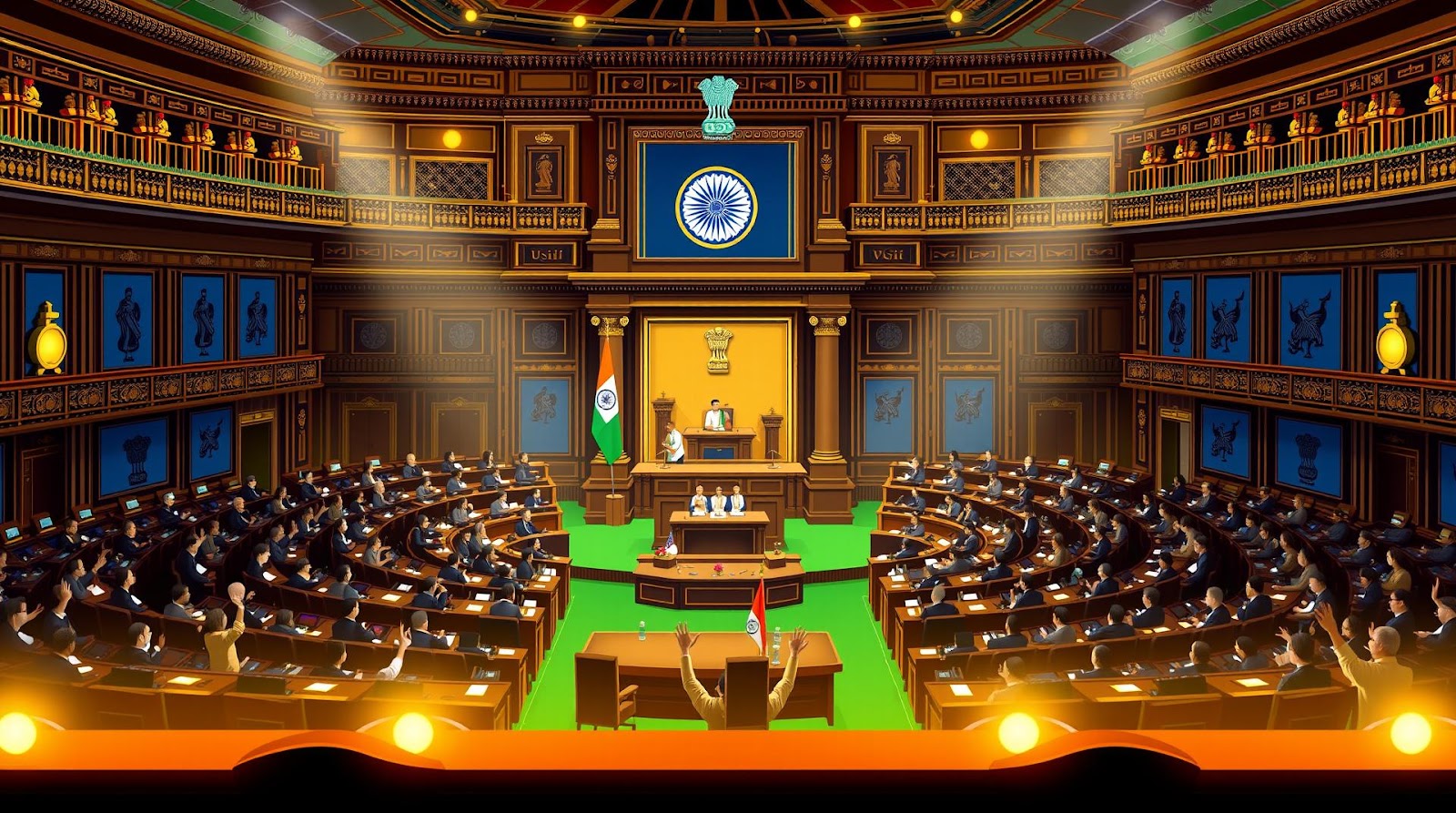
First things first: our Parliament has two houses. Not like a duplex — I mean two separate chambers. The Lok Sabha (House of the People) and the Rajya Sabha (Council of States). Both are necessary, and both have different powers.
Let me give you a quick mental image: the Lok Sabha is like your college's student council — directly elected by common people, closer to the ground, more reactive to current issues. The Rajya Sabha is like the university's academic council — represents states, focuses on long-term policy, brings experience and stability.
The Lok Sabha has 545 members (543 elected + 2 nominated). The Rajya Sabha has 250 members (238 elected by state assemblies + 12 nominated by the President). Now, you might wonder why we need both if one house can make laws. Great question — that's exactly the thinking behind our bicameral system.
Here's why both matter: Sometimes the Lok Sabha gets emotional about something trending on Twitter. The Rajya Sabha says, "Wait, let's think about this." It's like having a hot-headed friend and a calm friend advising you together. You usually make better decisions.
Who Runs These Houses?
The Speaker of Lok Sabha is the chief authority in the lower house — they decide who speaks, how long debates go, whether a bill is constitutionally valid. Think of them as the principal of Parliament. Similarly, the Vice President of India is the Chairman of Rajya Sabha (yeah, that's a separate role they hold alongside being VP).
The Prime Minister sits in the Lok Sabha (usually), and they're answerable to it. This is crucial for your exam — PM must answer questions, explain policies, face criticism. It's part of our parliamentary democracy system.
The Legislative Process: From Idea to Law (Step by Step)
Now here's the interesting part — the actual journey of a bill. Most students just memorize "Three Readings" and move on. But if you understand the logic, you'll never forget it.
Stage 1: The Birth — Introduction and First Reading
A bill starts as an idea. Maybe the government thinks, "Hey, we need tougher rules for child labor" or "Let's regulate cryptocurrency." A minister prepares a bill and introduces it in Parliament.
The First Reading is almost ceremonial. The bill is just introduced, its title is read, and members are given copies. No real debate happens. It's like when a Bollywood movie gets announced — you hear the title, you get excited, but you haven't watched it yet.
Here's what happens behind the scenes though — the bill is sent to a Parliamentary Standing Committee. This is crucial. These committees (usually chaired by opposition members, by the way) examine the bill in detail. They hold public hearings, invite experts, take suggestions. This is where the real work happens.
Let me tell you a trick I share with all my students: Remember the three readings as "Introduction, Discussion, Decision" — it makes the purpose of each stage crystal clear.
Stage 2: The Debate — Second Reading
After the Standing Committee submits its report (usually takes 2-3 months), the bill comes back for the Second Reading. This is where Parliament actually debates the bill. Point by point. Amendment by amendment.
This is also where things get spicy. Opposition parties raise concerns, government defends, back-benchers ask questions. Remember when the Citizenship Amendment Act was being discussed? The entire parliament was divided. That's a Second Reading in action.
During the Second Reading, there are usually two parts:
Part A: General discussion on the bill's philosophy and objectives. "Is this bill needed? Do we agree with its basic purpose?"
Part B: Clause-by-clause examination. Each article, each section, each word gets scrutinized. "Should it be 5 years or 7 years? Should this apply to children or adults only?" Every detail matters because this becomes law.
Members can propose amendments. If the ruling party is smart, they actually incorporate good suggestions because it strengthens the bill and builds consensus. If they're stubborn, they vote the amendments down. This is where parliamentary numbers matter — your coalition strength determines how much you can push through.
Stage 3: The Approval — Third Reading
After all amendments are settled, the bill comes for Third Reading. This is quick — mostly just members expressing their final views, then a vote. If it passes, it moves to the other house (usually Lok Sabha to Rajya Sabha or vice versa).
Now, if the other house passes it without changes, great — it goes to the President to sign, becomes law. But if the Rajya Sabha makes amendments to a bill from Lok Sabha, it goes back to Lok Sabha. If they disagree, it can go to something called a Joint Session of Parliament. That's dramatic — both houses meet together, and the Lok Sabha (being bigger) usually wins.
The Final Step: Presidential Assent
Last but not least — the President signs off. This is mostly procedural (the President rarely refuses, though they can send it back once for reconsideration). Once signed, it becomes an Act — actual law.
| Stage | What Happens | Duration (Approx) |
|---|---|---|
| Introduction & 1st Reading | Bill is presented, sent to Standing Committee | Immediate |
| Standing Committee Review | Detailed examination, public hearings, report | 2-3 months |
| 2nd Reading (General + Clause-wise) | Full debate, amendments proposed and voted | Variable (days to weeks) |
| 3rd Reading | Final views, voting, passage to other house | 1-2 days |
| Other House (If Required) | Same three readings repeated | 1-3 months |
| Presidential Assent | President signs, bill becomes Act | Days |
Special Bills: Money Bills and Constitutional Amendment Bills
Money Bills — The Lok Sabha's Special Power
Here's where it gets interesting. Not all bills are equal. Some are Money Bills.
A Money Bill deals with taxes, government spending, borrowing, or financial matters. And here's the rule: Money Bills can only originate in the Lok Sabha. The Rajya Sabha can suggest changes, but it cannot block them. The Lok Sabha has final say after 14 days.
Why? Because the Lok Sabha is directly elected by the people. You should have ultimate say over taxation and government spending — that's democracy. The Rajya Sabha, being representative of states and appointed in complex ways, doesn't get absolute veto power on money matters.
This is crucial for your exam — remember the mnemonic I'm about to give you: "LSMB" — Lok Sabha, Money Bills. Money Bills start in Lok Sabha, and Lok Sabha dominates them.
Constitutional Amendment Bills — The Heavy Duty Stuff
Then we have Constitutional Amendment Bills. These are different because they change our Constitution itself. They require a special majority — not a simple 50% + 1 vote, but 2/3 of members present and voting in both houses.
Also, many amendments (the really important ones) need ratification by at least 50% of state legislatures. This is the highest bar in our system. It's intentionally difficult because the Constitution shouldn't change with every new government.
Example: If you want to reduce the voting age from 18 to 16, you'd need 2/3 majority in both Parliament houses AND approval from half of India's state assemblies. Good luck with that, right? Which is exactly the point.
What Actually Happens During Parliamentary Debates (The Real Part)
You know what's funny? We learn all the procedural stuff but rarely talk about what actually happens in debates. Let me paint a real picture.
When a major bill comes up, the government whip (yes, that's a real title) makes sure party members show up. Opposition does the same. Then the relevant minister speaks first — explaining the bill's purpose. Opposition leader responds with their criticism. Other members jump in.
There's a lot of "Point of order, sir!" and "That's not factually correct!" And the Speaker sitting up there is basically refereeing a parliamentary boxing match, deciding who gets to speak next.
The government usually gets more time to speak (because they're the majority), but opposition gets dedicated time too. This is where careers are made — a brilliant speech during a bill debate can change public opinion or pressure the government to compromise.
Here's a real example I tell students: During the GST bill debates in 2016, opposition parties raised legitimate concerns about exemptions and state revenue loss. The government couldn't ignore them. They made adjustments. That's how parliamentary democracy works — not perfectly, but it works.
And after all the talking, there's voting. If it's a simple bill, maybe 60-70% of MPs are present. If it's controversial, might be 300+ in the chamber. The Speaker announces the vote, and members press buttons on their desk (modern Parliament has electronic voting now — very 21st century).
Key Powers and Privileges You Should Know
Members of Parliament have something called Parliamentary Privileges. This means they can't be sued for what they say inside Parliament. They have freedom of speech (within parliamentary rules). They also can't be arrested during parliamentary sessions without the Speaker's permission.
Why? Because we want MPs to speak freely, even if it's controversial, without fear of legal action from angry governments or powerful people. It's a safety net for keeping democracy alive.
Also, remember that Parliament has Committees — Standing Committees, Select Committees, Departmental Committees. These are workhorses. They scrutinize bills, audit government spending, investigate issues. Most real work happens in committees, not in main debates.
Why All This Complexity? The Wisdom Behind It
I often get asked, "Sir, why can't we just vote and pass laws quickly?" Valid question. But think about it — a law affects millions of lives. Taking time to debate, amend, reconsider is actually a feature, not a bug.
Our system is designed to slow down bad decisions. It's hard to push through laws without consensus. That's why communal violence bills require careful handling, why economic policies need discussion, why constitutional changes are almost impossible to do secretly.
Is it slow? Yes. Is it frustrating? Absolutely. But it's also why India hasn't had a dictatorship despite being such a diverse, volatile, chaotic country. The system works because it's hard to misuse.
When you're in the exam, remember this: every rule in Parliament, every step in the legislative process — it's there for a reason. Usually that reason is "to prevent abuse of power."
Final Thoughts
Parliament and the legislative process might seem boring on paper. But it's actually the heartbeat of our democracy. When you watch a heated debate on TV, understand that this is how arguments are supposed to be settled in a civilized society — with words, not weapons. With voting, not violence.
Master this topic, and you'll handle any UPSC or SSC question about Indian polity. More importantly, you'll understand how your country actually works. And honestly, that's pretty cool.
---Practice Questions
A) Constitutional Amendment Bill B) Money Bill C) Criminal Law Amendment Bill D) Education Bill
Answer: B) Money Bill — This is explicitly stated in Article 109 of the Constitution. Money Bills involving taxation, government spending, or borrowing can only originate in Lok Sabha.
A) 250 total (238 elected + 12 nominated) B) 245 total C) 300 total D) 275 total
Answer: A) 250 total (238 elected + 12 nominated) — This is fixed by the Constitution. The 12 nominated members are chosen by the President for their expertise.
A) Simple majority (50% + 1) B) Absolute majority (2/3 of total members) C) Special majority (2/3 of members present and voting in both houses) D) Unanimity
Answer: C) Special majority (2/3 of members present and voting in both houses) — Some amendments also need ratification from 50% of state legislatures. This is the highest bar in our legislative system.
A) Speaker of Lok Sabha B) Vice President of India C) Chief Justice of India D) Prime Minister
Answer: B) Vice President of India — The VP serves as the Chairman of Rajya Sabha, which is a constitutional role separate from their other duties.
A) First Reading B) Second Reading (Part B) C) Third Reading D) Standing Committee Stage
Answer: B) Second Reading (Part B) — The Second Reading has two parts: Part A is general discussion, Part B (also called Committee Stage) involves detailed clause-by-clause examination where amendments are proposed and voted.
Published by Dattatray Dagale • 13 May 2026
.jpg)
.png)



.png)



.png)


0 Comments