Introduction
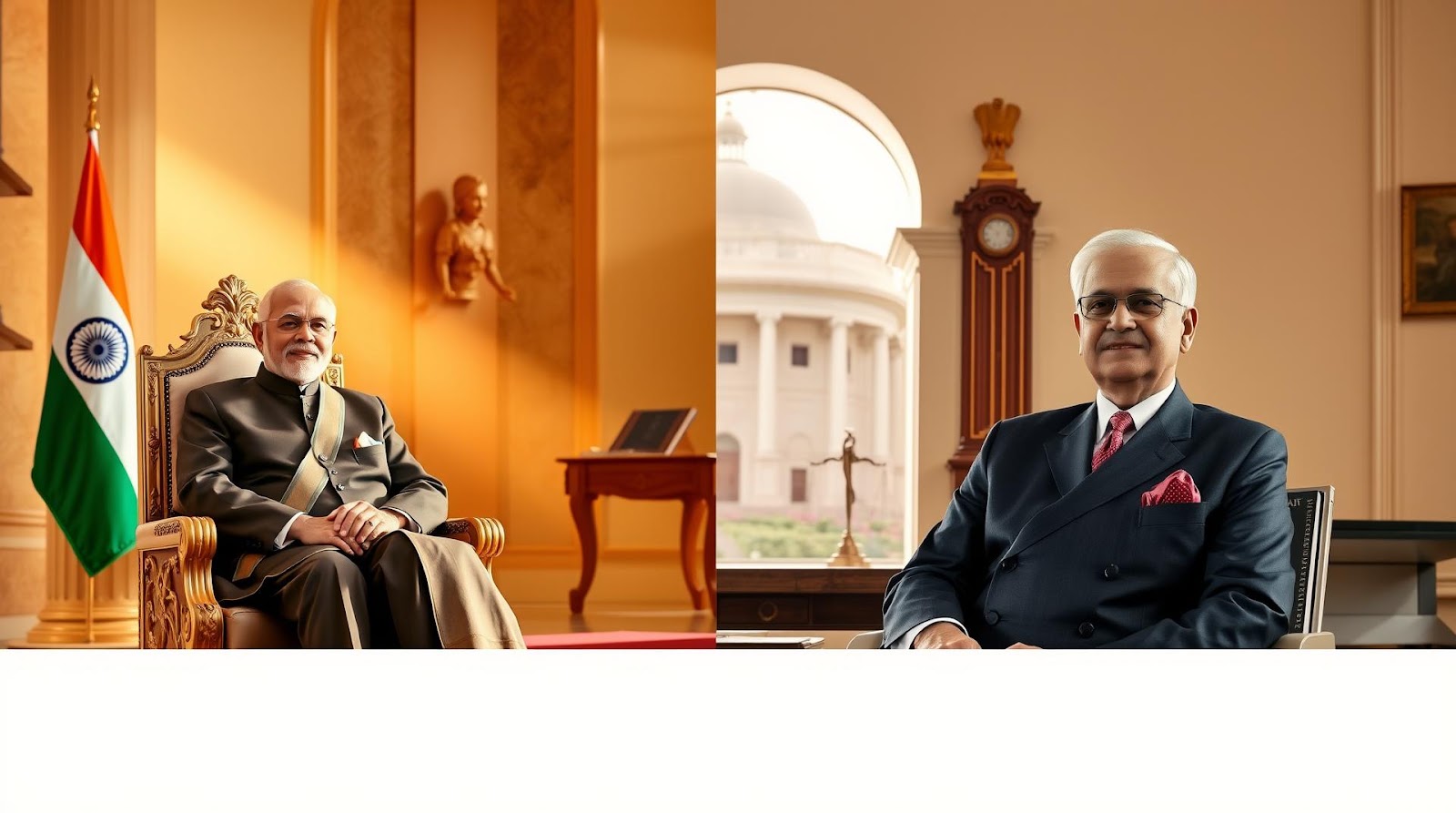
Let me start with a question I ask every batch of students: "Who's more powerful—the President or the Prime Minister?" I watch their confused faces, and then I smile because I know exactly what's about to happen in their minds. They're about to confuse constitutional theory with real power. And honestly? That's the most common mistake I see in exam halls.
Here's the thing about Indian polity that took me years to fully appreciate: we don't have a presidential system like America, and we don't have a purely parliamentary system either. We have something beautifully complicated—a hybrid that confuses students but absolutely fascinates those who truly understand it.
Today, I want to walk you through the roles of the President and Governor—not just what the Constitution says they can do, but what they actually do, what they *can't* do, and most importantly, why this matters for your exam. Stick with me because by the end, you'll stop confusing ceremonial power with real power, and that's when questions about the President and Governor become predictable, almost easy.
The President: India's Ceremonial Head of State
Constitutional Position and Election
The President of India is the Head of State. Now, I want you to remember this phrase: "Head of State, not Head of Government." This single distinction answers 60% of all President-related questions in exams.
Our President is elected by an Electoral College—not by direct popular vote. This Electoral College consists of elected members of Parliament (both Lok Sabha and Rajya Sabha) and elected members of State Legislative Assemblies. The voting system is weighted, meaning each MP's vote carries a certain value depending on the population of the state they represent. It's proportional representation in action, and honestly, the math can get messy, but the beauty is that no single state dominates the election.
A President serves a five-year term and can be re-elected. There's no restriction on the number of terms—theoretically, someone could be President forever if they keep getting elected (though that hasn't happened). The President must be an Indian citizen, at least 35 years old, and eligible to be a Lok Sabha member.
Powers That Look Big But Aren't
Here's where students get confused. On paper, the President has enormous powers. Laws are passed in the President's name. The President is the Supreme Commander of the Armed Forces. The President can declare war. The President pardons criminals. It all sounds incredibly powerful, right?
Wrong. This is what I call the "mask of power" in Indian polity.
All of these powers are **exercised on the advice of the Prime Minister and Council of Ministers**. This is the critical phrase you'll see in Articles 53, 72, 74, and others. The President doesn't make independent decisions on these matters. The President acts on the advice of the PM and cabinet.
Let me give you a relatable analogy: The President is like a celebrity brand ambassador for India. Everyone respects the position. Your company might need the brand ambassador's approval for certain big decisions, but the real strategy? That's decided by the CEO and management team. The brand ambassador just puts their face on it.
Let me break down the actual powers:
Executive Powers: The President appoints the Prime Minister (but here's the catch—this is done according to constitutional convention, and the person who commands the majority in Lok Sabha becomes PM). The President also appoints judges, governors, ambassadors, and other constitutional functionaries. But again, on the advice of the PM or relevant bodies.
Legislative Powers: Bills passed by Parliament require the President's assent to become law. But the President can't just refuse assent—they have options: (1) Give assent (2) Withhold assent, or (3) Return the bill for reconsideration. If Parliament passes it again with a simple majority, the President *must* give assent. So effectively? The President is rubber-stamping legislation.
Pardoning Powers: The President can grant pardons, reprieves, respites, and remissions. This is actually one of the few powers with some real discretion, though it's used sparingly and often involves consultation with the PM or relevant authorities.
The Governor: India's State Head of State
Role and Responsibilities
Now, the Governor is essentially the President of a state. Same principle applies: Head of State, not Head of Government. The actual government of the state is run by the Chief Minister, but the Governor is the constitutional figurehead.
A Governor is appointed by the President (on the advice of the Union Cabinet and Chief Minister of that state—though the PM's recommendation carries more weight). Governors serve five-year terms and can be reappointed. Unlike the President, a Governor typically serves in multiple states during their career, though they must retire by age 65.
For eligibility: a Governor must be an Indian citizen, at least 35 years old, and must not hold any other office of profit. They can't have an active role in any political party (though this rule has been honored more in the breach than the observance, if I'm being honest).
Constitutional Powers and Real Powers
Here's something that often surprises students: Governors have more **real discretionary power** than Presidents. Not because the Constitution gives them more—it doesn't—but because state politics is more volatile and offers more situations where gubernatorial discretion matters.
The Governor's key powers include:
Executive Authority: The Governor appoints the Chief Minister (and this is where discretion comes in—if no party has a clear majority, the Governor must decide who to invite to form government). The Governor also appoints state judges, state officials, and other constitutional functionaries.
Legislative Authority: The Governor summons, prorogues, and dissolves the State Assembly. They give assent to bills passed by the Assembly. Similar to the President, the Governor can return bills for reconsideration, but if passed again, must give assent.
Special Powers: This is where it gets interesting. The Governor has powers regarding scheduled castes, scheduled tribes, and backward classes welfare. The Governor can recommend to the President that President's rule be imposed in the state (Article 356). This is huge. If the Governor reports that the state government cannot function according to the Constitution, the President can dismiss the state government and impose central rule. This has been controversial, and there have been cases where Governors from different political parties than the state government have used this power politically.
Let me tell you a trick I teach students for remembering Governor powers: "EASE" — Executive (appointment of CM), Administrative (running state functions), Special (scheduling reports and recommendations), Executive (dissolution of assembly).
The Crucial Differences You Must Know
| Aspect | President | Governor |
|---|---|---|
| Elected By | Electoral College (MPs + State Assembly members) | Appointed by President (on PM's advice) |
| Term | 5 years, no age limit for reappointment | 5 years, must retire by 65 |
| Jurisdiction | National (whole country) | State |
| Discretionary Powers | Very limited; acts on PM's advice | More discretion, especially in government formation |
| Can Be Removed | By impeachment (rare) | By President's order at pleasure (can be removed anytime) |
| Relationship with PM | Bound by PM's advice (almost always) | Can differ with CM on certain matters |
The Discretion Question: When President and Governor Act Independently
Now, I know what you're thinking: "But sir, you said they act on advice. When do they actually have discretion?"
Good question. This is advanced-level stuff, and it separates students who'll get 90% marks from those who get 100%.
The President has discretion in a few narrow situations:
1. Appointment of PM when no clear majority exists (like during a hung Parliament). The President can invite anyone they believe can form a government.
2. Use of Article 356 (imposing President's rule) after a Governor's report, though this is constrained by judicial review.
3. Pardoning powers (absolute discretion, though conventions guide this).
The Governor has MORE situations requiring discretion:
1. **Asking a CM to prove their majority** when a government's legitimacy is questioned.
2. **Deciding who gets first chance to form government** when election results are fractured.
3. **Recommending dissolution of Assembly** (though this requires careful consideration, and courts now scrutinize this heavily).
Here's a memory trick I give students: **"DISCS"** for Governor discretion—Decision (government formation), Inquiry (into CM's majority), Suspension (recommending President's rule), Claim (of minority petitions), Status (dissolution timing).
Controversial Powers and Recent Controversies
I'd be doing you a disservice if I didn't mention the elephant in the room: Governors using their powers politically.
Article 356 (imposing President's rule) has been used controversially many times. In 1992, the President's rule was imposed in multiple states with ruling governments of a particular party. The courts had to step in and establish guidelines (S.R. Bommai case, 1994). Now, President's rule can only be imposed if the Governor's report is based on specific factual findings, and the Centre must act within 2 months.
Similarly, Governors withholding assent or delaying assent to bills has caused tension. The Supreme Court has ruled that Governors can't arbitrarily delay bills—there's an implicit time limit.
And then there's the matter of CM removal recommendations. In some states, Governors have written to the President asking for the CM's dismissal, effectively using their position as a political tool. This is technically within their powers but breaches constitutional conventions.
The bottom line: Yes, both President and Governor have powers that *look* absolute on paper, but courts and constitutional conventions now constrain these powers significantly. An exam question might ask you to discuss this tension, and you should be ready to cite cases like S.R. Bommai (1994), Rai Saheb Ram Chandra Singh (1977), or Bachan Singh (1966).
Quick Revision: The Essential Mnemonic
Here's the ultimate memory trick I tell students during last-minute revisions:
"POGO" for President and Governor comparison:
P — Powers (President: executive, legislative, pardoning; Governor: executive, legislative, special)
O — Origin (President: elected; Governor: appointed)
G — Governance (President: national, ceremonial; Governor: state, mix of ceremonial and real)
O — Obligations (President: follows PM's advice strictly; Governor: can exercise discretion in specific situations)
Simple, right? When you're sitting in the exam and you see a question about presidential powers, just think POGO and you'll automatically remember the key distinctions.
The real success in polity questions comes when you stop memorizing and start understanding the *why* behind each power. Why does the President need to act on the PM's advice? Because we're a parliamentary democracy, and the PM is accountable to Parliament. Why can a Governor act with more discretion? Because state politics is messier, and the Governor needs flexibility in government formation.
Once you understand the logic, the answers become intuitive rather than rote-learned. And that's the difference between getting decent marks and getting great marks on polity questions.
Practice Questions for You
A) Appointment of cabinet ministers B) Dismissal of a Chief Minister C) Dissolution of State Assembly D) Appointment of PM when no party has clear majority
Answer: D) This is one of the few situations where the President has genuine discretion, as no clear convention or constitutional guideline applies.
A) Governor can recommend whenever they feel government is ineffective B) Must be based on specific factual findings and Centre must act within 2 months C) Governor's recommendation is always final D) Governor can impose President's Rule directly
Answer: B) The S.R. Bommai judgment (1994) established strict guidelines for when President's Rule can be imposed.
A) Direct popular vote by citizens B) Electoral College consisting of elected MPs and State Assembly members C) Parliament alone D) A special committee appointed by the PM
Answer: B) The Electoral College uses weighted proportional representation to ensure no state dominates the election.
A) Bill becomes law automatically B) Governor can still withhold assent C) Governor must give assent D) Bill is sent to President
Answer: C) The Governor cannot indefinitely withhold assent; after reconsideration and passage, assent is mandatory.
A) Both can only be removed by impeachment B) President can be removed by Parliament, Governor by President at pleasure C) Neither can be removed D) Governor can be removed by State Assembly
Answer: B) The President requires impeachment for removal (high bar), while the Governor can be removed by the President anytime—they serve "at the pleasure of the President."
Published by Dattatray Dagale • 14 May 2026
.jpg)
.png)



.png)



.png)
0 Comments