Introduction
Alright, let's talk about something that genuinely excites me after teaching for over a decade — the Vedic period. I know what you're thinking: "Oh great, ancient Sanskrit texts and horse sacrifices. Sounds thrilling." But here's the thing — if you want to understand modern India, politics, society, philosophy, or even why we celebrate certain festivals the way we do, you absolutely must understand the Vedic period. It's like understanding the source code before you judge the app.
Think of it this way: every time your grandmother performs a puja, every time you hear the word "Aryan" in your history class, every time someone talks about the caste system or Vedic mathematics — it all traces back to this one extraordinary era. And I'm not exaggerating. The Vedic period isn't just history; it's the blueprint of Indian civilization itself.
So let me walk you through this period the way I explain it to my students just before their mains exams, when they finally realize: "Oh, THIS is why everything connects!"
What Exactly Was the Vedic Period?
The Vedic period spans roughly from 1500 BCE to 600 BCE, though historians still debate these dates over countless conferences. Let me give you the real picture, not just the textbook one.
Around 1500 BCE, a group of Indo-Aryans migrated into the Indian subcontinent from Central Asia. Now, this wasn't some organized invasion like you see in movies — it was more like a gradual migration of pastoral communities looking for better grazing lands and rivers. They brought with them something incredibly powerful: a language (Sanskrit), a set of beliefs, and a culture that would fundamentally reshape the subcontinent.
These Indo-Aryans didn't find an empty land. The Harappan civilization had already declined, and the Vedic people settled primarily in the Gangetic plains and northwestern regions. What happened next? They mixed, they adapted, they synthesized — and from this cultural fusion emerged the roots of Hinduism and much of what we call Indian civilization today.
Why "Vedic"? Let Me Explain
The term "Vedic" comes from the Vedas — the ancient Sanskrit texts that form the foundation of Hindu philosophy and knowledge. The Vedas aren't like other religious texts; they're more like a combination of poetry, philosophy, rituals, and practical knowledge all rolled into one. The earliest Vedas were composed orally and only written down much later.
Here's a memory trick I use with all my students: **RYAJU** — Rigveda, Yajurveda, Atharvaveda, Jajurveda, Upanishads. Wait, that's five, not four! Let me correct that: **RYA** are the first three Vedas (Rig, Yajur, Atharva), and then came the **Upanishads** and **Samaveda**. Actually, let me give you the cleaner version that sticks: think of the four Vedas as **"RYS-A"** — **R**igveda, **Y**ajurveda, **S**amaveda, **A**tharvaveda. Write those letters in this order and you'll never forget them!
The Two Phases: Early and Later Vedic Period
Now here's something I wish my own textbook had explained clearly — the Vedic period isn't monolithic. There are actually two distinct phases, and understanding the difference is crucial for your exam.
Early Vedic Period (1500-1000 BCE): The Pastoral Phase
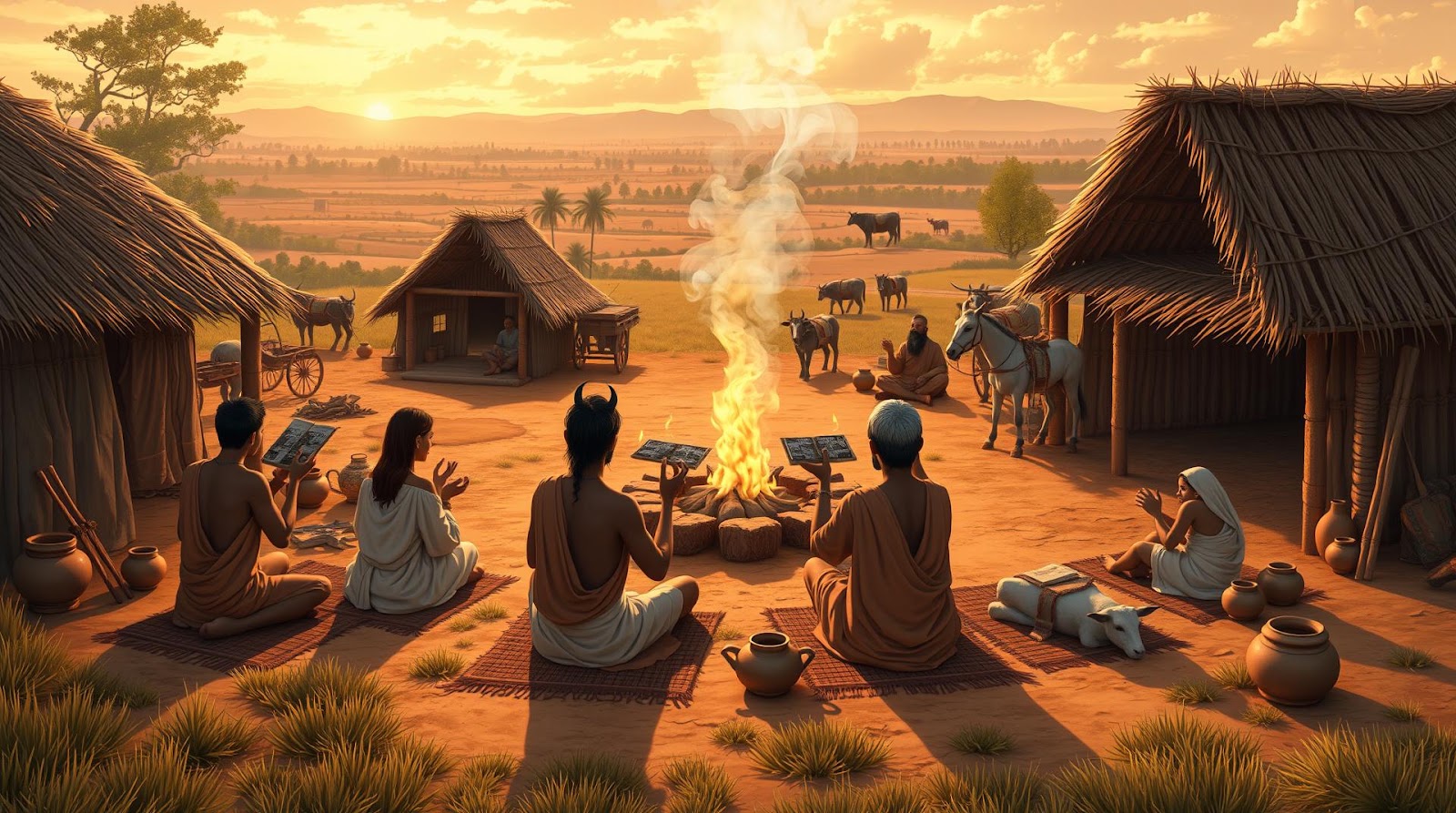
Picture this: small communities of pastoral people living along the Indus and Ganges, herding cattle, moving seasonally to find fresh pastures. They weren't farmers yet — they were nomadic warriors and pastoralists. Their economy was based on cattle (which is why cattle became sacred later). Their society had a simple structure, their weapons were bronze, and their gods were nature gods — Indra (the rain god, war god), Agni (fire), Vayu (wind).
The Rigveda is our best window into this period. It contains hymns, battle accounts, and descriptions of rituals. If you read the Rigveda, you get a sense of a martial, pastoral society constantly fighting for resources. The famous Battle of the Ten Kings (Dasharajnya) is described in the Rigveda, and it tells you everything about how conflict was central to their lives.
During this phase, society was divided into three classes: warriors (Kshatriyas), priests (Brahmins), and commoners (Vaishyas). The fourth class, the Shudras, emerged later. But here's what's interesting — this wasn't cast in stone yet. There was some mobility. It wasn't hereditary like it became later.
Later Vedic Period (1000-600 BCE): The Agricultural Transformation
Something major shifted around 1000 BCE. The Vedic people started moving eastward into the fertile Gangetic plains, and here's where everything changed. Iron tools arrived. Agriculture became possible on a massive scale. Instead of cattle herds, you could now farm. Societies became settled. Cities emerged.
This is when the Later Vedic texts — the Yajurveda, Samaveda, and Atharvaveda — were composed. The Brahmanas and Upanishads came from this period too. And this is also when the varna system became rigid and hereditary. The priesthood (Brahmins) consolidated power. Rituals became more complex and expensive. The social order became stratified.
By the end of the Later Vedic period, you had a fully formed hierarchical society with the foundations of what would become Hinduism. The Upanishads, composed in the later part of this phase, introduced philosophical concepts like Brahman (universal consciousness), Atman (soul), and karma that continue to shape Hindu philosophy today.
Key Features That Shaped Everything
The Varna System: Not Yet Caste, But Getting There
This is where I have to be very careful and precise, because the Vedic varna system and the modern caste system are related but not identical — though they're definitely connected historically.
In the Rigveda, the term "varna" simply means color, and it originally referred to a social division based on occupation and function. There were four varnas:
Brahmins — priests and scholars, responsible for rituals and knowledge
Kshatriyas — warriors and rulers, responsible for protection and governance
Vaishyas — farmers, merchants, and producers
Shudras — laborers and servants (added later, not in the early Rigveda)
The most famous description is in the Purusha Sukta (a hymn in the Rigveda), which describes the creation of these classes from the sacrifice of a cosmic man. It's mythology, but it became the ideological foundation for the whole system.
Here's what's crucial to understand: in the Early Vedic period, varna was based on gunas (qualities) and work (karma), not birth. You could theoretically change your varna through achievement. But as we move into the Later Vedic period and beyond, it gradually becomes hereditary and rigid. This is the slow transformation into what we know as the caste system today.
Why does this matter for your exam? Because the question often comes up: "Was the caste system present in the Vedic period?" The answer is nuanced: the varna system (its ancestor) existed, but the hereditary, rigid caste system wasn't fully formed yet. This distinction will get you marks.
Religious Beliefs and Practices
The Vedic people were polytheistic. They worshipped a pantheon of gods, many associated with natural phenomena. Indra was the king of gods and the god of war and rain. Agni was the god of fire and the messenger between gods and humans. Soma was a mysterious plant (probably a hallucinogenic) used in rituals. Surya was the sun god.
What's fascinating is how these gods gradually transformed. By the Later Vedic period, some gods become less important while others rise. This evolution continues into the Classical period where you get Brahma, Vishnu, and Shiva as the main trinity. It's not a sudden change — it's an evolution spanning centuries.
Rituals were central to Vedic life. The yajna (sacrifice) was the most important ritual. Think of it as the Vedic version of worship — you'd make offerings into a fire, and the priests would recite mantras. These rituals became increasingly elaborate and expensive, which is partly why the Brahmin priesthood gained so much power. Only they could perform these rituals correctly.
| Aspect | Early Vedic (1500-1000 BCE) | Later Vedic (1000-600 BCE) |
|---|---|---|
| Economy | Pastoral, cattle-based, nomadic | Agricultural, settled, farming-based |
| Society | Simple, relatively mobile, three classes | Complex, hereditary, four varnas, rigid hierarchy |
| Main Texts | Rigveda | Yajurveda, Samaveda, Atharvaveda, Upanishads |
| Religion | Polytheistic, nature gods, simple rituals | Polytheistic becoming philosophical, complex rituals, Brahmin dominance |
| Technology | Bronze weapons, horse-drawn chariots | Iron tools, better agriculture, improved chariots |
Literature, Language, and Knowledge
Sanskrit emerged during the Vedic period as the language of the Vedas and rituals. It's not the language these Indo-Aryans spoke when they arrived — it evolved over centuries. The Vedic Sanskrit of the Rigveda is actually different from the Classical Sanskrit that came later. Sanskrit had such a refined grammar system that the grammarian Panini (around 4th century BCE) could codify it so perfectly that it barely changed for the next 2,500 years!
The Vedas themselves are preserved through an oral tradition of incredible precision. Young Brahmins memorized every word, every syllable, every intonation. This is why we have such reliable texts even without written copies from that era. The oral tradition created redundancy — if one person's memory failed, a hundred others had it correct.
Beyond the four Vedas, the Vedic literature includes the Brahmanas (ritual texts), Aranyakas (forest texts), and Upanishads (philosophical texts). The Upanishads are particularly important for your exam because they represent a shift from ritualism toward philosophy. Questions like "Who am I?", "What is the nature of reality?", "What happens after death?" — these become central to the Upanishads.
One more thing that sticks with students: remember that the Vedas are shruti ("heard") — knowledge revealed by the gods. This is different from smriti ("remembered") — knowledge remembered by humans. This distinction becomes important when studying Hindu philosophy later.
Why the Vedic Period Still Matters
I'm going to be honest with you: some students wonder why they need to study something so ancient. Here's why I'm passionate about this topic:
First, the Vedic period established the intellectual and philosophical foundations of Hinduism that persist today. When we talk about concepts like dharma, karma, and moksha, we're discussing ideas that were first systematically explored in the Vedic and post-Vedic periods.
Second, understanding the origins of the varna system helps you understand modern India's social structure and the caste system debates that remain relevant in politics and society.
Third, the Sanskrit language, which became the language of classical India, took its form during this period. Sanskrit's influence on Indian languages, science, and philosophy is enormous.
Fourth, and this is what genuinely moves me — the Vedas represent humanity's attempt to understand the universe through reason, observation, and philosophy. Vedic mathematics, Vedic astronomy, Vedic medicine — these show an advanced civilization engaged in serious intellectual inquiry.
Finally, for your exam specifically, the Vedic period is foundational. Questions about later periods (Mahajanapadas, Maurya, Gupta) often require understanding the Vedic period as context. It's like learning the basic grammar before you try to read Shakespeare.
Common Misconceptions Cleared
After teaching hundreds of students, I've noticed some myths that keep circulating:
Myth 1: "The Vedas describe an invasion." The word often used is "invasion," but it was more of a migration. Invasion implies organized military conquest; migration means a gradual movement of people over decades and centuries.
Myth 2: "The Vedic people were the original inhabitants of India." No — they migrated in. The Harappans and other indigenous peoples were already here. What happened was cultural synthesis.
Myth 3: "The caste system was exactly the same in the Vedic period as today." No — the varna system was based on function; the modern caste system is hereditary and infinitely more complex. They're related, but not identical.
Myth 4: "Everything in the Vedas is factually true." The Vedas are a mix of ritual instructions, mythology, philosophy, and some historical references (like the Battle of the Ten Kings). We need to read them critically, not literally.
Practice Questions to Test Your Understanding
A) Rigveda — rituals and ceremonies B) Yajurveda — sacrificial procedures C) Samaveda — knowledge of health D) Atharvaveda — rituals for nobility
Answer: B) Yajurveda — sacrificial procedures. The Rigveda contains hymns and knowledge, Samaveda is about melodies, Atharvaveda is about healing and practical matters.
A) Shift from agriculture to pastoralism B) Shift from pastoralism to agriculture C) Development of iron weapons D) Decline of Sanskrit language
Answer: B) Shift from pastoralism to agriculture. This economic transformation led to settled societies and the complexification of social structures.
A) Agni B) Soma C) Indra D) Surya
Answer: C) Indra. Agni is fire, Soma is the ritual plant, Surya is the sun. Indra's prominence decreased in later periods.
A) Brahmanas B) Upanishads C) Samaveda D) Yajurveda
Answer: B) Upanishads. While Brahmanas still focus on rituals, Upanishads explore philosophical questions about reality, self, and existence.
A) Hereditary birth rights B) Wealth and property C) Occupation and function D) Military strength alone
Answer: C) Occupation and function. It was only later that varnas became rigid and hereditary, transforming into the modern caste system.
Final Thought: The Vedic period is like the root system of a massive tree. You can't fully appreciate the trunk, branches, and flowers of Indian civilization without understanding what's happening beneath the surface. Every time you learn about Ashoka, or medieval Hindu kingdoms, or modern India's cultural values — you're seeing the Vedic period's influence.
So the next time someone asks you "Why should I care about 3,500-year-old texts?" you tell them: because those texts contain the ideas that built a civilization, shaped billions of lives, and continue to influence how we think today. That's not just history. That's power.
Now go revise that revision table, practice those questions, and ace this topic in your exam. You've got this!
Published by Dattatray Dagale • 06 May 2026
.jpg)
.png)



.png)


.png)

0 Comments