Introduction
Let me start with a confession: when I first started teaching SSC CGL, I used to dread the Mughal Empire section. Students would groan, eyes would glaze over, and I'd see notebooks being closed before I could even write "Babar" on the board. Then one day, something clicked for me—and I'm going to share that with you right now.
Here's the thing: the Mughal Empire isn't just some dry, dusty historical period that happened 500 years ago and then disappeared. It's alive in your city right now. That monument you visited last year? Probably Mughal. The architectural style of old Delhi? Mughal influence. Even the way your grandparents describe "old India" often harks back to the grandeur of these emperors.
The Mughal Empire (1526–1857) is perhaps the most fascinating chapter of medieval Indian history because it answers a fundamental question: How did a handful of Central Asian emperors manage to rule nearly the entire Indian subcontinent for over three centuries? And more importantly for your exam: what lasting impact did they leave?
So let me take you on a proper journey through this empire—not the textbook way, but the way I explain it to my students over chai, with stories, tricks, and the kind of clarity that actually sticks in your head.
The Foundation: From Babar to Akbar (1526–1605)
The Accidental Emperor: Babar and the Battle of Panipat
Okay, imagine this scenario: You're living in Central Asia (modern-day Afghanistan), you've got some military ambitions, but things aren't working out great. You lose your homeland, you're getting pushed around, and then you think, "You know what? Let me go conquer India instead." That's basically Babar's life story.
Muhammad Babar (1483–1530) wasn't originally aiming for India. He was a Timurid descendant with decent military training and big dreams. But circumstances, fate, and a desperate invitation from an Indian sultan changed everything. When Daulat Khan Lodi (a disgruntled noble from the Delhi Sultanate) invited him to invade, Babar saw his opportunity.
Now, here's where it gets interesting. On April 21, 1526, at the First Battle of Panipat, Babar's 12,000 soldiers defeated Ibrahim Lodi's 100,000-strong army. How? Superior tactics, artillery, and something else critical: psychological warfare. Babar's use of the "tulughma" formation (a double envelopment tactic) completely confused Lodi's forces. It was like watching a chess grandmaster play against a beginner.
Let me give you a mnemonic I tell all my students to remember the early Mughal emperors: **B-A-J-A-A** (Babar, Akbar, Jahangir, Aurangzeb, and...wait, that's only 4, but you get the idea). Actually, let me fix that: **BAJAHU** (Babar, Akbar, Jahangir, Shah Jahan, Humayun). No wait, the chronology is wrong there! See, this is why I always tell students: create mnemonics that make sense to YOU, not just memorize mine.
Humayun's Struggle and the Afghan Interregnum
Here's the plot twist nobody expects: Babar's son, Humayun (1530–1540, 1555–1556), was absolutely terrible at ruling. He was a decent person, probably made good conversation, but as an emperor? Disastrous.
While Humayun was distracted, Sher Shah Suri (an Afghan noble) basically stole the throne and established the Sur Dynasty. For 15 years, the Mughal dream seemed dead. Humayun had to flee to Persia, live in exile, and genuinely contemplate whether his empire was finished. It's almost like a Bollywood movie where the hero has to leave the country but comes back stronger, right?
The lesson here—and this is something that appears in almost every exam question about Humayun—is that his weaknesses directly led to the strengthening of the empire under his son. Sometimes failure is a prerequisite for genius.
Akbar: The Empire's Greatest Emperor
If Babar built the house and Humayun failed to protect it, then Akbar (1556–1605) renovated it into a palace.
Akbar inherited the throne at age 13 and immediately faced the same Afghan threat that had overthrown his father. But unlike Humayun, Akbar had something special: ambition, intelligence, and the ability to learn. More importantly, he had a regent named Bairam Khan who shaped him in those crucial early years.
Now, you might be wondering: what made Akbar so different from other emperors? Three things stand out to me, and I think about these whenever I teach this period:
First, military reorganization: Akbar completely revamped the military system. He introduced what's called the "Mansabdari System"—a ranking system where nobility was based on merit and military service, not just lineage. Imagine going from "you rule because your grandfather did" to "you rule because you're actually good at your job." Revolutionary.
Second, religious tolerance: Akbar abolished the jizya (tax on non-Muslims), married a Hindu princess (Jodha Bai), and even married his own sister to a Hindu noble. This wasn't just personal preference; it was political genius. He understood that an empire with 80% Hindu population couldn't be ruled by constant religious oppression. He promoted "Sulh-i-kul" (universal peace)—the idea that different religions could coexist.
Third, administrative genius: Akbar divided his empire into provinces (subahs), each with a governor, collector, and military commander. It was like creating a franchise model—the center controlled the big decisions, but provinces had autonomy in execution.
One more thing about Akbar that students often miss: he couldn't read or write. Yes, seriously. The greatest Mughal emperor was illiterate. But he built a library, patronized scholars, and was deeply interested in knowledge. This teaches us something important: leadership isn't about knowing everything yourself; it's about surrounding yourself with people who do and having the intelligence to listen to them.
The Golden Age: Jahangir and Shah Jahan (1605–1658)
Jahangir: The Aesthetic Emperor
If Akbar was the administrator, Jahangir (1605–1627) was the connoisseur. He loved art, he loved literature, and honestly? He loved wine and opium a bit too much. His wife Nur Jahan basically ran the empire while he enjoyed the finer things in life.
But here's what makes Jahangir important for your exam: he maintained Akbar's policies of religious tolerance, expanded the empire further (especially in the Deccan), and his reign saw an incredible flourishing of art and culture. The miniature paintings during his time are absolutely stunning—if you get a chance, look them up online. They're not just beautiful; they're historical records.
Jahangir's memoirs, the "Tuzuk-i-Jahangiri," are also one of the most important primary sources for understanding this period. Examiners love asking about his policies and achievements.
Shah Jahan: The Builder Emperor
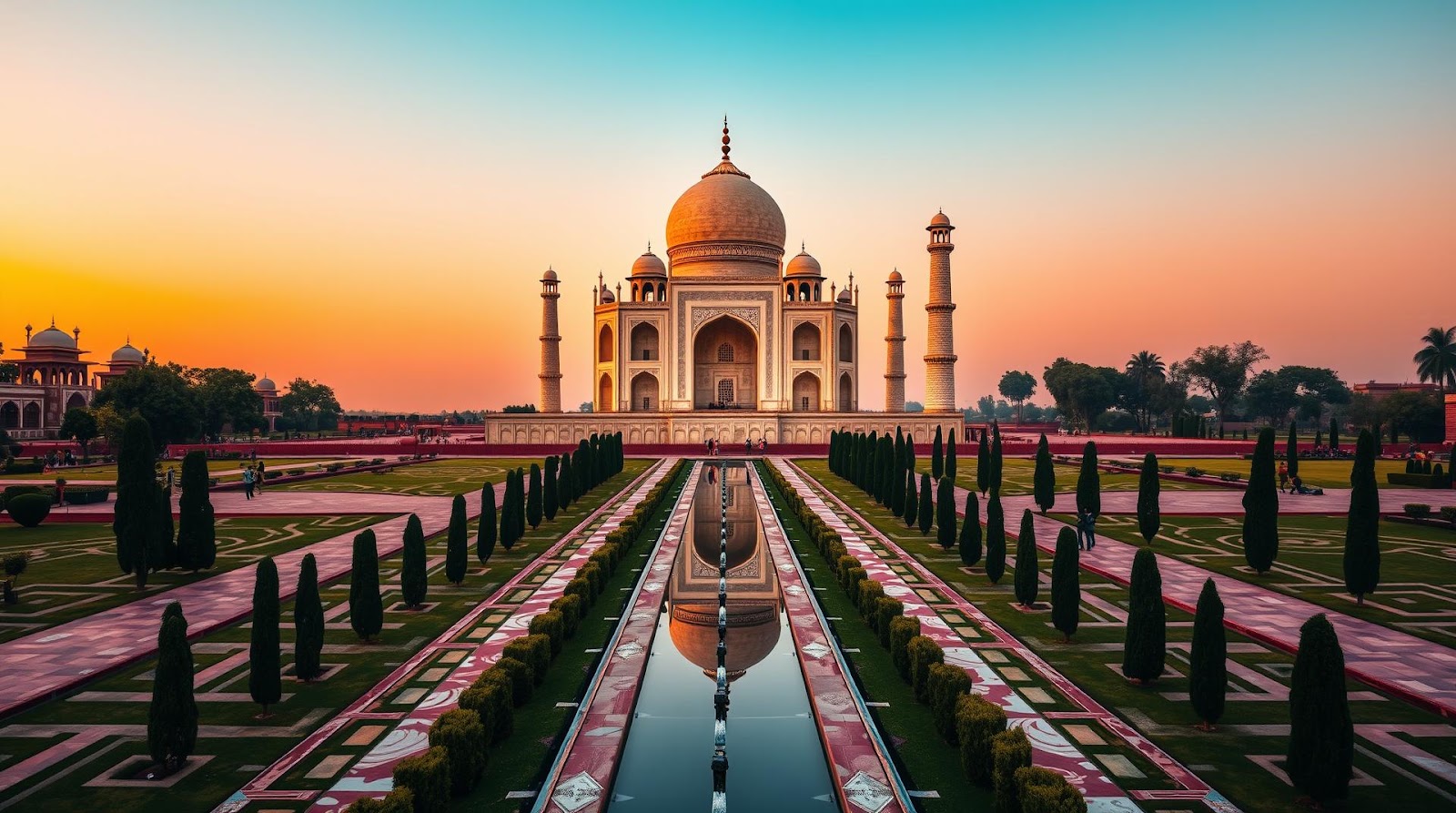
Now, Shah Jahan (1628–1658) is the emperor most people associate with the Mughal Empire because of one building: the Taj Mahal. And honestly, I can't blame them. It's the most visually stunning monument, and it tells an incredible story.
Shah Jahan built the Taj Mahal as a mausoleum for his wife Mumtaz Mahal, who died during childbirth in 1631. The construction took 22 years and employed 20,000 workers. Now, here's what students often get wrong in exams: the Taj Mahal is not just a love monument. It's also a symbol of Mughal power, artistic achievement, and architectural genius. When examiners ask about it, they're not asking for a romantic story; they want to know about the Indo-Islamic architectural synthesis, the precision of proportions, the skilled craftsmen from Central Asia and Persia.
But the Taj Mahal is just one of many monuments from Shah Jahan's reign. He also built:
• The Red Fort in Delhi (Lal Kila)
• The Jama Masjid in Delhi (one of the largest mosques in India)
• The Pearl Mosque (Moti Masjid)
• The Shalimar Gardens in Kashmir
• The Badshahi Mosque in Lahore
This man was basically the Bollywood director of the 1600s—he just wanted to make things visually perfect.
Shah Jahan's reign also saw the Mughal Empire at its territorial peak. From Afghanistan to Burma, from Kashmir to the Deccan—the Mughals controlled it all. The revenue was enormous, the culture was refined, and the art was world-class. European travelers visiting during this time often wrote home expressing shock at the wealth and organization they witnessed.
The Decline: Aurangzeb and the Fall (1658–1857)
Aurangzeb: The Orthodox Emperor Who Accelerated the Decline
Here's where the story takes a dark turn. Aurangzeb (1658–1707) was the complete opposite of Akbar and Shah Jahan. While they were tolerant and visionary, Aurangzeb was rigid and fundamentalist. And his policies directly contributed to the empire's decline, even if the decline happened gradually.
Some of Aurangzeb's decisions that haunted the empire:
Reintroduction of Jizya (1679): Akbar had abolished this tax on non-Muslims. Aurangzeb brought it back. Imagine the message this sent: "We don't want you as equal citizens; we want to tax your religion." It bred resentment and was essentially a slow-motion rebellion catalyst.
Destruction of temples: While earlier emperors had allowed temple construction and repair, Aurangzeb actively destroyed temples and banned new constructions. This wasn't just religious policy; it was political suicide because the majority Hindu population now felt genuinely persecuted.
Endless military campaigns in the Deccan: The Marathas, under Shivaji, had begun rising as a challenge to Mughal authority. Instead of adapting strategy, Aurangzeb spent 25 years (!) trying to militarily crush them. While he technically conquered their territories, he bankrupted the empire doing it. It's like spending your entire salary to win an argument you didn't need to win.
Neglect of administrative reforms: Where Akbar had innovated in governance, Aurangzeb basically said, "The system is fine; let's just enforce it more strictly." This meant that when new challenges emerged (regional powers, economic shifts), the empire had no adaptive capacity.
Here's the crucial thing though: Aurangzeb's reign was LONG (49 years), and for much of it, the empire seemed stable. Revenue was still flowing, territories were still controlled. But he was like a ship captain who ignored the small leaks below deck. They didn't matter when he was sailing smoothly, but they eventually became the reason the ship sank.
The Post-Aurangzeb Collapse
After Aurangzeb died in 1707, the Mughal Empire fragmented rapidly. His successors were weak, provincial governors started establishing independent kingdoms, and by 1750, the Mughal Emperor controlled little more than the Delhi region.
The empire didn't fall in one dramatic battle; it slowly dissolved. This is actually really important for your exam because questions often test whether you understand this gradual decline versus sudden collapse.
| Emperor | Period | Key Achievement | Key Problem |
|---|---|---|---|
| Babar | 1526–1530 | Founded empire; won Panipat I | Weak succession planning |
| Humayun | 1530–1540, 1555–1556 | Regained empire from Sher Shah | Lost throne to Afghan rulers |
| Akbar | 1556–1605 | Mansabdari system; religious tolerance; administration | None significant (greatest emperor) |
| Jahangir | 1605–1627 | Cultural patronage; art and literature flourished | Personal addiction issues; weak rule |
| Shah Jahan | 1628–1658 | Built Taj Mahal, Red Fort, Jama Masjid | Extravagant spending; succession conflict |
| Aurangzeb | 1658–1707 | Territorial expansion (Deccan) | Religious intolerance; endless wars; administrative rigidity |
Mughal Administration, Culture, and Lasting Legacy
How Did They Actually Govern?
You know what I realized after years of teaching? Many students can name Mughal emperors but have no idea how the empire actually functioned. Let me fix that quickly.
The Mughal administrative structure was hierarchical but relatively sophisticated for its time:
The Diwan-i-A'la (Prime Minister): The top bureaucrat who reported to the emperor. Think of him as the CEO of India Inc.
The Diwan-i-Vizarat (Finance Minister): Managed revenue, taxes, and the treasury. Every decision about how much tax to collect went through this person.
Provincial Governors (Subahdars): Each province (subah) had a governor who administered that region. There were 15 major subahs: Delhi, Agra, Awadh, Gujarat, Bengale, Malwa, and so on. These governors had considerable autonomy but reported to the center.
The Mansabdari System (Akbar's innovation): Military personnel and nobles received "mansabs" (ranks) which determined their salary, military responsibilities, and status. A person with mansab 5,000 was supposed to maintain 5,000 soldiers. This brilliant system meant that power was directly tied to military obligation, preventing nobles from becoming too powerful independently.
Revenue was collected through a system where the emperor owned all land (in theory). Farmers paid agricultural tax (usually 1/3 of produce), which flowed through the system: local tax collector → provincial official → central treasury. It was actually quite efficient for a pre-industrial society.
Culture, Art, and Architecture: The Visible Legacy
Here's what I love about teaching the Mughal period: the legacy is literally visible. Go to Delhi, and you're walking through Mughal history. The Red Fort, the Jama Masjid, the streets of Old Delhi—all Mughal.
Architecture: The Mughals synthesized Persian, Central Asian, and Indian architectural styles into something unique. The defining characteristics are: domes, arches, calligraphy, intricate lattice screens (jali), inlay work, and gardens with water features. The Taj Mahal is the most famous example, but honestly, every Mughal monument demonstrates this synthesis beautifully.
Literature: The court language was Persian, and Mughal emperors patronized poets and scholars extensively. Dara Shikoh (Shah Jahan's son) was a particularly important literary figure. The "Mughal Persian" literary tradition produced some of the finest poetry in history.
Painting: Mughal miniature paintings were incredibly detailed and often documented court life, hunts, and historical events. If you look at paintings from Akbar's court, you can see the Indo-Persian synthesis—the themes are Islamic, but the colors and techniques show Indian influence. Painters like Mir Mohan and Basawan were superstars of their time.
Music: The Mughals brought Persian classical music traditions, which mixed with Indian classical music to create a unique synthesis. Many classical music traditions you know today have Mughal roots.
Food: Biryani, korma, tandoori chicken—most of the "Indian" dishes you eat at restaurants actually have Mughal origins. The kitchens (khanasama) of Mughal courts created elaborate cuisines that blended Central Asian, Persian, and Indian traditions.
What I want you to understand is this: When examiners ask about Mughal culture, they're asking because the Mughals created a distinct civilization. It wasn't just Indian, and it wasn't just Persian or Central Asian—it was a unique synthesis. This synthesis is one of the most important contributions of the Mughal period.
Why the Mughal Empire Finally Fell
By 1700, the Mughal Empire was still massive on paper. But several things were happening simultaneously that spelled its doom:
Economic strain: Aurangzeb's wars in the Deccan drained the treasury. The empire that had seemed infinitely wealthy under Shah Jahan started showing cracks.
Regional powers rising: The Marathas under Shivaji and later the Peshwas, the Sikhs under Guru Gobind Singh, the Rajputs becoming more assertive, the Nizam of Hyderabad becoming semi-independent—these weren't coordinated rebellions, but they all eroded central authority.
Weak successors: After Aurangzeb, there wasn't a single capable emperor. Muhammad Shah (1719–1748) was the "last strong" emperor, but by then, the damage was done. His successor Ahmad Shah was even weaker.
The ultimate nail in the coffin: Nadir Shah's invasion in 1739. The Persian king invaded Delhi, plundered the imperial treasury (taking with him the Peacock Throne and the Kohinoor diamond!), and basically announced to the world that the Mughal emperor was powerless. After this, the Mughal Empire existed only in name in Delhi.
By the time the British East India Company started expanding in the 1750s, the Mughal Empire was already essentially dead. What the British conquered wasn't really a unified empire—it was a fragmented collection of independent kingdoms.
Quick Memory Tricks for Exam Day
Alright, I know you've got exams coming up, so let me give you some tricks I've developed over teaching 10,000+ students:
Trick 1: Remember the Six Great Mughals
Use this: "BAJAHU" (Say it like "badshah", the Urdu word for emperor—clever, right?)
B = Babar
A = Akbar
J = Jahangir
A = (Shah) Jahan
H = Humayun
U = Aurangzeb
Wait, the chronology is wrong there. Let me give you the right order as "BHAJAU": Babar, Humayun (who lost it), Akbar, Jahangir, (Shah) Jahan, Aurangzeb.
Trick 2: Aurangzeb's Problems (Exam Magnet!)
Remember: "RDM"
R = Reintroduced Jizya (Religious intolerance)
D = Destroyed temples (Divisive)
M = Military obsession (Marathan wars bankrupted the empire)
These three things directly caused decline. Examiners LOVE asking why the empire declined after Aurangzeb.
Trick 3: What Made Akbar Special
Think: "SRAM"
S = Sulh-i-Kul (Universal peace, religious tolerance)
R = Reorganized military (Mansabdari system)
A = Administration (Provincial system with subahs)
M = Married strategically (Hindu wife, secular approach)
These four things made him the greatest emperor.
I use these tricks in my classes, and students remember them for life. Create your own variations if these don't stick with you—personalized mnemonics are always better.
Final Thoughts: Why This Matters Beyond Exams
Here's something I tell all my students: history isn't just facts to memorize. It's a laboratory of human decision-making. When you study why Akbar succeeded while Aurangzeb (despite being a more capable military strategist) failed, you're not just learning history. You're learning about how policies, flexibility, and vision matter more than raw power.
The Mughal Empire lasted 330 years. That's longer than the entire history of independent India so far (76 years). During that time, they created some of the most beautiful monuments in the world, synthesized cultures in remarkable ways, and managed a complex empire. They also made mistakes—religious intolerance, economic mismanagement, and administrative rigidity—that directly contributed to their decline.
Every UPSC or SSC question about the Mughals is testing whether you understand this balance: how empires are built through vision and competence, and how they're destroyed through dogmatism and inflexibility.
Master this topic, and medieval Indian history becomes not just a question category, but a genuine understanding of cause and effect in history. And trust me, that's what separates students who score 80s from those who score 95s on exams.
Now go forth, ace those questions, and remember: Akbar's tolerance, not Aurangzeb's rigidity, is what made a legacy that lasts centuries.
Practice Questions: Test Your Understanding
A) Subahdari system B) Mansabdari system C) Jizya system D) Diwani system
Answer: B) Mansabdari system – This ranks military and nobility based on service and capability, revolutionizing how power was distributed in the empire.
A) Shah Jahan B) Jahangir C) Aurangzeb D) Akbar
Answer: C) Aurangzeb – His reintroduction of jizya, temple destruction, and the 25-year Deccan campaigns bankrupted the empire and caused widespread resentment.
A) It was the longest battle in medieval Indian history B) It established Babar's rule and founded the Mughal Empire C) It resulted in the rise of the Sur dynasty D) It saw the use of Indian artillery for the first time
Answer: B) It established Babar's rule and founded the Mughal Empire – This victory with superior tactics against a much larger force gave Babar control of Delhi and initiated the empire.
A) The immediate end of the Mughal Empire B) A 15-year Afghan interregnum where Sher Shah established the Sur Dynasty C) The permanent loss of northern India D) The migration of Mughal power to the Deccan
Answer: B) A 15-year Afghan interregnum where Sher Shah established the Sur Dynasty – Humayun's weakness allowed the Surs to temporarily control Delhi until Humayun's return in 1555.
A) Introducing the Mansabdari system B) Establishing Din-i-Ilahi C) Building monuments like the Taj Mahal and Red Fort D) Granting religious freedom to all citizens
Answer: C) Building monuments like the Taj Mahal and Red Fort – Shah Jahan's reign (1628–1658) was marked by extraordinary architectural achievements that showcased Mughal power and aesthetic refinement.
Published by Dattatray Dagale • 08 May 2026
.jpg)
.png)



.png)


.png)


0 Comments