Introduction
Let me start with a confession: when I first began teaching medieval Indian history, I found the Delhi Sultanate utterly confusing. Five dynasties, overlapping timelines, similar-sounding names... it felt like trying to follow a Bollywood script with too many sequels. But then something clicked, and I realized the Delhi Sultanate isn't just a bunch of random dynasties conquering and losing power. It's actually a fascinating story of cultural fusion, political intrigue, and how a foreign elite gradually became Indian.
If you're preparing for SSC CGL or UPSC, you absolutely need to understand this period because it's the bridge between ancient India and the Mughal Empire. The Delhi Sultanate (1206-1526) set patterns that would echo through Indian history for centuries. So grab a cup of chai, settle in, and let me walk you through one of the most misunderstood periods of Indian history.
What Was the Delhi Sultanate, Really?
Here's something most textbooks won't tell you clearly: the Delhi Sultanate wasn't one unified empire. Think of it like this — imagine if every 50 years, a new cricket team took over IPL, changed the rules slightly, brought in new players, but the basic game remained cricket. That's what happened with the Sultanate.
Between 1206 and 1526, five different dynasties ruled from Delhi. Each brought their own style, but they all followed a similar administrative template because, frankly, they didn't have to reinvent the wheel. They took the existing tax system, the army structure, and the bureaucracy they inherited and modified it based on their own needs and cultural preferences.
The Sultanate was essentially Muslim rule over a predominantly Hindu population. Now, I know that sounds contentious, and historians have debated this for centuries, but it's an important fact. What's equally important is that despite this religious difference, over 320 years, an incredible amount of cultural blending happened. The sultans didn't rule in isolation — they adopted local customs, patronized Indian art forms, and gradually their courts became distinctly Indo-Islamic rather than purely Islamic.
The Five Dynasties — My Trick to Remember Them
Let me give you a memory aid I share with all my students. The five dynasties were:
Slave → Khalji → Tughlaq → Sayyid → Lodi
Create a sentence: "Slave Khalji's Tughlaq Sayyid Lodi" — or simply remember S-K-T-S-L. I tell my students to imagine it as "Shakti Kapoor Takes Salman's Lunch" — absurd, I know, but it sticks! The point is: Slave (1206-1290) → Khalji (1290-1320) → Tughlaq (1320-1414) → Sayyid (1414-1451) → Lodi (1451-1526).
Each dynasty was different, but they all faced the same core challenges: maintaining control over vast territories, managing revenue, defending against Mongol invasions, and ruling over a population that often didn't share their religious beliefs.
The Dynasties That Shaped India
The Slave Dynasty (1206-1290): The Foundation
Qutb-ud-Din Aibak established the first dynasty after defeating Muhammad Ghori's forces and taking over his Indian territories. Now, here's what most people miss: Aibak didn't actually spend much time in Delhi. He ruled from Lahore and then Agra, which tells you something about how power in India was still decentralized.
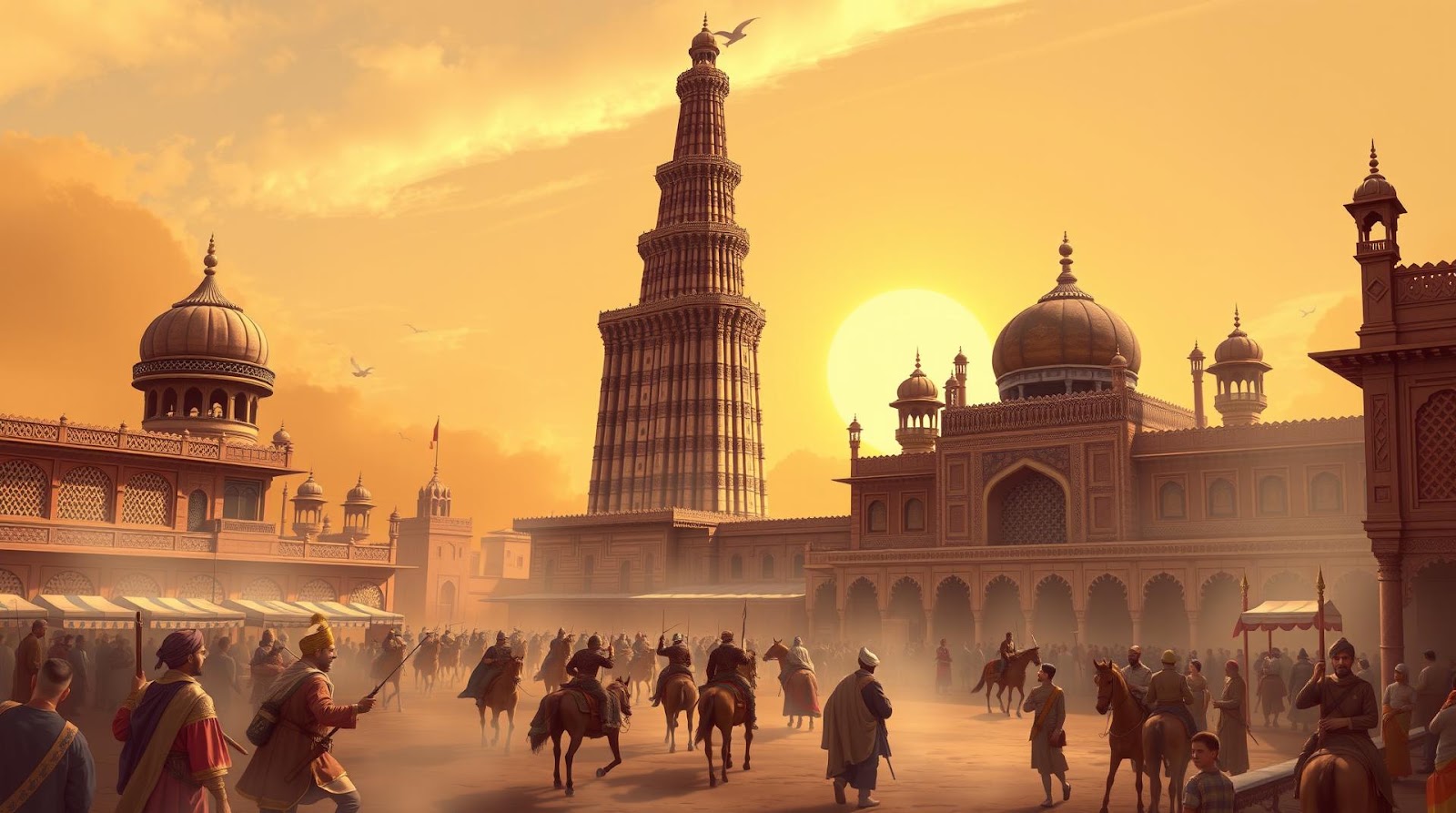
The most important thing about the Slave Dynasty was that it established the administrative framework. Aibak built the Qutb Minar — a structure that still stands in Delhi and is a UNESCO World Heritage Site. It's not just architecture; it was a statement: "We are here, we are powerful, and we're building a lasting civilization."
But the real game-changer was Illtutmish, who came later and actually consolidated power in Delhi. Under him, the sultanate expanded, and more importantly, he imported the Turkish administrative system that would last through all subsequent dynasties. He also established the Iqta system — kind of like feudal grants where land was given to officers in exchange for military service. This became the backbone of the sultanate's army.
The Khalji Dynasty (1290-1320): The Aggressive Expansionists
If the Slave Dynasty laid the foundation, the Khalji Dynasty turned up the aggression. Alauddin Khalji was one of the most ambitious and ruthless sultans, and I'll be honest — he's my favorite to teach because his policies were so extreme.
Alauddin did something revolutionary: he conquered southern India. Before him, no sultanate had seriously attempted controlling the Deccan. He sent his generals Malik Kafur deep into the south, and for a brief moment, Delhi's control extended all the way to Madurai. The booty he collected was enormous — thousands of horses, elephants, and treasure.
But here's the interesting part: how do you rule such a vast territory with 14th-century communication and transport? Alauddin realized the answer was control through fear and economic regulation. He implemented price controls on necessities, kept military slaves under strict surveillance, and centralized the bureaucracy to an unprecedented degree. He even moved the capital temporarily to Devagiri (Daulatabad) in the Deccan to better control the south.
His policies were harsh — sometimes brutally so — but they worked for maintaining stability. After his death, the dynasty collapsed quickly because his successors lacked his iron will.
The Tughlaq Dynasty (1320-1414): The Visionary Failures
Muhammad bin Tughlaq is one of my favorite characters to discuss with students because he represents something we see even today: brilliant ideas executed poorly. Historians debate whether he was a genius or mad, but I think he was both.
He attempted something revolutionary: moving the capital from Delhi to Devagiri and renaming it Daulatabad. His logic? Controlling the vast empire would be easier from a more central location. Smart, right? But here's the problem — he forced the entire court, administration, and even the common people to migrate. Imagine if tomorrow, the Indian government announced that we're shifting the capital to Indore because it's more central. The chaos would be unimaginable.
The migration was a disaster. People died on the journey, the economy disrupted, and eventually, he had to shift back to Delhi. But that's just one of his bold experiments. He also introduced token currency (coins made of brass and copper instead of precious metals) to fight inflation. Brilliant idea, terrible execution — people immediately counterfeited it, and the economy crashed.
Despite these failures, Tughlaq was an intellectual and patron of learning. His court was cultured, and he maintained diplomatic relations with distant kingdoms. He's a perfect example of how political vision and administrative reality don't always align.
The Sayyid and Lodi Dynasties (1414-1526): The Decline
After Tughlaq, things gradually fell apart. The Sayyid Dynasty (1414-1451) and Lodi Dynasty (1451-1526) tried to hold the crumbling empire together, but their grip weakened with each passing year. Regional governors became increasingly autonomous. Gujarat, Bengal, and the Deccan developed their own independent sultanates. The central authority of Delhi became more symbolic than real.
By the time Ibrahim Lodi ruled (1517-1526), the sultanate was just Delhi and its immediate surroundings. He was defeated by Babur at the Battle of Panipat in 1526, which ended the sultanate and began the Mughal era. But here's the thing — the Mughals actually adopted so many institutions and administrative practices from the Delhi Sultanate that it's not really an abrupt break. It's more like one dynasty gracefully handing over to the next.
Culture, Society, and Why This Period Still Matters
Now, if you're only studying the Sultanate to pass an exam, you might think it's just about rulers and battles. But what actually makes this period fascinating is the cultural revolution that happened quietly beneath the surface.
When Turkish and Persian elites came to India, they brought their own traditions. But they also absorbed Indian traditions. By the time of the later Sultanates, you see sultans speaking Hindi/Hindustani, consuming Indian food, and patronizing Indian art forms. This wasn't forced assimilation; it was natural cultural exchange.
Architecture is the most visible evidence. Look at the Qutb Minar — it has Islamic design principles but uses Indian marble and craftsmen. The courtyard design, the intricate lattice work (jali) — these are distinctly Indian. When you visit these monuments, you're looking at a conversation between two civilizations.
Music also flourished. The Sultanate period saw the development of new raag-rasa systems, new instruments, and new musical forms. Many classical Indian musicians served in sultanate courts. Was this "Hindu" or "Muslim" music? The question itself is meaningless — it was Indian music created by a multi-religious society.
The administrative system is equally important. The Sultanate formalized many practices that would become standard in Indian governance: the Diwani system (civilian administration), the Vizier (chief minister), the postal system, tax collection procedures, and even the concept of a centralized bureaucracy. When the British later created their own administrative structure, they found a ready-made model in what the Sultanate had built.
| Dynasty | Period | Key Ruler | Major Achievement | Key Challenge |
|---|---|---|---|---|
| Slave Dynasty | 1206–1290 | Illtutmish | Established Delhi as capital, created Iqta system | Succession disputes, limited territory |
| Khalji Dynasty | 1290–1320 | Alauddin Khalji | Conquered southern India, centralized power | Brutal rule, quick collapse after death |
| Tughlaq Dynasty | 1320–1414 | Muhammad bin Tughlaq | Ambitious reforms, cultural patronage | Failed policies, regional fragmentation |
| Sayyid Dynasty | 1414–1451 | Muzaffar Shah | Stabilization attempts | Weak central authority |
| Lodi Dynasty | 1451–1526 | Ibrahim Lodi | Afghan dominance | Defeated by Babur, end of sultanate |
What You Must Remember for Your Exam
Let me be practical here. If you're studying for SSC or UPSC, what are the high-probability topics?
First: The five dynasties and their chronological order. This is almost always asked directly. Use my S-K-T-S-L mnemonic.
Second: Key figures and their contributions. Qutb-ud-Din Aibak (founder), Illtutmish (consolidator), Alauddin Khalji (conqueror), and Muhammad bin Tughlaq (reformer). Learn at least one major contribution of each.
Third: Important structures and monuments. Qutb Minar, Jama Masjid, Safdarjung's Tomb — know which sultanate built what. This often comes up in architecture questions.
Fourth: Administrative systems like the Iqta system, Diwani, and the role of the Vizier. These are important because they influenced later empires.
Fifth: The transition to the Mughal Empire. Know that the Battle of Panipat (1526) ended the Sultanate, and Babur defeated Ibrahim Lodi.
One more trick I always share: when answering questions about cultural development during the Sultanate, always mention "Indo-Islamic culture" or "Hindu-Muslim synthesis." This shows the examiner that you understand nuance and aren't thinking in simplistic communal categories. The Delhi Sultanate was a period when Indian and Islamic traditions genuinely merged into something new.
Why This Matters Beyond the Exam
I'll end this section with something personal. When I teach the Delhi Sultanate, I'm not just teaching history for a checkbox. I'm teaching students that India has always been a place of cultural mixing, that foreign invasions don't simply destroy civilizations — they transform them, and sometimes that transformation is genuinely creative.
The Delhi Sultanate is proof that despite religious differences, political intrigue, and warfare, a shared geography can create something new. That's actually a pretty powerful lesson for a diverse, secular democracy like ours.
A) Alauddin Khalji B) Muhammad bin Tughlaq C) Ibrahim Lodi D) Qutb-ud-Din Aibak
Answer: B) Muhammad bin Tughlaq — He attempted this to better control the Deccan, but it was a failure.
A) Tax collection B) Maintaining military forces C) Religious administration D) Trade regulation
Answer: B) Maintaining military forces — Land grants were given to officers in exchange for maintaining cavalry and infantry.
A) Muhammad Ghori B) Qutb-ud-Din Aibak C) Illtutmish D) Alauddin Khalji
Answer: B) Qutb-ud-Din Aibak — He established the Slave Dynasty in 1206, though Illtutmish was the one who truly consolidated the sultanate.
A) Tughlaq B) Khalji C) Lodi D) Sayyid
Answer: C) Lodi — Ibrahim Lodi was defeated by Babur, ending the Delhi Sultanate and beginning Mughal rule.
A) Khalji B) Tughlaq C) Bahmani D) Lodi
Answer: C) Bahmani — The Bahmani Sultanate was an independent sultanate in the Deccan, not part of the Delhi Sultanate.
Published by Dattatray Dagale • 07 May 2026
.jpg)
.png)



.png)



.png)


0 Comments