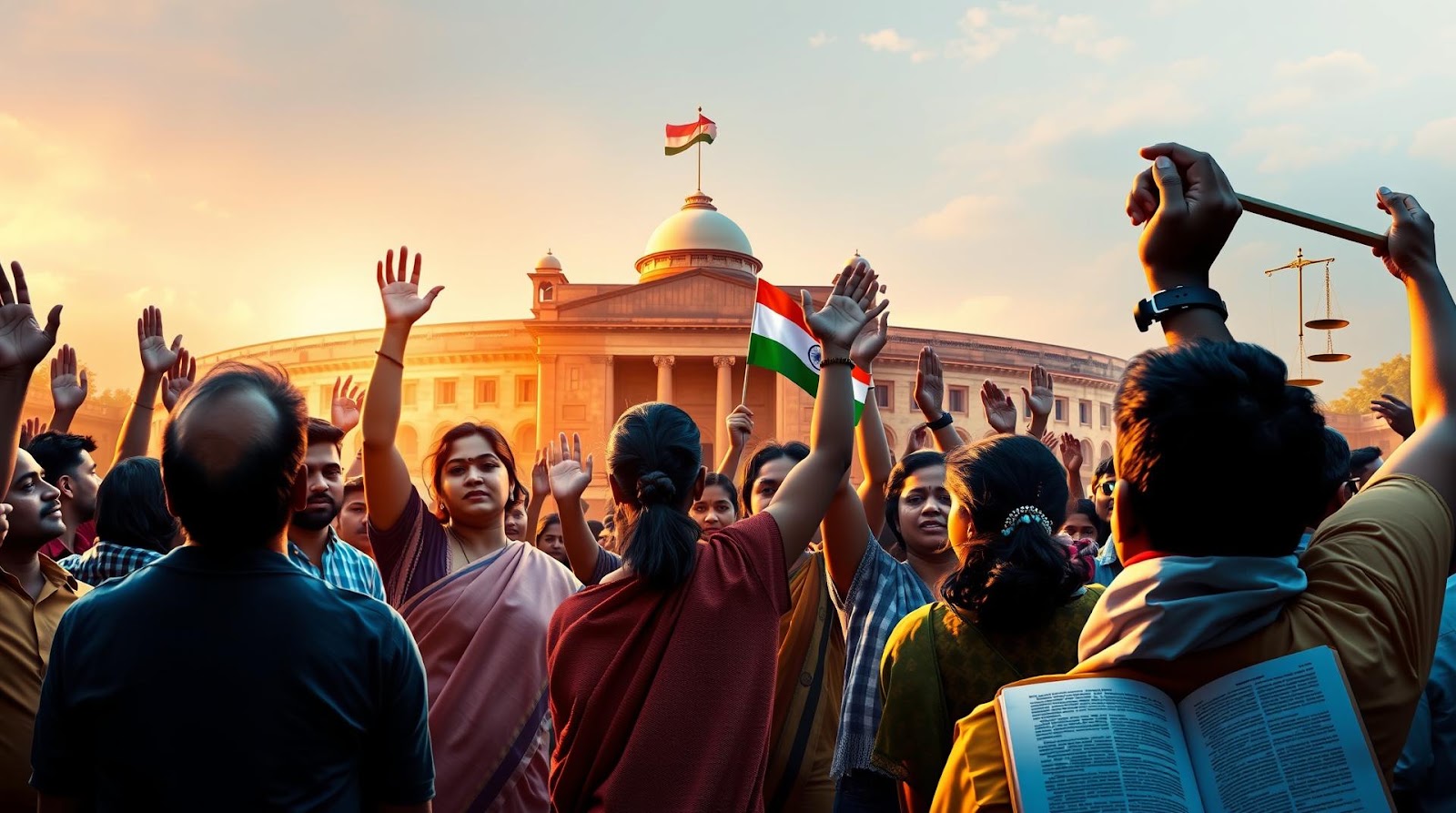
Introduction
You know, when I first started teaching SSC CGL ten years ago, I noticed something interesting. Most students could rattle off the six fundamental rights like robots, but ask them *why* these rights exist or how they actually work in real life? Blank stares. And that's a shame, because this topic isn't just about memorising lists—it's about understanding the very foundation that holds India together as a democratic nation.
Think of Fundamental Rights and Duties as a contract between the Indian citizen and the Indian state. The Constitution gives you certain freedoms and protections (your rights), but in return, it expects you to behave responsibly as a citizen (your duties). It's like the relationship between you and your school: the school provides education and facilities (rights), but you're expected to follow rules and attend classes (duties). Simple, right?
Now, I can tell you that in the last five SSC CGL exams, at least 2-3 questions have directly asked about fundamental rights or their limitations. UPSC takes it even deeper—they love asking about judicial interpretation, exceptions, and real-world conflicts. So let's dive in properly, because by the time you finish this post, you'll understand not just the what, but the why and how.
Understanding Fundamental Rights: The Big Picture
Fundamental Rights are the constitutional guarantees that protect the basic freedoms and dignity of every Indian citizen. They're listed in **Part III of the Indian Constitution (Articles 12–35)**, and they're directly enforceable in courts. This means if your rights are violated, you can go to court immediately without any intermediaries—that's massive.
Here's something I tell all my students: Fundamental Rights are not gifts from the government. They exist independent of government approval. The government cannot take them away arbitrarily. This is the radical idea embedded in our Constitution. Dr. Ambedkar and the Drafting Committee ensured that these rights would be protected from any majority tyranny or authoritarian government.
The Six Fundamental Rights (Remember CARE²D)
Let me give you a memory trick that actually sticks. Instead of trying to remember six separate rights, use the acronym **CARE²D**—it covers all of them:
- C – Equality (Constitutional Equality) → Article 14-18
- A – Freedom (Article wise) → Article 19-22
- R – Right to Exploitation (against exploitation) → Article 23-24
- E – Education & Culture → Article 29-30
- ² – No, wait… Let me be honest here. The traditional mnemonic doesn't work perfectly because the sixth right is "Constitutional Remedies" which is technically meta. Let me give you the real deal instead:
Actually, forget cute acronyms. The six fundamental rights are:
- Right to Equality (Articles 14-18)
- Right to Freedom (Articles 19-22)
- Right against Exploitation (Articles 23-24)
- Right to Freedom of Religion (Articles 25-28)
- Cultural and Educational Rights (Articles 29-30)
- Right to Constitutional Remedies (Article 32)
Now let's break down the important ones, because not all rights are tested equally.
Right to Equality – The Most Powerful One
Article 14 is the foundation of equality in India. It says "The State shall not deny to any person equality before the law or the equal protection of the laws within the territory of India." This means two things: - **Equality before law** (formal equality) – everyone is subject to the same law - **Equal protection of law** (substantive equality) – laws cannot discriminate arbitrarily I remember a case that perfectly illustrates this. In *Menaka Gandhi v. Union of India*, the Supreme Court expanded "equality" to mean not just equal treatment, but also substantive fairness. The Court essentially said: you can't hide behind a law if that law itself is discriminatory. Articles 15 and 16 extend this—the state cannot discriminate on grounds of religion, race, caste, sex, or place of birth. But here's where it gets tricky for exams: there are exceptions. The state *can* make special provisions for backward classes (SC/ST/OBC), women, and children. This is not discrimination; it's called **affirmative action** or **positive discrimination**.
Right to Freedom – The Most Debated One
Article 19 gives you six freedoms (originally seven, but one was removed). Here's what you get:
- Freedom of speech and expression (19a)
- Freedom to assemble peacefully without arms (19b)
- Freedom to form associations (19c)
- Freedom to move freely throughout India (19d)
- Freedom to reside and settle anywhere in India (19e)
- Freedom to practise any profession or trade (19g)
Now here's the clever part that examiners love: **These freedoms are NOT absolute.** Article 19(2)-(6) immediately places restrictions on these freedoms in the "interest of the state," "public order," "morality," etc. It's like giving you candy and then saying "but not all the time, not too much." During the COVID-19 lockdown, the government restricted freedom of movement (19d) and freedom to assemble (19b). Was this unconstitutional? No, because these restrictions were "reasonable" and in the interest of public health. The courts upheld it. This is how rights work in practice—balancing individual freedom with collective welfare.
Fundamental Duties: The Forgotten Half of the Story
Here's something that annoys me about most textbooks. They spend 80% of their time on Fundamental Rights and maybe 5 minutes on Fundamental Duties. But duties are equally important for understanding Indian citizenship. Without duties, rights become selfish entitlements.
Fundamental Duties are listed in **Article 51A** and were added by the 42nd Amendment in 1976 (the infamous Emergency amendment, but this one part was actually good). There are 11 duties originally, and the 86th Amendment added one more in 2002, making it 12.
Here's my memory trick for the main duties. Think of **"FRUITS OF INDIA"**:
- F – Follow Constitution and respect national symbols (flag, anthem, Constitution)
- R – Respect values of freedom struggle
- U – Uphold unity and integrity of India
- I – Improve public property, protect environment
- T – Tolerate differences (peaceful resolution of disputes)
- S – Safeguard public property and abjure violence
- O – Offer best efforts for excellence (in academics, professions)
- F – Foster scientific temper and humanism
- I – Intermediate in national defense and duty
- N – Nurture children (parents' duty to provide education)
- D – Defend India and render national service
- I – Instill values in children (constitutional values)
- A – Advance by education (especially for parents toward children)
Honestly, that's a bit forced. Let me just give you the categories that exams actually test:
- Respect the Constitution, flag, and national anthem
- Defend the country and render national service
- Protect public property and environment
- Maintain public morality and scientific temper
- Promote harmony and renounce violence
- Provide education to children (parental duty)
The key difference between rights and duties is that rights are *enforceable in court*, but duties are not—they're moral obligations. The Constitution itself says duties are not enforceable through courts (Article 51A explicitly states this). However, the Supreme Court has sometimes indirectly enforced them through public interest litigations and constitutional interpretation.
The Critical Catch: When Rights Can Be Restricted
This is where students usually mess up in exams. They think fundamental rights are absolute, but they're not. The Constitution itself provides the grounds on which rights can be restricted. Let me break this down clearly.
Reasonable Restrictions Under Articles 19(2)-(6)
For freedoms listed in Article 19, the Constitution allows "reasonable restrictions" in the interest of:
- Sovereignty and integrity of India
- State security and public order
- Decency or morality
- Contempt of court
- Defamation
- Incitement to an offense
Notice the word "reasonable." It's crucial. A restriction must be proportionate, necessary, and not arbitrary. The burden is on the *state* to prove that a restriction is reasonable, not on the citizen to prove it's unreasonable.
Emergency Powers – When Government Gets Serious
During national emergencies (Article 352) or state emergencies (Article 356), the government can suspend or curtail fundamental rights. This happened dramatically during the 1975 Emergency under Indira Gandhi, when many rights were suspended. This is why we now have strict checks and balances around emergency powers.
But here's the thing: even during emergencies, the Supreme Court has held that certain core rights (like the right to life and dignity) cannot be completely suspended. This came out during the Emergency era itself through cases like *ADM Jabalpur v. Shivkant Shukla*.
| Fundamental Right | Main Restriction | Example |
|---|---|---|
| Right to Equality (14) | State can make positive discrimination for SC/ST/OBC | Reservation in jobs and education |
| Freedom of Speech (19a) | Contempt, defamation, sedition, hate speech | Section 124A IPC (sedition law) |
| Freedom to Assemble (19b) | Can be restricted for public order | Curfew during communal riots |
| Freedom of Religion (25) | Public order and morality | Ban on sati, child marriage restrictions |
| Right to Property (removed as FR) | State can acquire for public purpose | Land acquisition for public projects |
Article 32: Your Nuclear Button Against Government Tyranny
If fundamental rights are the soul of the Constitution, then Article 32 is the body that brings them to life. Article 32 is literally the "Right to Constitutional Remedies." It allows any person to approach the Supreme Court if their fundamental rights are violated.
This is why Article 32 itself is considered a fundamental right. Without it, all other rights are just words on paper. You can file a writ petition (Habeas Corpus, Mandamus, Prohibition, Certiorari, or Quo Warranto) directly in the Supreme Court, and there's no requirement to exhaust other legal remedies first.
I always tell students: if a government official throws you in jail without a proper trial, you don't need a lawyer or a lower court. You can directly file a habeas corpus petition in the Supreme Court and demand your freedom. That's the power of Article 32. This is exactly what happened during the Emergency when political prisoners filed such petitions.
But here's a historical note: during the Emergency, even Article 32 was suspended! Indira Gandhi's government literally removed the right to go to the Supreme Court. That's how dangerous and important this article is. The moment the Emergency ended, it was restored. And we amended the Constitution to make sure such a thing could never happen again.
How Exams Test This Topic
Let me give you the patterns I've seen in the last decade of exams:
SSC CGL Pattern: Usually tests straightforward facts—"Which article deals with equality?" or "What are the six fundamental rights?" Sometimes they ask about reasonable restrictions or emergency powers. Direct, factual, no tricks.
UPSC Pattern: Way more sophisticated. They ask about judicial interpretation, conflicts between rights, the distinction between rights and duties, constitutional amendments that affected fundamental rights, and real-world case studies. Example: "How did the Supreme Court interpret 'right to privacy' as a fundamental right even though it's not explicitly mentioned in Part III?" (Answer: *Puttaswamy case*, 2017)
So if you're preparing for UPSC, go beyond memorisation. Read landmark cases. Understand how courts have expanded and narrowed these rights over time. Understand that rights are not static—they evolve with society.
For SSC, focus on the exact articles, the names of the rights, restrictions, and the difference between fundamental rights and directive principles (which I haven't covered here, but that's another topic). Make sure you can quickly recall which article deals with what.
Quick Revision Table
| Right / Duty | Article(s) | Key Points |
|---|---|---|
| Right to Equality | 14-18 | Equality before law, no discrimination, but reservation allowed for SC/ST/OBC |
| Right to Freedom | 19-22 | 6 freedoms; subject to reasonable restrictions by state |
| Right against Exploitation | 23-24 | Ban on trafficking and child labour; right to move and work freely |
| Right to Religion | 25-28 | Freedom to practice, propagate, manage religious affairs; state can restrict on public order |
| Cultural & Educational Rights | 29-30 | Protect minorities' right to culture, language, education |
| Right to Constitutional Remedies | 32 | Can approach Supreme Court for FR violation; writs available; non-suspendable per 44th Amendment |
| Fundamental Duties | 51A | NOT enforceable in courts; moral obligations; 11 + 1 duties (added 86th Amendment) |
Practice Questions to Test Your Knowledge
A) Right to Equality B) Right to Property C) Right to Freedom of Religion D) Right to Constitutional Remedies
Answer: B) Right to Property — It was a fundamental right (Article 19(1)(f)) but was removed by the 44th Amendment in 1978 and made a legal right under Article 300A.
A) Article 14 B) Article 15 C) Article 16 D) Article 17
Answer: C) Article 16 — But note that Article 15 also allows this for education. The key difference: Article 15 is about "Prohibition of Discrimination" while Article 16 specifically deals with "Equality of Opportunity in Matters of Public Employment."
A) Article 19 (Freedom) B) Article 21 (Life and Liberty) C) Article 32 (Constitutional Remedies) D) Article 14 (Equality)
Answer: C) Article 32 — Because without the right to approach courts, all other rights become meaningless. During the Emergency, Article 32 was suspended, which explains its critical importance.
A) Article 51A; Yes, enforceable B) Article 51A; No, not enforceable C) Article 32; Yes, enforceable D) Article 300A; No, not enforceable
Answer: B) Article 51A; No, not enforceable — The article itself explicitly states that duties are not enforceable in courts. However, they can be indirectly promoted through public interest litigations and constitutional interpretation.
A) Right to Equality B) Right to Freedom of Speech C) Right to Constitutional Remedies (Article 32) D) Right to Property
Answer: C) Right to Constitutional Remedies — The government suspended Article 32, meaning people couldn't approach courts to protect other rights. This is why the 44th Amendment later made Article 32 non-suspendable even during emergencies. This was one of the most dangerous moments in independent India's constitutional history.
Final Thoughts
Look, I've taught thousands of students, and I can tell you that most of them see Fundamental Rights as just another chapter to memorise. But that's missing the whole point. These rights and duties define what it means to be an Indian citizen in a democratic system. They're not abstract concepts—they're what protect you when the government overreaches, what allow you to protest injustice, what guarantee that no matter your religion, caste, or gender, you're equal before the law.
The fact that your grandfather's generation didn't have these protections, that they lived under colonial rule where such rights didn't exist, makes your rights even more precious. Every time you question authority peacefully (Article 19), every time you practice your religion freely (Article 25), every time you send your child to the school of your choice (Article 29-30)—you're exercising fundamental rights.
So as you prepare for your exams, don't just memorise articles. Understand the stories behind them. Read about the Emergency, about cases like *Kesavananda Bharati*, about how the Supreme Court has protected rights even against government pressure. That's when this topic becomes alive, and that's when it sticks in your memory forever.
All the best with your preparation. You've got this!
Published by Dattatray Dagale • 30 June 2026
.jpg)
.png)



.png)



.png)

0 Comments