Introduction
Let me start with a confession. When I first started teaching history to SSC aspirants, I used to rush through 1857. I'd treat it like a checkbox—mention the revolt, name a few leaders, move on. Then one of my students, a bright kid from Bihar, asked me a question that changed how I teach this topic forever: "Sir, if 1857 failed, how did we actually win freedom in 1947?"
That question made me realize something crucial: 1857 isn't just about a revolt that failed. It's about the moment India woke up. It's the moment when millions of ordinary Indians—soldiers, farmers, princes, common folk—looked at British rule and said "No more." It didn't end the British Raj in 1857, sure. But it planted seeds that would grow into a full-fledged independence movement.
Here's what makes 1857 so special for your exam prep: understand this revolt, and you'll understand the entire trajectory of the Indian freedom struggle. It's like the foundation of a building. Without it, the walls of Gandhi, Nehru, and Subhas Chandra Bose wouldn't have the same meaning.
The Powder Keg: What Led to the 1857 Revolt
You know how in cricket, a batsman doesn't just suddenly lose their cool? There's a build-up of frustrations—a series of decisions they disagree with, the pace bowler getting under their skin, the crowd jeering. By the time they explode, it's not just about one ball. By 1857, India was that batsman. And the British were bowling bouncers at our chin.
The Economic Exploitation
The British East India Company came to India as traders. But here's what happened over time: they became rulers who extracted wealth like nobody's business. Indian industries—textiles, indigo, spices—were destroyed so British goods could be sold instead. Indian farmers had to grow what the Company wanted, not what they needed. Taxes kept rising. The local economy collapsed.
By the 1840s-50s, famines hit. The British didn't care. They kept extracting taxes even when people were starving. This created massive resentment among zamindars (landowners), merchants, and farmers. They felt economically suffocated.
The Social and Religious Provocations
Now here's what the British didn't understand about Indian society—religion and tradition aren't separate from daily life. They're woven into everything. But the British administration kept stepping on these sentiments.
Christian missionaries were converting Indians. The British started interfering with caste practices (some changes were good, like ending sati, but the way they did it felt like cultural invasion). High taxes meant people couldn't afford religious ceremonies. For a Hindu or Muslim farmer, this felt like an assault on their identity itself.
And then came the Enfield rifle cartridges. These cartridges were greased with animal fat—either cow fat or pig fat, depending on who you ask. The very act of biting them (as soldiers had to do to load them) would violate the religious beliefs of Hindu and Muslim soldiers alike. This wasn't just a technical issue. It was a symbolic declaration: "We don't respect your religion."
The Political Disempowerment
The British were systematically removing Indian rulers from power. The "Doctrine of Lapse" (introduced by Lord Dalhousie) meant that if an Indian prince didn't have a male heir, their kingdom would be annexed to the British Empire. Can you imagine? You rule for generations, and suddenly, if you can't have a son, your kingdom is gone. Rulers like Nana Sahib, the Rani of Jhansi, and others were humiliated and dispossessed. These were people with armies, with followers, with centuries of legitimacy. Now they were powerless.
The British also didn't include Indians in positions of real power. You could be a clerk, a subordinate official, but never the top boss. This created resentment among educated Indians and the nobility alike.
The Revolt Itself: 1857 Timeline and Key Events
Let me give you a memory trick I use with all my students. Remember "MEND"—this helps you remember the first major centers of revolt:
M = Meerut (where it started)
E = Era of expansion (to other cities)
N = North and Central India (where it was strongest)
D = Defeated by 1858-59
The Spark: Meerut and Delhi (May 1857)
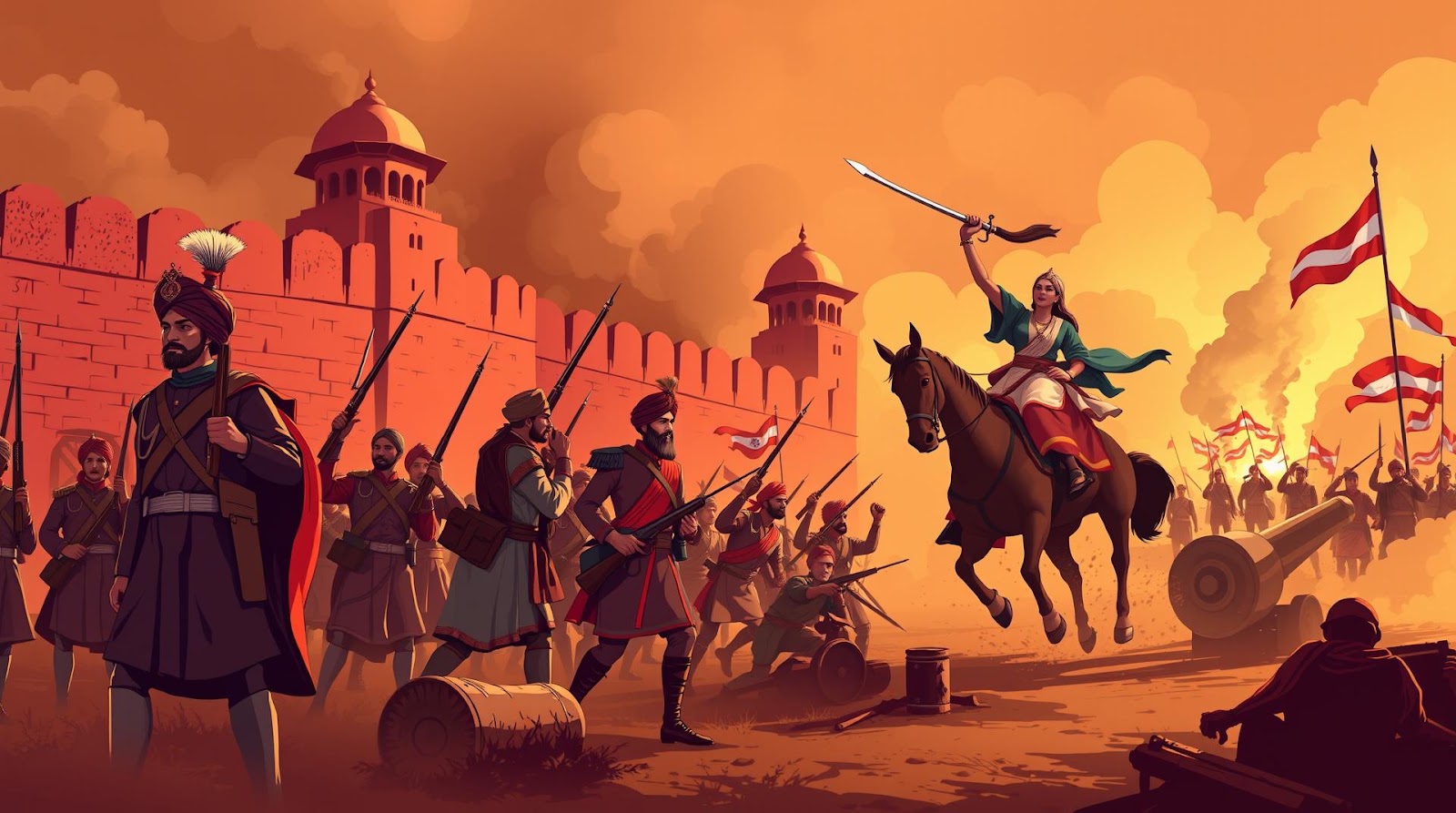
May 10, 1857. Meerut cantonment. Indian soldiers refused to use the Enfield rifle cartridges. They were court-martialed and imprisoned. Other soldiers saw their brothers being punished for refusing to compromise their faith. That night, they revolted. They freed their imprisoned comrades and marched toward Delhi.
Delhi, the old capital of the Mughal Empire, became the symbolic center of the revolt. The rebels declared the elderly Mughal Emperor Bahadur Shah Zafar as their leader. Now, here's an interesting historical twist—Bahadur Shah wasn't really in control. He was old, reluctant even. But his name gave legitimacy to the revolt. It said: "This isn't just against the Company. We're restoring the old India."
Spread Across the Heartland
From Delhi, the revolt spread like wildfire across the North and Central India. Lucknow became another major center. The Rani of Jhansi (Lakshmibai) fought with her small army against overwhelming British forces. Kanpur, Agra, Bareilly—everywhere, Indian soldiers and civilians rose up. Some uprisings were led by educated rebels, some by peasants, some by disgruntled princes. It wasn't one unified movement, but it had a common enemy and a common cause.
What's remarkable is how diverse this revolt was. Muslim soldiers fought alongside Hindu soldiers. Peasants fought alongside noblemen. In many places, common people actively supported the rebels by providing supplies and shelter. This wasn't a fringe movement—it had real, grassroots support.
The British Response and Suppression
The British were shocked. But they had something the rebels didn't: superior organization, better weapons, and fresh troops from England. They appointed generals like Henry Havelock and James Outram, who were ruthless. The British strategy was simple—suppress with overwhelming force, make examples, restore fear.
By late 1857, the British had regained control of Delhi and Kanpur. By mid-1858, Lucknow fell. The Rani of Jhansi died fighting (exact circumstances debated by historians). Bahadur Shah Zafar was captured and exiled to Burma where he died in 1862. By 1859, organized resistance had been crushed.
| Place | Leader/Notable Figure | Duration of Resistance | Outcome |
|---|---|---|---|
| Delhi | Bahadur Shah Zafar | May-Sep 1857 | Suppressed, Emperor exiled |
| Lucknow | Begum Hazrat Mahal | Jun 1857-Mar 1858 | British siege and capture |
| Jhansi | Rani Lakshmibai | Mar-Jun 1858 | Killed in battle |
| Kanpur | Nana Sahib | Jun-Jul 1857 | British recapture, Nana escaped |
| Bareilly | Khan Bahadur II | May 1857-May 1858 | Suppressed |
Why 1857 Failed and Why It Still Mattered
This is the section where I always pause and ask my students to think critically. Yes, 1857 failed militarily. The British crushed it. But here's what I want you to understand: failure in one battle doesn't mean defeat in the war. Sometimes, the most important victories are the ones that don't look like victories in the moment.
Why the Revolt Couldn't Succeed
First, it lacked unity. Different regions had different leaders with different goals. Nana Sahib wanted to restore his kingdom. The Rani of Jhansi fought for her principality. Bahadur Shah represented a Mughal restoration dream. There was no grand strategy, no central command, no unified vision of what "free India" would look like after the British left. You can't win a war when your soldiers don't know what they're fighting for beyond "against the British."
Second, the peasantry participated in some areas but not uniformly across India. South India remained mostly quiet. Bengal, despite being a hotbed of British activity, had limited revolts. This gave the British room to organize and bring in reinforcements.
Third—and this is crucial—the rebels didn't have the military technology or the organizational structure the British had. The British had industrial backing, a professional army structure, and the ability to coordinate across regions. The rebels had courage, numbers in some places, and local knowledge. But against modern colonial military machinery, that wasn't enough.
But Here's the Plot Twist: 1857 Changed Everything
The British realized something important after 1857: direct rule through a company wasn't working. They took direct control through the Crown. India became a British colony, then later, an Empire with an Empress (Victoria). This wasn't benevolence—it was adaptation.
But more importantly, 1857 showed Indians what collective resistance could achieve. It showed that the British weren't invincible gods. They were humans who could be challenged. This realization spread through Indian society. It inspired a new generation—the educated middle class, the journalists, the lawyers, the students—who would later lead the freedom struggle through different means: petitions, press, civil disobedience, and mass movements.
The generation that led the Indian National Congress (founded in 1885) didn't fight like 1857. They didn't use swords. They used arguments, evidence, and public opinion. They understood that military rebellion had failed, so they'd try a different path. But they were standing on the shoulders of 1857's martyrs.
1857 and Its Legacy: The Bridge to Modern India
You know what I tell students when they ask "Will 1857 come in my exam?" I say: "Every single question about modern India connects back to 1857." Let me explain why.
The 1857 revolt redrew the map of Indian consciousness. Before 1857, there was no "India" as a united concept—not really. There were kingdoms, empires, regions, religions. After 1857, there was an "India" that could collectively resist colonial rule. The idea of a nation was born.
The leaders who came after—Rammohan Roy, Ishwar Chandra Vidyasagar, Dayanand Saraswati, and later Gopal Krishna Gokhale, Aurobindo Ghosh, and eventually Gandhi—they all internalized this lesson: India needed to be united. The diversity of 1857 (Hindu soldiers, Muslim soldiers, peasants, princes) showed both the strength and the fragility of unified resistance. The next generation worked to make that unity stronger through ideologies, organizations, and mass participation.
Here's another memory trick: Think of 1857 as the "WAKE UP" call:
W = Western rule was not permanent
A = All sections could unite (soldiers, peasants, princes)
K = Knowledge of military limitations against modern weapons
E = Educational and intellectual response came next
U = United India became the goal
P = Political independence movement emerged
By 1947, when India became independent, it was through a very different method than 1857 attempted. But the road to 1947 started from the ashes of 1857. Every Congress session, every speech by Gandhi, every march for independence—they stood on the foundation that 1857 had laid: the idea that Indians could resist and could win.
For your SSC and UPSC preparation, master 1857 not just as a historical event, but as the turning point in Indian history. It's where everything changed. It's where India stopped being passive and started being active in its own destiny.
Practice Questions for Your Revision
A) Enfield rifle cartridge issue B) Economic exploitation by the East India Company C) The Doctrine of Lapse D) British introduction of railways
Answer: D) British introduction of railways. While railways were a source of some social disruption, they were not a major cause of the 1857 revolt. The cartridge issue, economic exploitation, and the Doctrine of Lapse were primary causes.
A) He was a military strategist B) He represented the symbolic continuation of Mughal authority C) He was young and energetic D) He had the support of all Indian princes
Answer: B) He represented the symbolic continuation of Mughal authority. Bahadur Shah was elderly and initially reluctant, but his name gave legitimacy to the revolt by connecting it to the Mughal past.
A) She signed a peace treaty with the British B) She was exiled to Burma after the revolt C) She died fighting British forces D) She led the revolt in Lucknow
Answer: C) She died fighting British forces. Lakshmibai led the resistance in Jhansi and died in combat in June 1858, becoming one of the most celebrated figures of the 1857 revolt.
A) The rebels had no weapons B) Lack of unity and coordination among different rebel groups C) Most Indians were against the revolt D) The revolt lasted only a few days
Answer: B) Lack of unity and coordination among different rebel groups. Different leaders had different goals, there was no central command, and the revolt wasn't synchronized across regions, making it impossible to sustain against organized British military response.
A) They reduced taxation for Indian farmers B) They transferred control from the East India Company to direct Crown rule C) They allowed Indians to hold the highest administrative posts D) They granted independence to Indian principalities
Answer: B) They transferred control from the East India Company to direct Crown rule. Following 1857, the British Crown took direct control of India, replacing the East India Company's direct administration, though this remained fundamentally colonial in nature.
Published by Dattatray Dagale • 03 June 2026
.jpg)
.png)



.png)



.png)


0 Comments