Introduction
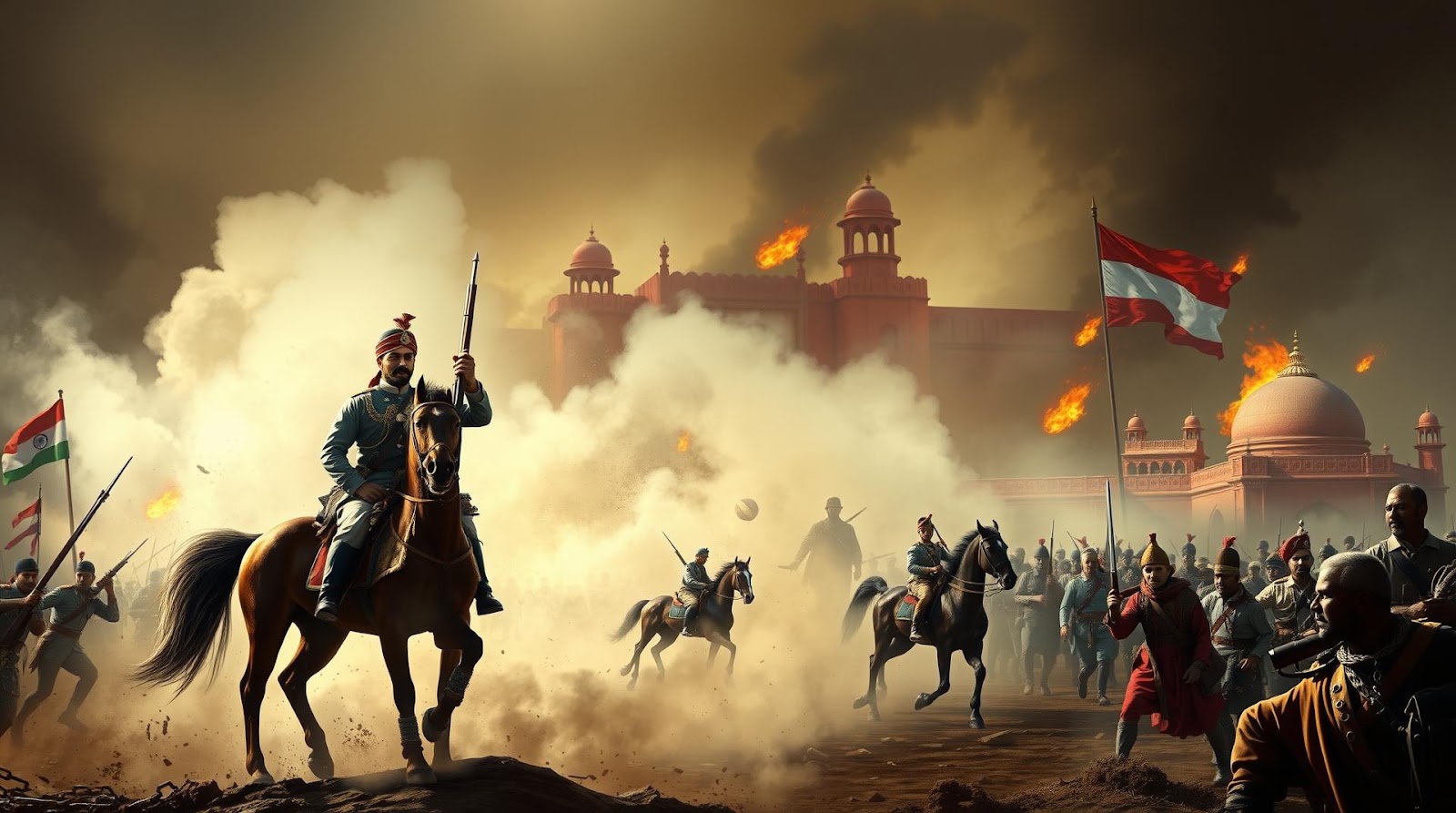
Let me start with a confession. When I was preparing for my own exams years ago, I used to think 1857 was just another date to memorize. The Revolt of 1857. Sepoy Mutiny. Bang — facts, figures, done. But the first time I actually *understood* what happened that year, I had goosebumps. And that's when I realized: this isn't history to memorize. It's a story to feel.
Here's the thing about 1857 that most textbooks miss — it wasn't just a military rebellion. It was the moment when ordinary Indians, from all walks of life, decided they'd had enough. A sepoy in Meerut, a farmer in Jhansi, a weaver in Delhi, a zamindari in Lucknow — they all rose up at roughly the same time, against the same enemy, without a central WhatsApp group to coordinate (imagine that!). That's what makes it special.
Now, if you're studying this for SSC CGL or UPSC, you probably have a bunch of questions. Who started it? Why did it fail? What exactly changed after it? Don't worry — I'm going to walk you through all of this the way I explain it to my students, with stories, patterns, and yes, even some memory tricks that actually stick.
The Powder Keg: Why India Was Ready to Explode
You know how in cricket, sometimes a bowler doesn't actually win the match, but by the time he finishes his spell, the opposition is already rattled? The batsmen are tense, the fielding is off, and the next bowler just needs one good delivery to finish it. That's what India was like by 1850s — a batsman waiting for the final ball.
Economic Humiliation and Land Policies
The British had a brilliant strategy for controlling India: bleed it economically. Between 1750 and 1850, India's share of world GDP went from 23% down to just 4%. Think about that. We went from being one of the richest civilizations on Earth to being treated like a cash cow.
The Permanent Settlement of 1793 (under Lord Cornwallis) completely changed land ownership. Zamindars became landlords collecting taxes for the British, but the actual farmers — the ryots — had no security whatsoever. If crops failed, they still had to pay. If the zamindar decided to raise taxes (and they always did), they had no recourse. Millions lost their lands. Weavers lost their markets because cheap British cloth flooded India. Artisans became unemployed.
I always tell my students: imagine your father's business gets destroyed because a foreign company undercuts his prices. Now imagine that same foreign company also controls the government, the courts, and the police. That's how Indians felt.
The Religious Powder Keg
Here's where the British made a critical mistake — they started meddling with religion. The Sati Prohibition (1829) and the Caste Disability Removal Act were good reforms *in principle*, but the way they were imposed felt like cultural aggression. Indians weren't asked. Indians weren't consulted. It was: "This is what we're doing. Deal with it."
But the real trigger? The 1853 Enlistment Act. It said Indian soldiers had to be willing to serve anywhere in the world, across the seas. Now, for both Hindu and Muslim soldiers, crossing the ocean meant losing caste. It was a spiritual death. And the British seemed genuinely indifferent to this concern. That's when the sepoys realized: the British don't respect us as people.
The Spark: How It All Began on May 10, 1857
The immediate trigger was something that seems almost absurd now — greased cartridges. The new Enfield rifles required soldiers to bite open the cartridge (which was wrapped in greased paper) before loading. The grease was rumored to be made from cow and pig fat.
For Hindu soldiers, using cow fat was sacrilege. For Muslim soldiers, pig fat was haram. It was the perfect insult, deliberately designed (whether intentionally or through sheer obtuseness, nobody knows). When soldiers at Meerut refused to use these cartridges in April 1857, they were court-martialed and imprisoned. On May 10, their comrades rebelled, freeing them and burning the barracks.
What's fascinating is what happened next. The rebellion didn't stay in Meerut. Within weeks, it spread across North India like wildfire — to Delhi, Lucknow, Jhansi, Kanpur, Gwalior. It was as if Indians had been waiting for someone to strike the first match, and the whole forest caught fire at once.
Key Centers of the Revolt
Delhi became the symbolic capital of the rebellion. The rebels declared the last Mughal emperor, Bahadur Shah II Zafar, as the leader of the independence movement. Now here's something most students miss — Bahadur Shah was in his 80s, weak, and reluctant. But he became the figurehead because rebels needed *legitimacy*. They needed to connect to India's past grandeur.
Lucknow was where one of the fiercest fights happened. Begum Hazrat Mahal, the mother of the young Nawab, led the resistance. She's often forgotten in textbooks, but she was every bit as brave as any male leader.
Jhansi — ah, now here's where I get emotional. Rani Lakshmi Bai, the widow of the Raja of Jhansi, refused to accept British annexation of her state (under the Doctrine of Lapse). When the rebellion came, she joined it. She led cavalry charges while her enemies described her as "the most dangerous of all the rebel leaders." She died fighting, probably in 1858, though the exact details are debated.
Here's a memory trick I teach all my students: "Delhi-Lucknow-Jhansi-Kanpur-Gwalior" — these five places matter most. Just think of them as India's top-5 list for the revolt. When you see these names in a question, you know you're talking about 1857.
Why Did It Fail? The Honest Truth
This is the part that still frustrates me. Because the revolt didn't fail due to lack of courage. It failed because of organization, communication, and British military advantage.
First, the rebels had no unified command. Delhi had the Mughal emperor, but he wasn't a military strategist. Lucknow had Begum Hazrat Mahal. Jhansi had Rani Lakshmi Bai. Kanpur had Nana Sahib. They fought bravely, but separately. The British, on the other hand, had a unified command structure, better weapons, and communication networks. They could move troops rapidly and concentrate force where needed.
Second, not all of India rebelled. South India was largely quiet. Large parts of Bengal too. The British managed to keep these regions loyal through a mix of accommodation and military presence. This meant they could draw reinforcements from these areas to crush the rebellion in the north.
Third, the rebels couldn't sustain their initial momentum. The initial surprise worked in their favor, but once the British regrouped (by late 1857), it became a war of attrition. And Indians couldn't match the British in artillery, ammunition, and supplies.
The final blow came between late 1858 and mid-1859. Delhi fell in September 1857 after a brutal siege. Lucknow was relieved in September 1857, though fighting continued. By 1859, the last pockets of resistance were crushed. Bahadur Shah was exiled. Rani Lakshmi Bai died in battle. Nana Sahib fled.
What Actually Changed After 1857?
Here's where most students make a mistake. They think: "The rebellion failed, so nothing changed." Wrong. Everything changed — just not in the way the rebels hoped.
Administrative Changes
The British realized that governing through the East India Company was risky. The Company was profit-hungry, and its oppressive policies had caused the rebellion. So in 1858, they took direct control. India became a direct Crown possession. Queen Victoria issued a proclamation promising to respect Indian religions, customs, and traditions (in theory, at least).
The British also became more sensitive to Indian sentiments. They stopped aggressive policies of cultural assimilation. They appointed more Indians to administrative positions (though in junior roles, never the top spots).
Military Reorganization
The British completely restructured the Indian Army. They introduced the policy of "martial races" — the idea that some communities (Punjabis, Sikhs, Gurkhas) were naturally suited to military service, while others were considered less reliable. This was both racist and strategic. It broke the unity that had emerged during 1857. A soldier from Punjab would be less likely to rebel if he was fighting Bengalis, and vice versa.
The British also ensured that Indians never dominated any single unit. They mixed communities and had British officers in every significant position. The goal was simple: prevent another all-India rebellion.
The Birth of Modern Nationalism
Here's the most important part: 1857 planted the seeds of modern Indian nationalism. It failed militarily, but it succeeded spiritually. The Indian National Congress was founded in 1885 (just 28 years later). Leaders like Bal Gangadhar Tilak, Lala Lajpat Rai, and Bipin Chandra Pal cited 1857 as their inspiration.
A failed revolt often teaches a nation what *not* to do. The early freedom fighters realized that armed rebellion against a superior military power wasn't practical. They shifted to education, journalism, legal struggles, and political organization. And that's what eventually won us freedom in 1947.
| Event/Year | Key Details | Significance |
|---|---|---|
| April 1857 — Meerut | Sepoys refuse greased cartridges; court-martialed | Immediate trigger for rebellion |
| May 10, 1857 | Meerut garrison rebels; spreads to Delhi, Lucknow, etc. | Mass uprising begins across North India |
| Sept 1857 — Delhi Falls | British capture Delhi after siege; Bahadur Shah captured | Symbolic center of rebellion crushed |
| 1858 — Lucknow Relief | British relieve Lucknow; Begum Hazrat Mahal flees | Major stronghold recaptured by British |
| June 1858 — Rani Lakshmi Bai Dies | Rani dies in battle near Gwalior | Symbol of female courage; becomes legendary figure |
| Aug 1858 — Crown Control | British Crown assumes direct control from East India Company | End of Company rule; beginning of British Raj |
| 1885 — Congress Founded | Indian National Congress established | 1857's legacy becomes modern nationalism |
Let me leave you with this thought. The 1857 Revolt was a moment when India collectively said "No." To exploitation, to humiliation, to being treated as less than human. Yes, it failed militarily. But it succeeded in something deeper — it proved that India still had spirit, still had warriors, still had leaders willing to die for freedom.
Every freedom fighter who came after — from Tilak to Gandhi to Netaji — drew inspiration from the courage shown in 1857. And that's why, even though the rebellion was crushed, its spirit couldn't be. And ultimately, that spirit won us freedom 90 years later.
When you're studying this for exams, don't just memorize dates and names. Ask yourself: Why did they rebel? What were they fighting for? What did it cost them? What did we learn? That's when history becomes real, and that's when you'll never forget these lessons.
Practice Questions
A) The Sati Prohibition Act B) The Enlistment Act of 1853 C) The greased cartridges issue D) The Doctrine of Lapse
Answer: C) The greased cartridges issue. Soldiers of both Hindu and Muslim faith refused to use cartridges allegedly greased with cow and pig fat, as it violated their religious beliefs. This refusal at Meerut led to the court-martial of sepoys, triggering the wider rebellion.
A) Lucknow B) Delhi C) Jhansi D) Kanpur
Answer: B) Delhi. The rebels declared Bahadur Shah II Zafar, the last Mughal emperor, as the leader of the independence movement, making Delhi the symbolic heart of the rebellion.
A) Rani Lakshmi Bai B) Begum Hazrat Mahal C) Nana Sahib D) Raja Ram Mohan Roy
Answer: D) Raja Ram Mohan Roy. Roy was a social reformer and founder of the Brahmo Samaj. He was NOT associated with the military rebellion of 1857. The other three were prominent rebel leaders.
A) The East India Company was dissolved and India came under direct Crown rule B) Indians were given majority representation in the Legislative Council C) The Viceroy's powers were significantly reduced D) The Indian Army was disbanded and replaced with British troops
Answer: A) The East India Company was dissolved and India came under direct Crown rule. In 1858, the British Crown assumed direct control of India from the East India Company, ending the Company's monopoly. Queen Victoria's proclamation promised respect for Indian religions and customs.
A) By granting more powers to Indian leaders B) By introducing the "martial races" policy and mixing communities in military units C) By reducing the size of the Indian Army D) By establishing separate Indian and British armies
Answer: B) By introducing the "martial races" policy and mixing communities in military units. The British classified certain communities as "martial races" and deliberately mixed different communities in military regiments to prevent unified rebellion. They also ensured British officers held all senior positions.
Published by Dattatray Dagale • 09 May 2026
.jpg)
.png)



.png)



.png)


0 Comments