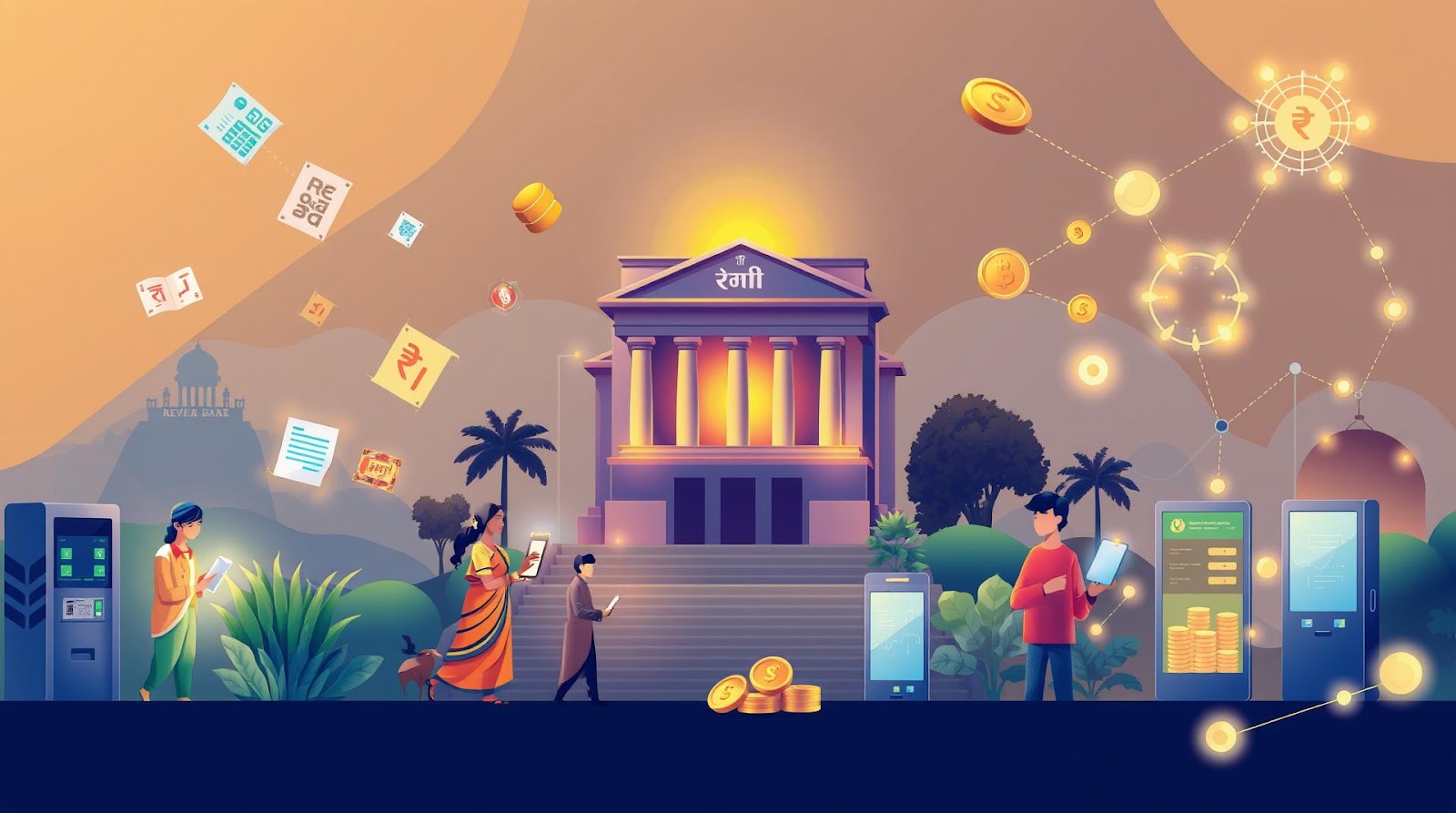
Why Banking and Finance Actually Isn't Boring
Listen, I get it. When I first started teaching economics, students would groan the moment I said "banking sector." Their eyes would glaze over like they were watching paint dry. But then one day, I asked them: "Who gives your parents a loan for that house? Who keeps your grandmother's life savings safe? Who decides if you can buy that bike on EMI?" Suddenly, everyone's hand went up.
That's when it clicked for me — banking and finance isn't some abstract, distant topic. It's the invisible engine running your entire financial life. And if you're preparing for SSC CGL or UPSC, understanding this properly isn't just about getting marks. It's about understanding how India actually works.
Let me give you a personal example. My nephew wanted to open a medical shop, right? He came to me stressed about loans, interest rates, collateral — all that stuff. I realized that everything I was explaining to him is exactly what appears in your exam. Banking regulations, RBI's role, different types of credit schemes — it's all real. It's all happening around you, every single day.
The Banking System: India's Financial Backbone
Understanding the Structure
Okay, so imagine banking like a cricket team. The RBI? That's like your captain — sets the rules, makes the big decisions, and keeps everyone in line. Then you have your scheduled banks (both public and private), cooperative banks, regional rural banks, and all the non-banking financial companies. Each has their own role, their own strength.
Here's what I tell my students to remember the banking hierarchy: "RBI RUNS THE SHOW" — Reserve Bank, Regulator, Unified system, National oversight, Supervises all financial institutions, The headquarters of Indian finance, Holds government reserves, Oversees Money supply.
The Reserve Bank of India (RBI) was established in 1935, and honestly, it's one of the most powerful institutions you need to understand. Why? Because literally every financial decision in this country flows from RBI's policies. Interest rates go up? That affects your home loan. Money gets tight in the market? That's RBI controlling liquidity. It's fascinating stuff, really.
Now, the scheduled banks — these are the ones you interact with. State Bank of India, ICICI, Axis, HDFC. They're "scheduled" because they're listed in the Schedule 2 of the RBI Act, 1934. Don't just memorize this definition — understand that scheduled banks have special privileges. They get money from RBI, they follow stricter norms, and in return, they have more credibility. It's like the difference between a player in IPL versus a local cricket league, you see?
Public Sector vs Private Banks: The Real Difference
You might be wondering — what's the actual difference between a public sector bank and a private bank? Why does it matter?
Public sector banks (like SBI, Bank of Baroda, Punjab National Bank) are owned by the government. This means they're answerable to you — the taxpayer, the citizen. Their priority? Financial inclusion. They open branches in remote villages even if it's not super profitable. They offer special schemes for farmers, for minority communities, for small businesses. It's like a social responsibility thing.
Private banks? They're owned by private shareholders. ICICI, Axis, HDFC — they're here to make profits. But that doesn't mean they're evil or anything. They're usually more efficient, they have better technology, their customer service is often snappier. It's just a different business model.
Here's a memory trick I give students: "PUBLIC = PEOPLE, PRIVATE = PROFIT". Not always a hard rule, but it helps you remember the general orientation.
RBI's Tools and Functions: How Money Gets Controlled
Monetary Policy and Interest Rates
Alright, here's where it gets really interesting. The RBI doesn't just sit in Delhi looking official. It actively manages something called monetary policy, which basically means controlling the money supply and interest rates in the economy.
Think of it this way: if there's too much money floating around in the market, prices go up (inflation). If there's too little money, businesses don't invest, people don't spend, and the economy slows down (recession). The RBI has to find that sweet spot. It's like seasoning a dish — too much salt ruins it, too little and it's bland. You need the perfect balance.
The most important tool? The repo rate. This is the rate at which banks borrow from RBI. When RBI increases the repo rate, borrowing becomes expensive, so banks lend less, and money becomes tight. This fights inflation. When RBI decreases it, borrowing is cheap, banks lend more, and money flows freely. This stimulates growth.
You've probably heard news anchors say "RBI cuts repo rate by 25 basis points!" A basis point is just 0.01%. So 25 basis points = 0.25%. Sounds tiny, but multiply that across an entire economy and it's huge.
Open Market Operations and Cash Reserve Ratio
OMO stands for Open Market Operations. Basically, RBI buys and sells government securities in the open market. When it buys, it pumps money into the system. When it sells, it sucks money out. It's like a tap — RBI controls the flow.
Then there's the CRR — Cash Reserve Ratio. Every commercial bank has to keep a certain percentage of its deposits as reserve cash with RBI. This money doesn't go into lending; it stays locked. If RBI increases CRR, banks have less money to lend. If it decreases CRR, banks can lend more. During COVID, RBI decreased CRR to help banks lend more and support businesses. Smart move, right?
And don't forget the SLR — Statutory Liquidity Ratio. Banks have to maintain this in liquid form (government bonds, cash). Currently it's around 18%. This ensures banks have a safety cushion and aren't too reckless with their lending.
| Tool | What It Does | Increases Money When… |
|---|---|---|
| Repo Rate | Rate at which banks borrow from RBI | RBI decreases it |
| CRR | Percentage banks must keep as cash reserve | RBI decreases it |
| SLR | Percentage banks must keep as liquid assets | RBI decreases it |
| OMO | RBI buys/sells government securities | RBI buys securities |
Financial Inclusion and Credit Schemes: Banking For Everyone
You know what I love about the Indian banking system? The attempts to make banking democratic. Not everyone in India has access to traditional banking, right? There are farmers in Bihar who've never seen a bank from inside. There are women entrepreneurs in small towns who don't know where to get a loan. This is where financial inclusion comes in.
The Pradhan Mantri Jan Dhan Yojana (PMJDY) — launched in 2014 — aimed to give every Indian a bank account. Free account, no minimum balance, debit card, insurance. The goal? To bring the unbanked into the formal financial system. And you know what? It worked. Hundreds of millions of accounts opened. Now, these people can access loans, can save officially, can build credit history.
Then you have schemes like Mudra Loans for small entrepreneurs, Kisan Credit Card for farmers, and Priority Sector Lending norms that ensure banks lend a certain percentage to agriculture, small businesses, and weaker sections. These aren't just charity programs — they're strategic moves to grow the entire economy.
When a farmer gets a Kisan Credit Card, he borrows at reasonable rates, invests in better seeds and equipment, produces more, earns more, saves more. That money comes back into the economy. His kids can study better. He can upgrade his farm. See? The whole system benefits.
Here's something I always emphasize to students: Banking is political economics. Every policy decision has real consequences for real people. When you understand this, studying banking becomes less about memorizing definitions and more about understanding India itself.
The Digital Revolution: Modern Banking in India
Okay, this is where banking gets genuinely exciting. Five or six years ago, digital payments were a novelty. Now? If you're not using UPI (Unified Payments Interface), you're basically living in the Stone Age.
The National Payments Corporation of India (NPCI) created UPI in 2016. It's a real-time, bank-to-bank transfer system that works 24/7. You can send money to literally anyone with just their phone number or UPI ID. No forms, no hassle, minimal charges. It's brilliant. And during demonetization, it became a lifeline for the economy.
Then you have NEFT (National Electronic Funds Transfer) and RTGS (Real Time Gross Settlement) for large transfers, and IMPS (Immediate Payment Service) for urgent transfers. Each has its own use case, its own time frame, its own charges.
But here's what I want you to realize: this digital infrastructure is state-of-the-art. When RBI promotes digital payments, it's not just about convenience. It's about financial data, about tracking money flows, about reducing black money, about bringing transparency to the economy. Every transaction leaves a digital footprint. That data helps the government, helps banks, helps the entire financial system become more efficient and harder to game.
And COVID-19 accelerated all this. When lockdowns happened, digital payments exploded. Contact-less transactions became a necessity. Now, even small vendors use QR codes. Our grandmother's generation, which never trusted banks, is now comfortable with digital wallets. That's a massive shift, and it's still happening.
A) Repo Rate B) Open Market Operations C) Statutory Liquidity Ratio D) Commodity Tax
Answer: D) Commodity Tax — This is a fiscal policy tool, not a monetary policy tool.
A) Increase income tax collection B) Financial inclusion and universal banking C) Reduce agricultural production D) Promote private banks only
Answer: B) Financial inclusion and universal banking — PMJDY targets bringing unbanked population into the formal financial system.
A) Inflation will increase B) Inflation will decrease C) Inflation remains unchanged D) Inflation doubles
Answer: B) Inflation will decrease — Higher repo rate makes borrowing expensive, reduces money supply, and controls inflation.
A) UPI transfers only work during business hours B) UPI is managed by RBI exclusively C) UPI allows real-time, 24/7 bank transfers D) UPI can only transfer amounts below ₹1 lakh
Answer: C) UPI allows real-time, 24/7 bank transfers — NPCI operates UPI, which functions round-the-clock.
A) Scheduled banks only lend to farmers B) Scheduled banks are listed in Schedule 2 of RBI Act and follow stricter norms C) Non-scheduled banks are larger D) They are the same thing with different names
Answer: B) Scheduled banks are listed in Schedule 2 of RBI Act and follow stricter norms — This gives them special privileges and higher credibility.
Published by Dattatray Dagale • 08 July 2026
.jpg)
.png)



.png)



.png)


0 Comments