Introduction
Let me start with a confession: when I first started teaching economics, I found banking topics utterly boring. Then one day, a student asked me, "Sir, why does my father's salary credit happen instantly but a cheque takes three days?" That single question changed everything for me.
Because once you understand why the banking system works the way it does, you realise you're not studying abstract rules—you're learning the mechanics that literally power India's entire economy. From the farmer selling his harvest to the tech startup raising funds, banking and finance touch every corner of our nation's story.
And here's the thing: if you're preparing for SSC CGL, UPSC, or any competitive exam, banking and finance questions are goldmines. They're conceptual, they're testable, and once you crack the fundamentals, you'll see similar patterns repeating everywhere. So grab your tea, settle in, and let's demystify this together.
The Architecture of Indian Banking: Who Does What?
Here's what confuses most students: they think "banking" is just about banks. But India's financial system is actually a beautiful ecosystem with different players doing different jobs.
The Reserve Bank of India (RBI) – The Godfather of It All
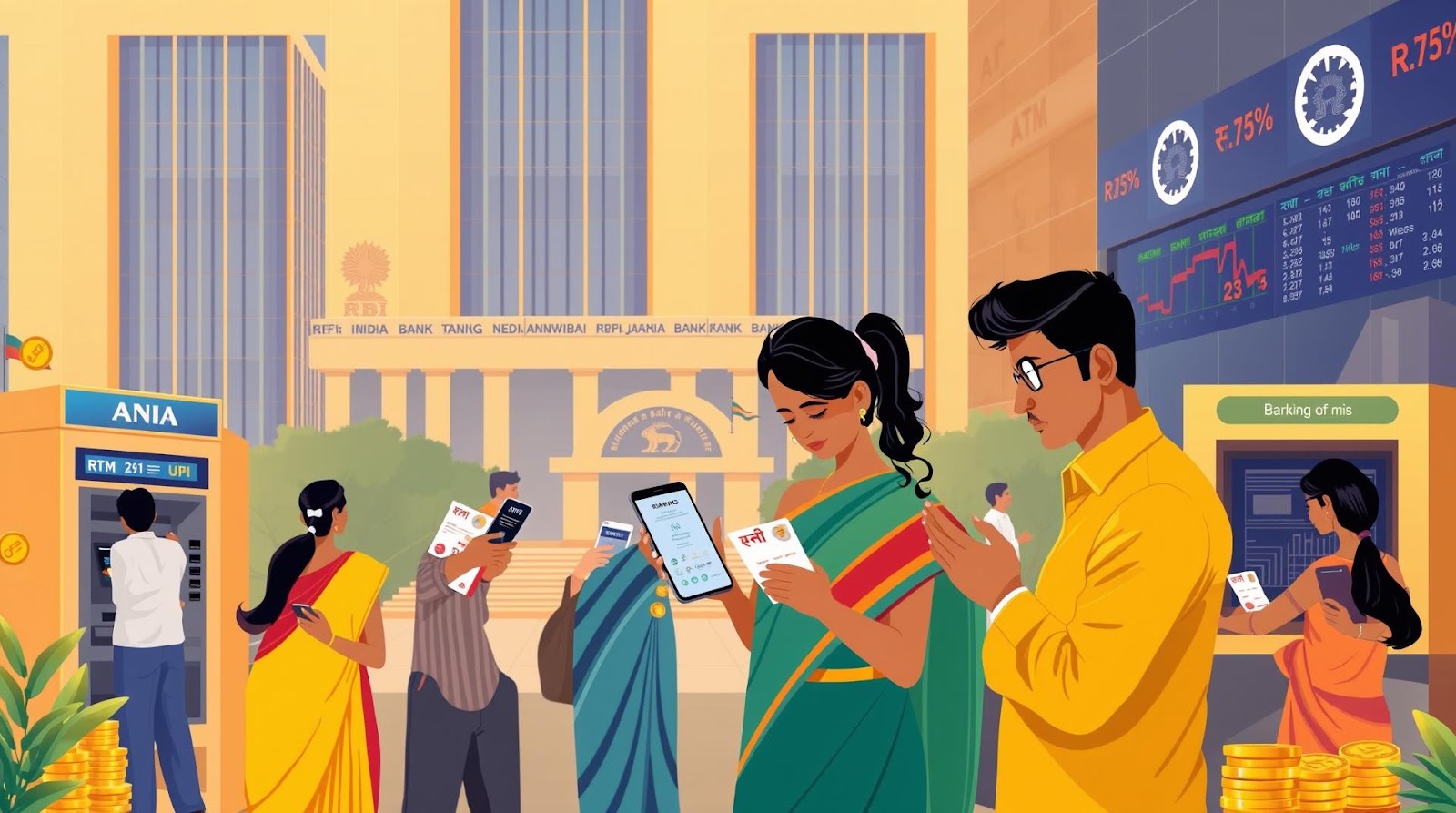
Imagine if Amitabh Bachchan in Sholay was the RBI. Everyone else is playing by its rules. The RBI is India's central bank, and here's what makes it special—it doesn't give credit cards or personal loans to you and me. Instead, it oversees everyone else who does.
Think of the RBI's job in three buckets:
First, monetary policy. When the RBI's governor announces interest rate changes (remember the repo rate discussions on TV?), that ripples through everything. If the RBI increases the repo rate, banks have to pay more to borrow from it, so they increase their lending rates. Your home loan becomes expensive. Your mother thinks twice about taking that personal loan. This is how the RBI controls inflation and growth in the economy.
Second, banking regulation. The RBI makes sure banks don't go crazy and lose your money. It sets rules like "You must keep 4% of deposits as cash reserves" (the Cash Reserve Ratio or CRR). It's like a parent making sure their teenager doesn't blow all their pocket money on video games.
Third, money management. The RBI prints currency, manages India's foreign exchange reserves, and basically keeps the show running. When you see "Reserve Bank of India" printed on a ₹500 note, that's their signature, literally.
Commercial Banks – The Everyday Heroes
These are the banks you and I interact with: HDFC, ICICI, SBI, Axis, and dozens more. Their job is straightforward—take deposits from people like you, and lend that money to people who need it (for homes, cars, business, etc.).
Now here's where it gets interesting. Banks don't lend out ALL the deposits they receive. They keep a certain percentage as reserves (that CRR we mentioned). The rest? That's their lending pool. A bank takes your ₹1 lakh deposit at 4% interest and lends it to a business at 9% interest. The difference (5%) is how they make money.
Banks are credit intermediaries—they bridge the gap between savers (people like us) and borrowers (businesses and individuals who need money).
Cooperative and Regional Rural Banks
Here's something I wish more students understood: not everyone in India has access to a fancy HDFC branch. In small towns and villages, there are Cooperative Banks (run by member-owned societies) and Regional Rural Banks that serve local communities. They're equally important to India's financial inclusion story.
Key Banking Concepts That Appear in Every Exam
Let me give you the core concepts that show up repeatedly. Master these, and you'll handle 70% of banking questions.
Interest Rates and the Repo Rate
The Repo Rate is like the interest rate parents charge their kids for borrowing money—except it's what banks pay the RBI. When banks need emergency cash, they sell securities to the RBI at this rate and buy them back later.
Let me give you a trick I tell all my students: Remember "REPO RATE = Bank borrowing rate." When the RBI hikes the repo rate, banks' borrowing cost increases, so they increase their lending rates. This cools down inflation because people borrow less. Lower repo rates do the opposite—they encourage borrowing and spending.
The Reverse Repo Rate is the opposite: it's what the RBI pays banks to park money with it. If the repo rate is 5%, the reverse repo might be 4.5%. Banks earn money by depositing with the RBI if market returns are lower.
CRR and SLR – Your Mnemonic Friend
Two reserve ratios confuse students constantly. Let me make them crystal clear:
CRR (Cash Reserve Ratio): Cash reserves kept with the RBI itself. Currently around 4%. This is actual cash—not investments, just cash. The RBI holds it as a safety buffer.
SLR (Statutory Liquidity Ratio): Safe Liquid Assets that banks keep in addition to CRR. This includes government securities, gold, and other liquid investments. Currently around 18%.
Here's my mnemonic: "CRR = RBI ka ghar (house), SLR = Bank ka ghar." CRR goes to the RBI's house; SLR stays in the bank's house but must be in safe forms.
Why does this matter? If CRR is high, banks have less money to lend, so credit becomes tight. The RBI uses these tools like a thermostat to control how much credit flows through the economy.
Credit Creation and Money Multiplier
Here's something beautiful about banking: when a bank lends you ₹10 lakh for a home, it's literally creating money in the economy. You take that loan, the builder deposits it in their account, they pay their workers, those workers deposit it in their accounts, and so on. One original ₹10 lakh creates multiple transactions and increases the money supply.
This is called the Money Multiplier Effect. The formula is simple: if CRR is 10%, the money multiplier is 1 ÷ 0.10 = 10. This means a ₹1 crore injection in the banking system can theoretically create ₹10 crore in money supply.
| Concept | What It Is | RBI Can Do When Inflation Rises |
|---|---|---|
| Repo Rate | Rate at which banks borrow from RBI | Increase it (makes borrowing expensive) |
| CRR | Cash reserves with RBI | Increase it (reduces lending capacity) |
| SLR | Safe liquid assets banks must hold | Increase it (locks more funds) |
| Open Market Operations (OMO) | RBI buys/sells securities in market | Sells securities (sucks cash from market) |
Financial Markets and Beyond Banking
Now, banking is just one part of finance. There's a whole world of financial markets that work alongside the banking system.
The Stock Market – Where Companies Dance
When you buy a share of Reliance Industries, you're buying a tiny piece of ownership in that company. The stock market (BSE and NSE) is where these shares are bought and sold. Companies raise capital here; investors hope to make money.
The Sensex (BSE's index) and Nifty (NSE's index) are like fever thermometers for the Indian economy. When they go up, it signals investor confidence. When they crash, everyone panics.
The Bond Market – Where Governments Borrow
When the Indian government needs to borrow money, it doesn't go to a bank. It issues bonds—basically IOUs that investors buy. If you buy a ₹10,000 government bond at 6% interest, the government pays you ₹600 annually. It's safer than stocks but lower returns.
The Money Market – The Quick-Cash Corner
Banks and financial institutions sometimes need cash for just a few days or weeks. They go to the money market to borrow, using instruments like Call Money (overnight loans) and Treasury Bills (short-term government loans). It's like the emergency credit card of financial institutions.
The most important tool here is the Repo rate (Repurchase Agreement), which we discussed earlier. Banks use repos constantly to manage day-to-day cash needs.
Financial Inclusion and Modern Challenges
You know what I find inspiring? When I was young, banking was a luxury. Today, even a farmer in Maharashtra can have a bank account and use it digitally. But we're not there yet everywhere.
Financial inclusion means ensuring every Indian has access to banking services. Schemes like Jan Dhan Yojana have opened millions of zero-balance accounts. Digital payment platforms like UPI have made money transfers instantaneous and free.
But here's the reality: financial inclusion isn't just about accounts; it's about credit access, insurance, and investment products reaching smaller towns. That's where Regional Rural Banks and Cooperative Banks play a critical role.
On the challenges side, we're dealing with modern issues like cyber fraud, cryptocurrency regulation, and the Great Recession's lessons. Banks are getting stricter about documentation (KYC - Know Your Customer), which sometimes frustrates customers but protects against money laundering.
There you have it—from the RBI's ivory tower to your neighbourhood bank, the entire architecture that keeps India's money flowing. The beautiful part? This isn't just exam content. Understanding this means you understand how the ₹2 lakh crore Indian economy actually breathes.
Next time interest rates change, you'll know why. Next time someone talks about inflation, you'll understand the mechanisms behind it. And on exam day, these concepts will feel like old friends.
Practice Questions to Test Your Knowledge
A) Bank lending increases significantly B) Borrowing becomes expensive for banks and eventually for consumers C) Stock market automatically rises D) Government spending increases
Answer: B) Borrowing becomes expensive for banks and eventually for consumers. When the repo rate rises, banks have to pay more to borrow from RBI, so they increase their lending rates. This discourages borrowing.
A) CRR is for commercial banks; SLR is for cooperative banks B) CRR is cash kept with RBI; SLR is safe liquid assets kept by banks themselves C) CRR increases inflation; SLR decreases it D) Both are the same thing with different names
Answer: B) CRR is cash kept with RBI; SLR is safe liquid assets kept by banks themselves. This is the fundamental distinction—CRR goes to the RBI's vaults; SLR stays with the bank but must be in approved securities and gold.
A) Banks create infinite money from deposits B) One deposit can become multiple transactions as it circulates through different accounts C) The RBI prints new notes for each loan D) Savings automatically double every year
Answer: B) One deposit can become multiple transactions as it circulates through different accounts. When you deposit ₹1 lakh, the bank lends it out, and when the borrower deposits it, it becomes ₹1 lakh again in the system. This cycle creates a multiplier effect.
A) To regulate stock market trading B) To control the money supply by buying and selling government securities C) To set salary levels for bank employees D) To manage international trade
Answer: B) To control the money supply by buying and selling government securities. When the RBI sells securities, it sucks money out of the system (contractionary); when it buys, it injects money (expansionary).
A) Make in India B) Pradhan Mantri Jan Dhan Yojana C) Swachh Bharat Mission D) Digital India
Answer: B) Pradhan Mantri Jan Dhan Yojana. This landmark scheme, launched in 2014, has opened millions of zero-balance bank accounts, especially in rural areas, promoting financial inclusion across India.
Published by Dattatray Dagale • 13 June 2026
.jpg)
.png)



.png)



.png)


0 Comments