Introduction
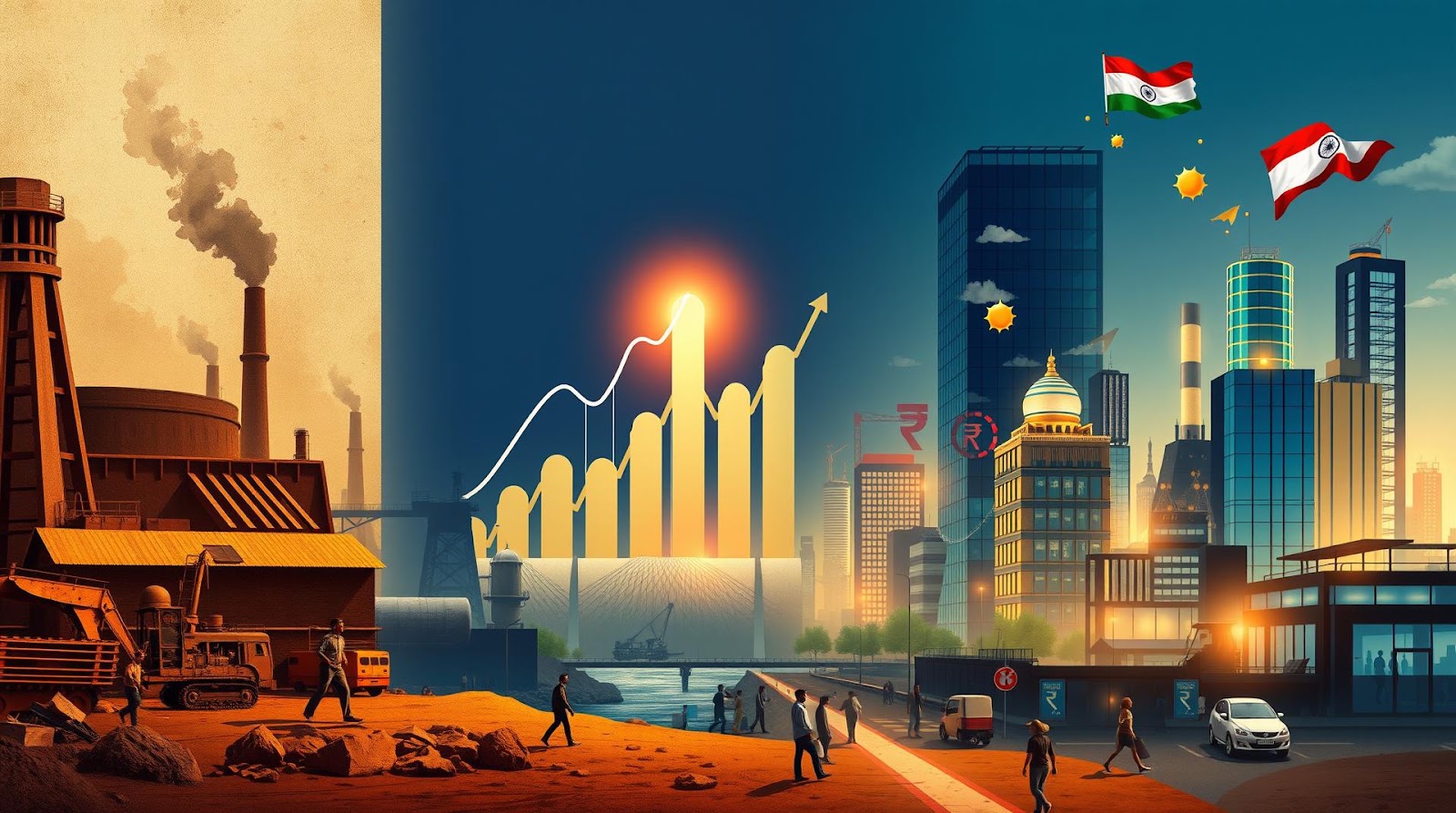
Let me start with a confession: when I first began teaching economics, the Five Year Plans seemed like the most boring topic imaginable. Lines of numbers, government jargon, economic terminology that made students' eyes glaze over. Then one day, a student asked me a simple question: "Sir, why did India choose five years? Why not four? Why not ten?"
That one question changed how I teach this topic. Because the Five Year Plans aren't just about numbers and statistics—they're about India's journey. They're about how a newly independent nation tried to build itself from scratch, fumbled, learned, and eventually transformed into the world's fastest-growing major economy. And honestly? That's a story worth telling.
If you're preparing for SSC CGL, UPSC, or any competitive exam, you need to understand Five Year Plans not as isolated facts, but as chapters in India's economic autobiography. In this post, I'm going to walk you through this journey—from Jawaharlal Nehru's ambitious socialist vision to Manmohan Singh's liberalization, and everything in between.
The Genesis: Why Five Years? Why Plans at All?
Here's a question I often ask in my classes: "After independence, what's the first thing a new country needs to do?" Usually, students answer "build infrastructure" or "create jobs." Both correct, but incomplete.
The real answer is this: India needed a vision. A roadmap. A way to tell its people, "Here's where we're going, and here's how we'll get there."
The Soviet Influence and Nehru's Dream
Now, why did we copy the Soviet Union's planning model? India's first Prime Minister, Jawaharlal Nehru, was deeply influenced by the Soviet five-year planning system. He visited the Soviet Union and was impressed—genuinely impressed—by how a supposedly backward agrarian nation had transformed itself into an industrial powerhouse through centralized planning.
Nehru believed that India, like the Soviet Union, needed to industrialize rapidly. He wasn't a communist (despite what some textbooks imply), but he believed that free markets alone couldn't lift 350 million people out of poverty. The state had to lead the charge. The state had to make big decisions, allocate resources, and steer the economy toward development.
The Planning Commission (now NITI Aayog) was established in 1950, even before the Constitution was finalized. Think about that—before India formally became a republic, Nehru was already drawing up economic blueprints. The first Five Year Plan began in 1951.
So why five years specifically? Because it's a sweet spot. Long enough to implement meaningful projects, short enough to stay relevant and adaptable. Plus, it sounds impressive—something about "five-year" plans carries weight, doesn't it?
The Socialist Approach: Industries, Dams, and Steel Plants
The early plans were unapologetically focused on heavy industrialization. Dams, steel plants, coal mines—these were Nehru's "temples of modern India." He famously said that dams were more important than temples, which, coming from a Hindu-majority nation, was quite a statement.
The idea was straightforward: build the infrastructure, build heavy industries, and everything else will follow. Agriculture? It'll improve naturally. Small businesses? They'll emerge when the time is right. Consumer goods? That can wait.
Let me give you a memory trick I tell my students: NIP-NIC.
N = Nehru's Industrialization Push N = Ignored Consumer goods.
The early plans (First through Fourth) were heavily skewed toward public sector enterprises and heavy industry. The private sector was viewed with suspicion—almost as if India had to prove it could develop without relying on capitalists or foreign investors.
The Three Phases of Five Year Plans: Growth, Stagnation, and Transformation
If you want to crack any exam question about Five Year Plans, you need to understand that they fell into three broad phases. Let me break this down for you.
Phase 1: The Heroic Era (First to Fourth Plans, 1951-1974)
These plans were about laying foundations. Heavy industry, agriculture (though not perfectly), and basic infrastructure. Growth was modest—around 3.5-4% annually. Not spectacular, but steady.
The Fourth Plan (1969-74) ended with the Bangladesh War and an oil crisis. India was struggling with inflation, unemployment, and the realization that planned economy alone wasn't delivering miracles.
Phase 2: The Lost Decades (Fifth to Eighth Plans, 1974-1997)
This is a harder period to explain. After the oil crisis of 1973, India faced stagflation (simultaneous stagnation and inflation—an economic nightmare). The Fifth Plan introduced the concept of "growth with equity," which sounds noble but, in practice, meant slower growth, bureaucratic controls, and limited foreign investment.
The Sixth Plan (under Indira Gandhi) pushed for technology and energy independence. The Seventh Plan (under Rajiv Gandhi) talked about modernization. But here's the thing: these plans were becoming increasingly disconnected from reality. The private sector was growing despite the plans, not because of them. Black money, parallel economies, and informal sectors were booming.
By the 1980s, India was essentially split into two economies: the official, planned, public-sector-dominated economy on paper, and the real, unplanned, private-sector-driven economy on the ground.
Phase 3: The Liberalization Era (Ninth Plan onwards, 1997-present)
And now we arrive at the most important transformation. In 1991, facing a severe balance of payments crisis (India literally ran out of foreign exchange), Prime Minister P.V. Narasimha Rao and Finance Minister Manmohan Singh made a bold decision: liberalize the economy.
This wasn't a gradual shift. This was revolutionary. Suddenly, foreign direct investment was welcome. Import restrictions were removed. Private sectors could invest in previously reserved areas. The private sector could manufacture almost anything.
The Ninth Plan (1997-2002) was explicitly different from all previous plans. It acknowledged that the private sector, not the government, would be the engine of growth. The government's role shifted from "provider" to "facilitator."
Here's what changed fundamentally:
Old Model: Government decides what to produce, how much to produce, and at what price. Private sector is restricted. Foreign companies are outsiders.
New Model: Market forces determine production. Government provides framework. Foreign investment is welcomed. Private sector leads, government supports.
And you know what? Growth accelerated dramatically. From 3-4% in the planning era to 5-6% in the 1990s, and then 7-8% in the 2000s. By 2005-2008, India was growing at nearly 9% annually. We were called the "Shining India." Remember that slogan?
| Plan Period | Key Focus | Avg. Growth Rate | Major Challenge |
|---|---|---|---|
| 1st-4th (1951-74) | Heavy Industry, Dams, Steel | 3.5-4% | Oil Crisis, War |
| 5th-8th (1974-97) | Equity, Technology, Energy | 3-4% | License Raj, Inflation |
| 9th onwards (1997+) | Liberalization, Private Sector | 5-9% | Inequality, Job Quality |
Economic Reforms: The 1991 Watershed Moment
I want to spend some time on 1991 because it's genuinely transformative—like the moment a cricketer suddenly changes their technique and starts scoring centuries instead of ducks.
The Crisis That Forced Change
By 1991, India's foreign exchange reserves were down to barely two weeks of imports. The government was essentially broke. Inflation was running rampant. The state of the economy was so dire that former PM Inder Gujral once joked that India was selling its gold reserves.
Wait, that wasn't a joke. India literally did sell gold reserves to raise cash. About 20 tonnes of gold from India's reserves were mortgaged to the Bank of England. That's how desperate the situation was.
Manmohan Singh took charge and implemented what's now called "Liberalization, Privatization, and Globalization" (or LPG). Here's what each meant:
Liberalization: Remove government controls. Allow businesses to make their own decisions. Reduce licensing requirements.
Privatization: Reduce government involvement in business. Encourage private companies to take over sectors previously dominated by the public sector.
Globalization: Open India's markets to the world. Reduce tariffs. Allow foreign companies to compete in India.
Here's a mnemonic I created for my students that actually stuck: LPG = "Let Private Go" (globally). Kind of cheesy, but students remember it!
The Three Pillars of Reform
1. Trade Liberalization: Import duties came down. Suddenly, Indian companies had to compete with foreign brands. Was it painful? Absolutely. Many small manufacturers died. But survivors became globally competitive. This is why Indian IT companies, Indian pharma, and Indian textiles are now world-class.
2. Financial Sector Reforms: The banking system, stock market, and capital markets were opened up. Private banks entered India. Foreign investors could buy Indian stocks. This created a liquid, efficient financial system.
3. Sectoral Reforms: Telecom was privatized (which is why you have affordable mobile phones today). Airlines were opened to private players (remember when flying was only for the wealthy?). Insurance was opened to private competition.
The results? Explosive growth. From 1991 to 2008, India averaged 6%+ growth annually. Poverty declined dramatically. A middle class emerged. By 2005, India was the world's IT capital. By 2010, it was a manufacturing hub. By 2020, Indian startups were creating global giants like Flipkart and Paytm.
Were there downsides? Sure. Income inequality widened. Workers in uncompetitive sectors suffered. Environmental standards were sometimes compromised. But the fundamental shift toward market-led growth was irreversible and, on balance, positive for the vast majority of Indians.
Beyond Plans: The End of Central Planning and Rise of Sectoral Policies
Here's something interesting that exam questions often miss: official Five Year Plans actually ended in 2017.
Yes, you read that right. After 66 years of Five Year Plans, India's government decided to shift gears. The Twelfth Plan (2012-17) was the last. The Modi government, which came to power in 2014, was skeptical of centralized planning. They believed that in a globalized economy with rapid technological change, rigid five-year plans were outdated.
The Planning Commission was disbanded in 2015 and replaced with NITI Aayog (National Institution for Transforming India), which operates differently. Instead of command-and-control planning, NITI Aayog focuses on policy research, knowledge sharing, and strategic advising. It's less "telling states what to do" and more "helping states figure out what to do."
This reflects a deeper truth: India's economy is now too complex, too diverse, and too fast-moving for central planning. What works in Tamil Nadu might not work in Assam. What was relevant in 2015 might be obsolete by 2018. The economy needs flexibility, not five-year rigidity.
Instead of plans, the government now operates through sectoral policies: Make in India, Digital India, Skill India, Startup India. Each targets specific areas. This is more agile, more adaptive, and frankly, more suited to 21st-century economics.
Wrapping Up: What Should You Remember?
If you remember nothing else from this post, remember this:
Phase 1 (1951-1974): Socialist heavy industrialization. Nehru's vision of self-reliance. Modest growth, but solid foundations.
Phase 2 (1974-1991): Stagflation, license raj, and lost opportunity. Controls strangled growth. But seeds of change were planted.
Phase 3 (1991-2017): Liberalization and market-led growth. Five Year Plans acknowledged private sector. India's growth exploded.
Phase 4 (2017-present): End of formal central planning. Shift to sectoral policies. Emphasis on innovation and flexibility.
For your exams, remember that Five Year Plans weren't good or bad—they were contextual. In 1951, a planned approach made sense. In 1991, it became a constraint. By 2017, it was irrelevant. Understanding this evolution is what separates good answers from great ones.
And remember: India's story isn't one of following one ideology perfectly. It's a story of a nation learning, adapting, and finding its own path. That's true of Five Year Plans, and it's true of India itself.
---Quick Revision Table: Five Year Plans at a Glance
| Plan | Years | Focus Area | Key Features |
|---|---|---|---|
| 1st | 1951-56 | Agriculture, Dams | Bhakra-Nangal, Infrastructure |
| 2nd | 1956-61 | Heavy Industry | Rourkela, Durgapur Steel Plants |
| 3rd | 1961-66 | Self-reliance | Green Revolution groundwork |
| 4th | 1969-74 | Growth with Stability | Oil crisis impact, Bangladesh War |
| 5th | 1974-79 | Growth with Equity | Poverty reduction focus |
| 9th | 1997-2002 | Growth, Social Development, Self-reliance | Post-liberalization, private sector welcome |
| 12th (Last) | 2012-17 | Inclusive Growth | Last formal plan before NITI Aayog |
Practice Questions: Test Your Knowledge
A) 1947 B) 1950 C) 1951 D) 1952
Answer: B) 1950. The Planning Commission was set up even before India's Constitution was finalized, reflecting Nehru's commitment to planned development.
A) Rajiv Gandhi B) V.P. Singh C) P.V. Narasimha Rao D) Atal Bihari Vajpayee
Answer: C) P.V. Narasimha Rao. Aided by Finance Minister Manmohan Singh, he opened India's economy during a severe balance of payments crisis.
A) Liquefied Petroleum Gas B) Liberalization, Privatization, Globalization C) Legislative Policy Group D) Land Policy Guidelines
Answer: B) Liberalization, Privatization, Globalization. This acronym summarizes the three pillars of India's economic reform strategy.
A) 10th Plan B) 11th Plan C) 12th Plan D) 13th Plan
Answer: C) 12th Plan (2012-17). After this, India replaced the Planning Commission with NITI Aayog.
A) NITI Aayog B) Economic Commission C) Development Board D) National Council for Planning
Answer: A) NITI Aayog. The shift reflected India's move from centralized planning to sectoral policy-making and strategic advisory roles.
Published by Dattatray Dagale • 07 July 2026
.jpg)
.png)



.png)



.png)


0 Comments