Introduction
Let me start with a confession: when I first started teaching economics to SSC and UPSC aspirants, Five Year Plans felt like the most boring topic in the world. Seriously. I'd drone on about Harrod-Domar models and growth rates, and I could literally see my students' eyes glaze over. Then one day, a student asked me a simple question: "Sir, why did we *need* plans at all?"
That question changed how I teach this topic entirely. Because here's the thing — India's Five Year Plans aren't just about statistics and growth percentages. They're about a young, independent nation figuring out how to feed 350 million people in 1950, with barely any industrial base, almost no foreign exchange, and centuries of colonial exploitation as baggage. They're about the audacity of saying, "We're going to become self-sufficient in food, build steel plants, develop nuclear technology, and do this on our own terms."
That's a story worth telling. And that's what we're diving into today.
The Why Behind the Plans: Understanding Pre-Reform India
What India Inherited in 1947
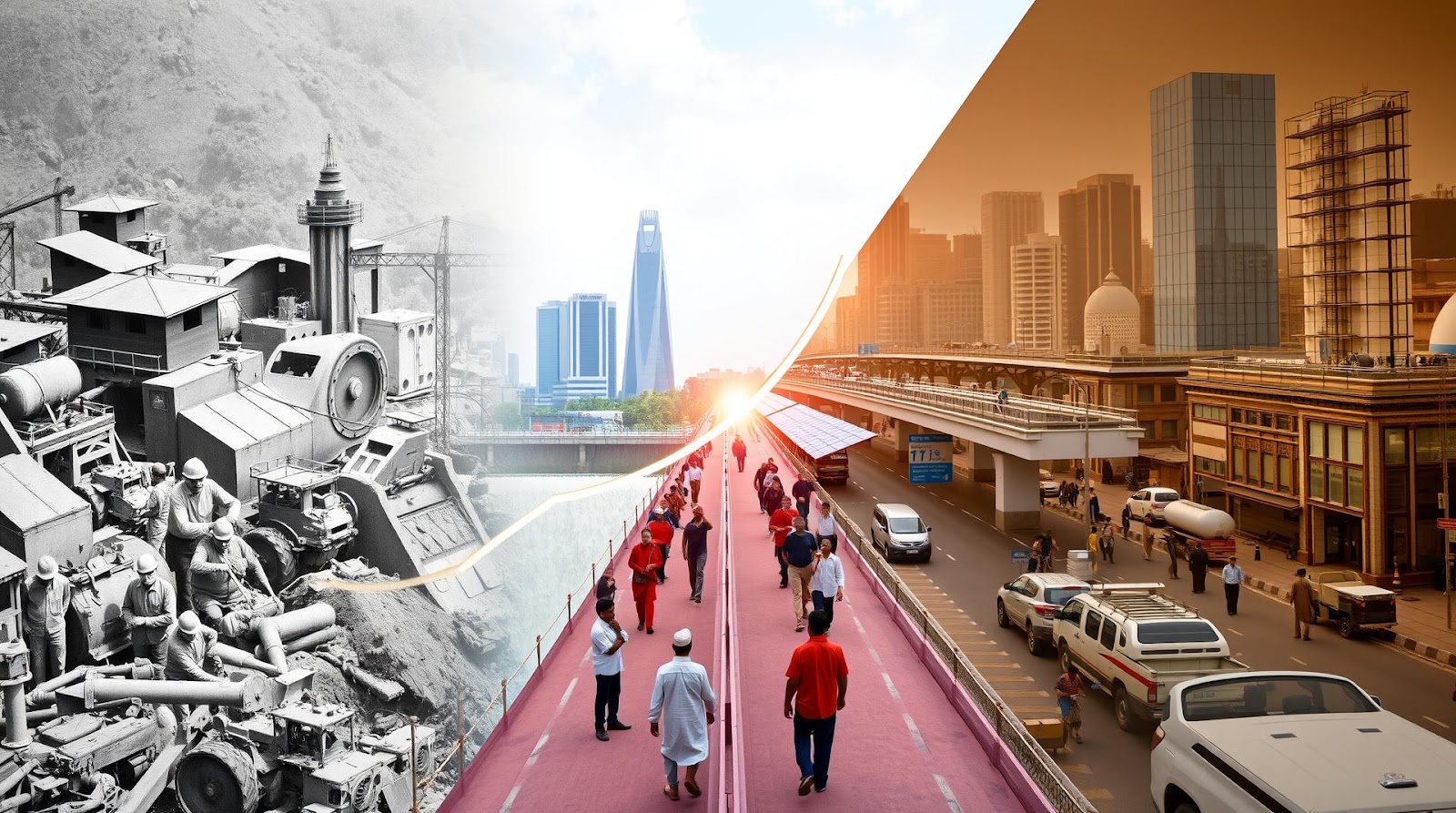
Picture this: it's August 15, 1947. India is free, but it's also absolutely broken. The British had systematically destroyed India's textile and manufacturing sectors over 200 years. Our share of world GDP had fallen from about 23% in 1700 to just 4% by 1950. We had virtually no heavy industry, no infrastructure, and a population that was growing faster than our ability to feed it.
Dr. Rajendra Prasad (our first President) famously said, "We have a starving population." That wasn't metaphorical. People were actually starving. There was no planning framework, no coordinated industrial development, and private industry alone couldn't have solved this problem in a reasonable timeframe.
Into this chaos stepped Dr. Rajni Mehta... wait, no, I'm mixing things up. Let me correct that — it was Dr. M.N. Roy who first proposed the idea, but more importantly, it was Pandit Jawaharlal Nehru who championed scientific planning as the way forward. Nehru believed that a planned economy, inspired partly by Soviet models (but adapted for democratic India), was the only way to rapidly industrialize and lift the country out of poverty.
Why Plans? Why Not Market Forces Alone?
Here's a question I always ask my students: if you have ₹100, would you invest it in something profitable tomorrow, or something that takes 10 years to show returns but transforms the nation? Most people choose quick profit. That's why markets alone won't build steel plants, railway lines, or universities in a poor country. Someone has to force that long-term vision. That's where planning came in.
The Twelve-Period Plan Era: Building Modern India (1951-1991)
First to Third Plans: The Foundation Years (1951-1966)
The First Five Year Plan (1951-56) was genuinely focused. It emphasized agriculture, irrigation, and basic infrastructure. The investment was modest — about ₹2,000 crores — but it was strategic. Dams like Bhakra and Hirakund were built. Food production increased. It wasn't flashy, but it worked.
The Second Plan (1956-61) was where things got ambitious. This is when Pandit Nehru's vision of "temples of modern India" became real. Massive steel plants — Bhilai, Rourkela, Durgapur — came up with help from Soviet Union, Germany, and Britain respectively. Heavy engineering plants, power stations, universities, and research centers mushroomed across the country.
The Third Plan (1961-66) continued this momentum. But by now, we were also facing external pressures — the Indo-Chinese War of 1962 drained resources, the Indo-Pakistani War of 1965 cost money. Growth slowed. The plans were working, but India was also learning harsh lessons about defense spending and geopolitics.
Fourth to Sixth Plans: The Green Revolution Era (1969-1980)
Here's where I tell students a trick I use to remember this period: "GG Period" = Green Revolution + Growth
The Fourth Plan (1969-74) coincided with the Green Revolution. Agricultural productivity exploded. High-yielding varieties of wheat and rice, combined with better irrigation and fertilizers, transformed India from a perpetual food-importing nation to self-sufficient. By the late 1970s, India was even exporting food. That's monumental.
Prime Minister Indira Gandhi's "Garibi Hatao" (Remove Poverty) slogan reflected the plans' focus on poverty reduction. The Fifth Plan (1974-79) and Sixth Plan (1980-85) continued agricultural emphasis while also pushing for rural industries and decentralized development. Employment generation became a key focus.
Now, I'll be honest — these plans also had issues. There was bureaucratic inefficiency. Corruption crept in. Some industries became bloated and inefficient because they had guaranteed government support. But the fundamental goal — making India self-reliant — was being achieved.
Seventh Plan to Tenth Plan: The Transition (1985-2007)
The Seventh Plan (1985-90) was interesting because it marked the beginning of a mindset shift. Prime Minister Rajiv Gandhi opened India slightly to technology and private enterprise. But the framework was still largely controlled.
Then came 1991. And everything changed.
| Plan | Period | Key Focus | Major Achievement |
|---|---|---|---|
| First | 1951-56 | Agriculture & Irrigation | Built major dams |
| Second | 1956-61 | Heavy Industry | Steel plants established |
| Fourth-Sixth | 1969-1985 | Green Revolution | Food self-sufficiency |
| Eighth-Tenth | 1992-2007 | Economic Liberalization | Service sector growth, IT boom |
The 1991 Economic Crisis and Reforms: India's Turning Point
What Went Wrong?
By 1990-91, India's planned economy model was creaking. Foreign exchange reserves had plummeted to about 3 weeks' worth of imports. The government couldn't even pay for imported oil. Inflation was in double digits. We were essentially on the brink of a debt default. This wasn't just economics — it was a national emergency.
Why did it happen? The licensing system had become so bureaucratic and strangling that businesses couldn't grow or innovate. Public sector companies, protected from competition, had become bloated and inefficient. Trade barriers meant Indian goods couldn't compete globally. We were literally locked out of the world economy.
Dr. Manmohan Singh's Reforms: The Watershed Moment
Prime Minister P.V. Narasimha Rao, with his Finance Minister Dr. Manmohan Singh, took a decision that was politically risky but economically essential. They opened up the economy. This is the moment I always emphasize to students because it's the hinge on which modern India swings.
The reforms included:
Liberalization: The government reduced its role in business. The licensing system was slashed. Private sector could now enter industries previously reserved for the public sector. Remember the term "License Raj"? That era was ending.
Privatization (Limited): The government started selling stakes in public sector companies. Not wholesale privatization like in some countries, but strategic disinvestment. This raised money and improved efficiency.
Globalization: Import duties were slashed. Foreign Direct Investment was encouraged. Indian companies could now invest abroad. We joined the WTO in 1995.
Financial Sector Reforms: Banks were allowed to enter new markets. Insurance was opened to private companies. The stock market was deregulated.
Now here's a trick I tell students to remember the economic reform priorities: "LPG" = Liberalization, Privatization, Globalization. You'll see this acronym everywhere in exams, and once you know what it means, you've got the essence of 1991 reforms.
Post-1991 Economic Growth and Challenges
The results were visible within years. The Eighth Plan (1992-97) saw GDP growth accelerate. The service sector, particularly IT and ITeS, exploded. Companies like Infosys, TCS, and Wipro became global players. India became known as the world's back office.
By the 2000s, India was a different country. When I was young and asked "What do you want to do?", kids would say "Government job." By the 2000s, kids were dreaming of starting startups and becoming entrepreneurs. That's the power of economic reforms.
But reforms also brought challenges. Income inequality increased. Small industries faced competition from larger, more efficient ones. Traditional sectors like textiles and agriculture faced pressure. There were regional imbalances — some states benefited more than others. These are real issues that policymakers still grapple with.
Modern Economic Strategy: Beyond Five Year Plans
The End of Five Year Plans
Here's something that might surprise you: India officially stopped making Five Year Plans after 2017. The Twelfth Plan (2012-17) was the last one. The government shifted to a more flexible system called "15-Year Vision" with rolling 3-year targets.
Why? Because the world had changed. Global markets move fast. Five-year rigidity couldn't keep up with technology disruption, climate change, and competitive pressures. The planning system that was revolutionary in 1951 had to evolve.
Current Focus Areas
Modern India's economic strategy focuses on:
Make in India: Attracting manufacturing back to India. Using labor advantages and improving infrastructure to become a global manufacturing hub, not just a services hub.
Digital Economy: Pushing digital payments (remember demonetization and UPI?), e-governance, and digital literacy.
Sustainable Development: Climate concerns, renewable energy targets, and balancing growth with environmental protection.
Inclusive Growth: Schemes like Pradhan Mantri Jan Dhan Yojana, MGNREGA, and healthcare schemes trying to ensure growth benefits reach the poorest sections.
These are different challenges from 1951, and they require different solutions.
Key Takeaways for Your Exams
Alright, let me distill this into exam-relevant points because I know that's ultimately what you need:
Five Year Plans were India's response to post-colonial poverty and lack of industrialization. They worked — we became self-sufficient in food, built heavy industry, and created a foundation for modern development.
The planned economy model had limitations: Bureaucracy, inefficiency, and lack of global competitiveness eventually constrained growth.
1991 Reforms (LPG) fundamentally changed India's economic trajectory. From a closed economy to an open one. From "License Raj" to market competition. From government-run everything to a mixed economy with private dynamism.
Post-1991, India's growth accelerated: GDP growth rates moved from 3-4% (the "Hindu rate of growth") to 6-8%+ consistently. India became a significant global economy.
Modern challenges are different from 1950s challenges: We're not fighting hunger anymore (mostly). We're fighting inequality, environmental damage, and the need to compete globally while keeping growth inclusive.
These aren't just historical facts. They're the story of how a nation rebuilt itself. And that story, frankly, is pretty inspiring.
A) Liberalization of the economy B) Increase in protective tariffs and subsidies C) Encouragement of Foreign Direct Investment D) Privatization of select public sector units
Answer: B) Increase in protective tariffs and subsidies. The 1991 reforms actually reduced tariffs and removed many subsidies.
A) Second Five Year Plan B) Third Five Year Plan C) Fourth Five Year Plan D) Fifth Five Year Plan
Answer: C) Fourth Five Year Plan (1969-74). The Green Revolution significantly boosted agricultural productivity during this period.
A) A licensing system that controlled industrial growth and restricted private enterprise B) A system that encouraged privatization C) A system that promoted foreign investment D) A system that eliminated bureaucratic control
Answer: A) A licensing system that controlled industrial growth and restricted private enterprise. This was the bureaucratic framework that stifled economic growth before 1991.
A) Yashwant Sinha B) Dr. Manmohan Singh C) Arun Jaitley D) Nirmala Sitharaman
Answer: B) Dr. Manmohan Singh. He was Finance Minister under PM P.V. Narasimha Rao and is widely credited with initiating India's economic liberalization.
A) Liquefied Petroleum Gas B) Liberalization, Privatization, Globalization C) Licensing Policy Guidelines D) Long-term Planning Goals
Answer: B) Liberalization, Privatization, Globalization. This acronym represents the three pillars of India's 1991 economic reforms.
Published by Dattatray Dagale • 12 June 2026
.jpg)
.png)



.png)


.png)

0 Comments