Introduction
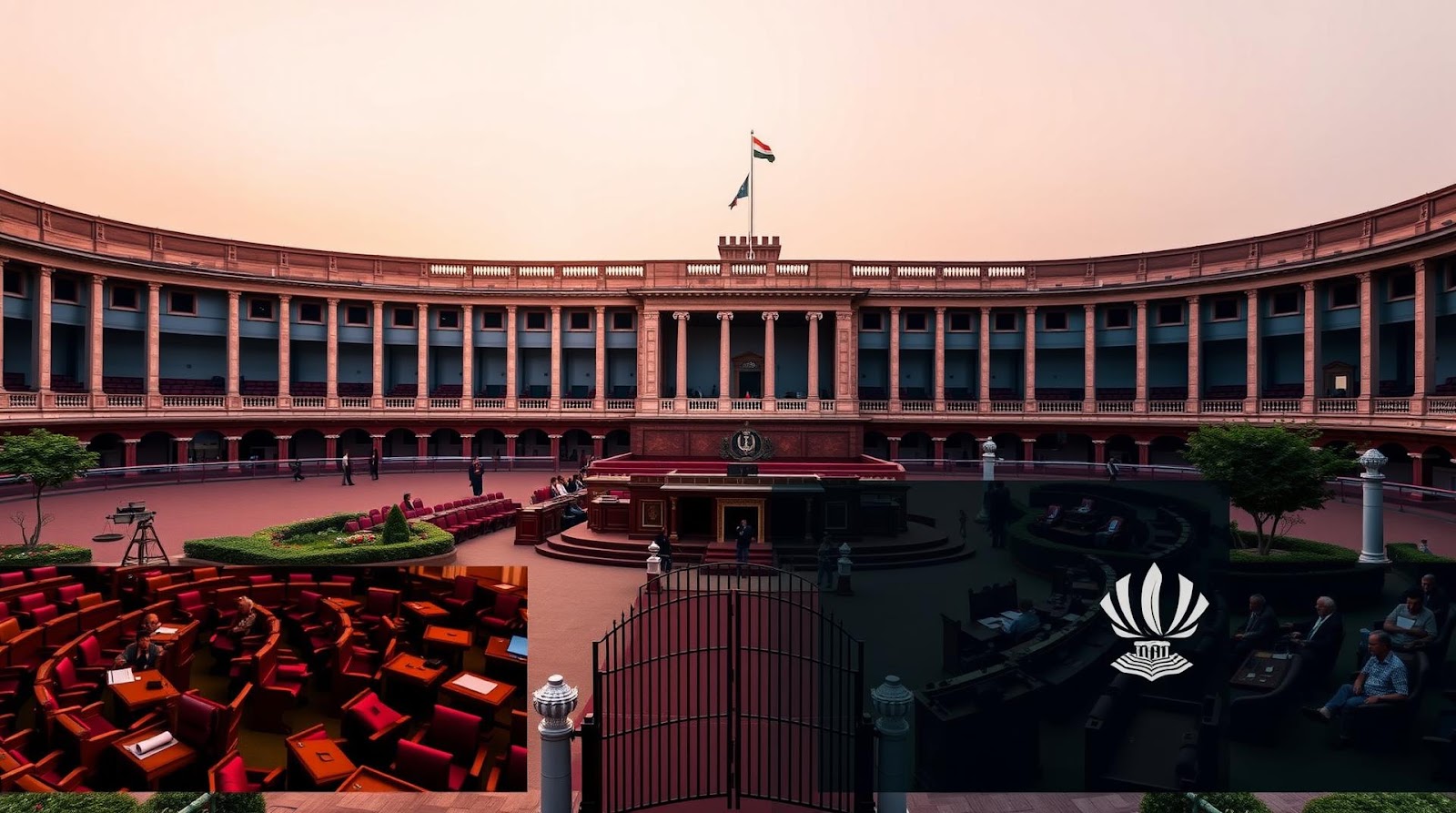
Look, I've been teaching polity for over a decade now, and I can tell you with absolute certainty that Parliament is where India's real magic happens. Yet, when I ask students what happens inside those grand buildings in New Delhi, most of them freeze. They know Parliament exists. They know it makes laws. But the actual *how* of it all? That's where things get fuzzy.
Here's what I've learned: Parliament isn't some mysterious black box. It's actually quite logical once you understand the structure. Think of it like a cricket match — you need players (MPs), you need rules (procedures), you need an umpire (Speaker), and you need a clear objective (passing laws). The only difference is that instead of winning a trophy, we're shaping the nation's future.
In this post, I'm going to walk you through Parliament exactly as I teach it in my evening batch. No jargon overload, no confusing definitions. Just the real thing, explained the way I'd explain it to my own younger brother studying for SSC CGL.
Understanding Parliament's Structure: The Two Houses Explained
First thing first: India's Parliament has two houses. Let me give you my favorite way to remember this — think of a typical Indian joint family.
The Lok Sabha (House of the People) is like the younger generation — energetic, directly elected by the people, constantly changing every five years, and where most of the action happens. It has 545 members (543 elected + 2 nominated by the President). This is the house of people's representatives, and it's fiercely democratic.
The Rajya Sabha (Council of States) is like the elders — more stable, less frequently changing, representing the states, and bringing wisdom and experience. It has 245 members (233 elected indirectly + 12 nominated by the President). Only one-third of Rajya Sabha members retire every two years, so there's continuity.
Why Two Houses? The Genius Behind It
Now you might be wondering — why do we need both? Can't one house do everything?
Here's the thing: having two houses acts like a safety valve. When the Lok Sabha passes an emotional bill under public pressure (which happens, trust me), the Rajya Sabha often brings a cooler head. It's a system of checks and balances. If you're aiming for UPSC, this concept is absolutely crucial — the Founding Fathers deliberately created this tension to prevent hasty, ill-conceived laws.
The Rajya Sabha also protects the interests of smaller states. A state like Goa or Tripura gets a voice in the Rajya Sabha that they might not have in the Lok Sabha where population matters. Genius, really.
Leadership: The Speaker and the Chairman
Every organization needs a referee. In Parliament, the Speaker of Lok Sabha is that person. Elected by Lok Sabha members, the Speaker maintains order, decides which questions get asked, and interprets parliamentary rules. I like to tell students that the Speaker is like a principal in a school — they keep discipline and ensure procedures are followed.
Similarly, the Chairman of Rajya Sabha is the Vice-President of India. Yes, you read that right. The VP isn't just a ceremonial figurehead — they actually have a job in Parliament!
The Legislative Process: How a Bill Becomes Law
Alright, this is where most students get confused. But I promise you, if you understand this section, you'll nail every parliamentary procedure question in your exam.
Let me break down the journey of a bill from birth to becoming a law. I call it the "PIAF" method — and I've been using this with students for years now.
Stage 1: Introduction (First Reading)
A bill starts its life with a simple introduction. Any member can introduce a bill (except Money Bills — we'll get to that), and they need to give notice. The bill is published in the parliamentary gazette. No debate happens here. It's just an announcement: "Hey, we want to discuss this idea."
Let me give you a real example from recent years. When the Bharatiya Nyaya Sanhita 2023 was being discussed, it started exactly like this — someone introduced it, everyone got a copy, and then the actual work began.
Stage 2: Committee Stage (Second Reading)
Now comes the detailed scrutiny. The bill goes to a parliamentary committee (or sometimes a select committee). These committees are like workshop teams — they discuss the bill clause by clause, take expert opinions, hear from the public, and prepare a detailed report.
This is the *real* legislative work, honestly. The speeches you see in Parliament? That's theater for public consumption. The actual lawmaking happens in these committee rooms.
After the committee, the bill comes back to the house for discussion. Members debate it, amendments are proposed, and things can get quite heated. I remember watching debates on the GST bill — members from different states were passionately defending their state's interests.
Stage 3: Passage (Third Reading)
After debate and amendments, the bill comes to a vote. If it passes in the house where it was introduced, it moves to the other house. If it fails, it dies (though it can be reintroduced later).
Here's a critical point: if a bill passes in Lok Sabha and fails in Rajya Sabha, it doesn't automatically die. If the bill is a Money Bill (deals with revenue, taxation, or expenditure), the Lok Sabha's decision is final. The Rajya Sabha can only recommend changes, which Lok Sabha can ignore. This is why Money Bills are so powerful — they bypass the upper house's veto.
But if it's not a Money Bill? Then both houses need to agree. If they disagree, the President can convene a joint sitting where both houses meet together. Whichever side has more votes wins. This is rare, but it does happen.
Stage 4: Assent (Presidential Signature)
Once both houses pass the bill, it goes to the President. The President has three choices:
Option 1: Give assent immediately. Bill becomes law.
Option 2: Withhold assent. Bill dies (this is rare and controversial).
Option 3: Return the bill for reconsideration. Parliament can pass it again, and then President usually gives assent. This happened with the Right to Information Bill — the President sent it back, Parliament passed it again, and it became law.
I tell my students: the President has a veto, but it's not an absolute veto. It's more like a "think again please" option. In a parliamentary democracy like ours, the legislature ultimately wins.
| Bill Stage | What Happens | Where It Happens |
|---|---|---|
| First Reading | Bill introduced, printed, circulated | Parliamentary house |
| Second Reading | General debate, clause-by-clause discussion, amendments | Committee/House |
| Third Reading | Final debate and vote | Parliamentary house |
| Presidential Assent | President signs bill into law | Rashtrapati Bhavan |
Special Types of Bills: Money Bills and Constitutional Amendments
Money Bills: The Lok Sabha's Special Power
If there's one thing that gives Lok Sabha an edge over Rajya Sabha, it's Money Bills. These deal with government finances — taxes, borrowing, spending, etc.
The Speaker decides whether a bill is a Money Bill or not. Once declared, the Rajya Sabha becomes almost powerless. They can discuss it, but they can't reject it. The Lok Sabha's decision is final.
Why? Because the Lok Sabha represents the people directly, and people care most about taxation and spending. The Founding Fathers believed that elected representatives (Lok Sabha) should have final say on the people's money.
Constitutional Amendment Bills: The Hardest to Pass
Now, if you want to change the Constitution itself (not just laws, but the Constitution), you need a special process.
You need a two-thirds majority in both houses. It's intentionally difficult — because the Constitution shouldn't be changed on a whim. When India went through major amendments like the 42nd Amendment (which some call the "blackest period"), it still followed this procedure (though the government of that time was criticized for misusing its powers).
Let me give you my memory trick here: CONSTITUTIONAL = COMPLICATED. Two-thirds majority, both houses, and if you're amending something related to federalism (like the states' powers), even the states need to ratify it. It's like getting a bill passed, then getting your parents' approval, then getting your grandparents' approval too!
Parliamentary Sessions and Procedures: The Daily Drama
Sessions: When Parliament Actually Meets
Parliament doesn't sit all year round. It meets in sessions. There are usually three sessions per year:
Budget Session: February to April. The government presents the budget, discusses spending for the next fiscal year.
Monsoon Session: July to August. Named so because it happens during monsoon season in Delhi. Works best in an air-conditioned building, obviously!
Winter Session: November to December. Shortest session, when the weather is pleasant in Delhi.
During sessions, Parliament conducts business — bills are introduced, questions are asked, debates happen. Between sessions, it's just committees working behind the scenes.
Question Hour: The Daily Interrogation
If you watch Parliament TV (yes, it exists and is surprisingly gripping), the first hour after session begins is Question Hour. Members stand up and ask questions to ministers. Ministers answer — sometimes directly, sometimes evasively!
This is democracy in action. An average MP can question a powerful minister. Try doing that to a government official in many other countries!
There's a whole etiquette to questions: Starred Questions (with oral answers), Unstarred Questions (with written answers), Supplementary Questions. I won't bore you with the details, but the key point is: Question Hour is where accountability happens.
Voting and Divisions
When a bill comes to vote, it's called a "Division." Members vote "Aye" or "No." Nowadays it's done electronically, but traditionally members would literally walk into separate rooms to vote — one room for Yes, one for No. That's why it's called a "division!"
A simple majority is needed for most bills (50% + 1). But as I mentioned, constitutional amendments need two-thirds majority. And Money Bills in Rajya Sabha? They can't even have a real vote!
Important Parliamentary Concepts You Must Know
Adjournment Motion: A way to stop all parliamentary business and discuss an urgent matter. Rarely allowed, but when allowed, it's dramatic.
No-Confidence Motion: MPs can move a motion saying they have no confidence in the government (Prime Minister). If it passes, the government falls. This is the ultimate check on executive power.
Censure Motion: Less severe than no-confidence. Expressing disapproval of a specific policy or action, but not removing the government.
Zero Hour: After Question Hour (which is one hour), the "Zero Hour" begins where members can raise any issue they want. It's informal, often chaotic, but it's where backbenchers get heard.
My advice: if you're studying for competitive exams, focus on understanding the *why* behind these procedures, not just memorizing them. Why does Parliament have these mechanisms? Because they're all checks and balances ensuring that power doesn't concentrate in one place.
Conclusion: Why This Matters for Your Exam (and Your Life)
Here's what I want you to take away: Parliament is not some distant, abstract concept. It's the engine room of Indian democracy. Every law you follow, every policy that affects your life, started as an idea in Parliament.
Understanding how Parliament works isn't just about passing exams (though it definitely helps). It's about becoming a conscious citizen who understands how power works in a democracy. When you watch the evening news and see Parliament debates, you'll understand the significance. When you hear about a bill being passed or rejected, you'll know exactly what happened and why.
For exam purposes: memorize the stages of bill passage, know the difference between Money Bills and other bills, understand the structure of Parliament, and remember the key concepts like Question Hour and No-Confidence motions. But more importantly, understand the *logic* behind these procedures.
I genuinely hope this post made Parliament clearer for you. Drop a comment if you have questions — I read and respond to every single one. And if you found this helpful, share it with friends preparing for SSC or UPSC. We're all in this together!
Now, test your understanding with the practice questions below. Give them a genuine shot before checking answers!
A) 18 years B) 21 years C) 25 years D) 30 years
Answer: C) 25 years. Members of Lok Sabha must be at least 25 years old (21 for Rajya Sabha, but Lok Sabha requires 25).
A) Prime Minister B) Speaker of Lok Sabha C) Finance Minister D) President
Answer: B) Speaker of Lok Sabha. The Speaker has the final authority to certify whether a bill is a Money Bill or not.
A) 2 B) 5 C) 10 D) 12
Answer: A) 2. The President can nominate 2 members to represent the Anglo-Indian community in Lok Sabha.
A) 2 B) 3 C) 4 D) 5
Answer: C) 4. A bill typically passes through four stages: First Reading (introduction), Second Reading (discussion and committee stage), Third Reading (final vote), and Presidential Assent.
A) Simple majority B) Absolute majority C) Two-thirds majority D) Three-fourths majority
Answer: C) Two-thirds majority. Article 368 of the Constitution requires a two-thirds majority in both houses for constitutional amendments, making it deliberately difficult to change the Constitution on a whim.
Published by Dattatray Dagale • 02 July 2026
.jpg)
.png)



.png)




.png)


0 Comments