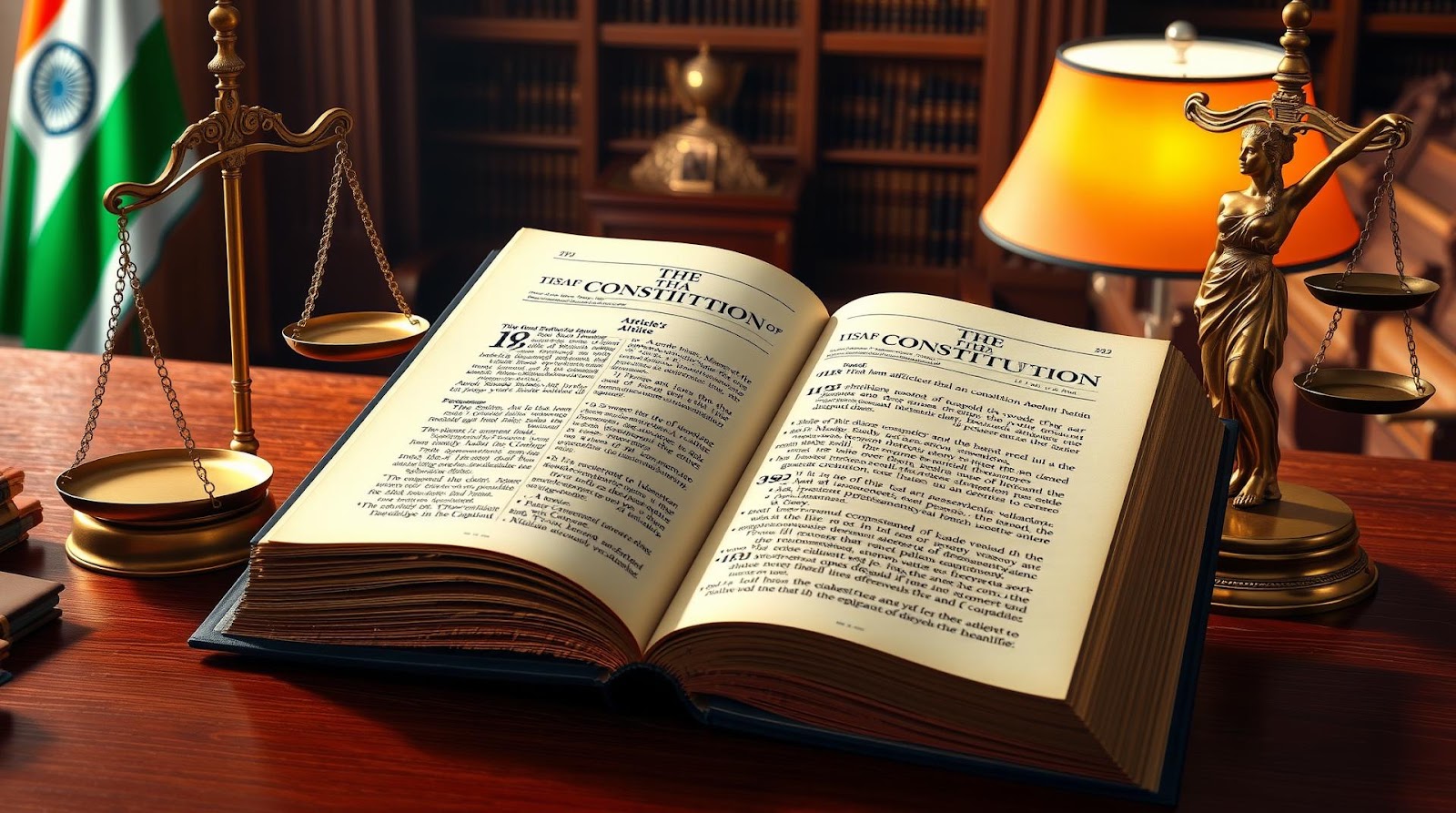
Introduction
Listen, I've been teaching polity for over a decade now, and if there's one thing I've noticed, it's that students panic when they hear "constitutional articles." The Constitution has 470 articles (originally), and everyone assumes they need to memorize all of them. Spoiler alert: you don't.
But here's what you do need to know — and know it cold — are maybe 30-40 articles that appear in nearly every exam, year after year. These are the articles that form the backbone of how India actually works. They're the difference between knowing Indian polity and just collecting random facts.
I've had thousands of students walk into the exam room with Article 370 on their minds but blanking on Article 21. That's because they didn't know which articles to prioritize. Today, I'm going to fix that for you. Let's talk about the articles that actually matter for your SSC CGL or UPSC exam — and more importantly, for understanding how our democracy functions.
The Foundation Articles: Your Constitution's Building Blocks
Articles 1-4: The "Who Are We?" Section
Every exam has at least one question about these articles. I call them the "identity articles" because they literally define India.
Article 1 is almost silly in its simplicity, but it trips up students every time: "India, that is Bharat, shall be a Union of States." That's it. That's the opening line of our Constitution. One question I always ask my students: "Why did Dr. Ambedkar use both 'India' and 'Bharat'?" The answer gives you perspective on our constitutional drafters' thinking — they wanted both the modern international name and our ancient cultural identity. Beautiful, really.
Article 2 is about Parliament's power to admit new states or create new territories. This was crucial for integrating princely states, and it's relevant today when questions come up about Jammu & Kashmir or new union territories. Article 3 extends this — Parliament can form new states or alter boundaries. And Article 4 says that if Parliament does something under Articles 2 and 3, it's considered a constitutional amendment but doesn't require the formal amendment process. Tricky, right?
Here's a memory trick I teach: Think "1-4" as "Identity-Creation-Alteration-Legal Shield." The Constitution first says who we are, then gives Parliament powers to add new bits, change existing bits, and make sure those changes stick without needing super-complicated amendment procedures.
Articles 12-35: Fundamental Rights — The Crown Jewels
Now we're entering the heavy-hitters zone. Articles 12-35 contain our Fundamental Rights, and I cannot stress enough how much these appear in exams. Not just polity exams — these pop up in general knowledge questions too.
Article 12 defines "State" — and this is where students often mess up. "State" doesn't just mean the government. It includes Parliament, executive, judiciary, local bodies, and even private entities performing state functions. Remember the Private Bill Doctrine? That's all from Article 12 interpretation.
Article 14 — Equality before law. Every year. Every single exam. This is the non-discrimination clause. It applies to everyone, citizens and non-citizens alike. Its counterpart, Article 15, adds that the State can't discriminate on grounds only of religion, race, caste, sex, or place of birth. Notice the word "only"? That's crucial. The State can classify people for reasonable purposes — it just can't use these specific grounds as the sole reason.
Article 19 is where you find the freedoms — speech, expression, assembly, movement, profession. But here's the thing: all these freedoms have reasonable restrictions. You can't yell "Fire!" in a cinema, as the American saying goes. The Constitution allows restrictions on grounds of sovereignty, integrity, public order, decency, morality, and state security. Learn that list of six grounds. I bet money it appears in your exam.
Article 21 is my personal favorite — "No person shall be deprived of his life or personal liberty except according to procedure established by law." This sounds simple, but the Supreme Court has expanded it to include right to education, right to health, right to privacy, right to live with dignity. Some questions will test your knowledge of these Supreme Court expansions, not just the article text itself.
Article 23 bans traffic in human beings and forced labor. Article 24 prohibits child labor in factories and mines. Article 25-28 deal with religious freedom — pretty straightforward, and they do appear in exams.
The Powers Game: Articles 53-151 (Executive, Legislature, and Their Powers)
Articles 53-78: The President and Council of Ministers
Here's where our presidential system meets parliamentary government, and it's beautifully confusing.
Article 53 says the executive power of the Union is vested in the President. But — and this is a massive "but" — Article 74 says the President acts on the advice of the Council of Ministers headed by the Prime Minister. So the President is a figurehead? Not entirely. The President has powers that can't be delegated (like appointment powers in specific cases, emergency powers), but in practice, runs on PM's advice.
Article 75 covers the Council of Ministers. Here's a test-maker's favorite: How long can a minister remain without being elected to Parliament? Answer from Article 75: six months. Mark that down. Also, the PM must be an MP (either Lok Sabha or Rajya Sabha), but other ministers can technically be non-MPs for those six months.
Article 77 is about the transaction of business of the Government of India. Seems boring? It establishes that government business is conducted in the President's name. Article 78 makes it the PM's duty to keep the President informed — this is the bedrock of the President-PM relationship.
Articles 79-123: Parliament — The Lawmaking Beast
Parliament is our supreme legislative body, and understanding its structure is fundamental.
Article 79 tells us Parliament consists of President, Lok Sabha, and Rajya Sabha. Yes, the President is technically part of Parliament — important for that one random question.
Articles 81-88 cover Lok Sabha (composition, qualifications, term). Remember: 552 members, 530 for states, 20 for Union Territories, 2 nominated by President. The term is 5 years. Articles 89-97 cover Rajya Sabha (permanent, rotating, 1/3 retire every 2 years). 245 members, 233 elected, 12 nominated.
Now, the powers of Parliament are distributed across multiple articles, but the key ones are Article 110 (definition of "Money Bill" — crucial!), Article 109 (procedure for Money Bills), and Articles 100-107 (procedures for voting, quorum, etc.).
Let me give you a trick for Money Bills. I call it the "SPATE" rule:
- S — Salary, allowances, pensions
- P — Payments and borrowing
- A — Audit and accounting
- T — Taxes and duties
- E — Expenditure
If a bill is only about these things, it's a Money Bill. Rajya Sabha can only delay it by 14 days. Lok Sabha has the final say. This distinction comes up in every other exam.
The Judicial Backbone: Articles 124-147
The Supreme Court and High Courts. Your Constitution's way of saying, "Someone's got to keep everyone else honest."
Article 124 establishes the Supreme Court. It has a Chief Justice and (currently) 33 other judges. Note the number — it changes as Parliament legislates. Article 125 is about the SC's seat in Delhi. Article 126 covers acting Chief Justices. These details seem trivial but appear in "Which article states..." type questions.
Article 127 allows retired judges to sit on the SC. Article 128 allows the Chief Justice to invite retired judges when needed. Article 129 says the SC is a court of record — its decisions and proceedings are recorded officially and carry evidentiary weight.
The crucial ones for exam purposes:
Article 131 — Original jurisdiction. The SC can directly hear cases where a state is a party. This is how states sue each other (like water disputes).
Article 132 — Appellate jurisdiction regarding constitutional questions. Article 133 — Civil appeals. Article 134 — Criminal appeals.
Article 139 is special — it grants the SC power to issue writs (habeas corpus, mandamus, prohibition, certiorari, quo warranto). These writs are your Fundamental Rights' bodyguards. When someone's rights are violated, writs come to the rescue.
Article 141 says that law declared by the SC is binding on all courts in India. And Article 142 gives the SC extraordinary power to do complete justice — it can pass orders not strictly covered by normal law. This is where judicial creativity happens.
The Special Cases: Articles That Changed India
Article 370 (Erstwhile): The Kashmiri Exception
You know this one's important because it literally made headlines in 2019. Article 370 granted special status to Jammu and Kashmir — it could have its own constitution, had special provisions regarding citizenship and property ownership, and Parliament's legislative powers were limited there.
The article was "temporary" (using Article 370 itself). On August 5, 2019, via presidential order under Article 370(3), it was abrogated. For exams, remember the key points: It gave J&K autonomy, and its removal was a pivotal constitutional moment.
Article 356: President's Rule — The Emergency Takeover
When a state government fails to function, the President can declare President's Rule under Article 356. This has been controversial — used 125+ times, sometimes blatantly for political reasons. The Supreme Court has read down this article significantly, requiring the President to be satisfied that a state can't be governed.
This article almost always appears because it's politically sensitive and frequently tested. Know when it can be invoked (breakdown of constitutional machinery), and remember that the Supreme Court has imposed safeguards.
Articles 368-369: Amendment Procedure
Article 368 is where the Constitution can be amended. Three types of amendments exist:
- Simple majority — Just Parliament (for procedural matters)
- 2/3 majority — Both houses of Parliament (for most matters)
- 2/3 + state ratification — Parliament plus state legislatures (for federal structure matters like Division of Powers or representation in Parliament)
Article 368(4) (added in the 24th Amendment) says that amendments ARE "laws" and can be struck down by SC if they violate the Basic Structure. This is how the Supreme Court controls constitutional amendments.
Article 369 is often overlooked but interesting — it provides for temporary modifications during emergencies (declared under Article 352, 356, or 360). It allows the President to modify laws during emergencies, but these modifications expire when the emergency ends.
| Article | Key Topic | Why It Matters |
|---|---|---|
| 14-15 | Equality & Non-Discrimination | Foundation of rights, tested every exam |
| 19 | Freedoms (Speech, Assembly, etc.) | Understand restrictions—six grounds critical |
| 21 | Right to Life & Liberty | Expanded by SC; includes privacy, education, dignity |
| 74 | President Acts on PM's Advice | Core of parliamentary system |
| 110 | Money Bill Definition | SPATE rule; tested regularly |
| 124-139 | Supreme Court Structure & Powers | Jurisdiction, writs, composition |
| 352-360 | Emergency Powers | National, State, Financial emergencies |
| 368 | Amendment Procedure | Three types; Basic Structure doctrine applies |
Articles 352-360: Emergency Provisions
Three types of national emergencies:
Article 352 — National Emergency (declared when threat to sovereignty or integrity). During this, President can suspend rights, expand Union's legislative powers, and redirect state revenues to the center. Only declared once (1975, The Emergency). Tests emphasize the conditions and consequences.
Article 356 — State Emergency (President's Rule). When a state government can't function. Controversial because it's been misused.
Article 360 — Financial Emergency. When financial stability is threatened. Rarely declared; less frequently tested but appears occasionally.
The 44th Amendment (1978) added safeguards: Parliament must approve within two months, President can't act unilaterally, and rights can't be suspended under Article 352.
Final Revision: Your Article Checklist
Here's my honest advice: Don't memorize every article number. Instead, understand the concepts, and know which article governs each concept. When you see "which article deals with...", you should be able to recall it naturally because you understand the logic.
For your next study session, pick any article from the list above and ask yourself: "Why does this article exist? What problem does it solve?" That mindset shift — from memorization to understanding — changes everything.
And here's a final thought from my classroom: The Constitution isn't just a legal document. It's the story of what India decided about itself. Every article reflects a choice, a compromise, a value. When you understand that, exams become less about rote learning and more about interesting puzzles.
Now go ace that test!
Practice Questions
A) Only the Central Government B) Only State Governments C) Parliament, Executive, Judiciary, and even private entities performing state functions D) Only the Judiciary
Answer: C) Parliament, Executive, Judiciary, and even private entities performing state functions
A) Article 100 B) Article 110 C) Article 120 D) Article 109
Answer: B) Article 110
A) Right to privacy B) Right to education C) Right to religious freedom D) Right to health
Answer: C) Right to religious freedom (this falls under Articles 25-28, not Article 21)
A) 3 months B) 6 months C) 9 months D) 12 months
Answer: B) 6 months (as per Article 75)
A) Amendments regarding taxation B) Amendments regarding Fundamental Rights C) Amendments regarding federal structure and representation in Parliament D) Amendments regarding the judiciary
Answer: C) Amendments regarding federal structure and representation in Parliament (requires 2/3 majority in both houses + ratification by at least half the state legislatures)
Published by Dattatray Dagale • 01 July 2026
.jpg)
.png)



.png)



.png)

0 Comments