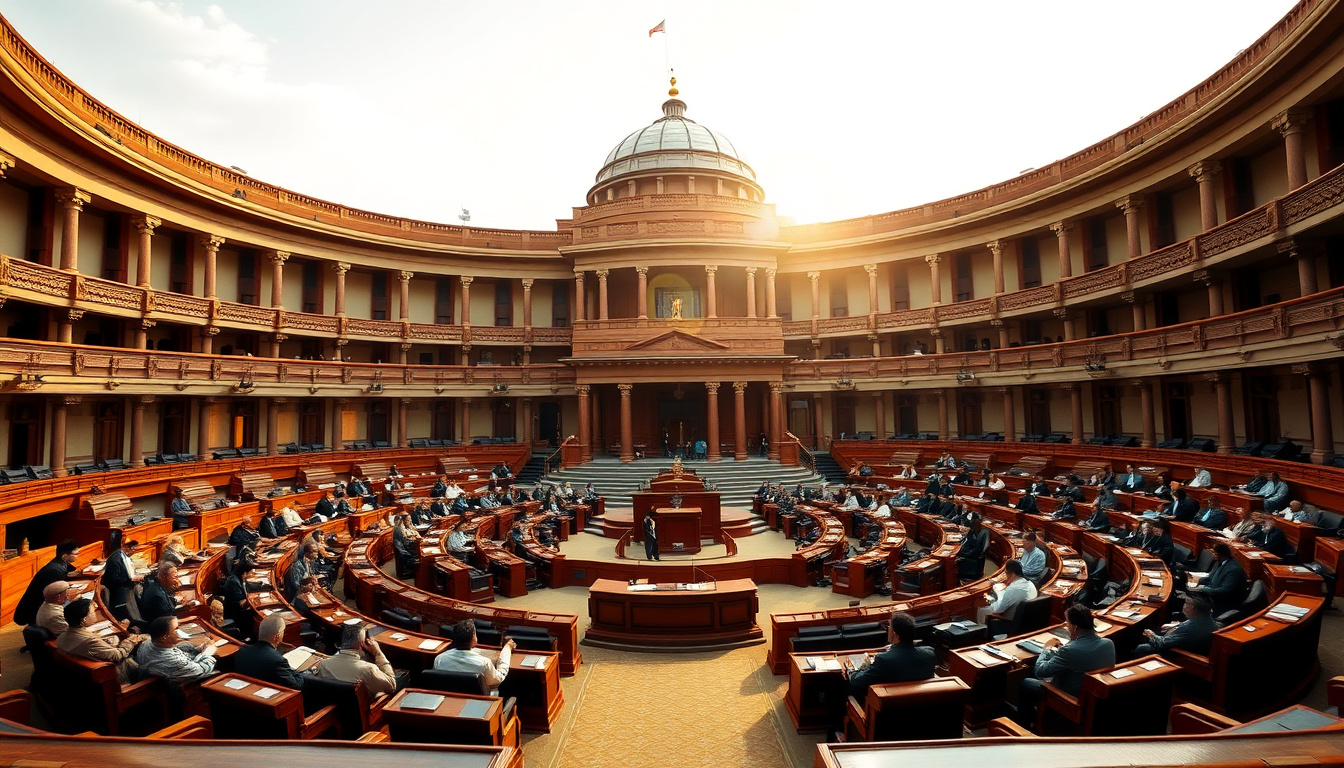
Introduction
Let me start with a confession: when I first taught Parliament to my students about a decade ago, I made it sound like some mystical, untouchable institution. Big building, big words, big decisions. My students looked at me like I was explaining quantum physics.
Then one day, a bright kid from Delhi raised her hand and asked, "Sir, is Parliament like the Rajya Sabha cricket commentary where everyone's arguing about the same match?" I nearly fell off my chair laughing—but she was absolutely right. And that's when I realized I'd been teaching it all wrong.
Parliament isn't magic. It's literally how 1.4 billion Indians argue about laws in a structured way. And once you see it like that—as a system of checks, balances, and healthy chaos—everything clicks into place. That's what we're going to explore today. By the end of this post, you'll not only understand how Parliament works, but you'll actually find it fascinating.
What Exactly Is Parliament? (And Why It's Not Just One Building)
Here's the first thing that confuses students: they think Parliament is one thing. It's not. Parliament is three things working together, like a three-part harmony in a Bollywood song. If one note is off, the whole thing falls apart.
The Three-Part System
Parliament consists of:
1. The President – Now before you scroll past, hear me out. The President is technically part of Parliament. Sounds weird? It is. Our President has very limited actual power in the legislative process—they're more like the ceremonial stamp of approval. But they are, technically, part of Parliament. This is one of those Indian Constitutional quirks that catches students off guard in exams.
2. The Lok Sabha (House of the People) – This is the popular house. 543 elected members. This is where the real power sits. When people say "Parliament passed a bill," they usually mean the Lok Sabha approved it. Lok Sabha members are elected directly by you and me. They represent the common person. Hence, "people's house."
3. The Rajya Sabha (Council of States) – This is the upper house, and here's where it gets interesting. Rajya Sabha members aren't directly elected. They're chosen by state legislatures. There are 245 elected members plus 12 nominated members. It's more deliberative, more experienced, and frankly, more interested in protecting state interests. Think of it as the "senior house" that reviews what the youngsters in Lok Sabha are doing.
Let me give you a trick I tell all my students: Remember "LR"—Lok Sabha = Lok (people), Rajya Sabha = Rajya (states). Lok is popular, Rajya is protective of state powers. Easy to remember, hard to forget.
What Powers Do They Actually Have?
The Lok Sabha is clearly the dominant house. It can pass the budget (money bills) independently. It can pass laws independently. The Rajya Sabha can only delay certain bills (except money bills). But here's the nuance: if the two houses disagree on a non-money bill, there's a joint sitting. And in a joint sitting? Lok Sabha wins because it has more members. So the Lok Sabha will almost always get its way in the end.
That said, Rajya Sabha isn't powerless. It's where your experienced politicians sit. They ask tough questions. They scrutinize. They represent state interests in national legislation. And for constitutional amendments? Both houses need equal majorities. So Rajya Sabha gets real power there.
The Legislative Process: How a Bill Becomes a Law (It's More Interesting Than You Think)
Alright, this is where most textbooks lose students with boring flowcharts. Let me tell you the story of a bill instead. Think of it like Bollywood: meet-cute, complications, interval twist, climax, resolution.
Stage 1: The Introduction (Meet-Cute)
A bill is introduced in either house. Usually Lok Sabha for most bills, though certain bills like money bills MUST start in Lok Sabha. When a bill is introduced, it's called the First Reading. No voting happens. It's just "Hey everyone, we're thinking about doing this." It gets printed, circulated, and people can read it and prepare their arguments.
Stage 2: The Committee Stage (Complications)
Here's where work actually happens. The bill goes to a parliamentary committee—maybe 30-40 members who are experts in that field. They examine every clause. They hear from experts. They make changes. This stage is crucial and often gets overlooked by students, but it's where the real legislative work happens. Most bills are substantially improved here.
Stage 3: The Second Reading (The Argument)
Now the bill comes back to the full house. This is the crucial stage. Members discuss it. They propose amendments. The government defends it. Opposition attacks it. Remember watching IPL and everyone has opinions? This is exactly like that. The General Discussion happens first—everyone gets to voice opinions. Then comes the Clause-by-Clause Consideration—every single provision is debated.
And here's something students often miss: amendments can completely change a bill. The government might come in with one version, but after this stage, it could be something quite different.
Stage 4: The Third Reading (The Climax)
The bill is presented in its final form. Usually no more amendments are allowed at this point. Members vote. If it passes, it moves to the other house (if not already passed there).
Stage 5: The Presidential Approval (The Resolution)
The bill reaches the President. Now here's something crucial: the President isn't just a rubber stamp. The President can send the bill back for reconsideration. If Parliament passes it again (usually with more support), the President must sign it. But that right to send back gives the President a meaningful role.
Once signed, it becomes a law. And boom—now you, the citizen, are bound by it.
Let me give you another memory trick: "I-C-2-3-P" – Introduction, Committee, Second Reading, Third Reading, Presidential assent. Sounds like a password, but it works!
| Stage | What Happens | Key Point |
|---|---|---|
| First Reading | Bill introduced, printed, circulated | No voting |
| Committee Stage | Committee examines, suggests changes | Most detailed work happens here |
| Second Reading | General discussion, then clause-by-clause debate | Amendments proposed and voted |
| Third Reading | Final form presented, voted on | Few/no amendments allowed |
| Other House | Repeats similar process (if not money bill) | Rajya Sabha can delay, not block |
| Presidential Assent | President signs bill into law | President can send back once |
Three Special Types of Bills (Because Parliament Loves Complications)
Not all bills follow the standard process. Parliament loves exceptions, and exam-makers love asking about them. So let's talk about the three special categories.
Money Bills
These bills deal with taxation, government spending, loans, and money. The Constitution is very clear: money bills MUST originate in Lok Sabha. Why? Because Lok Sabha is directly elected by people, and the logic is that people (through their elected representatives) should control the purse strings. Makes sense, right?
Here's the interesting part: when a money bill goes to Rajya Sabha, they have 14 days. If they don't return it, it's automatically passed. Even if they return it with amendments, Lok Sabha can simply reject all amendments, and it's still passed. This is the ultimate power of Lok Sabha. No other bill has this privilege.
Constitutional Amendment Bills
These are the serious stuff. To amend the Constitution, you need a special majority in both houses. Not just a simple majority—a special majority. Article 368 defines this: you need 2/3 of members present and voting in both houses. Also, for some amendments (like federal structure), you need ratification by at least half the state legislatures.
This is why the Constitution is stable. You can't just change it based on temporary political winds. You need serious consensus.
Private Members' Bills
Not all bills come from the government. Individual MPs can introduce bills too. These are called Private Members' Bills. Now, most private bills don't pass because the government controls the legislative schedule. But some do pass—and when they do, it's usually because the government privately supports them or they address something universally agreed upon.
Fun fact: many important laws started as private members' bills before the government took them up. This shows that Parliament isn't just about government control—individual MPs do have power, though limited.
The Organizational Structure: Who Does What and Why
Parliament has an internal structure that students often ignore. But understanding it is crucial because it shows how decisions actually happen.
At the top is the Speaker (Lok Sabha) and Chairman (Rajya Sabha). Don't mistake them for ceremonial positions. The Speaker controls debates, decides on procedural questions, and maintains order. A strong Speaker can shape how Parliament functions. A weak one? Chaos.
Then you have Parliamentary Committees. These are super important and rarely taught well. There are standing committees (permanent) and ad-hoc committees (temporary). Standing committees oversee specific ministries. They scrutinize budgets, examine bills, and ask tough questions. You'd be surprised how much legislative work happens in these committees, away from the public eye.
Then there's the Council of Ministers—the government. They run the country day-to-day. They can be members of Parliament (they must be) and answer questions from MPs. This is called Question Hour—and it's probably the most entertaining part of Parliament if you ever watch it. Ministers getting grilled live. No rehearsed speech, just thinking on their feet.
Key Differences Between Lok Sabha and Rajya Sabha (Quick Reference)
Students always mix these up. So let me make this crystal clear with direct comparisons.
Lok Sabha is popular, Rajya Sabha is protective. Lok Sabha is elected directly every 5 years by people. Rajya Sabha is elected by state legislatures for 6 years (1/3 retire every 2 years). Lok Sabha has 543 elected members, Rajya Sabha has 245 + 12 nominated. Lok Sabha controls money, Rajya Sabha protects federalism. When they disagree on non-money bills, joint sitting happens, and Lok Sabha wins because of numbers.
Here's my final mnemonic for these differences: "POWER vs STABILITY". Lok Sabha = POWER (directly elected, controls money, can be dissolved, fast). Rajya Sabha = STABILITY (state protection, permanent, deliberative, experienced).
Common Exam Confusions (Cleared Up)
After teaching thousands of students, I know exactly what confuses them. Let me address the most common ones right now, because I guarantee these will be in your exam.
Confusion 1: "Isn't the President the head of Parliament?" – Technically yes, but practically no. The President is mostly ceremonial. Real power rests with Parliament—the Speaker, the PM, the committees. The President signs bills, addresses Parliament, but doesn't control it. This distinction matters.
Confusion 2: "Can Rajya Sabha block a bill?" – For money bills, absolutely not. For regular bills, not really—they can delay (14 days maximum for money bills, no limit for regular bills technically, but conventions apply), but eventually Lok Sabha gets its way. The Constitution is clear about Lok Sabha's supremacy.
Confusion 3: "Do all MPs have equal power?" – Nope. The PM is an MP but has way more power. Ministers are MPs with cabinet responsibility. Backbenchers are MPs but have limited say. Also, MPs from the ruling coalition have more effective power than opposition MPs. Real world > constitutional text.
Confusion 4: "What exactly does Rajya Sabha do then?" – Great question! They scrutinize. They ask questions. They represent state interests. They slow down hasty legislation. They protect federalism. They handle constitutional amendments (equal voice with Lok Sabha). Their role is quality control and state protection, not obstruction.
Why All This Structure Matters (The Philosophy)
Before we wrap up, let me tell you why the Constitution makers designed Parliament this way. It's not random.
Our framers were terrified of mob rule and majoritarian dictatorship. So they built in checks. They said: the people should have power (Lok Sabha), but experienced people should review decisions (Rajya Sabha). They said: the people control money (Lok Sabha), but states must have a say (Rajya Sabha). They said: change the Constitution, yes, but make it hard (special majorities).
This is why Parliament is deliberately inefficient sometimes. Efficiency is the enemy of deliberation. Our Constitution makers preferred careful deliberation over quick decisions. They wanted conflict and discussion—because that's how you avoid terrible mistakes.
Understanding this philosophy makes all the strange rules suddenly make sense.
Alright, you now know more about Parliament than most Indians. You understand not just how it works, but why it works that way. Next time you hear about a bill being passed or a parliamentary debate, you'll actually know what's happening behind the scenes. And honestly? That's pretty cool.
Now let's test what you've learned.
A) Money bills can originate in either house of Parliament B) Money bills must originate in Lok Sabha C) Money bills can originate in Rajya Sabha D) Money bills require special majority in both houses
Answer: B) Money bills must originate in Lok Sabha. This is established by Article 109 of the Constitution. Lok Sabha has exclusive control over money matters because it's directly elected by the people.
A) 7 days B) 14 days C) 30 days D) There is no fixed maximum period
Answer: D) There is no fixed maximum period. While Rajya Sabha can delay, the Constitution doesn't specify a time limit for non-money bills, though conventions usually apply.
A) Rajya Sabha's decision prevails B) Lok Sabha's decision prevails C) A joint sitting is held D) The bill is abandoned
Answer: C) A joint sitting is held. In a joint sitting, both houses meet together, and since Lok Sabha has more members (543 vs 245 elected in Rajya Sabha), Lok Sabha essentially wins. But the procedure itself is a joint sitting.
A) It can amend bills from Lok Sabha B) It controls the budget C) It can reject constitutional amendments D) It represents state interests
Answer: B) It controls the budget. Lok Sabha has exclusive control over money bills and budgets. Rajya Sabha can't touch money bills in terms of amendment or rejection.
A) Before First Reading B) Between First and Second Reading C) Between Second and Third Reading D) After Third Reading
Answer: B) Between First and Second Reading. The committee stage comes after the First Reading (introduction) and before the Second Reading (general discussion). This is where detailed scrutiny happens.
Published by Dattatray Dagale • 27 July 2026
.jpg)
.png)



.png)




.png)


0 Comments