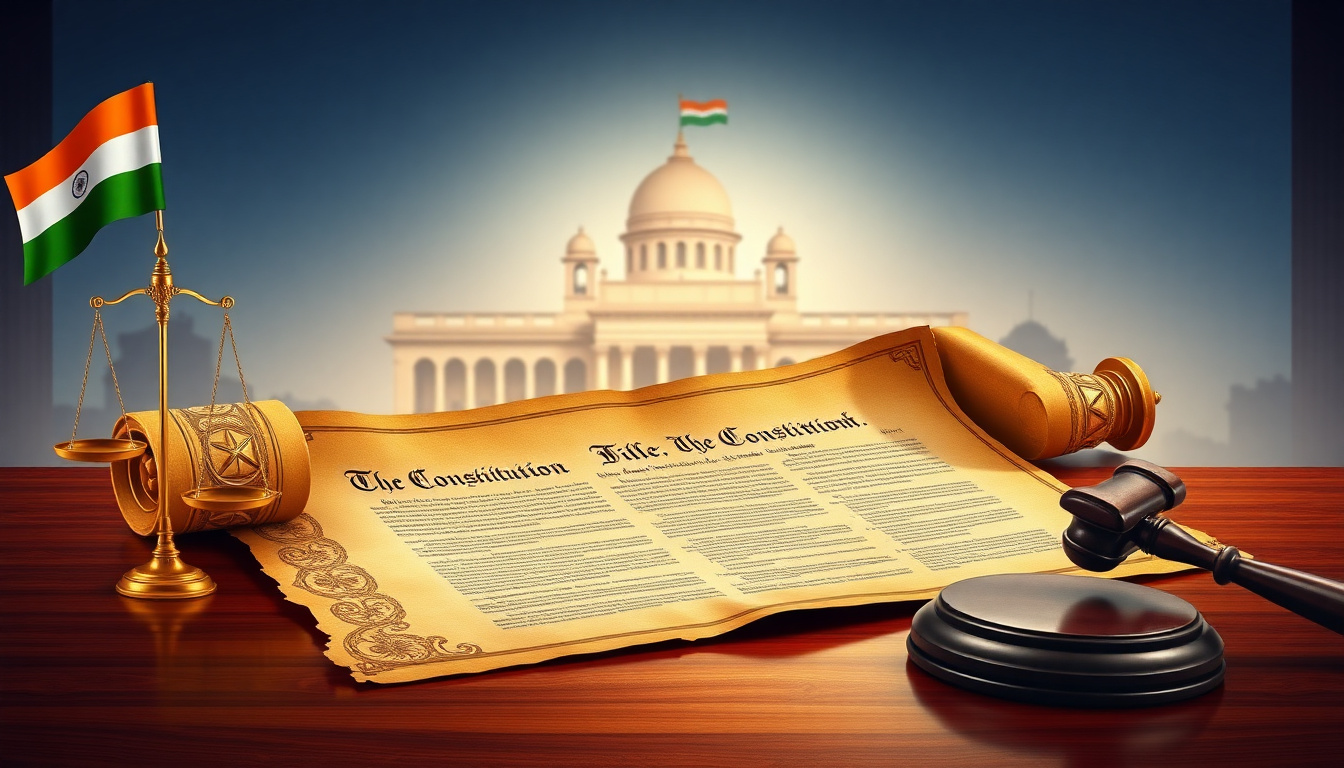
Introduction
Listen, I've been teaching SSC and UPSC aspirants for over a decade now, and I can tell you with absolute certainty: the Constitution of India isn't just some dusty legal document sitting in a museum. It's alive. It's breathing in every law we pass, every judgment our courts deliver, and every election we conduct. And if you want to crack any competitive exam, you need to know which articles actually matter.
I remember this student, Priya, who once told me she'd memorized all 470 articles of the Constitution. I asked her what Article 352 does. Blank stare. That's the problem—we often confuse quantity with quality. Today, I'm not going to overwhelm you with every single article. Instead, I'll walk you through the ones that frequently appear in exams and, more importantly, the ones that genuinely shape how India functions.
Think of the Constitution like a cricket match. You don't need to know every rule book page by page; you just need to understand the rules that actually determine who wins. That's what we're doing today.
The Foundation Articles: Where Everything Begins
Article 1: India is a Union of States
Let's start with the opening line—literally. Article 1 is where Dr. Ambedkar and the drafting committee made their first major statement: "India, that is Bharat, shall be a Union of States."
Now, you might be thinking, "So what? Of course India is a union." But here's the nuance that exam setters love: this single article establishes that India is a union, not a federation. Why does this matter? Because it means the states don't have the power to secede. They're bound together permanently. This distinction has come up in Supreme Court judgments and is a favorite MCQ topic.
Here's a memory trick I teach all my students: "USA = Federation. India = Union." In the US, states technically had the right to leave (though the Civil War settled that). In India? Never. We're permanently welded together from day one.
Articles 2 and 3: The Flexible Borders
Articles 2 and 3 are the Constitution's way of saying, "Yes, we can add new states and reorganize existing ones." Article 2 lets Parliament admit new territories, and Article 3 gives Parliament the power to form new states, change boundaries, and alter names—without requiring the consent of that state.
This is huge. In 2014, when Telangana was created, this is the article that made it legally possible. Many states have complained about this power (Maharashtra and Karnataka have had border disputes for decades), but Article 3 stands firm. Parliament's word is final.
The exam trick here? Remember that Article 3 doesn't need state consent, but it does need the President's approval and Parliament's legislative action. Some students forget this nuance.
The Jewels in the Crown: Rights and Duties Articles
Articles 12-35: Fundamental Rights (The Game-Changer Articles)
Alright, so technically this is a range, but I'm grouping them because they're interconnected and absolutely crucial. These articles guarantee six fundamental rights, and they're what separates a democracy from an autocracy.
Article 12 defines "State"—and this is sneaky territory. The State doesn't just mean the government. It includes Parliament, every government official, and even government-owned corporations. This broad definition means that fundamental rights apply widely.
Articles 14-18 cover equality. Article 14 is the big one: "Equality before the law." This means no special privileges. Remember when the Supreme Court struck down Section 377 (the old sodomy law) partially using Article 14? That's this article at work. It says you can't be discriminated against based on religion, caste, sex, or place of birth.
Now here's what I tell students: Article 15 is the anti-discrimination clause, but Article 16 is its twin for government jobs. Article 16 says recruitment in government can't discriminate based on religion, caste, sex, or place of birth. But—and this is crucial—it allows reservations for SC/ST/OBC because these are special circumstances requiring special remedies. This is why our reservations system is constitutional.
Articles 19-22 are about personal freedom. Article 19 gives you the right to free speech (subject to restrictions), freedom of assembly, freedom of association, freedom of movement, and freedom to practice any profession. But notice it says "subject to restrictions"—the government can restrict these in the interest of national security, public order, morality, etc.
Here's a real example: During COVID-19, lockdowns restricted Article 19 rights, but courts upheld them as reasonable restrictions for public health. That's how Article 19 works in practice.
Article 20 protects against prosecution for acts that weren't illegal when committed. Article 21 (my personal favorite) says no one shall be deprived of life or personal liberty except by law. This seems simple, but courts have expanded it to include right to education, right to information, right to privacy, and even right to die with dignity. It's the most actively used article in the Constitution.
Articles 25-28: Religious Freedom
These articles guarantee freedom of religion—you can practice any religion, propagate it, and manage religious affairs. But here's the catch: these rights are subject to public order, morality, and health. So you can practice any religion, but you can't use religion as a cover for illegal activities.
This came up in the Baba Ramdev case when he was questioned on misleading health claims. And in cases involving female genital mutilation or child marriage in certain communities—religion doesn't override constitutional values.
The Emergency Brake: Articles 352-360
Now we're getting to the dramatic stuff. These five articles give the President emergency powers, and they've shaped Indian history significantly.
Article 352: National Emergency (The Fearsome One)
Article 352 allows the President to declare a national emergency in case of war, external aggression, or armed rebellion. When this happens—and this is massive—the federal system temporarily becomes unitary. State governments lose much of their autonomy.
This article was misused during the 1975 Emergency declared by then-President Fakhruddin Ali Ahmed on PM Indira Gandhi's advice. For 21 months, fundamental rights were suspended, and thousands were arrested without trial. It's a dark chapter in Indian democracy, and that's exactly why this article is so important to understand.
Here's the memory trick: 352 = The "War" Emergency. Remember: 3 = War/Aggression/Rebellion, 52 = Big trouble ahead.
Article 356: President's Rule (The State Emergency)
This one lets the President dismiss a state government and impose President's Rule if the state government can't function. Now, this sounds simple, but it's been hugely controversial. Some CMs have been removed for questionable reasons.
The Supreme Court stepped in with the S.R. Bommai case (1994) and said the President can't just dismiss a state government on a whim. There have to be reasonable grounds, and the President's decision can be challenged in court. This was a landmark judgment that actually protected federalism.
Articles 355, 357, 358, 359, 360: The Emergency Arsenal
Article 355 is the Union's duty to protect states. Article 357 deals with what happens to state revenues during President's Rule. Articles 358 and 359 are the scary ones—during national emergency, Article 358 allows Parliament to suspend Articles 19 (freedom of speech, assembly, etc.) automatically. Article 359 lets Parliament suspend other fundamental rights by presidential order.
Article 360 is the financial emergency—declared when the country's financial stability is threatened. It's never been used, but technically it allows the President to restrict salaries, allowances, and pensions of government employees and judges.
| Article | Type of Emergency | Key Feature | Used Before? |
|---|---|---|---|
| 352 | National Emergency | War/Aggression/Rebellion | Yes (1962, 1971, 1975) |
| 356 | State Emergency | State Gov't Dysfunction | Yes (Multiple times) |
| 360 | Financial Emergency | Financial Crisis | Never |
| 358/359 | During National Emergency | Suspend Fundamental Rights | Yes (1975-77) |
The Structural Articles: How India Actually Runs
Articles 79-122: Parliament and Its Functions
Article 79 establishes Parliament—the President, Lok Sabha, and Rajya Sabha. Articles 81 onwards detail the composition, qualifications, and election procedures. But the real money questions come from understanding what Parliament can and can't do.
Article 110 defines what a "Money Bill" is. This is crucial because Money Bills can only originate in the Lok Sabha, and the Rajya Sabha can't reject them. The recent farm laws controversy was partly about whether these should have been Money Bills (they weren't).
Articles 123-149: Executive Powers and Ordinances
Article 123 lets the President issue ordinances when Parliament isn't in session. But here's the catch: an ordinance must be approved by both houses within 6 weeks of the next session, or it lapses. This prevents the President (on advice of the PM) from making permanent changes without Parliament's blessing.
Articles 226-227: Judicial Powers
Article 226 is why the High Court can issue writs (habeas corpus, mandamus, prohibition, certiorari, quo warranto) to protect fundamental rights and enforce duties. This is the power that lets courts intervene when something goes wrong. When a High Court orders the release of someone illegally detained, it's using Article 226.
The Supreme Court's broader jurisdiction comes from Articles 32 and 141-142, which let it issue writs for fundamental rights and gives it advisory jurisdiction.
Let me be honest: these articles are dense. But they're the skeleton key to understanding how our three-branch government (legislature, executive, judiciary) actually restrains each other. That's why exams love testing these.
Quick Mnemonic for Emergency Articles
I teach my students this simple trick to remember the emergency articles:
"352 = War. 356 = State. 360 = Finances. 358/359 = Rights Suspended."
Or even simpler: "3 stands for Emergency, the number after determines the type."
The Constitution of India isn't static. It's living, breathing, constantly being interpreted by courts, amended by Parliament, and tested by real-world situations. When you understand these key articles, you're not just memorizing for exams—you're understanding how your country actually works.
My final tip? Don't just read articles. Read Supreme Court landmark judgments that interpret them. S.R. Bommai v. Union of India, Kesavananda Bharati v. State of Kerala, Navtej Singh Johar v. Union of India—these cases bring articles to life. That's when it all clicks.
Practice Questions
A) Article 1 B) Article 2 C) Article 3 D) Article 4
Answer: C) Article 3 — This article gives Parliament the power to form new states, change boundaries, and alter names. Article 2 admits new territories, Article 3 actually creates states.
A) Economic recession B) War with another country C) Natural disaster D) Collapse of a state government
Answer: B) War with another country — Article 352 specifically allows emergency in cases of war, external aggression, or armed rebellion. Economic and natural disasters fall under different articles.
A) Article 14 B) Article 19 C) Article 21 D) Article 25
Answer: C) Article 21 — This is the most expansively interpreted fundamental right. Courts have read numerous rights into it beyond the literal text.
A) The President must consult all state governments B) The President's decision can be challenged in court C) The state CM must agree D) Parliament must pass a special resolution
Answer: B) The President's decision can be challenged in court — The Supreme Court established that Article 356 can't be used arbitrarily. The President must have reasonable grounds, and the decision is subject to judicial review.
A) Article 358 B) Article 359 C) Article 360 D) Article 361
Answer: A) Article 358 — Article 358 automatically suspends Article 19 (freedom of expression, assembly, etc.) during a national emergency. Article 359 can suspend other fundamental rights by presidential order during emergency. This is why the 1975 Emergency was so devastating—these rights vanished automatically.
Published by Dattatray Dagale • 26 July 2026
.jpg)
.png)



.png)


.png)

0 Comments