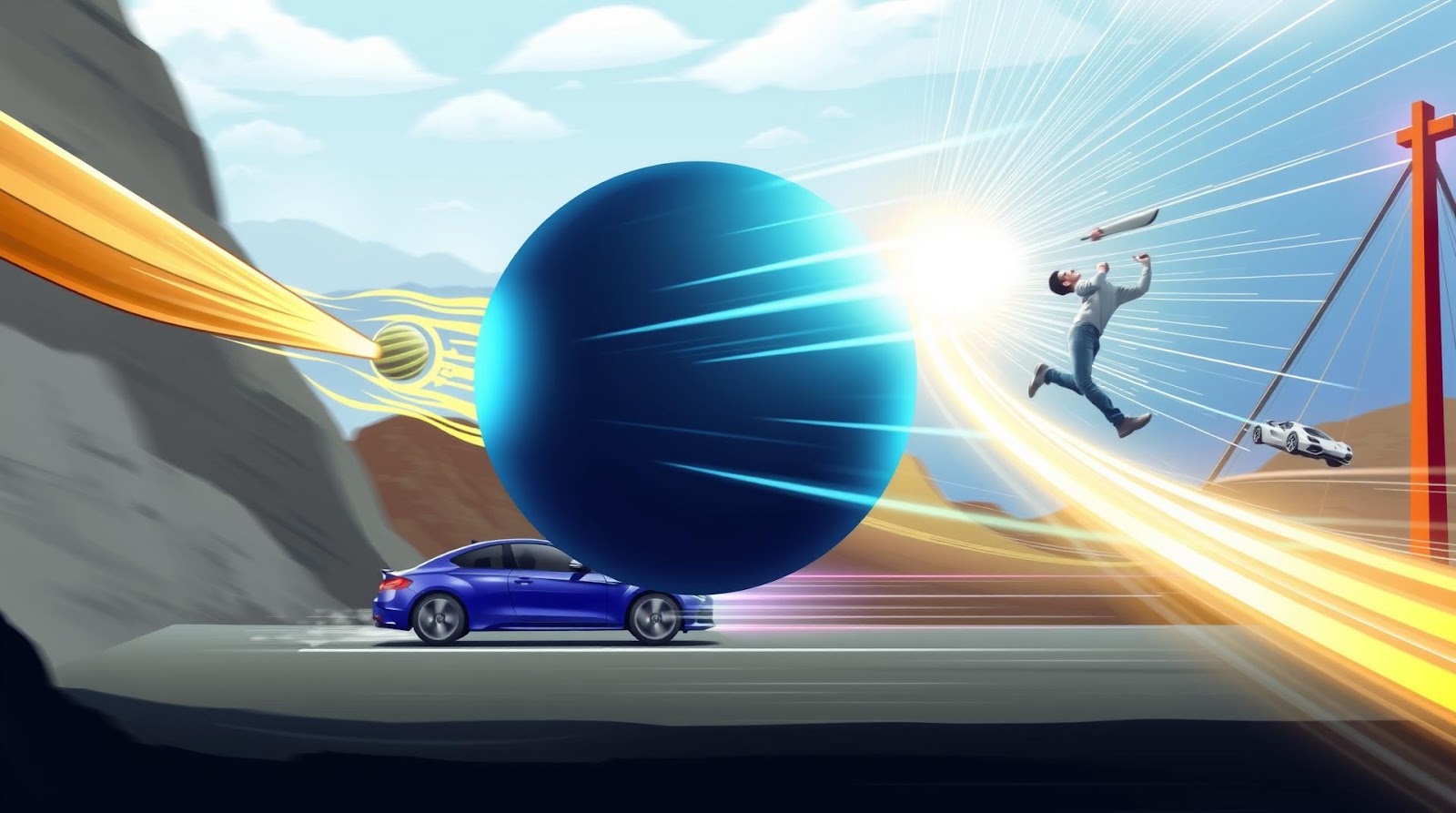
Introduction
You know, I've been teaching physics for over a decade now, and the one thing I've noticed is that students are terrified of this chapter. But here's what I tell everyone on day one: you've *already* been doing physics your entire life. Every time you kick a football, every time you feel the jolt when a bus suddenly brakes, every time you wonder why the sun doesn't fall out of the sky — that's all physics.
Motion, force, and energy are the three pillars holding up the entire universe. And once you understand how they work together, everything clicks. It's not some abstract theory locked away in textbooks. It's alive in your world right now.
Let me be honest — this chapter typically has 8-10 questions in SSC CGL and often appears in UPSC too. But more importantly, the concepts here are fundamental. You'll see them again and again in thermodynamics, work-energy, rotational motion — everything builds on these foundations. So let's crack this properly, shall we?
Understanding Motion: When Things Move and Why
What Exactly is Motion?
Motion is simply the change in position of an object with respect to a reference point over time. Now, "reference point" is crucial here. See, if you're sitting on a train, you're at rest with respect to the seat next to you, but you're moving with respect to someone standing on the platform. Motion is relative.
In physics, we usually work with three types of motion:
Linear motion: Something moving in a straight line. A car on a highway. An arrow shot from a bow. Simple.
Circular motion: Something moving in a circle. Earth around the sun. A merry-go-round. A cricket ball bowled with spin. Here's the trick — even though the speed stays constant, the direction keeps changing, which means there's acceleration. This catches people off guard.
Projectile motion: Something moving under the influence of gravity in a parabolic path. A batsman hitting a six in cricket. A stone thrown horizontally from a cliff. This combines horizontal and vertical motion, and exams love this.
The Three Equations of Motion
Ah, the holy trinity. I'll teach you a memory trick right now that I've used with thousands of students.
The three equations are:
v = u + at
s = ut + ½at²
v² = u² + 2as
Here's the mnemonic I invented: "VUS" — Very Useful Stuff. The first letters give you the order!
- v = final velocity
- u = initial velocity
- a = acceleration
- t = time
- s = displacement
Now, why three equations? Because each one is useful when a different piece of information is missing. If you don't have time, use the third one. If you don't have displacement, use the first one. It's like having three different keys for three different locks.
Let me give you a real example. A car accelerates from 0 to 60 km/h in 5 seconds on a straight road. Using v = u + at, we find the acceleration. Then using s = ut + ½at², we find how far it traveled. This is the physics of real driving, and yes, it appears in exams.
Force: The Push and Pull of the Universe
Newton's Laws — The Foundation
Isaac Newton changed everything. Three laws. That's all. And these three laws explain why planets orbit, why you get pushed back in your seat when a car accelerates, why you slide forward when it brakes, everything.
First Law: An object at rest stays at rest, and an object in motion stays in motion unless acted upon by an external force. This is called inertia. You know when you're in a bus that suddenly stops, and you lurch forward? That's inertia. Your body wants to keep moving forward because nothing's stopping it. That's why seatbelts exist.
Second Law: F = ma. Force equals mass times acceleration. This is the most important equation in mechanics. It tells you that if you want to accelerate something heavy, you need a bigger force. A Nano needs less fuel than a truck because it has less mass.
Third Law: For every action, there's an equal and opposite reaction. When you jump, you push down on the Earth, and the Earth pushes up on you with equal force (which is why you go up). When a gun fires, the bullet accelerates forward, and the gun recoils backward. Simple, but most students forget this in exams.
Types of Forces You Need to Know
Now here's where things get practical. There are several types of forces that come up again and again:
Friction: The resistance when two surfaces slide against each other. Static friction (when something is stationary but you're trying to move it) is always stronger than kinetic friction (when something is already moving). This is why it's harder to get a car moving from rest than to keep it moving. Friction is why we can walk without slipping, and why roads need traction.
Normal force: The force perpendicular to a surface when something rests on it. A book on a table experiences normal force equal to its weight (mg). This is always equal to the weight if the surface is horizontal, but changes if the surface is tilted.
Tension: The force in a rope or cable pulling something. When you hang from a rope, the rope experiences tension equal to your weight plus any acceleration.
Weight: This is literally the force of gravity on your mass. W = mg. Don't confuse it with mass. Your mass is the same everywhere, but your weight changes if gravity changes. On the Moon, you'd weigh one-sixth of what you weigh on Earth, but your mass stays the same.
Here's my trick for remembering the difference: "M is for Massive, W is for Weighing." Mass is intrinsic. Weight depends on gravity. Simple!
| Quantity | Symbol | Unit | Formula |
|---|---|---|---|
| Force | F | Newton (N) | F = ma |
| Weight | W | Newton (N) | W = mg |
| Acceleration | a | m/s² | a = v - u / t |
| Momentum | p | kg⋅m/s | p = mv |
| Friction | f | Newton (N) | f = μN |
Energy: The Currency of the Universe
What is Energy, Really?
Energy is the capacity to do work. That's it. It's not some mysterious thing. It's literally the ability to make something happen. The sun has energy because it can heat Earth and grow crops. A moving car has energy because it can crash through a wall. A stretched rubber band has energy because when you release it, it can fly across the room.
Energy comes in many forms, but for SSC and UPSC, you need to focus on these:
Kinetic Energy (KE): The energy of motion. KE = ½mv². Notice it depends on the square of velocity. This means if you double your speed, your kinetic energy quadruples. This is why speeding is so dangerous — the energy to stop you increases exponentially. A car at 100 km/h has four times the kinetic energy of the same car at 50 km/h.
Potential Energy (PE): The energy stored due to position. If you hold a book above the ground, it has gravitational potential energy equal to mgh (where h is height). This is why a falling coconut from a tall tree is more dangerous than one from a short tree. Potential energy becomes kinetic when you release it.
Work: This is formal: Work = Force × Displacement × cos(θ). The angle θ matters. If you push something in the direction it moves, you're doing positive work. If you push against its motion, you're doing negative work (like friction slowing a car). If you push perpendicular to motion, you do zero work (even though you might feel tired!).
The Work-Energy Theorem
This is my favorite concept because it's so elegant. The work-energy theorem states: Work done = Change in kinetic energy. In equation form: W = ΔKE = ½m(v² - u²).
Let me give you a real scenario. A cricket ball moving at 20 m/s hits a batsman's leg pad and comes to rest. The work done by the leg pad on the ball equals the change in kinetic energy. The kinetic energy decreases to zero, so the work is negative (the pad absorbs the energy through bruising and deformation). This explains why getting hit by a ball hurts — all that kinetic energy is being absorbed by your body.
Here's another example: A car accelerates from 0 to 60 km/h on a straight road. The engine does work on the car, increasing its kinetic energy. Some of this work goes into overcoming friction and air resistance (which is why we need to keep the engine running), but the net work equals the increase in kinetic energy.
Conservation of Energy
This is the most fundamental principle in physics: Energy cannot be created or destroyed; it can only be converted from one form to another. Total energy in a closed system remains constant.
Imagine a pendulum swinging. At the highest point, it has maximum potential energy and zero kinetic energy (it momentarily stops). At the lowest point, it has maximum kinetic energy and zero potential energy (it's moving fastest). But the sum PE + KE remains constant throughout the swing. That's conservation of energy.
In real life, some energy always gets converted to heat due to friction and air resistance. This is why a pendulum eventually stops swinging. The mechanical energy is converted to heat in the air and the pivot point. But if you account for that heat, total energy is still conserved.
Now here's something important: in exams, when they say "neglect friction" or "idealize the system," they're telling you to assume energy is perfectly conserved. Use this assumption.
Putting It All Together: Real-World Applications
Let me tie everything together with a scenario you've all experienced.
You're sitting in a moving bus. The bus is traveling at constant velocity (no acceleration yet). You're at rest relative to the bus, so there's no force acting on you (Newton's first law). Your speed relative to the ground is, say, 60 km/h, so you have kinetic energy, but since you're moving at constant speed, no net work is being done on you.
Suddenly, the bus accelerates. A force acts on you (through friction with the seat and the seat pushing on you). This force accelerates you forward. The bus engine does work, increasing the kinetic energy of both the bus and you. Work = Force × Distance, and since you're accelerating, the force is in the direction of motion, so work is positive.
Now the bus suddenly brakes. Friction between your body and the seat applies a force backward (opposite to motion). This does negative work, decreasing your kinetic energy. If the friction force is strong enough, you slow down. If not, inertia wins and you lurch forward. This is why seatbelts are essential — they provide a large friction force to stop you along with the bus.
Meanwhile, all the kinetic energy the bus had is being converted. Some is converted to potential energy as it climbs a hill. Some is converted to heat as the brakes get hot. Some is dissipated as sound and vibration. But energy is never lost — always conserved, always transformed.
This scenario touches on motion (acceleration in different phases), force (friction, normal force from the seat), and energy (kinetic to thermal to potential). This is physics. This is why this chapter matters.
Final Tips for Exam Success
I've seen thousands of students answer these questions. Here's what separates the ones who get full marks from the ones who don't:
First: Always draw a free body diagram. Seriously. Before you write a single equation, sketch all the forces acting on the object. This clarifies your thinking immediately.
Second: Pay attention to signs. Negative work means energy is being taken away. Negative acceleration means deceleration. Negative displacement means movement in the opposite direction. Don't just plug in numbers; understand what they mean.
Third: Use conservation of energy when forces are conservative (like gravity). It's often faster than calculating work directly.
Fourth: Remember that motion, force, and energy are interconnected. A force causes acceleration, which causes change in velocity, which changes kinetic energy. They're not separate topics; they're different angles on the same reality.
You've got this. Physics isn't a mystery. It's just a systematic way of understanding how the world works. And now you know the fundamentals.
A) 2000 N B) 4000 N C) 5000 N D) 10000 N
Answer: B) 4000 N. Using F = ma: a = v/t = 20/5 = 4 m/s². F = 1000 × 4 = 4000 N.
A) 50 J B) 100 J C) 200 J D) 400 J
Answer: C) 200 J. PE = mgh = 2 × 10 × 10 = 200 J.
A) 10 m/s B) 20 m/s C) 25 m/s D) 30 m/s
Answer: A) 10 m/s. Using v = u + at: v = 30 + (−10)(2) = 30 − 20 = 10 m/s.
A) 500 N B) 1000 N C) 1500 N D) 2000 N
Answer: C) 1500 N. Deceleration: a = Δv/t = 10/0.5 = 20 m/s². The ground must provide force to decelerate (F = ma = 50 × 20 = 1000 N) plus support weight (mg = 50 × 10 = 500 N). Total = 1500 N.
A) −1687500 J B) −168750 J C) 168750 J D) 1687500 J
Answer: B) −168750 J. Work = Change in KE = ½m(v² − u²) = ½ × 1500 × (0² − 15²) = 750 × (−225) = −168750 J. Negative because brakes remove energy.
Published by Dattatray Dagale • 11 July 2026
.jpg)
.png)



.png)



.png)



0 Comments