Introduction
Let me tell you something I've noticed after teaching thousands of SSC and UPSC aspirants — the students who truly ace their science papers are the ones who stop memorizing and start *understanding* the environment around them. Seriously. I had a student once who couldn't remember the difference between biotic and abiotic factors, but the moment I asked him to look at his own terrace garden and identify which things were living and non-living, something clicked. He scored 38 out of 40 in ecology that year.
Environment and Ecology is not some intimidating topic that requires you to become a botanist overnight. It's about understanding the web of relationships that keeps our planet running. And here's the beautiful part — you're already living inside this ecosystem! You see it every day. The birds outside your window, the trees on your street, the monsoon rains, the pollution in your city — it's all ecology in action.
In this post, I'm going to walk you through the fundamentals of environment and ecology in a way that'll stick with you long after your exam. No jargon overload, no unnecessary complexity. Just clear, practical knowledge the way I'd explain it to you over a cup of chai.
What Exactly Is an Ecosystem? (And Why Should You Care)
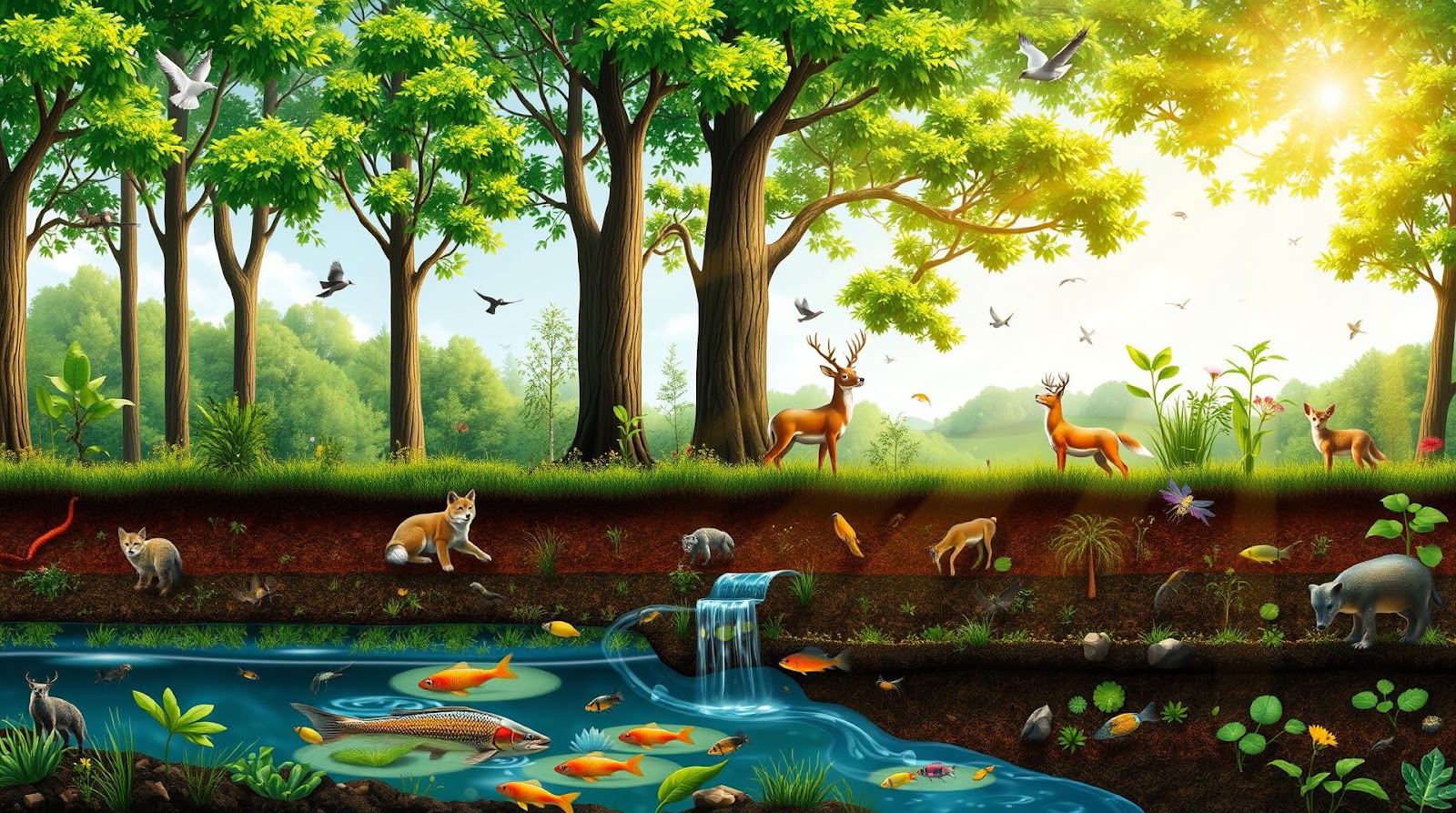
Here's where most students go wrong — they think an ecosystem is some complicated scientific term that only biologists need to understand. Wrong. An ecosystem is simply a *community of living organisms interacting with their physical environment*. That's it. Your house is a tiny ecosystem. Your city is a larger ecosystem. Earth is the ultimate ecosystem.
The Two Main Components
Every ecosystem has two fundamental parts, and I want you to remember this forever: **Biotic** and **Abiotic**.
The *biotic* component is everything living — plants, animals, bacteria, fungi, humans, insects. Think of "bio" = life. If it breathes, grows, reproduces, or eats, it's biotic.
The *abiotic* component is everything non-living — sunlight, water, soil, air, temperature, humidity, wind. These are the physical factors that support life but aren't alive themselves.
Now here's a trick I tell all my students: **ABIOTIC = A (not) + BIOTIC**. The "A" means without. So abiotic literally means "without life." Simple, right? And once you remember this, you'll never confuse them again.
The Structure of an Ecosystem
Think of an ecosystem like a building. It has different levels, and each level depends on the ones below it. This is what we call the **trophic levels**:
Producers: These are plants. They're the foundation of everything because they use sunlight to create food through photosynthesis. Without them, nothing else survives. In the forest, it's the trees and shrubs. In a pond, it's the algae.
Primary Consumers: These are herbivores — deer, rabbits, grasshoppers, cows. They eat the plants (producers). If you remember Hindi from school, think "pehle consumer" = first consumer = they come first after plants.
Secondary Consumers: These are carnivores that eat the herbivores. A tiger eating a deer, an eagle eating a rabbit. They're second-level eaters.
Tertiary Consumers: These are top predators that eat the secondary consumers. A lion eating a hyena, an eagle eating a snake. They're at the top of the food chain.
Decomposers: Bacteria, fungi, and other organisms that break down dead matter and return nutrients to the soil. They're the cleanup crew that ensures nothing goes to waste.
You might be wondering — what's the point of knowing all this? Well, understanding trophic levels helps you answer questions about energy flow, food chains, and why ecosystems collapse when one species is removed. If you remove all the tigers (secondary consumers), the deer population explodes, they overgraze all the plants (producers), and suddenly there's no food for anyone. The whole system crashes.
Biogeochemical Cycles: The Planet's Recycling System
Here's something that blew my mind when I first learned it — the atoms in your body right now? Some of them have been through millions of organisms over billions of years. That carbon in your muscle? It was probably in a dinosaur once. That nitrogen? Maybe it was in a plant in ancient Rome. This is because of biogeochemical cycles.
A biogeochemical cycle is the movement of a chemical element or compound through the biotic and abiotic components of an ecosystem. Think of it like a never-ending recycling program that Earth runs.
The Big Four Cycles You Must Know
The Carbon Cycle: Carbon moves from the atmosphere (as CO₂) into plants (through photosynthesis), then to animals (through eating), and back to the atmosphere (through respiration and decomposition). Humans are messing with this cycle big time by burning fossil fuels and adding extra CO₂ to the air.
The Nitrogen Cycle: Nitrogen is in the air, but plants can't use it directly. They need nitrogen-fixing bacteria in the soil to convert it into a usable form. Animals eat the plants, and when they die, decomposers break them down, returning nitrogen to the soil. Farmers understand this well — they rotate crops and add manure to maintain soil nitrogen.
The Water Cycle: This one you know from school — evaporation, condensation, precipitation. Water moves from oceans to atmosphere to land and back again. It's continuous and it's essential.
The Phosphorus Cycle: Phosphorus is found in rocks and soil. Plants absorb it, animals eat the plants, and when organisms die, decomposers return it to the soil. Unlike the carbon and nitrogen cycles, phosphorus doesn't have a gaseous phase, so it moves more slowly.
Here's a memory trick for the gaseous vs. non-gaseous cycles: **GAN** — Gaseous cycles are Carbon, nitrogen, and... wait, that's only two. Actually, think **CNW** — **C**arbon, **N**itrogen, and **W**ater have gaseous phases. Phosphorus doesn't.
| Cycle | Reservoir | Key Process | Gaseous? |
|---|---|---|---|
| Carbon | Atmosphere (CO₂) | Photosynthesis, respiration | Yes |
| Nitrogen | Atmosphere (N₂) | Nitrogen fixation by bacteria | Yes |
| Water | Oceans, atmosphere | Evaporation, precipitation | Yes |
| Phosphorus | Rocks, soil | Weathering, decomposition | No |
Biodiversity: The Variety That Keeps Earth Alive
Biodiversity simply means biological diversity — the variety of different species in a given area. It's usually discussed at three levels:
Genetic Diversity: The variation within a species. Not all dogs look the same, not all roses are identical. This variation is crucial because it allows species to adapt to changing conditions.
Species Diversity: The number of different species in an area. A tropical rainforest has high species diversity with thousands of different plants, animals, and microorganisms. A desert has lower species diversity.
Ecosystem Diversity: The variety of different ecosystems on Earth. Forests, grasslands, deserts, oceans, wetlands — each has unique characteristics and species.
Now, why should you care about this? Because biodiversity is under serious threat, and questions about conservation are *extremely* common in exams. When species go extinct, we lose genetic resources, medicines, and ecological balance. Did you know that about 25% of pharmaceutical drugs are derived from plants? And we've only tested about 5% of plant species for medicinal properties. Imagine what we're losing when rainforests are cleared.
Threats to Biodiversity and Why They Matter
Habitat Loss: This is the biggest threat. When forests are cut down for agriculture or cities expand, organisms lose their homes. I always think of it this way — would you want to live somewhere with no house, no food, no safety? That's what happens to animals when habitats are destroyed.
Pollution: Industrial waste, pesticides, plastic, heavy metals — they all poison ecosystems. I once saw a river near a textile factory that was completely changed color from the dyes. All the fish were gone.
Overexploitation: Hunting, overfishing, and excessive harvesting can drive species to extinction. Remember the dodo bird? Gone forever because people hunted it for food without considering consequences.
Invasive Species: When non-native species are introduced to an ecosystem, they can outcompete native species and cause ecological chaos. Water hyacinth in Indian lakes is a classic example — it reproduces so fast that it chokes waterways and kills native aquatic plants.
Climate Change: Rising temperatures, changing rainfall patterns, and extreme weather events are disrupting ecosystems worldwide. Species that have adapted to specific temperature ranges are struggling to survive.
Population Ecology: Understanding Growth and Carrying Capacity
Population ecology is about understanding how populations of organisms grow, stabilize, and sometimes crash. This section feels abstract until you realize it applies to humans too.
Every population has what we call a **carrying capacity** — the maximum number of individuals an environment can support indefinitely. Think of it like your house's capacity. If you have a 2-bedroom apartment, it has a carrying capacity of maybe 4-5 people comfortably. If 10 people try to live there, the resources (space, water, food) become strained.
Population growth follows two main patterns:
Exponential Growth: When there are plenty of resources and no limiting factors, populations grow exponentially — doubling every generation. In real life, this is rare because resources eventually run out. Bacteria in a fresh growth medium show this pattern initially.
Logistic Growth: This is more realistic. Population grows exponentially at first, then the growth rate slows down as resources become limited, and finally the population stabilizes around the carrying capacity. It looks like an S-shaped curve.
The factors that limit population growth are called **limiting factors** or **resistance to the environment**. These include:
- Biotic limiting factors: Predation, disease, competition, parasitism
- Abiotic limiting factors: Water, nutrients, light, temperature, space
Here's why this matters for exams — questions about why a population declined or stabilized are always about identifying the limiting factors. If you see a graph where a rabbit population suddenly crashes, you should be thinking: "What changed? Did the wolf population increase? Did the grass die? Did disease spread?" These are your limiting factors at work.
Quick Revision Table
| Concept | Definition | Example |
|---|---|---|
| Biotic | Living organisms | Tiger, grass, bacteria |
| Abiotic | Non-living physical factors | Sunlight, water, soil pH |
| Producer | Organism that makes its own food | Green plants, algae |
| Consumer | Organism that eats other organisms | Herbivores, carnivores, omnivores |
| Decomposer | Breaks down dead matter | Fungi, bacteria, earthworms |
| Carrying Capacity | Max population size environment can support | A forest can support X number of deer |
| Succession | Gradual change in ecosystem over time | Bare rock → lichens → grasses → forest |
Final Thoughts: Why This Matters Beyond the Exam
I want to leave you with something important. Learning about environment and ecology isn't just about passing an exam — it's about understanding the world you live in and why certain things are happening. Climate change, rising pollution, extinct species, environmental laws — they all make sense when you understand these fundamentals.
The next time you see a news story about deforestation in the Amazon, a tiger reserve being expanded, or water pollution, you'll have the knowledge to understand *why* it matters. And honestly? That's the real victory.
Study hard, practice those MCQs below, and remember — you're not just memorizing facts, you're learning to read the world. Good luck!
Practice Questions
A) Deer grazing in a forest B) Bacteria decomposing dead leaves C) Temperature and humidity D) Hawks preying on rabbits
Answer: C) Temperature and humidity
A) 100% B) 50% C) 10% D) 5%
Answer: C) 10%
A) Carbon cycle B) Nitrogen cycle C) Phosphorus cycle D) Water cycle
Answer: C) Phosphorus cycle
A) Population density B) Carrying capacity C) Growth rate D) Biotic potential
Answer: B) Carrying capacity
A) Rainfall B) Soil pH C) Predation D) Sunlight
Answer: C) Predation
Published by Dattatray Dagale • 13 July 2026
.jpg)
.png)



.png)



.png)
0 Comments