Introduction
Let me start with a confession: when I first started teaching economics, the Five Year Plans seemed like the most boring topic imaginable. Long numbers, obscure targets, historical names... I thought my students would fall asleep. But then something clicked. I realized these weren't just government documents gathering dust in libraries. They were the blueprint of modern India—literally how we went from a struggling post-independence nation to a $3 trillion economy. That's when I started telling students: "If you want to understand why your grandfather couldn't afford a bicycle but your dad could buy a car and you can book an Uber, you need to understand Five Year Plans."
I know what you're thinking: "Really? Is it that dramatic?" Yes, absolutely. And here's what's even more interesting—the story keeps evolving. These plans, and the economic reforms that came with them, shaped everything from the GST you see on your shopping bills to the startup revolution that's changing how Indians think about entrepreneurship.
So let's dig into this together. I'll show you not just the what and when, but the why and how—the way I explain it to my batch when we're discussing India's economic journey.
What Were Five Year Plans, and Why Did India Need Them?
Picture this: it's August 1947. India just became independent. The British left behind a broken economy, massive poverty, and zero industrial infrastructure. Nehru looked at this situation and thought, "We need a roadmap. Not just for one year, but for five years at a time." And that's how the Five Year Plans were born.
Now, here's something most textbooks don't explain clearly: Nehru didn't invent this idea. He borrowed the concept from the Soviet Union's economic planning model. But here's the crucial difference—while the Soviets used it for totalitarian control, Nehru adapted it for a democratic country. That's actually a remarkable achievement when you think about it.
The Core Idea Behind Five Year Plans
The fundamental logic was simple but powerful: instead of leaving economic growth to chance or markets, the government would identify priority areas, allocate resources strategically, and set targets. Think of it like a cricket team planning their season—you don't just hope to win; you identify which batsmen to develop, which bowlers to focus on, where to bat first. Except here, we're talking about developing dams, steel plants, and agricultural productivity.
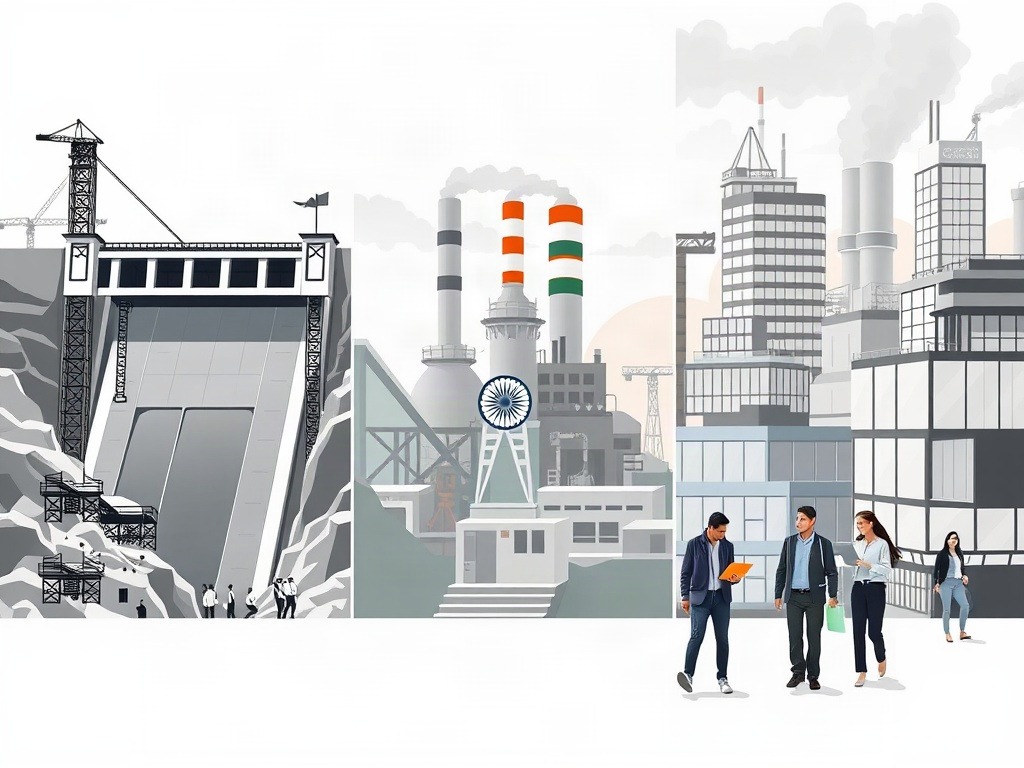
The very first Five Year Plan (1951-56) had a specific focus: agriculture and irrigation. Why? Because India's population was starving, and without food security, nothing else mattered. Under this plan, major dams like the Bhakra Nangal were constructed. Sardar Vallabhbhai Patel used to call these dams "the temples of modern India"—poetic, right? But also true.
Nehru's Vision: Import-Substitution and Heavy Industry
The Second Five Year Plan (1956-61) was where things got really ambitious. Nehru decided India needed heavy industries—steel plants, power plants, refineries. The idea was simple: India will produce what it needs internally instead of importing everything. This is called "import substitution industrialization."
Let me give you a memory trick I use with students: think "ISI" as Import Substitution = Independence. Because in Nehru's mind, if you're importing everything, you're still dependent. Build your own industries, and you're truly free.
The government set up massive state-owned enterprises like SAIL (Steel Authority of India), BHEL (Bharat Heavy Electricals), and Indian Oil Corporation. These were the backbone of India's industrial growth for decades. Were they always efficient? No. But they created an industrial base that hadn't existed before.
The Evolution: From Planning to Market Reforms
Now here's where I need to be honest with you. By the 1970s and 1980s, the Five Year Plan model was showing cracks. India's growth rate was sluggish—around 3-4% annually, which economists sarcastically called the "Hindu Rate of Growth." We had massive state-owned enterprises that were inefficient, corruption was rampant, and the private sector was so tightly controlled that entrepreneurship was nearly impossible.
You want to start a business in the 1970s? You needed government permission called a "license." It could take months or years. The famous phrase "License Raj" became synonymous with bureaucratic nightmare. My grandfather once told me he waited 18 months to get permission to expand his small manufacturing unit. By then, the technology had already become outdated!
The Economic Crisis of 1991 and the Turning Point
In 1991, India faced a balance of payments crisis. Our foreign exchange reserves were so depleted that, at one point, we could barely cover two weeks of imports. The government was on the verge of defaulting on international loans. This was the wake-up call.
Enter Dr. Manmohan Singh, then Finance Minister. He made a bold decision: liberalize the economy. Remove licenses, open up to foreign investment, reduce government control, and let markets work. It was revolutionary for India at that time. People were genuinely scared. "Foreign companies will destroy our industry," they said. "Our businesses can't compete," others warned.
But Singh and PM Narasimha Rao pushed through. And you know what? Within a few years, Indian businesses started thriving precisely because they had to compete. Software companies like TCS, Infosys, and Wipro became global players. New sectors boomed. The growth rate shot up from 1.1% (1991) to consistent 6-8%.
The New Five Year Plans: Adapting to a Market Economy
The later Five Year Plans (from the 8th Plan onwards) were completely different in flavor. Instead of "the government will build everything," the message became "the government will create conditions for growth; private sector will lead." Privatization started. Foreign Direct Investment (FDI) was invited. Special Economic Zones were created.
The 10th Five Year Plan (2002-07) was renamed the "Inclusive Growth" plan. The 11th Plan (2007-12) explicitly focused on "Faster, More Inclusive and Sustainable Growth." Notice the language shift? From controlling the economy to enabling it.
And then in 2014, something interesting happened. The new government under PM Modi decided to discontinue the Five Year Plan model altogether and introduced something called the "National Development Agenda" with a 15-year vision. Some say it was a symbolic break from Nehruvian socialist ideals. Some say it was just rebranding. Either way, the planning structure became less rigid and more adaptable.
| Five Year Plan | Period | Primary Focus | Key Achievement |
|---|---|---|---|
| First | 1951-56 | Agriculture & Irrigation | Dams built, Green Revolution foundation |
| Second | 1956-61 | Heavy Industry | SAIL, BHEL, Steel Plants established |
| Green Revolution Plans | 4th-6th (1966-80) | Agricultural Technology | Food self-sufficiency achieved |
| Post-Liberalization Plans | 8th onwards (1992+) | Market-led Growth | Software boom, FDI inflows, 6-8% growth |
Major Economic Reforms That Changed India
Now let's talk about the specific reforms that actually moved the needle. Plans are nice on paper, but reforms are what change people's lives.
The 1991 Liberalization Reforms
This was THE watershed moment. Dr. Singh opened up Foreign Direct Investment caps, removed industrial licensing for most sectors, devalued the rupee to make exports competitive, and started privatizing government companies. The result? Industries that were sleepy suddenly woke up and started competing globally.
Here's a personal anecdote: in 1995, Indian software engineers were considered second-rate globally. By 2005, companies were hunting for Indian talent. Why? Because when forced to compete with global standards, Indian professionals delivered. The offshore IT revolution wouldn't have happened without liberalization.
Agricultural Reforms and Green Revolution
The Green Revolution (1960s-70s) wasn't technically a formal "reform" but a carefully planned initiative to increase agricultural productivity using modern technology—high-yield variety seeds, fertilizers, irrigation. It transformed India from a food-importing nation to self-sufficient. This single policy probably saved millions of lives.
The Haryana-Punjab region became the "granary of India." Interestingly, this also created long-term challenges—groundwater depletion, soil degradation, farmer debt—which we're still grappling with today.
Monetary Policy and RBI Autonomy
For decades, the RBI was controlled by the government, often forced to print money to fund government spending, which caused inflation. In 1997, a major reform gave the RBI operational independence. It meant the central bank could make decisions based on economic data, not political pressure.
Here's my memory trick: think "RBI = Reserve Bank of Independence." Because that's what it got—independence. And inflation control improved significantly after that.
GST and Indirect Tax Reforms
The goods and service tax, implemented in 2017, was arguably the biggest indirect tax reform since independence. Before GST, India had a maze of different taxes—excise, VAT, service tax—all at different rates. A product manufactured in Gujarat and sold in Maharashtra would face multiple layers of taxes. GST unified all of this into a single, transparent system.
Was it perfect on day one? No. Was there chaos? Absolutely. But the long-term simplification it brought to Indian business was transformational. Now, there's one tax, one form, one rate—except for the occasional drama when the GST Council changes rates, which traders will never forgive me for reminding them about!
What These Plans and Reforms Mean for Your Exam (and Your Future)
I always tell my students: understand the philosophy, not just the timeline. The shift from planned economy to market economy isn't just an exam answer. It explains why India has a booming startup ecosystem now. It explains why foreign companies want to invest here. It explains why you have career choices today that your grandparents couldn't have imagined.
For SSC and UPSC exams, you'll get questions about which plan focused on what, which reforms happened when, what were the outcomes. The standard answers are important, but the deeper understanding is what makes you write compelling answers that fetch full marks.
Remember: Five Year Plans were the "what" and "when" of India's development. Economic Reforms were the "how" that actually delivered results. Together, they explain India's transformation from a poor, struggling nation to a global economic player.
Now, let's test your understanding with some practice questions:
A) Fourth Five Year Plan B) Seventh Five Year Plan C) Eighth Five Year Plan D) Tenth Five Year Plan
Answer: C) The Eighth Five Year Plan (1992-97) came after the 1991 liberalization reforms, marking the transition to a market-oriented economy.
A) Agricultural development B) Heavy industrialization C) Service sector growth D) Green Revolution
Answer: B) Heavy industrialization. Nehru's vision focused on building foundational industries like steel, power, and heavy machinery through public sector enterprises.
A) Yashwant Sinha B) Dr. Manmohan Singh C) Arun Jaitley D) Pranab Mukherjee
Answer: B) Dr. Manmohan Singh introduced the groundbreaking liberalization reforms during the balance of payments crisis of 1991.
A) 1947-1965 B) 1965-1991 C) 1991-2005 D) 2005 onwards
Answer: B) 1965-1991. During this period, entrepreneurs needed government licenses for almost every business decision, leading to bureaucratic delays and inefficiency.
A) Liberalization (1991) B) Monetary policy reforms (1997) C) Goods and Services Tax (2017) D) Agricultural reforms (1960s)
Answer: C) The Goods and Services Tax (GST), implemented in 2017, merged various indirect taxes into one unified tax structure, simplifying compliance for businesses.
Published by Dattatray Dagale • 26 August 2026
.jpg)
.png)



.png)


.png)


0 Comments