Introduction
Let me start with a confession—when I first started teaching economics to SSC CGL students about twelve years ago, I found Five Year Plans incredibly boring. Charts, targets, industrial production percentages... it all felt like watching paint dry on a monsoon day. But then something clicked. One of my students asked me a simple question: "Sir, why did India choose five years? Why not ten?" That innocent question transformed how I understood our entire economic journey.
Today, I'm going to walk you through India's Five Year Plans and Economic Reforms the way I explain it to my brightest students—not as dry history, but as the real story of how we transformed from a struggling post-independence nation into an economic powerhouse. By the end of this post, you'll not only understand what these plans were, but why they matter for your exam and, more importantly, why they shaped the India you live in today.
Understanding Five Year Plans: Why Five Years, Anyway?
Here's the thing most textbooks won't explain clearly—when Dr. Rajendra Prasad, our first President, and Pandit Jawaharlal Nehru looked at rebuilding India in 1947, they didn't just pull "five years" out of thin air. They looked at what the Soviet Union had done with their planned economy model and thought: "Why not adapt this for our mixed economy?" Five years became the sweet spot—long enough to show real progress, short enough to course-correct if things went wrong.
Think of it like a cricket series. You can't judge a batsman's form in a single match (that's your yearly plan), but watching five matches gives you genuine insight. That's the philosophy behind Five Year Plans.
The Plan Commission and How It All Started
In March 1950, India established the Planning Commission with Pandit Nehru as its Chairman. Now, you might think this sounds like a government office that files papers—and initially, it kind of was! But here's what made it revolutionary: for the first time in Indian history, we had a structured, democratic framework to allocate resources and set economic targets.
The Planning Commission wasn't supposed to dictate how everyone should work. Instead, it coordinated between different states, industries, and sectors to create a coherent development strategy. In theory, beautiful. In practice? Well, that's where the complications began, and that's what makes this story so interesting for your exam.
The Core Objectives That Guided Every Plan
Every single Five Year Plan from the First to the Twelfth was built around four main pillars—let me give you a memory trick I teach all my students:
SEEG—Self-reliance, Employment, Equity, Growth. Remember it like this: an economy needs to "SEEG" (see) all four directions to move forward. Let me explain each:
- Self-reliance (Swavlamban): Make India independent from foreign imports and technology
- Employment: Create jobs so people have dignity and purchasing power
- Equity: Ensure resources reach the poor and backward regions, not just the already-developed areas
- Growth: Increase overall productivity and GDP
These weren't empty slogans. When you study actual plan documents, you see how seriously our planners took these objectives. Of course, achieving all four simultaneously? That's where things got tricky.
The Journey Through Twelve Plans: Successes and Lessons
The Early Plans: Building the Foundation (First to Fourth, 1951-1974)
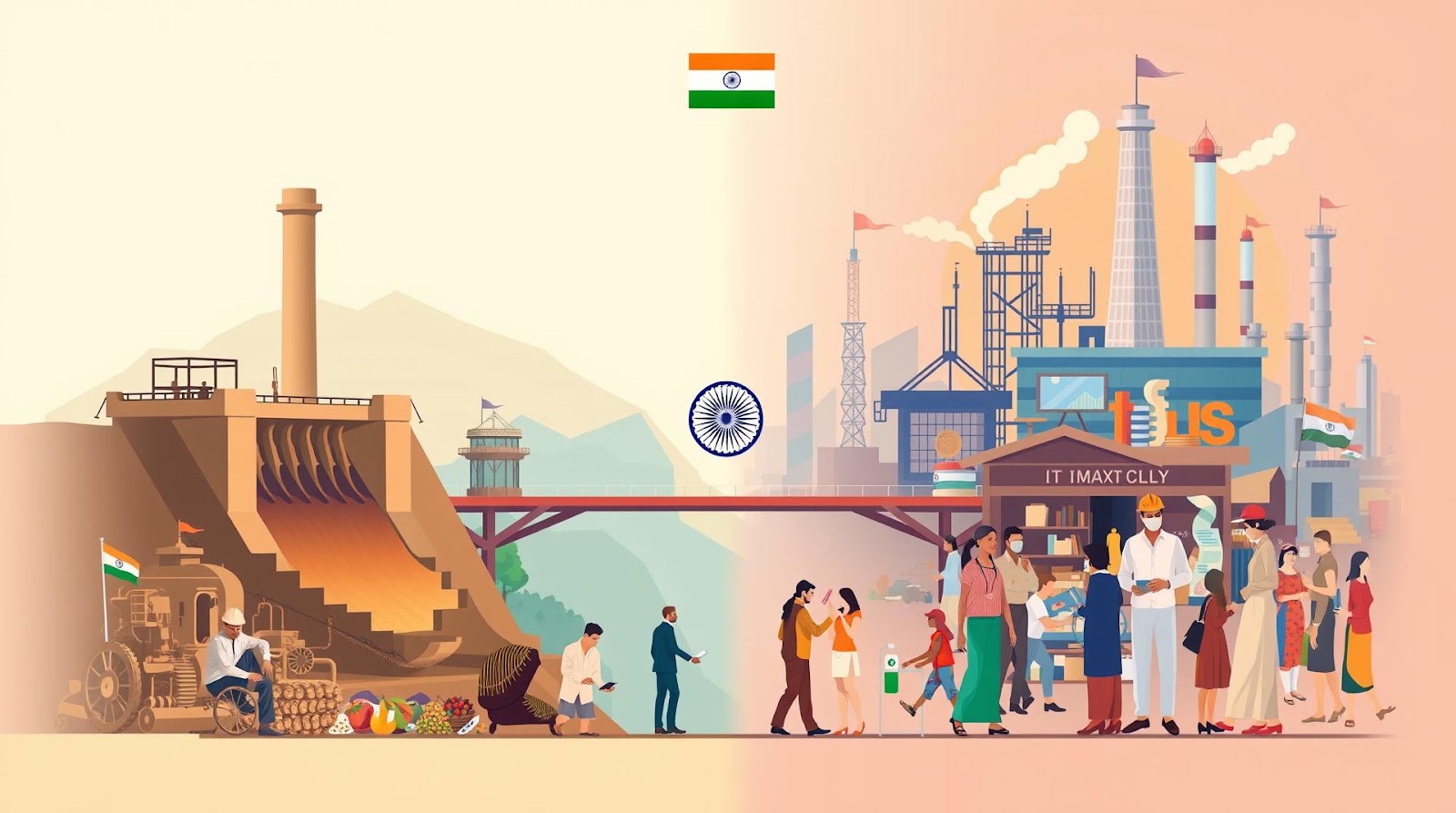
The First Five Year Plan (1951-1956) under PC Mahalanobis emphasized heavy industries. Think of it as building a house—before you paint the walls pretty, you need a solid foundation. India invested heavily in steel plants (TISCO, Bhilai, Rourkela), hydroelectric projects, and irrigation dams. These weren't sexy investments, but they were necessary.
The Second Plan (1956-1961) continued this focus. Industries boomed. By the Third Plan (1961-1966), things were looking good—agricultural production was increasing, industrial capacity was growing. Then came the Fourth Plan (1969-1974), and here's where you see planning actually responding to reality. The earlier plans had been a bit too optimistic, sometimes even naive, about what India could achieve. The Fourth Plan became more pragmatic.
The Middle Years: Crisis, Adaptation, and the Green Revolution (Fifth to Eighth, 1974-1992)
Now here's where the story becomes really interesting. The Fifth Plan (1974-1979) happened during a period of global oil crisis and inflation. India was struggling. Unemployment was high. Social unrest was visible. The Emergency was declared (1975-1977), and planning took a backseat to political survival.
But something beautiful happened during these middle plans—the Green Revolution took off. Agricultural productivity skyrocketed. By the late 1970s and 1980s, India went from being a food-importing country to achieving food security. That's not just an economic achievement; that's a transformation of national dignity.
The Sixth Plan (1980-1985) under Rajiv Gandhi brought technology into focus. Energy production increased. The Seventh Plan (1985-1990) continued this momentum, and by the time the Eighth Plan came around (1992-1997), something fundamental was about to change.
The Watershed Moment: Economic Liberalization and Beyond (Ninth to Twelfth Plans, 1997-2017)
Now, you absolutely cannot discuss Five Year Plans without discussing what happened in 1991. This is crucial for your exam, so pay attention.
By 1991, India was in economic crisis. Foreign exchange reserves were dangerously low—we had just three weeks' worth of imports left. The government was nearly bankrupt. This wasn't a scenario for debate; this was a threat to national survival.
Enter Dr. Manmohan Singh and Prime Minister P.V. Narasimha Rao. They made a decision that was brave, controversial, and ultimately transformational: economic liberalization. India opened up to foreign investment, reduced license requirements, and allowed market forces more room to operate.
The Ninth Plan (1997-2002) onwards operated in this new liberalized framework. And here's the thing—the growth rates increased dramatically. Average GDP growth during the 10th and 11th Plans was around 8-9%. Compare that to around 3-4% during the planned economy era, and you see the impact of liberalization.
But—and this is important—liberalization wasn't a magic wand. It created new inequalities, left some sections behind, and benefited urban areas more than rural ones. The Twelfth Plan (2012-2017) actually tried to address these concerns with its emphasis on inclusive growth.
| Plan Period | Key Focus | Average Growth Rate |
|---|---|---|
| 1st (1951-56) | Heavy Industries, Dams | 3.6% |
| 5th (1974-79) | Social Justice Focus | 5.0% |
| 9th (1997-02) | Post-Liberalization | 5.5% |
| 11th (2007-12) | Inclusive Growth | 8.9% |
Economic Reforms: The Big Picture
Pre-1991: The License Raj Era
Before 1991, India operated under what people called the "License Raj"—a system where you needed permission (a license) to do almost everything in business. Want to start a factory? License. Want to expand it? Another license. Want to import something? Multiple licenses.
This system had good intentions. It was supposed to protect domestic industry and ensure planned development. But in practice, it created corruption, inefficiency, and bureaucratic red tape so thick that new entrepreneurs lost hope.
I always tell my students: imagine if every time you wanted to study a new subject, you had to ask permission from ten different teachers, each with their own checklist. That's how business felt in pre-1991 India.
The 1991 Reforms: Opening the Door
The 1991 reforms, also called the New Economic Policy, had three main components. Let me give you another memory trick: DIP—Deregulation, Investment, and Privatization.
- Deregulation: Remove unnecessary licenses and controls. Let business breathe.
- Investment: Encourage foreign direct investment. Open sectors that were previously closed.
- Privatization: Allow private sector to enter areas previously reserved for the government.
What happened? The private sector exploded. Telecom, which was a government monopoly, suddenly had competition. Companies like Reliance, Airtel, and Vodafone entered the market. Phone tariffs crashed from ₹20 per minute to ₹1 per minute. Today, we have 2+ billion phone connections. That's the power of reforms.
Specific Reforms That Changed Everything
Telecom Sector Liberalization (1991): Before this, only BSNL existed. After liberalization, competition emerged. Today, Indians have more phone connections than toilets—which is both funny and telling about our development priorities!
Trade Liberalization: Import duties came down. Export restrictions were removed. This exposed Indian companies to global competition, which sounds painful but actually made them stronger.
Financial Sector Reforms: Banking and insurance opened up. Private banks could now compete with state-owned banks. The quality of service improved dramatically.
FDI in Retail (2012): This was controversial but revolutionary. Foreign companies like Walmart could now operate in India. While small traders protested (and justifiably so), consumer prices fell, and supply chains became efficient.
Criticisms and the Balanced View: What Five Year Plans Couldn't Achieve
Now, I wouldn't be a good teacher if I just sang praises. Let me be honest about the limitations.
Five Year Plans were rigid in a country that's inherently chaotic and diverse. Tamil Nadu's priorities were different from Kerala's, which were different from Bihar's. A centralized plan from Delhi couldn't always account for these ground realities. Many targets were missed. Some were too optimistic, others too pessimistic.
The agricultural sector, despite the Green Revolution, saw unequal development. Some regions flourished (Punjab, Haryana), while others remained backward. This created regional disparities that persist even today.
And here's the uncomfortable truth: liberalization created unprecedented growth, but it also created unprecedented inequality. The top 10% captured most of the wealth gains. Urban areas boomed while villages were left behind. These are facts, not controversies.
Post-1991, planning became less important. NITI Aayog's establishment in 2015 marked the formal end of Five Year Plans. Today, we have aspirational targets and sectoral strategies, but not the unified planning framework of before.
The question exam setters love to ask: Was this transition good or bad? The honest answer: Both. Good because it encouraged innovation and growth. Bad because it reduced the focus on equity and inclusion. The real job of policymakers is to capture the benefits of both approaches—planned thinking with market efficiency.
Key Takeaways for Your Exam
If you're preparing for SSC CGL or UPSC, here's what you absolutely must know:
- Planning Commission was established in 1950; NITI Aayog replaced it in 2015
- First Four Plans: Heavy industry focus; moderate growth
- Fifth to Eighth Plans: Green Revolution success; political turbulence
- 1991 Reforms: Economic liberalization; opening up of sectors
- Ninth to Twelfth Plans: High growth; focus on inclusive growth in later plans
- Key reformers: Dr. Manmohan Singh (Finance Minister 1991), P.V. Narasimha Rao (PM)
And here's a personal tip from 12 years of teaching: when you see a question about Five Year Plans or economic reforms, don't just memorize dates and growth rates. Understand the context. Why was that decision made? What were the problems it solved? What new problems did it create? That's how you get 4/4 marks on essay questions, and that's how you actually understand our economy.
A) Sardar Vallabhbhai Patel B) P.C. Mahalanobis C) C. Rajagopalachari D) Pandit Nehru
Answer: B) P.C. Mahalanobis – He was the chief architect and advisor on the Soviet-inspired planned economy model.
A) 1989 B) 1990 C) 1991 D) 1992
Answer: C) 1991 – The New Economic Policy was announced on July 24, 1991, by P.V. Narasimha Rao's government.
A) Economic Survey Board B) NITI Aayog C) Ministry of Planning D) Development Commission
Answer: B) NITI Aayog – National Institution for Transforming India replaced the Planning Commission under the Modi government.
A) Agriculture B) Textile Industry C) Heavy Industries and Infrastructure D) Information Technology
Answer: C) Heavy Industries and Infrastructure – Steel plants, dams, and power generation were prioritized to build the economic foundation.
A) Rule of the licensing department B) The system requiring government permission for business activities C) Royal decree on commercial matters D) Control of foreign trade only
Answer: B) The system requiring government permission for business activities – This was the pre-1991 regulatory framework that stifled entrepreneurship.
Published by Dattatray Dagale • 23 April 2026
.jpg)
.png)



.png)




.png)

0 Comments