Introduction
Listen, I've been teaching physics for over a decade now, and I can tell you with absolute certainty: if you understand motion, force, and energy properly, you've basically cracked 40% of your physics problems. These three concepts are like the holy trinity of mechanics — they're connected, they're everywhere, and they're absolutely unavoidable in SSC CGL, UPSC, and every competitive exam worth taking.
The interesting thing? Most students make this harder than it needs to be. They memorize formulas like robots, plug in numbers, and hope for the best. But here's what I tell my students over chai: physics isn't about memorization. It's about understanding how the world actually works. Once you get that, the formulas almost memorize themselves.
In this post, we're going to break down motion, force, and energy in a way that sticks. I'll give you tricks I've tested on thousands of students, real-world examples that'll make you go "Oh, that's why!", and yes, the formulas too — but they'll make sense.
Motion: The Dance of Physics
Let me start with something you already know. Right now, you're sitting still reading this. But you're not really still, are you? You're moving through space, the Earth is spinning, and the solar system is hurtling through the galaxy. Motion is everywhere. The question physics asks is: how do we describe it?
What Exactly Is Motion?
Motion is a change in position with respect to a reference point. That's it. That's the foundation. Nothing moves in absolute terms — motion is always relative to something else.
Now, here's where it gets fun. We describe motion using three key things:
Speed vs Velocity: I always tell my students this trick — speed is what the car's speedometer shows (just the magnitude), while velocity is speed with direction. So "60 km/h" is speed, but "60 km/h towards Delhi" is velocity. Simple? Yes. But you'd be amazed how many students get this wrong in exams.
Acceleration: This is just the rate of change of velocity. And here's the thing — acceleration isn't just about speeding up. Slowing down is negative acceleration (deceleration). Even moving at constant speed in a circle is acceleration because your direction is changing. Your brain might not feel like you're accelerating when you drive straight at constant speed, but physics says you're not accelerating. Beautiful, right?
The Three Laws of Motion (Newton's Gift to Physics)
Newton basically handed us the instruction manual for how objects move, and honestly, it's genius.
First Law (Law of Inertia): An object in motion stays in motion, and an object at rest stays at rest, unless acted upon by an external force. This is why you lurch forward when a bus suddenly stops. Your body wants to keep moving. Why does a cricket ball keep moving after you throw it? Because there's nothing stopping it (well, air resistance, but let's ignore that for now).
Second Law (F = ma): Force equals mass times acceleration. This is the most important equation in classical mechanics. Let me make it stick: Force is what causes acceleration. A bigger force creates bigger acceleration. A heavier object (more mass) needs more force to accelerate at the same rate. That's why it's harder to push a loaded truck than an empty car.
Third Law (Action-Reaction): For every action, there's an equal and opposite reaction. When you jump, you push down on the Earth, and the Earth pushes up on you with equal force. You jump up because the Earth pushes you. This is why astronauts can push themselves around in space — they push against the spacecraft, and the spacecraft pushes back on them.
Force: The Push That Changes Everything
You know what force is already, even if you don't think you do. When you push a door, throw a ball, or pull a rope — that's force. Formally, force is an interaction that changes the motion of an object. Newton's second law (F = ma) is literally the definition of force in physics.
Types of Forces (And Why They Matter)
Now here's where it gets practical. There are different types of forces, and recognizing them in problems is half the battle.
Gravitational Force: The Earth pulls on you with force (F = mg, where g ≈ 9.8 m/s²). This is why you don't float away. Every object with mass attracts every other object with mass. You're literally attracted to your phone right now, but the force is so incredibly tiny that we ignore it.
Friction: This is the sneaky one. When two surfaces touch, friction opposes motion. Static friction keeps things at rest (like your book staying on the table). Kinetic friction acts when things are already moving (like a sliding book slowing down). I have a mental trick for this: "Friction is the lazy force — it doesn't want anything to move."
Normal Force: This is the force a surface exerts perpendicular to itself. Your chair pushing up on you is normal force. It's always perpendicular to the surface. Why does it matter? Because when you're calculating motion on an incline or any surface, you need to account for normal force.
Tension: This is the force in ropes, strings, or cables. When you pull a rope, it pulls back on you with equal force (Newton's third law). Tension problems are common in exams, and here's my trick: draw a free body diagram and label every force. Seriously, do this and 80% of your confusion vanishes.
Free Body Diagrams: Your Secret Weapon
Listen, I'm going to give you advice that'll transform your physics problem-solving: always, always draw a free body diagram. It looks like extra work, but it saves time and mistakes.
A free body diagram shows an object and all the forces acting on it. Draw the object as a simple shape, then draw arrows representing each force (with the arrow pointing in the direction of the force). The length of the arrow roughly represents the magnitude of the force.
Once you see all the forces visually, the problem becomes obvious. You can apply Newton's second law (F = ma) in each direction separately. Horizontal forces cause horizontal acceleration. Vertical forces cause vertical acceleration. Done.
Energy: The Currency of the Universe
Now we're getting to my favorite part. Energy is genuinely one of the most beautiful concepts in physics because it explains why things happen, and it's conserved. You can't create or destroy energy — you can only transform it.
Kinetic and Potential Energy
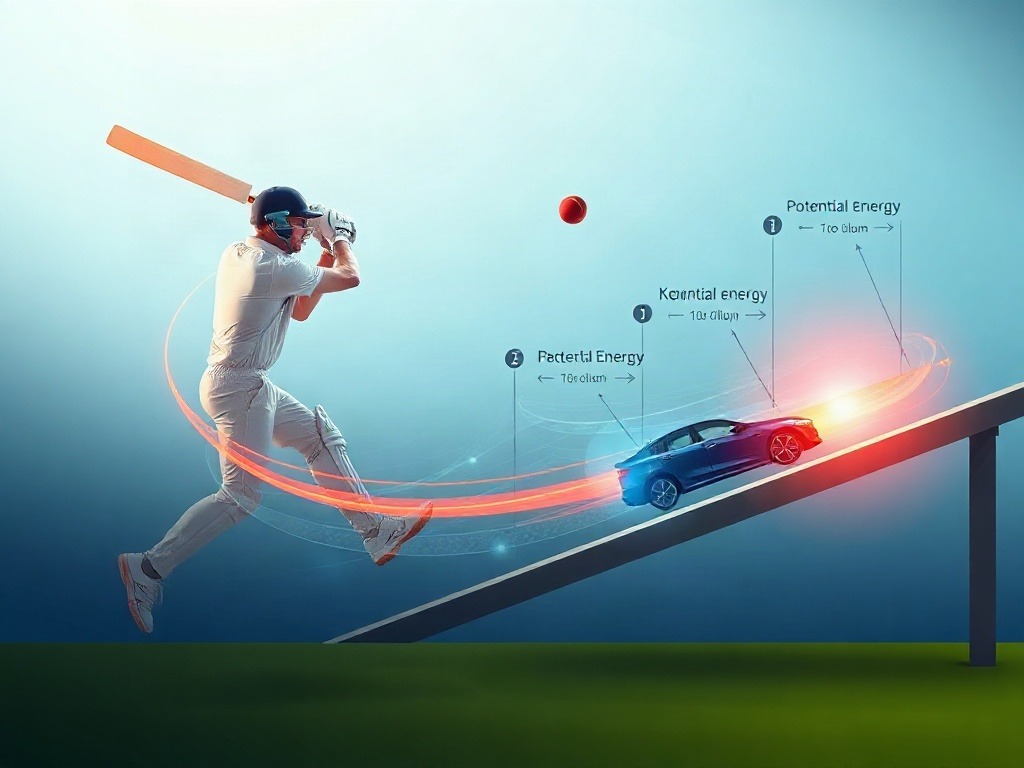
Kinetic Energy (KE): This is the energy of motion. KE = ½mv². Notice what matters: mass and velocity (squared). This means if you double your speed, you quadruple your kinetic energy. That's why car crashes at 60 km/h are so much worse than at 30 km/h.
Potential Energy (PE): This is stored energy. For gravity, PE = mgh (mass × gravity × height). Think of it as energy waiting to be released. When you lift something up, you're storing energy in it. When you drop it, that potential energy converts to kinetic energy.
Here's my mnemonic that students love: "KE is active, PE is patient." Kinetic energy is doing something right now. Potential energy is just waiting for its chance.
The Law of Conservation of Energy
This is the big one. Energy can't be created or destroyed. It only transforms from one form to another. When you throw a ball up, it starts with kinetic energy. As it goes up, kinetic energy decreases and potential energy increases. At the highest point, all the kinetic energy has transformed to potential energy. On the way down, it reverses.
This is why I love energy problems — they're almost solvable by this principle alone. If you know the total energy of a system, and you know it's conserved, you can figure out everything else.
Now, in real life, there's air resistance and friction, so some energy converts to heat. That's why a bouncing ball doesn't bounce back to the same height — some energy went into heating the air and the ball. But in exam problems, they usually ask you to ignore air resistance, so energy is perfectly conserved.
Work: Energy in Transition
Work is what connects force and energy. Work = Force × Distance × cos(θ), where θ is the angle between the force and displacement. If you push in the direction something moves, you're doing positive work. If you push against its motion, you're doing negative work.
Think of it this way: work is how energy gets transferred. When you push a car (applying force), you're doing work on it, and that work increases its kinetic energy.
| Concept | Formula | What It Means |
|---|---|---|
| Velocity | v = u + at | Final velocity after acceleration |
| Displacement | s = ut + ½at² | Distance covered with constant acceleration |
| Force | F = ma | Mass times acceleration |
| Kinetic Energy | KE = ½mv² | Energy of moving objects |
| Potential Energy | PE = mgh | Stored energy at height |
| Work | W = F·s·cos(θ) | Force applied over distance |
| Power | P = W/t | Work done per unit time |
Tying It All Together: Real-World Examples
Okay, let me give you examples that'll make this stick forever because these are the kinds of scenarios that show up in exams.
Example 1: A Car Braking When a car brakes, the brakes apply a force opposing the motion. This force causes negative acceleration (deceleration). The kinetic energy of the car decreases. Where does that energy go? Into heat in the brake pads. That's why brakes get hot. The law of conservation of energy is still obeyed — kinetic energy just transformed to thermal energy.
Example 2: A Ball Thrown Vertically Upward You throw a ball with initial velocity u. At the bottom, it has maximum kinetic energy and zero potential energy. As it rises, kinetic energy decreases, and potential energy increases. At the maximum height, velocity is zero, so kinetic energy is zero and potential energy is maximum. The total mechanical energy remains constant throughout (ignoring air resistance).
Example 3: A Pendulum This is the textbook example of energy conservation. At the lowest point, the pendulum has maximum kinetic energy and minimum potential energy. As it swings up, kinetic energy converts to potential energy. At the highest point, potential energy is maximum and kinetic energy is zero. Then it swings back down. This exchange happens continuously.
These aren't just theoretical exercises. Understanding these principles helps you predict how real systems behave, and that's what exam questions test.
Exam Strategy: How to Solve These Problems
Alright, final piece of advice before we get to practice questions. I've watched thousands of students solve physics problems, and the ones who score highest follow this routine:
Step 1: Draw it out. Sketch the situation. Draw a free body diagram. Label everything you know and everything you want to find.
Step 2: Identify the physics. What concept is this testing? Is it motion? Force? Energy? Identify what you're supposed to use.
Step 3: Choose your equations. Now you know which formulas are relevant. Don't just throw equations at the problem.
Step 4: Substitute and solve. Plug in numbers carefully. Watch your units. Physics marks are lost to silly mistakes more than conceptual misunderstandings.
Step 5: Check your answer. Does it make physical sense? If you calculated that friction makes something accelerate faster, something's wrong. Your physics intuition should catch most mistakes.
One more thing — in SSC CGL and UPSC, you often get conceptual questions without numbers. That's where deep understanding matters. These questions test whether you actually understand the concepts or just memorized formulas. Spend time thinking about why things work, not just how to calculate them.
I promise you, if you master motion, force, and energy, you've got the foundation for everything else in physics. Waves, thermodynamics, electricity — they all build on these fundamentals. And honestly? They're genuinely interesting. Physics isn't boring. It's just waiting for you to see how the world actually works.
---Practice Questions
A) 2 m/s² B) 4 m/s² C) 5 m/s² D) 10 m/s²
Answer: B) 4 m/s². Using v = u + at, where u = 0, v = 20, t = 5: a = (20-0)/5 = 4 m/s²
A) 10 J B) 15 J C) 20 J D) 25 J
Answer: D) 25 J. KE = ½mv² = ½ × 0.5 × 10² = 0.25 × 100 = 25 J
A) Ground pushes you backward B) Ground pushes you forward C) You push the ground, and ground pushes you with equal force D) There is no reaction force
Answer: C) You push the ground backward (action), and the ground pushes you forward (reaction) with equal magnitude.
A) 20 m/s B) 30 m/s C) 40 m/s D) 50 m/s
Answer: C) 40 m/s. Using v² = u² + 2as, where u = 0, a = 10, s = 80: v² = 0 + 2(10)(80) = 1600, so v = 40 m/s
A) 2 m/s² B) 5 m/s² C) 8 m/s² D) 12 m/s²
Answer: B) 5 m/s². Using F = ma, we get a = F/m = 10/2 = 5 m/s²
Published by Dattatray Dagale • 30 August 2026
.jpg)
.png)



.png)




.png)


0 Comments