Introduction
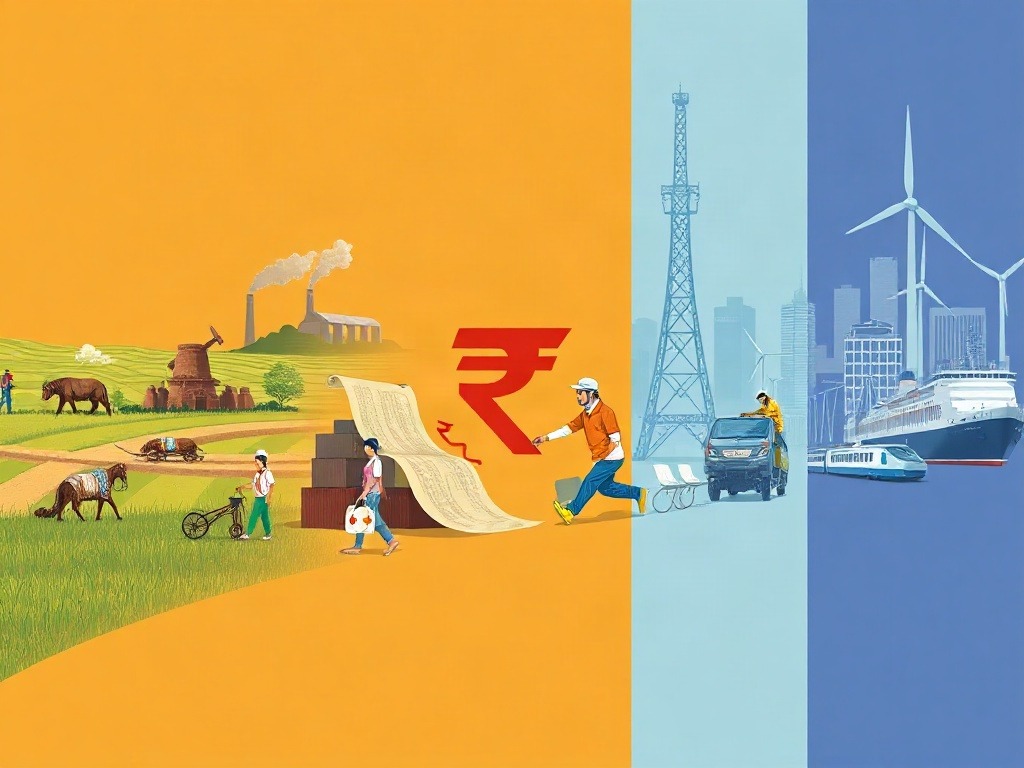
Let me take you back to 1951. India is barely four years old as an independent nation. We have a literacy rate of 12%, factories that barely work, and villages where people are still using wooden ploughs. Dr. Rajendra Prasad is our first President, and Pandit Nehru is staring at a blank slate, trying to figure out: how do we build a modern nation from scratch?
That's where Five Year Plans came in. And honestly, when I first started teaching this topic, I realized most students think it's boring because they imagine some dusty government document. But it's actually the story of how India went from a colonial, agrarian economy to becoming a nuclear power with IT companies that rule Silicon Valley. Pretty dramatic, right?
So let's talk about Five Year Plans, economic reforms, and how these ideas literally shaped the India you and I live in today.
Understanding Five Year Plans: The Vision Behind the Strategy
What Were Five Year Plans, Anyway?
Imagine you're a cricket captain. You don't just walk onto the field and hope for the best, right? You have a strategy. You plan where your fielders will stand, what bowlers will play, what your batting order will be. A Five Year Plan was exactly that—India's economic strategy document, prepared by the Planning Commission.
These were comprehensive blueprints for economic development, designed to mobilize resources, allocate investments, and set targets for industrial and agricultural growth. Starting from 1951 with the First Five Year Plan, India committed to planned economic development. Why five years? Because it's a manageable timeframe—long enough to see real change, but short enough to monitor and adjust.
Now here's the interesting part: India didn't invent this idea. The Soviet Union had already been running Five Year Plans successfully since 1928. Pandit Nehru was impressed by the Soviet model of planned industrialization. But unlike the USSR's completely command economy, India adopted a mixed economy approach—part planning, part market forces.
The Mixed Economy Model
This is crucial to understand for your exams. India chose what's called a "mixed economy." Let me explain with something you can visualize:
Think of it like this: the government would handle the "commanding heights" of the economy—big industries like steel, coal, electricity, railways. These are like the main pillars of a building. Meanwhile, small businesses and private sectors would operate in supporting roles. The private sector could grow, but the government would guide the overall direction.
This was Nehru's vision, and it shaped India for decades. The government became the primary investor in heavy industries, infrastructure, and social sectors like education and healthcare. This is why even today, you have PSUs (Public Sector Undertakings) like Steel Authority of India (SAIL), Coal India Limited, and Indian Railways.
The Journey Through Five Year Plans: From Agriculture to IT
The Early Plans (1st to 4th): Building the Foundation
The First Five Year Plan (1951-56) focused heavily on agriculture and irrigation. India was still primarily agricultural, with over 70% of the population dependent on farming. We needed to increase food production urgently. This plan invested in dams—remember the dams Nehru called "temples of modern India"? Bhakra Nangal, Damodar Valley Project, these were all part of this vision.
The Second Plan (1956-61) shifted focus to heavy industries. Steel plants were set up at Rourkela, Bhilai, and Durgapur. This was transformative. India was literally building the factories that would make other things. It's like learning to fish instead of just being given fish.
But here's where things get real: by the Third and Fourth Plans (1961-66 and 1966-74), we hit rough patches. There were droughts, the 1962 war with China, the 1965 war with Pakistan. Economic growth slowed. Food production became critically important again. Agricultural reforms became the focus.
The Green Revolution: When Plans Met Reality
This is one of my favorite teaching moments because it shows how planning can actually work. In the 1960s, India faced severe food shortages. We were literally begging for food aid from America. Then came the Green Revolution—a focused, planned effort to increase agricultural productivity through better seeds, fertilizers, and irrigation techniques.
Scientists like M.S. Swaminathan worked with the government to introduce high-yield variety (HYV) seeds. By the late 1960s and 1970s, India went from being a food-deficit country to achieving food self-sufficiency. This was the power of planning combined with scientific innovation.
Let me give you a trick to remember the Five Year Plans by their focus:
Memory Trick - "HEMP-HI"
First Two Plans = Heavy & Agri (Heavy industries and Agriculture)
Third & Fourth = Stagnation & Green (Wars and Green Revolution)
Fifth Sixth = Poverty & Growth (Poverty alleviation and faster growth)
Seventh onwards = Reform & IT (Economic reforms and Information Technology)
Economic Reforms: The 1991 Turning Point
Why Did We Need Reforms?
Fast forward to 1990. The Soviet Union has just collapsed. And India? We're in serious economic trouble. Our foreign exchange reserves had dropped to just $1.2 billion—barely enough to cover three weeks of imports. We were on the verge of defaulting on our external debts. It was a genuine crisis.
The planned economy model, while successful in creating industries, had become rigid and inefficient. State-owned enterprises were bleeding money. Corruption was rampant. Private sector growth was strangled by excessive government control and red tape. The entire system screamed for change.
Enter Dr. Manmohan Singh as Finance Minister under P.V. Narasimha Rao. And this is where India's economic story completely transformed.
The Reforms: Liberalization, Privatization, Globalization (LPG)
The Economic Reforms of 1991 are often remembered as the LPG model. Let me break down what each actually means:
Liberalization: This meant removing government control and restrictions. Before 1991, you couldn't start a business without a license. The government controlled which industries you could enter, how much you could produce, what prices you could charge. This was called the "License Raj." It was suffocating. After reforms, you could start enterprises more freely. Import and export restrictions were eased. Private sectors were allowed to enter sectors that were previously reserved for government.
Privatization: Not all government enterprises were suddenly sold off—that's a misconception many students have. Instead, the government allowed private companies to compete in sectors previously monopolized by PSUs. Airlines, telecommunications, banking—all opened up. Some PSUs were partially privatized (government still holds stake). The idea was to make businesses more efficient through competition.
Globalization: India opened its doors to foreign trade and investment. Tariffs were reduced. Foreign Direct Investment (FDI) was welcomed. Indian companies could export freely. This connected India to global markets.
Now, you might be wondering—didn't this hurt the common people? This is where I always tell my students: reforms are like surgery. They're painful in the short term, but necessary for long-term health. Yes, initially many PSU workers faced job insecurity, and some industries struggled. But over the long term, the economy grew at much faster rates. By 2000s, India was growing at 8-9% annually—the "India Shining" years.
Impact and Evolution: From Plans to Market-Driven Growth
Let me show you just how dramatically things changed with a quick comparison table:
| Metric | Pre-1991 Era | Post-1991 Era |
|---|---|---|
| GDP Growth Rate | 3-4% (Hindu Rate of Growth) | 7-8% average, peaked at 10.3% (2007) |
| Foreign Exchange | Chronic deficit, gold pawned to survive | Over $600 billion by 2020 |
| Private Sector Role | Highly restricted, license-dependent | Free to expand, competing globally |
| Global Ranking (Economy) | 11th largest | 5th largest (as of 2023) |
| Poverty Rate | 45-50% of population | Around 20% by 2020 |
The shift from Five Year Plans to market-driven growth marks a fundamental change in India's economic philosophy. The 12th Five Year Plan (2012-17) was actually the last one. The Modi government discontinued the Planning Commission entirely in 2015 and replaced it with NITI Aayog, which is more advisory and less directive. This reflects India's move toward a market economy from a planned economy.
But here's something important to understand: we didn't completely abandon planning. India still has strategic focus areas—infrastructure, renewable energy, education, healthcare. It's just that the market plays a much bigger role now.
The Ongoing Reforms
After 1991, economic reforms have been continuous. Some major ones include:
2004 onwards: Sectors like telecom, aviation, and retail saw massive growth. This created the telecom revolution—remember when a mobile call cost ₹16 per minute? Now it's nearly free.
2016: The GST (Goods and Services Tax) replaced multiple indirect taxes. This was a huge structural reform that simplified the tax system.
2015-2020: The government focused on infrastructure through programs like Make in India, Startup India, and Digital India. These were policy reforms aimed at attracting investment and creating jobs.
Each reform builds on the previous one. It's not a one-time thing; it's an ongoing process of making the economy more efficient, transparent, and competitive.
For your exams, remember this: Five Year Plans represented planned economy thinking (1951-1991), while economic reforms represent market-oriented thinking (1991 onwards). Both were necessary at different stages of India's development.
Quick Revision Table
| Phase | Period | Key Features | Main Focus |
|---|---|---|---|
| Planned Economy Phase 1 | 1951-1966 | Government controls major industries, mixed economy, dams and factories | Agriculture, Heavy Industries |
| Planned Economy Phase 2 | 1966-1990 | Green Revolution, food self-sufficiency, continued public sector dominance | Food Security, Poverty Alleviation |
| Economic Reforms Phase | 1991 onwards | Liberalization, Privatization, Globalization (LPG), foreign investment allowed | Market-driven growth, Global integration |
Key Takeaways for Your Exam
When you're sitting for your SSC CGL or UPSC exam, and you see a question about Five Year Plans or economic reforms, remember:
1. Five Year Plans were about control and direction—the government decided where investments should go. This suited India's immediate post-independence needs, but became inefficient later.
2. Economic Reforms were about freedom and efficiency—allowing markets to operate, encouraging competition, welcoming foreign investment. This accelerated India's growth.
3. Both were necessary—don't view them as "good vs. bad." Planned economy built our basic industries and infrastructure. Reforms made them competitive globally.
4. The transition was about timing—in 1951, you couldn't have had free market economy (no capital, no private entrepreneurs ready). By 1991, the market was mature enough to take the lead.
Now let me ask you—as India moves forward, do you think we need more reforms? What would you reform if you were the Finance Minister? That's the kind of thinking that helps you ace these topics in interviews and essay questions.
Practice Questions
A) Government controlled heavy industries while allowing private sector in smaller businesses B) Complete government control over all sectors of economy C) Planning Commission guided resource allocation D) Private enterprises were allowed to operate in certain sectors
Answer: B) Complete government control over all sectors of economy. India's mixed economy specifically avoided complete government control; it was a blend of public and private sectors.
A) High inflation and loss of foreign exchange reserves B) Failure of the Green Revolution C) War with Pakistan D) Collapse of the Soviet Union only
Answer: A) High inflation and loss of foreign exchange reserves. India's forex reserves had plummeted to just $1.2 billion, nearly putting the country on default. While the Soviet collapse contributed to geopolitical changes, the immediate crisis was fiscal.
A) Protecting forests and the environment B) Increasing agricultural productivity through modern techniques and HYV seeds C) Rapid industrialization of rural areas D) Switching to organic farming
Answer: B) Increasing agricultural productivity through modern techniques and HYV seeds. The Green Revolution used high-yield variety seeds, better irrigation, and fertilizers to increase food production and achieve self-sufficiency.
A) Reserve Bank of India B) Planning Commission C) Finance Ministry D) Ministry of Statistics
Answer: B) Planning Commission. NITI Aayog (National Institution for Transforming India) was established to replace the Planning Commission, reflecting the shift from a planned economy to a market-driven approach.
A) Liquefied Petroleum Gas reform B) Liberalization, Privatization, and Globalization C) Labor-Profit-Growth model D) Land-Production-Growth strategy
Answer: B) Liberalization, Privatization, and Globalization. This is the framework of India's economic reforms: removing government controls (liberalization), allowing private ownership (privatization), and opening the economy to world trade (globalization).
Published by Dattatray Dagale • 20 September 2026
.jpg)
.png)



.png)


.png)


0 Comments