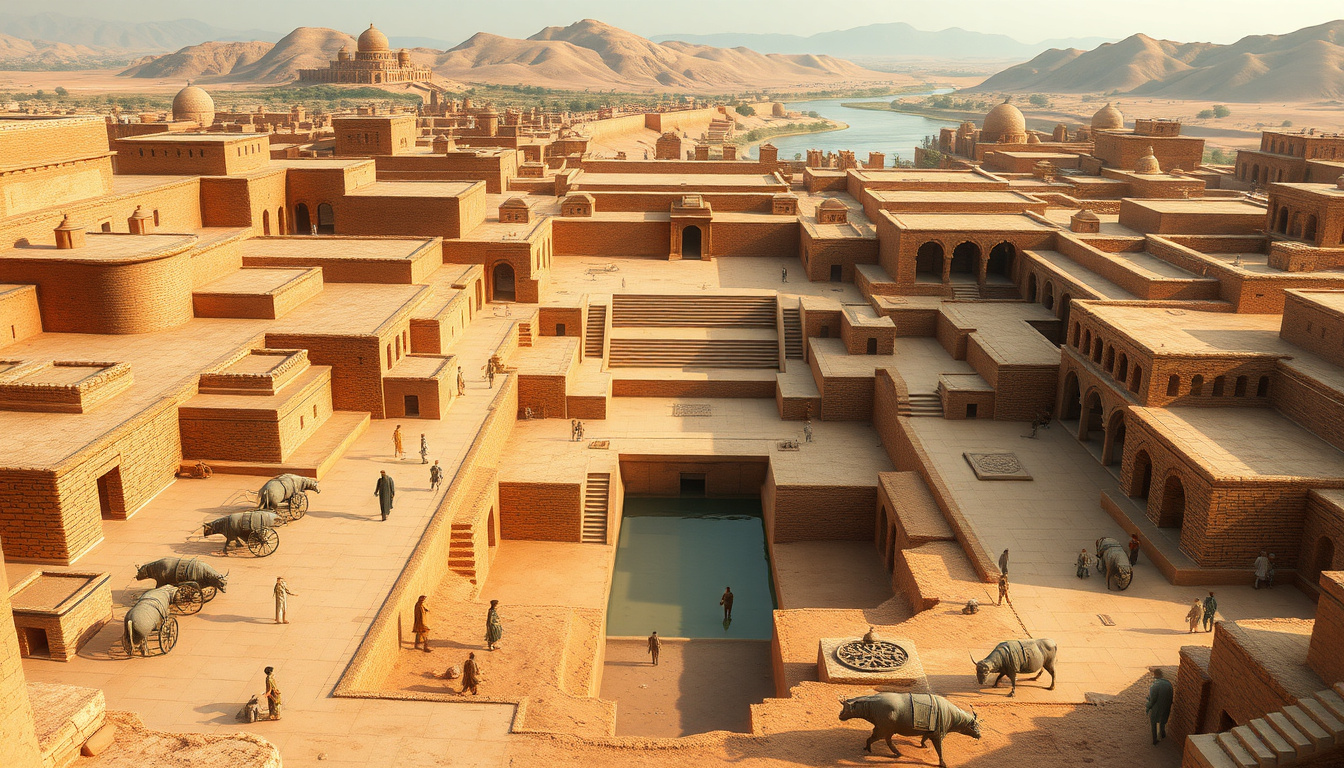
Why Should You Care About a Dead Civilisation?
I'll be honest with you — when I first started teaching, I thought the Indus Valley Civilisation was just another dusty topic to memorise for exams. Then one day, a student asked me: "Sir, if we don't even know what their writing means, how do we know anything about them?"
That question changed how I teach this topic. Because here's the thing: the Indus Valley Civilisation is like a detective mystery that's been unsolved for over a century. We have the crime scene (beautifully preserved ruins), we have the evidence (seals, pottery, town plans), but we're still trying to crack the code. And that's exactly why it matters — not just for your exam, but because it represents everything we love about history: mystery, innovation, and the unknown.
Plus, if you nail this topic, you'll impress your interviewer. Trust me, nothing beats casually mentioning undeciphered scripts at a UPSC interview. Game changer.
The Indus Valley Civilisation: What, Where, and When
Where Did This Civilisation Actually Flourish?
Picture this: it's around 2600 BCE, and you're standing at the banks of the Indus River. But unlike the chaotic monsoon-fed river we know today, imagine a gentler, slower-moving river system. This is where one of humanity's greatest civilisations thrived — and here's what amazes me every time I teach this: it spread across an area roughly the size of modern-day Western Europe.
The civilisation covered parts of what is now Pakistan, northwestern India, Afghanistan, and even traces in Iran. The major sites — Harappa, Mohenjo-daro, Dholavira, Kalibangan — stretch from Sindh to Gujarat to Punjab. When I show my students maps, they often gasp at the sheer geographical spread. This wasn't some small settlement; this was a continental-scale civilisation.
Now here's the interesting part: the name "Indus Valley Civilisation" is actually a bit misleading. Yes, it started along the Indus, but archaeologists found massive settlements in the Saraswati River valley too. Some scholars call it the "Harappan Civilisation" (after Harappa, one of the first sites excavated), while others prefer "Sindhu-Saraswati Civilisation" to be geographically accurate. For your exam, though, all three names are correct — just use what your textbook uses.
The Timeline: When Exactly Did They Rule?
Here's a memory trick I share with all my students: 2600-1900 BCE — the "Main Period". But to be precise, archaeologists divide it into phases:
Early Harappan (3300-2600 BCE) — the warm-up phase, when settlements were smaller and less planned. Mature Harappan (2600-1900 BCE) — the peak, when cities like Mohenjo-daro were fully developed. Late Harappan (1900-1300 BCE) — the decline, when the civilisation started fragmenting.
Think of it like an Indian cricket tournament: Early phase is the group matches, Mature is the knockout stage, and Late is the post-tournament drama. The Mature period is what we obsess over in exams because that's when everything was perfect.
The Urban Marvel: City Planning That Still Impresses Architects Today
Street Grids and Drainage Systems That Make Modern Cities Jealous
Let me paint you a picture of Mohenjo-daro, the most excavated site of the IVC. When you walk through its ruins, you see something shocking: perfect grid patterns. Streets running north-south and east-west at precise right angles. In 2600 BCE! This isn't accidental; this is deliberate urban planning.
What gets me every single time is the drainage system. They had underground brick drains, covered sewage pipes, and waste disposal systems that funnelled water and waste out of the city. Meanwhile, European cities 3,000 years later were still throwing sewage into the streets. That's not exaggeration — that's history.
I tell my students: "If you were building a city for SSC CGL exam purposes, and someone asked you to design it 2,600 years before modern civil engineering was invented, could you do it? The Indus people did."
Standardisation: The Secret Behind Their Success
Now here's something most textbooks don't emphasise enough, and it's brilliant for exam answers: the Indus Valley people were obsessed with standardisation. Seriously. Not like modern standardisation where we have ISO certifications, but just... everything matched.
Brick sizes? Standardised. Weights and measures? Standardised. Road widths? Standardised. Even the height of doorways! This level of uniformity across thousands of square kilometres suggests a centralised government, organised trade, and a culture that valued consistency. It's like if every mobile phone in India, without any modern communication, looked exactly the same — that's the level of coordination we're talking about.
Here's a memory trick: "HPS" — Harappans made Perfect Standardisation. Corny, I know, but it works in exams.
| Aspect of Life | What They Did | Why It Matters |
|---|---|---|
| Urban Planning | Grid-pattern cities with straight roads | Shows sophisticated governance & engineering |
| Drainage Systems | Underground brick sewers, waste management | Advanced sanitation 4,600 years ago |
| Standardisation | Uniform brick sizes, weights, measures | Indicates centralised control & trade networks |
| Architecture | Brick buildings, mostly residential (no temples) | Religious structures weren't the focus |
| Public Spaces | Great Bath, granaries, market areas | Community spaces for civic life |
Daily Life, Trade, and the Great Unsolved Mystery of Their Writing
What Did They Eat, Make, and Trade?
The Indus Valley people were farmers first. They grew wheat, barley, and cotton — yes, cotton! This is important because cotton textiles became a major export. Archaeological evidence shows they domesticated cattle, sheep, and goats, and they also hunted. Their diet was probably similar to what we eat in rural India today: grains, pulses, and occasional meat.
But here's what excites me: they were master craftspeople. We've found evidence of pottery workshops, bead manufacturing, and seal production. Those seals — small square or rectangular pieces with inscriptions and animal designs — are absolutely crucial to understanding them. Some show unicorns (possibly mythical representations), bulls, tigers, and rhinoceroses.
Their trade network was massive. We've found Indus Valley artefacts in Mesopotamia, the Persian Gulf, and Oman. They exported cotton, timber, and beads. They imported metals like tin (for bronze-making) and lapis lazuli from Afghanistan. This wasn't just local trading; this was international commerce happening 4,600 years ago.
The Undeciphered Script: The Greatest Mystery
Now, let's talk about the elephant in the room — or rather, the seal in the museum. The Indus script is one of humanity's greatest unsolved mysteries. We have over 4,000 seals and inscribed objects, but we cannot read them. Not a single word.
Here's why this matters for your exam answer: people have proposed theories. Some say it's a logographic script (each symbol means a word). Others argue it's syllabic. Some scholars, with no evidence whatsoever, have tried to connect it to Indo-European languages, but the mainstream archaeological community doesn't support this.
The honest truth? We don't know. And that's actually beautiful in a way. It keeps historians humble.
Let me give you a memory trick for remembering key features of Indus script: "SUBS" — Seal-based, Undeciphered, Brief (short inscriptions), Symbolic (picture signs).
Why Did They Disappear? The Great Collapse
This is where the story gets mysterious. Around 1900 BCE, the Indus Valley Civilisation began to decline. By 1300 BCE, it had largely disappeared. So what happened? Was it invasion? Climate change? Earthquake? Religious upheaval?
Here's the current archaeological consensus: it wasn't one thing, but several factors combined. Climate change (reduced monsoon rainfall) led to agricultural stress. The Saraswati River, which was their lifeblood, dried up due to geological changes. Population pressure and resource scarcity followed. Some cities were abandoned; others shrank. Eventually, the urban culture that defined them faded away.
Was there an Aryan invasion that destroyed them? This was the old theory, but modern archaeology has largely rejected it. The Vedic Aryans came gradually over centuries; they didn't "invade" and destroy. The Indus people didn't disappear — many of them mixed with incoming populations, and their descendants are probably living in India today.
I always tell my students: civilisations don't just vanish like Atlantis. They transform. The Indus Valley Civilisation didn't end; it evolved.
Key Takeaways for Your Exam
Let me summarise the most important points that always appear in exams:
Geography: Indus-Saraswati river basins, spread across 1.26 million square kilometres, from Himalayas to Gujarat to Rajasthan.
Time Period: 2600-1900 BCE (Mature Phase), with Early and Late phases before and after.
Cities: Mohenjo-daro (the capital?), Harappa, Dholavira, Kalibangan — know at least these four names.
Features: Grid-pattern cities, standardised bricks, advanced drainage, no temples, no large palaces, no evidence of warfare (very few weapons).
Economy: Agriculture (wheat, barley, cotton), trade networks extending to Mesopotamia and the Persian Gulf.
Mystery: Undeciphered script, unknown religion, unclear political structure (probably not a king-based monarchy).
Decline: Climate change, drying of Saraswati, not invasion.
Practice Questions
A) Grid-pattern streets and drainage systems B) Large temples and palaces dominating the skyline C) Standardised brick sizes D) Evidence of planned urban layout
Answer: B) Large temples and palaces dominating the skyline — The Indus Valley people built primarily residential structures and public buildings, not monumental religious or royal architecture.
A) Invasion by Aryan tribes B) A single devastating earthquake C) Climate change and drying of the Saraswati River D) Plague and disease
Answer: C) Climate change and drying of the Saraswati River — Modern archaeology rejects the invasion theory. Environmental stress, particularly reduced monsoon rainfall and river changes, is the accepted cause.
A) Harappa B) Mohenjo-daro C) Dholavira D) Kalibangan
Answer: B) Mohenjo-daro — The Great Bath, believed to have been used for ritual or community purposes, is one of the most iconic structures of the Indus Valley Civilisation.
A) There are too few examples to study B) The language was lost completely C) We lack a bilingual inscription (like the Rosetta Stone) to decode it D) It was deliberately destroyed by later civilisations
Answer: C) We lack a bilingual inscription to decode it — Without a text in both Indus script and a known language, decipherment remains impossible using traditional methods.
A) The entire civilisation was controlled by a single authoritarian ruler B) A high level of centralised governance and organised trade networks C) The people had no individual freedom D) They were less developed than Mesopotamian civilisations
Answer: B) A high level of centralised governance and organised trade networks — Standardisation across such a vast area indicates coordinated administration and likely a shared trade system.
Published by Dattatray Dagale • 19 July 2026
.jpg)
.png)



.png)


.png)


0 Comments