Introduction
Let me start with a confession. When I first started teaching, I used to treat 1857 like just another chapter to rush through before moving to the "important" bits of the freedom struggle. Big mistake. I was sitting with a student one day—Priya, sharp as a tack—and she asked me a simple question: "Sir, if 1857 failed, why do we call it the beginning of the freedom struggle?"
That question changed how I teach this entire period. Because here's the truth: 1857 wasn't just a revolt. It was a turning point. It was the moment when Indians—ordinary farmers, soldiers, princes, and townspeople—first said a collective "no" to foreign rule. Yes, it failed. Spectacularly. But it planted a seed that would grow into the independence movement we celebrate today.
If you're preparing for SSC CGL or UPSC, you'll need to know 1857 inside out. Not just the dates and names, but the *why* and the *how*. So grab a cup of chai and let's dive in together.
The Build-Up: Why Was India Ready to Explode?
Picture this: it's the mid-1800s. The East India Company has been ruling India for nearly a century, but here's the catch—they're not ruling like a government. They're ruling like a business. And businesses care about profit, not people.
Economic Exploitation and Land Revenue
The Company's policies were bleeding India dry. They imposed heavy taxes on land, changed the entire revenue system, and basically made sure that farmers couldn't make ends meet. Remember the Permanent Settlement of Bengal? That was introduced back in 1793, but its effects were still crippling by 1857. Local zamindars (landowners) had become tax collectors for the British, and the actual farmers—the ones doing the work—got nothing.
Then came the commercialization of agriculture. The British forced farmers to grow cash crops like indigo, cotton, and opium instead of food grains. Sounds like a great business plan if you're sitting in London. Sounds like disaster if you're a farmer in Bihar watching your family go hungry.
The Social and Religious Tensions
Here's where it gets really interesting. The British weren't just taking money. They were meddling with Indian society itself. The Company employed Christian missionaries, and while they didn't force conversion, the very presence felt like an assault on traditional Indian values. Muslims felt threatened. Hindus felt threatened. Everyone felt like their way of life was under attack.
Then there was the incident that everyone remembers—or should remember—the Enfield rifle. The British issued a new rifle with cartridges that soldiers had to bite open. The rumor spread that these cartridges were greased with cow and pig fat. Now, if you're a Hindu soldier, biting cow fat is a massive religious violation. If you're a Muslim soldier, pig fat is equally taboo. Perfect storm, right? The British dismissed these concerns as superstition. Big, *big* mistake.
Let me give you a trick I tell all my students: When you see "religious grievance + economic hardship + military discontent," always think "revolution." This is your red flag combination.
The Revolt: From Meerut to Kanpur (May–December 1857)
How It Started: Meerut and the Chain Reaction
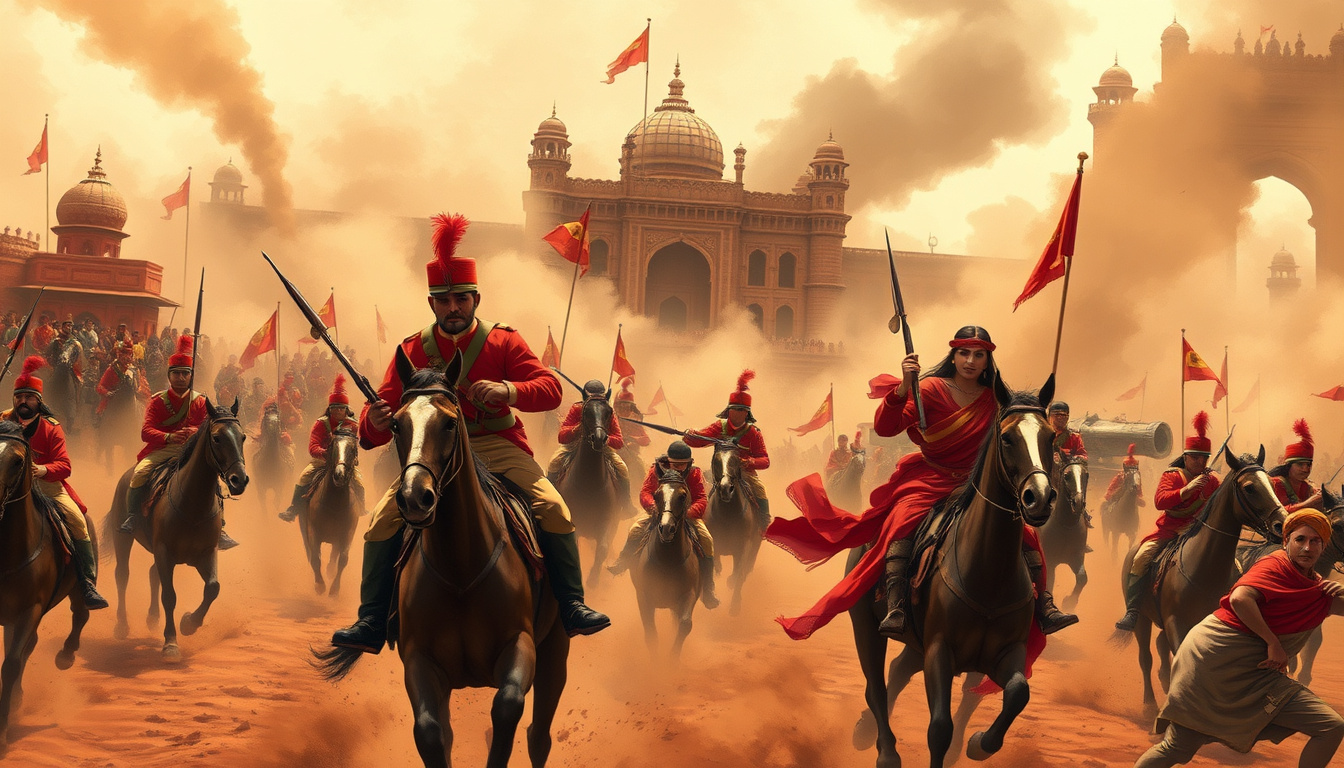
The actual spark was small. On May 10, 1857, at the Meerut cantonment, 85 sepoys of the 3rd Bengal Light Cavalry refused to use the Enfield cartridges. The British court-martialed them, sentenced them to 10 years imprisonment, and humiliated them publicly by removing their uniforms in front of other soldiers.
The other sepoys were furious. That very night, they mutinied. They freed the imprisoned soldiers and marched to Delhi, which was still symbolically important as the Mughal capital. And here's the genius part of the rebellion—once they reached Delhi, they proclaimed the aging Bahadur Shah II, the last Mughal emperor, as the leader of the revolt. Suddenly, this wasn't just a sepoy mutiny. It became a larger independence movement with a figurehead that ordinary Indians could rally behind.
Now here's the interesting part. The rebellion wasn't planned by some central committee sitting in a secret room. It spread organically. One garrison would rebel, and news would reach another, and they'd rebel too. From Meerut, it spread to Kanpur, Lucknow, Jhansi, Arrah—all across North and Central India. The Bengal Presidency became a war zone.
Key Figures and Their Stories
I love teaching this part because the people involved were absolutely fascinating. You had Rani Lakshmibai of Jhansi—just 23 years old, a widow denied her son's inheritance by the British, leading cavalry charges against professional soldiers. You had Kunwar Singh in Arrah, this elderly zamindar who led guerrilla warfare and famously shot himself in the arm rather than let the British capture him. There was Maulvi Ahmadullah Shah, a religious leader who transformed the revolt from military mutiny into a mass movement.
And then there was Nana Sahib in Kanpur. The Peshwa's adopted son, deprived of his pension by the British, he became one of the most important rebel leaders. The incident at Kanpur—where British women and children were killed—was portrayed as a massacre by the British press. Whether it was premeditated or a result of war chaos, it became the event that hardened British resolve for brutal retaliation.
Here's a mnemonic I came up with for my students to remember the major rebel leaders: **RAJ-KAN-LUC**—Rani (Lakshmibai), Ahmadullah, Jhansi, Kunwar Singh, Arrah, Nana Sahib, Kanpur, Lucknow. It's not perfect, but it sticks in your head!
Why Did the Revolt Fail?
By October 1857, it was becoming clear that the British would suppress the rebellion. By early 1858, it was essentially over. So what went wrong?
First, the rebels were fighting without a unified strategy. There was no central command, no coordinated plan across different regions. Everyone was fighting their own local battle. Compare this to the organized, professional British military apparatus with clear chains of command.
Second, and this is crucial for your exam, the rebellion didn't get support from all sections of Indian society. The South, particularly the Madras Presidency, remained largely quiet. Many zamindars in Bengal, especially those who'd benefited from the Permanent Settlement, either stayed neutral or supported the British. The educated Bengali elite, who would later become the backbone of the nationalist movement, were somewhat distant from the 1857 struggle.
Third, the British had resources—reinforcements, modern weaponry, naval support, and absolutely ruthless determination. By November 1857, they had reinforced Delhi and started a systematic campaign to crush the rebellion in each major center.
And finally—and this is something that often gets overlooked—the rebels couldn't sustain it. Agriculture was disrupted, supplies ran out, and after 18 months of continuous fighting, people were exhausted. The Lucknow garrison, for instance, held out for an incredible 87 days, but eventually, they were simply outgunned and starved into submission.
| Major Centers of Rebellion | Key Leader(s) | Duration/Outcome |
|---|---|---|
| Delhi | Bahadur Shah II | May–Sept 1857, Suppressed; Emperor exiled |
| Kanpur | Nana Sahib | June–Dec 1857, Escaped to Nepal |
| Lucknow | Maulvi Ahmadullah, Begum Hazrat Mahal | June 1857–March 1858, Suppressed |
| Jhansi | Rani Lakshmibai | May–June 1858, Killed in action |
| Arrah/Bihar | Kunwar Singh | July 1857–April 1858, Escaped |
The Aftermath: How 1857 Changed India Forever
Here's what I find absolutely remarkable. Even though the revolt failed militarily, it succeeded in something much more important—it changed the course of history.
Immediate Political Changes
The British realized that the East India Company couldn't manage India anymore. In 1858, the Company was abolished, and India came under direct British Crown rule. Queen Victoria became the Empress of India (a title she was quite proud of, by the way). This shift from Company rule to Crown rule might seem like a minor administrative change, but it actually gave Indians some hope that they could petition the Crown for justice or reforms, unlike dealing with a profit-hungry corporation.
The British also introduced the Indian Councils Act of 1861, which allowed Indians to sit on executive councils—not with any real power, mind you, but it was a symbolic gesture. More importantly, it gave educated Indians a platform to speak up and organize politically.
The Birth of Modern Indian Nationalism
This is the really important bit for your understanding of modern India. The 1857 revolt created a shared memory of resistance. When the Indian National Congress was founded in 1885, just 27 years later, it was filled with leaders who either remembered 1857 or had grown up hearing about it. Figures like Dadabhai Naoroji, Surendranath Banerjee, and later Gandhi and Nehru all drew inspiration from 1857.
The rebellion showed Indians that they could stand together against the British. Yes, they'd been defeated. Yes, the reprisals were brutal (the British executed thousands, sometimes entire villages). But the psychological impact was enormous. Indians now knew that resistance was possible.
You could argue that the freedom struggle from 1885 onwards was really the continuation of the 1857 spirit, just with different tactics. Instead of guns and cavalry, it became pamphlets and speeches. Instead of armed rebellion, it became non-cooperation movements and civil disobedience.
Military and Administrative Reorganization
The British learned hard lessons from 1857. They reorganized the Indian Army to prevent any single regiment from becoming too powerful. They increased the proportion of British soldiers. They made sure never to concentrate too many Indian troops in one place. They also brought in more British officers into administrative positions because they no longer trusted Indian elites completely.
Ironically, this paranoia of the British actually accelerated the growth of Indian nationalism. By restricting Indian participation in senior positions, they created a class of educated, frustrated Indians who felt cheated and became the intellectual core of the independence movement.
Let me give you one final mnemonic for the three phases of the freedom struggle and how 1857 fits in: **RAN-MOD-MAG**—Radical phase (1857-1905), Moderate phase (1885-1905), Gandhi phase (1920-1947). 1857 was the explosive start before the organized movement even began.
Final Thoughts for Your Exam Prep
When you're answering questions about 1857, remember this: don't just memorize dates and names. Understand the *chain of causation*. Economic hardship → Religious grievance → Military discontent → Rebellion → Failure → Constitutional changes → Modern nationalist movement.
Every question about 1857 is asking you to understand one of these links. Why did it start? (Religious grievance + military discontent). Why did it fail? (Lack of unity + better-equipped enemy). Why does it matter? (Changed British policy and inspired later movements).
I've taught hundreds of students, and the ones who really ace these questions are the ones who can tell the story of 1857 like they're explaining it to a friend over chai—connecting the dots, understanding the human element, and recognizing why it mattered not just then, but for India's future.
You've got this. Now go read a few more sources, practice some questions, and remember: history isn't about memorization. It's about understanding the journey of a nation.
A) Zamindars, because it affected land revenue collection B) Sepoys, because the cartridges were rumored to be greased with cow and pig fat C) Princes, because it threatened their military power D) Merchants, because it disrupted trade routes
Answer: B) Sepoys, because the cartridges were rumored to be greased with cow and pig fat
A) Kanpur B) Jhansi C) Madras D) Lucknow
Answer: C) Madras (The Madras Presidency remained largely uninvolved in the 1857 Revolt)
A) Introduction of the Indian Civil Service B) Abolition of the East India Company and direct Crown rule C) Formation of the Indian National Congress D) Introduction of the Vernacular Press Act
Answer: B) Abolition of the East India Company and direct Crown rule
A) Nana Sahib B) Rani Lakshmibai C) Bahadur Shah II D) Kunwar Singh
Answer: C) Bahadur Shah II (The last Mughal emperor, chosen as a symbolic leader)
A) It resulted in the abolition of princely states B) It prevented further revolts in India C) Although militarily suppressed, it inspired modern Indian nationalism and led to constitutional reforms D) It forced the British to grant immediate independence
Answer: C) Although militarily suppressed, it inspired modern Indian nationalism and led to constitutional reforms
Published by Dattatray Dagale • 17 August 2026
.jpg)
.png)



.png)



.png)

0 Comments