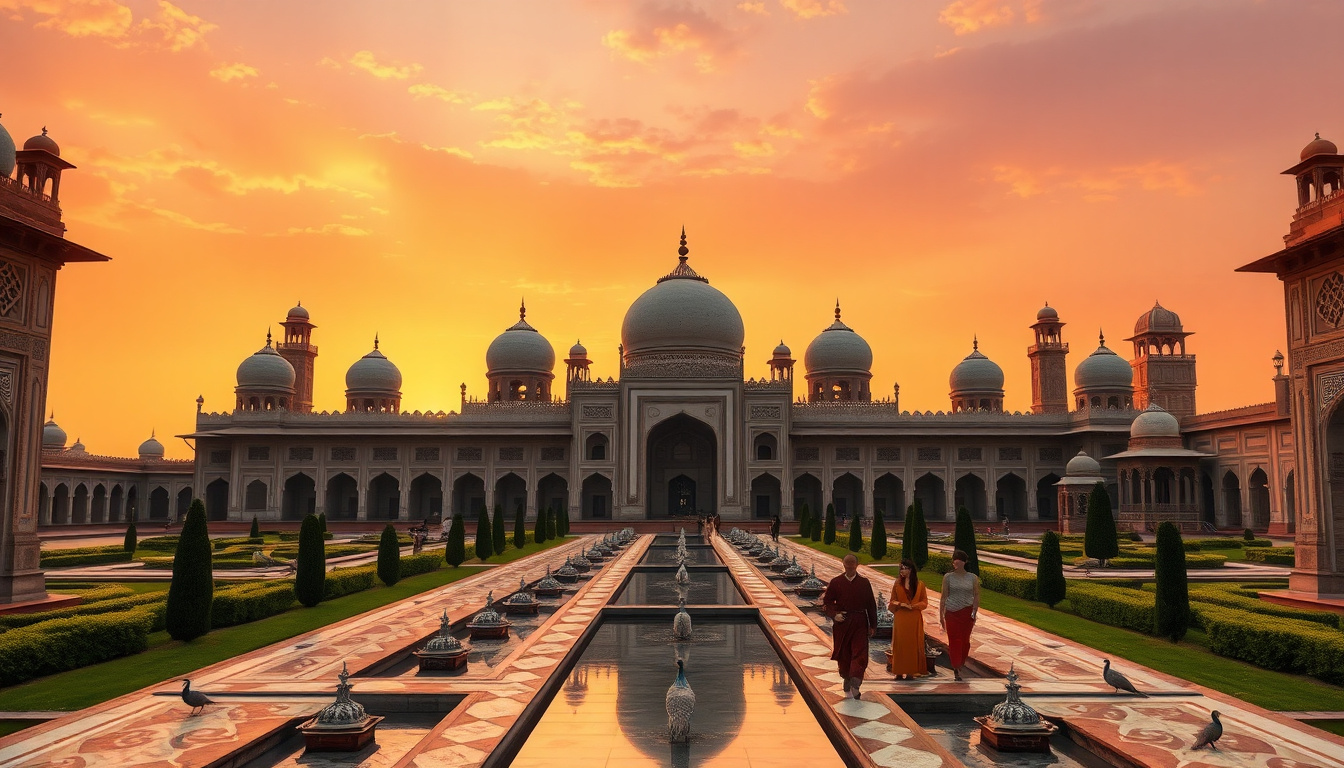
Introduction
Let me start with a confession: when I first started teaching, I used to treat the Mughal Empire like a checklist of dates and rulers. Babar came, Akbar ruled, Aurangzeb happened, the end. My students would nod off faster than you can say "Taj Mahal." Then one day, a student asked me: "Sir, if the Mughals were invaders, why do we still speak Urdu? Why do we eat biryani? Why is there so much of them left in our India?"
That question changed how I teach this topic. Because here's the truth: the Mughal Empire wasn't just about conquest and kingdoms. It was a 330-year-long conversation between different cultures, religions, and ideas that fundamentally shaped what India became. And that's far more interesting than any textbook date.
Whether you're prepping for SSC CGL, UPSC, or just curious about history, understanding the Mughals means understanding a crucial part of modern India itself. So grab some chai, and let's explore this together.
From Babar's Ambition to an Empire: The Early Mughals
Who Were the Mughals, Really?
First, the word "Mughal" itself—it's derived from "Mongol." Now, the Mughals weren't quite Mongols in the way Genghis Khan was. Think of them as Central Asian Muslims, descendants of Timur (Tamerlane) on their father's side and Genghis Khan on their mother's side. They carried the ambition of conquest but wrapped it in Islamic culture. It's like if someone told you that your history textbook had a love child—that's basically the Mughal story.
Babar (ruled 1526-1530) was the founder, and his real name was Zahir ud-Din Muhammad. He was born in Andijan (modern-day Uzbekistan) and had lost his Central Asian kingdom by the time he came to India. So he came with something to prove—literally. His victory at the First Battle of Panipat in 1526 against Ibrahim Lodi is where our textbooks mark "the beginning," but I like to think of it as the moment when someone walked into a room and changed everything forever.
Babar wasn't just a conqueror; he was curious. He wrote memoirs (the Babur-nama), he observed Indian architecture, he planted gardens. Later Mughals would take this curiosity and turn it into something magnificent.
Humayun and the Rough Years
Here's where the story gets messy—literally. Babar's son Humayun (ruled 1530-1556) was brilliant but incredibly unlucky. He lost battles, lost his throne, had to flee to Persia, spent years wandering. For a while, it looked like the Mughal experiment might be over before it really began. But then—and this is important for understanding Indian history—Humayun came back. He returned from exile with Persian cultural sophistication and rebuilt the empire.
Why does this matter? Because when your empire goes through crisis and comes back stronger, it usually means it's learned something. The Mughal Empire, lesson learned: you can't rule India with just military force. You need legitimacy, culture, and understanding of local systems. This lesson prepared the ground for what came next.
Akbar: The Emperor Who Changed the Game
If Babar was the founder and Humayun the survivor, Akbar (ruled 1556-1605) was the genius architect. And I mean this literally—his reign is where you see the Mughal Empire actually become an empire in the way we understand it.
Akbar came to the throne at age 13. By age 15, he'd won the Second Battle of Panipat (1556) and started consolidating power. By age 20, he'd begun transforming how empires actually work in India. This guy was so forward-thinking that if you transplanted him to 2024, he'd probably still be ahead of the curve.
The Genius of Administrative Innovation
Here's what makes Akbar different from every conqueror before or after: he didn't just want to rule India. He wanted to become Indian—culturally and administratively. Let me explain what I mean.
Akbar created something revolutionary called the Mansabdari system. Essentially, it was a graded hierarchy of military officials (mansabdars) who received ranks and were compensated with revenue from land holdings. Now, this might sound boring in description, but here's why it mattered: it was a merit-based system. You weren't born into power; you earned it through ability. Sounds familiar? It's basically the ancient version of civil service exams.
More importantly, Akbar didn't restrict these positions to Muslims or aristocrats. He appointed capable Hindu generals, administrators, and nobles. His best finance minister was Todar Mal, a Hindu. His best general was Man Singh, a Rajput. This wasn't charity; it was pragmatism combined with genuine respect for talent.
Religious Policy and Din-i-Ilahi
Now here's where students usually get confused, so let me untangle this carefully. Akbar is famous for religious tolerance, but it was more nuanced than "everyone was friends." He abolished the jizya (tax on non-Muslims), but that was partly economic policy—more revenue came from encouraging Hindu merchants and farmers to prosper. He allowed freedom of worship, but he also wanted to create a synthetic religion called Din-i-Ilahi (Faith of God) that combined elements of Hinduism, Islam, Christianity, and Zoroastrianism.
The Din-i-Ilahi never caught on with common people—it was too elitist and philosophical. But here's the important bit: it shows Akbar's mindset. He wasn't being religiously neutral out of weakness or confusion. He was actively trying to create a syncretic culture where Indian Muslims and Hindus could exist as one people. That's radically different.
Did it work perfectly? No. But it created a political environment where Hindu-Muslim collaboration became normal. And that, more than any formal policy, shaped India's future.
A - Administrative innovation (Mansabdari system)
M - Military consolidation
M - Multicultural policies
O - Outstanding cultural patronage
The Peak of Mughal Grandeur: Jahangir, Shah Jahan, and Cultural Excellence
After Akbar, the empire didn't decline immediately. Instead, it went through what I call the "golden period"—a time of such cultural and architectural splendor that even today, centuries later, we're still awestruck.
Jahangir and the Age of Refinement
Jahangir (ruled 1605-1627) inherited a stable, vast empire from his father. Instead of obsessing over conquest, he focused on what he loved: art, gardens, and wine (yes, despite Islam, Mughal emperors weren't always strictly orthodox—history is messy and human). He was a patron of miniature painting and kept a detailed journal (the Tuzuk-i-Jahangiri) where he recorded observations about art, nature, and politics with almost scientific precision.
You might wonder: what's the significance of a painting or a journal? Here's why: when emperors have time to appreciate art and write journals, it means the empire is stable enough that they're not constantly fighting for survival. It's a sign of maturity and security.
Shah Jahan and the Monument of Love
Then came Shah Jahan (ruled 1628-1658), and this is where the Mughal Empire became practically mythological. Shah Jahan is famous for one thing above all: the Taj Mahal, built as a mausoleum for his wife Mumtaz Mahal, who died during childbirth.
Now, I know you've heard about the Taj Mahal a thousand times. But here's what I want you to understand: it's not just beautiful. It's a statement. The Taj Mahal cost approximately 32 million rupees at that time (equivalent to roughly 12 billion rupees today). It took 22 years and 20,000 workers to build. An emperor was saying, essentially: "My love is so vast that I'm going to reshape the landscape itself to honor it."
This is important historically because it shows the empire's resources and architectural ambition. But it's also a hint of what was to come—because that same emperor, later in life, imprisoned his own son and was kept under house arrest himself. The Taj Mahal's beauty masks a harsh political reality: empires built on personal power eventually crumble when that person loses control.
| Emperor | Rule Period | Key Achievement | Major Policy |
|---|---|---|---|
| Babar | 1526-1530 | Founded the empire at Panipat I | Military conquest |
| Humayun | 1530-1556 | Survived crisis and returned to power | Persian cultural influence |
| Akbar | 1556-1605 | Expanded and consolidated empire | Mansabdari system; religious tolerance |
| Jahangir | 1605-1627 | Stabilized borders and refined culture | Art patronage and administration |
| Shah Jahan | 1628-1658 | Built Taj Mahal and Shahjahanabad | Architectural grandeur |
| Aurangzeb | 1658-1707 | Maximum territorial expansion | Religious orthodoxy; jizya reimposed |
The Decline: Aurangzeb and the End of an Era
If Akbar is the hero of the Mughal story, Aurangzeb (ruled 1658-1707) is the tragic antagonist—not because he was evil, but because his choices led to unraveling what his ancestors built.
A Different Vision
Aurangzeb was religiously orthodox in a way previous emperors weren't. Where Akbar created the Mansabdari system to include Hindus, Aurangzeb slowly favored Muslims. Where earlier emperors patronized all kinds of art and music, Aurangzeb believed music was forbidden by Islam and discouraged it. Where Akbar abolished jizya (tax on non-Muslims), Aurangzeb reimposed it in 1679.
Now, here's the key question: was Aurangzeb wrong? Not necessarily by his own beliefs. He was genuinely pious and believed he was following Islamic law. But politically? It was catastrophic.
The reimposition of jizya angered the Hindu population, especially the merchant classes who had prospered under earlier emperors. It pushed regional powers like the Marathas to resist. Meanwhile, Aurangzeb spent 25 years fighting the Deccan wars against regional kingdoms—wars that cost enormous resources and never fully succeeded. He expanded the empire to its largest territorial extent, but the cost? Unsustainable.
By the end of Aurangzeb's reign, the empire was vast but stretched too thin, the treasury depleted, and regional powers (Marathas, Sikhs, Rajputs) increasingly autonomous. It's like blowing a balloon to its absolute maximum size—it's impressive for a moment, then... well, you know what happens.
The Succession Crisis and Decay
After Aurangzeb's death in 1707, the empire faced its succession crisis. Unlike earlier periods, there wasn't a clear, undisputed heir who commanded universal respect. Instead, you had competing princes, regional governors with their own armies, and central authority that couldn't hold the center.
By mid-18th century, the Mughal Empire existed mostly on paper. Regional powers like the Marathas, the Sikh Khalsa, and local nawabs had real power. The Mughal emperors remained in Delhi with ceremonial authority and religious respect, but military and political power had devolved to others. It was like someone had removed the frame from a painting—the image was still there, but it had no structure to hold it together.
D - Deccan wars (resource drain)
A - Alienated Hindus (jizya reimposed)
R - Regional powers rose
E - Empire stretched too thin
The Mughal Legacy: Why It Still Matters Today
Here's the thing about the Mughal Empire—it ended around 1857 when the British formally abolished it after the Sepoy Mutiny. But it never really ended. The Mughals are still with us.
Look at what they left: our language (Urdu, and massive Persian-Arabic vocabulary in Hindi), our food (biryani, tandoori, kebabs), our architecture (not just monuments but the entire Indo-Islamic architectural tradition), our administrative structures (the bureaucratic apparatus the British inherited and modified was partly Mughal), our calendar (the Islamic calendar used across India), and most importantly—the idea that a multicultural, multi-religious empire could actually function.
The Akbari vision of religious coexistence—despite its failures—set a template. When we write "Unity in Diversity" as India's motto today, we're channeling centuries of Hindu-Muslim coexistence that the Mughals, at their best moments, actually practiced.
For your exams, remember: the Mughals weren't just rulers who came and went. They transformed the Indian subcontinent so fundamentally that you cannot understand modern India, Pakistan, or Bangladesh without understanding the Mughal period. That's not hyperbole. That's the actual weight of historical significance.
When you're sitting in the exam hall and you see a question about the Mughals, you're not just answering about some dead empire. You're answering about the foundations of modern India itself.
Practice Questions: Test Your Understanding
A) Babar B) Akbar C) Jahangir D) Aurangzeb
Answer: B) Akbar - He abolished jizya to encourage economic growth and improve Hindu-Muslim relations. Aurangzeb later reimposed it.
A) Collecting land revenue B) Creating a merit-based military hierarchy C) Eliminating Hindu participation in government D) Establishing Islamic courts
Answer: B) Creating a merit-based military hierarchy - The Mansabdari system allowed talented individuals (both Muslim and Hindu) to advance based on ability rather than birth.
A) Second Battle of Panipat B) First Battle of Panipat C) Battle of Khanwa D) Battle of Talikota
Answer: B) First Battle of Panipat (1526) - Babar defeated Ibrahim Lodi and established Mughal rule. This is a KEY DATE for exams (1526).
A) Akbar B) Jahangir C) Shah Jahan D) Muhammad Shah
Answer: C) Shah Jahan - He built the Taj Mahal in memory of his wife Mumtaz Mahal, who died in 1631. It took 22 years and 20,000 workers to complete.
A) A tax levied on merchants B) A religious policy of the Marathas C) A syncretic religion created by Akbar combining elements of various faiths D) An administrative division of the empire
Answer: C) A syncretic religion created by Akbar - It combined elements of Hinduism, Islam, Christianity, and Zoroastrianism, though it never gained mass acceptance.
Published by Dattatray Dagale • 22 July 2026
.jpg)
.png)



.png)

.png)


0 Comments