Introduction
Let me be honest with you—when I first started teaching Mughal history, I made it way too complicated. I'd throw dates at students like machine-gun fire: 1526, 1556, 1605, 1707... and wonder why they'd zone out by the second name. Then one day, a student asked me a simple question: "Sir, why should I care about these emperors?" That changed everything.
That's when I realized that the Mughal Empire isn't just a list of kings and battles to memorize. It's the story of how a dynasty from Central Asia came to India, adapted, blended cultures, and created something so magnificent that we're still living in the shadow of its legacy. Every time you visit the Taj Mahal, eat a biryani, or enjoy miniature paintings—you're touching the Mughal world.
For SSC CGL and UPSC, understanding the Mughals is non-negotiable. Not only does it form a solid chunk of the medieval history section, but the administrative systems they created, the cultural synthesis they achieved, and yes, even the tensions they created—all of this shapes how India functions today. So let's dive in, shall we?
The Rise: From Babur to Akbar's Golden Age
Babur: The Founder (1526-1530)
Here's something I tell my students: Babur didn't come to India to start an empire. He came as a refugee.
Zahir ud-Din Muhammad Babur was a Timurid prince from Central Asia who'd lost his ancestral kingdom in Samarkand. Desperate and ambitious, he eyed the Delhi Sultanate, which was fragmented and weak under Ibrahim Lodi. In 1526, at the Battle of Panipat, Babur's smaller but disciplined army—armed with artillery and using superior tactics—demolished Ibrahim's forces. One guy, one battle, and boom—the Mughal Empire was born.
Now, here's the thing: Babur wasn't interested in staying in India initially. He preferred Kabul! He actually wrote in his memoirs about how hot and dusty India was, how he missed Central Asian fruits, and how strange the people seemed. But his son Humayun and grandson Akbar? They had different ideas. They decided to make India their home.
Humayun and the Sur Interregnum: A Tricky Period
You might be wondering why we don't talk about Humayun as much as we do about Akbar or Aurangzeb. Well, because honestly, Humayun had a rough time. After Babur's death, this nice but not-so-sharp emperor lost the empire to an Afghan general named Sher Shah Sur. For 15 years—from 1540 to 1555—Humayun was basically wandering around with his family, living in exile.
The good news? Sher Shah Sur, though not a Mughal, did something brilliant. He reformed the administration, built the Grand Trunk Road (yes, the same NH48 your WhatsApp travels on), and created an efficient postal system. When Humayun's son Akbar eventually took back the empire, he borrowed heavily from Sher Shah's administrative playbook. So even in defeat, there was a template for success.
Akbar: The Real Game-Changer (1556-1605)
If I had to pick one Mughal emperor to revise for your exam, it's Akbar. Hands down. This guy is the reason the Mughal Empire became more than just another dynasty ruling India—he made it truly Indian.
Akbar came to power at age 13, and his regent, Bairam Khan, stabilized the kingdom. But what made Akbar legendary was his vision. He realized something crucial: to rule India, you can't impose Afghan or Central Asian culture on 100 million Indians. You have to blend, adapt, and respect local traditions.
Let me give you a trick I tell all my students to remember Akbar's major policies: "AMAR HAI" (AMAR = Akbar's Marks)
- A — Abolish Jizya (the tax on non-Muslims) in 1564
- M — Mansabdari system (ranking officers by salary and military responsibility)
- A — Appointed capable people regardless of religion (Birbal was Hindu, Abul Fazl was Muslim)
- R — Religious tolerance and Din-i-Ilahi (his syncretic faith)
- H — Headquartered in Agra, then Fatehpur Sikri
- A — Architecture and art flourished
- I — Irrigation and land reforms
Akbar's revenue system was genius. He created the Zabti system where land was measured, assessed, and taxed fairly. Farmers knew what they'd pay. Nobles couldn't randomly extract taxes. It was like early capitalism with rules—a win-win for state revenue and agricultural productivity.
And yes, Din-i-Ilahi—his attempt to create a syncretic religion combining Hindu and Muslim elements—mostly failed and is often over-emphasized in exams. But the spirit behind it? That's what made Akbar special: he genuinely wanted Hindu-Muslim harmony, not just administrative convenience.
The Apex and Decline: From Jahangir to Aurangzeb
Jahangir and Shah Jahan: The Artistic Peak
After Akbar, his son Jahangir (1605-1627) took over. Now, Jahangir is often portrayed as weak because he depended heavily on his wife Nur Jahan. But here's the nuance: Nur Jahan was brilliant! She influenced policy, arranged diplomatic marriages, and basically showed that power can be shared. Their court became a haven for art, poetry, and culture.
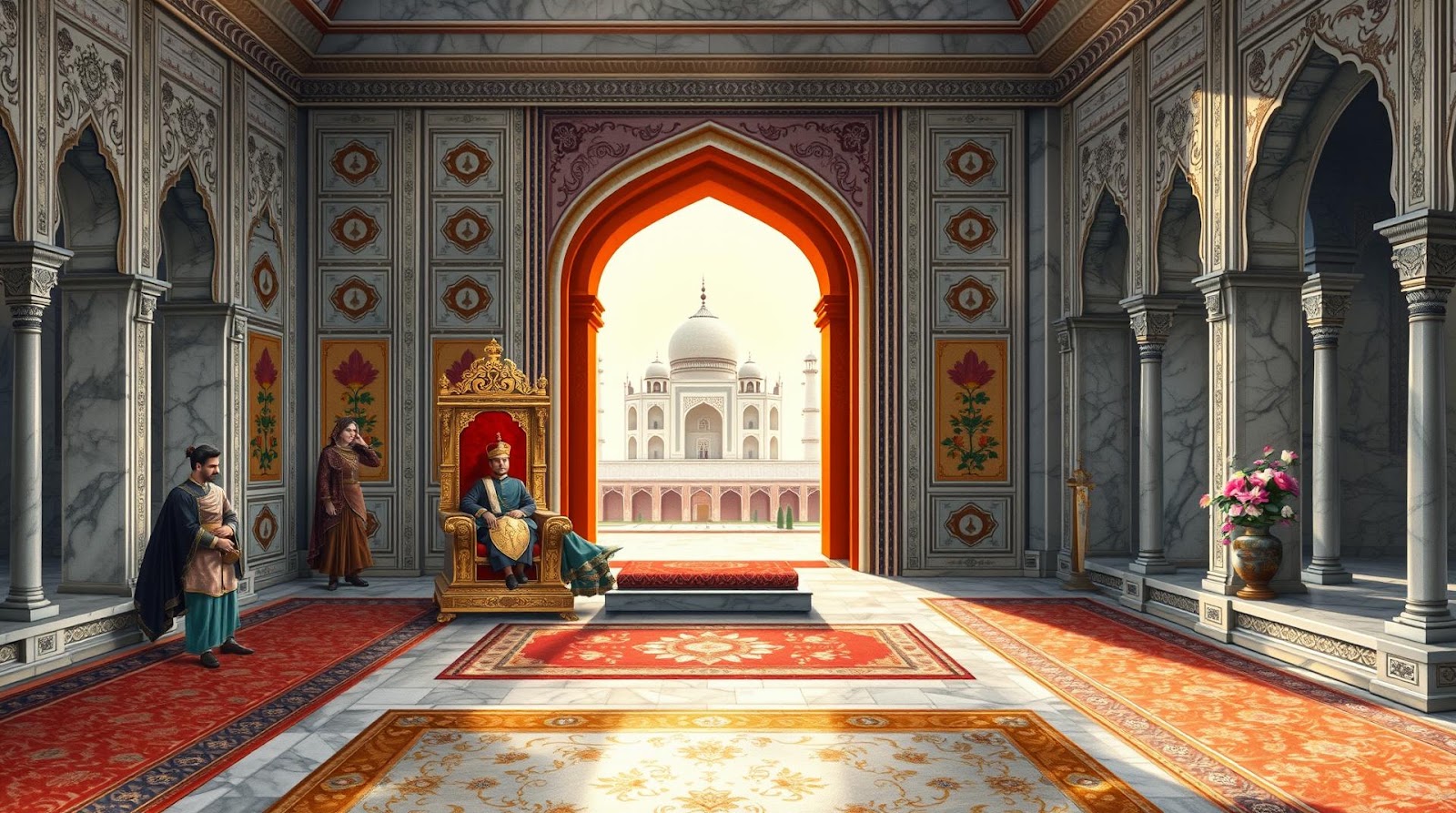
Then came Shah Jahan (1628-1658), Jahangir's son. You know him because of the Taj Mahal. Yes, that gorgeous white marble monument is actually a love story—Shah Jahan built it for his wife Mumtaz Mahal after she died during childbirth. Romantic? Sure. But also—it drained the treasury. The empire was spending so much on monuments, maintenance, and court luxury that the common farmer was paying heavier taxes.
Shah Jahan was great for culture but rough on economy. The Mughal administration, which Akbar had kept lean and efficient, started bloating. Nobles multiplied, corruption increased, and the tax burden on peasants became crushing.
Aurangzeb: The Strict Reformer Who Broke the Empire (1658-1707)
Now here's where it gets dramatic. Shah Jahan had four sons, and they fought over succession like siblings competing for the TV remote—except with armies. Aurangzeb, the third son, was ruthless. He imprisoned his own father, killed his brothers, and took the throne. Brutal? Yes. But also, strategically sound in that era.
Aurangzeb was everything Akbar wasn't: rigid, orthodox, and uncompromising. He re-imposed the jizya tax on non-Muslims, destroyed temples that he saw as threats, appointed only Muslim nobles, and launched endless military campaigns in the Deccan trying to conquer every last bit of territory.
Here's the irony: Aurangzeb made the empire vast—it reached its largest territorial extent under him. But he also broke its heart. By taxing heavily, persecuting minorities, and ignoring agriculture for military spending, he created the conditions for collapse. When he died in 1707, the empire didn't immediately fall, but it was already dying from the inside.
Quick memory trick for the two sides of Aurangzeb: "Gold for Ambition, Lead for Legacy." Gold = territorial expansion (looks good on maps), Lead = heavy burden on people (weighs everything down). The territorial gains didn't translate to stable rule.
The Administrative and Cultural Genius of the Mughals
The Mansabdari System: Medieval Meritocracy?
Let me explain the Mansabdari system because it's absolutely brilliant, and you'll definitely get questions on it.
Imagine if your salary, rank, and job responsibility were all tied to one number—your "mansab." That's what the Mughals did. A mansab was a numerical ranking (for example, mansab 5000) which meant you commanded 5000 cavalry soldiers and earned a salary that reflected that rank. No family privilege, no hereditary right—in theory, anyone could rise if they performed well.
In practice? It was more complex. Aurangzeb's later years saw the system become corrupted. But during Akbar's time, it was genuinely performance-based. This is why the Mughal administration could expand rapidly without falling apart—talented people from any background could be promoted based on merit.
Cultural Synthesis: The Real Legacy
You know what amazes me most about the Mughals? They didn't just rule India—they became Indian. Yes, they were Muslim rulers, but they adopted Indian clothing (the achkan!), ate Indian food (biryani is their gift to us), supported Indian artists, and even learned Indian languages. Hindi/Urdu developed as a fusion language during their reign.
The Mughal court was a melting pot. Hindu generals commanded Muslim soldiers. Muslim architects designed temples. Indian musicians performed in court. This synthesis wasn't forced multiculturalism—it was pragmatic coexistence born from living together and genuinely appreciating each other's contributions.
Architecture is the best example. Mughal architecture blended Persian, Central Asian, and Indian styles. The Taj Mahal, Red Fort, Jama Masjid, Fatehpur Sikri—these aren't just Persian copies or Indian imitations. They're genuinely new, unique, and unmistakably Mughal Indian.
| Emperor | Reign | Key Achievement | Major Policy |
|---|---|---|---|
| Babur | 1526–1530 | Founder; won Battle of Panipat | Established military superiority |
| Humayun | 1530–1556 | Lost and regained empire | Stabilized after Sher Shah Sur interregnum |
| Akbar | 1556–1605 | Religious tolerance; administrative reforms | Abolish jizya, Mansabdari, Zabti system |
| Jahangir | 1605–1627 | Art and culture flourished | Court patronage of miniatures and poetry |
| Shah Jahan | 1628–1658 | Built Taj Mahal and Red Fort | Architectural grandeur (but fiscal drain) |
| Aurangzeb | 1658–1707 | Largest territorial extent; orthodox policies | Re-impose jizya, persecute minorities |
Why the Mughal Empire Matters Today
Here's something I realized after teaching for a decade: most students memorize Mughal history for exams but don't understand why it matters beyond that. Let me change that.
First, the Mughals showed that diverse people can coexist under one administrative system. The Hindu-Muslim tensions didn't erupt into constant warfare—they managed each other, traded, married, and created culture together. That's a historical fact worth remembering.
Second, every administrative system we have today—the bureaucracy, the military ranking, even concepts of meritocracy—has roots in Mughal innovations. The IAS system, the way we rank officers, the concept of competitive examination for jobs—these evolved from Mughal principles of governance.
Third, the Mughals created the Indian style we recognize today. Urdu, Hindustani music, the architecture of our cities, the way we celebrate Diwali and Eid, even our food—it's all blended Mughal-Indian synthesis. You can't understand modern India without understanding Mughal India.
For your exams, remember this: the Mughal Empire was the golden age of medieval India. It wasn't perfect, and it eventually collapsed, but the 200+ years it lasted shaped everything that came after. Every UPSC question about medieval administration, culture, or society will trace back to Mughal innovations.
A) Babur B) Humayun C) Akbar D) Jahangir
Answer: C) Akbar abolished the jizya in 1564 as part of his policy of religious tolerance.
A) Hereditary rank B) Religious affiliation C) Military responsibility and salary D) Landholding size
Answer: C) Military responsibility and salary. The mansab number determined both rank and compensation.
A) Ibrahim Lodi B) Babur C) Sher Shah Sur D) Rana Sanga
Answer: B) Babur defeated Ibrahim Lodi in 1526, establishing Mughal rule in India.
A) Akbar B) Jahangir C) Shah Jahan D) Aurangzeb
Answer: C) Shah Jahan built the Taj Mahal for his wife Mumtaz Mahal (1632-1653).
A) A military ranking system B) Land measurement and fair taxation system C) A religious reform policy D) A trade regulation system
Answer: B) The Zabti system involved measuring land accurately and assessing fair taxes, preventing arbitrary tax collection.
Published by Dattatray Dagale • 27 June 2026
.jpg)
.png)



.png)



.png)

0 Comments