Introduction
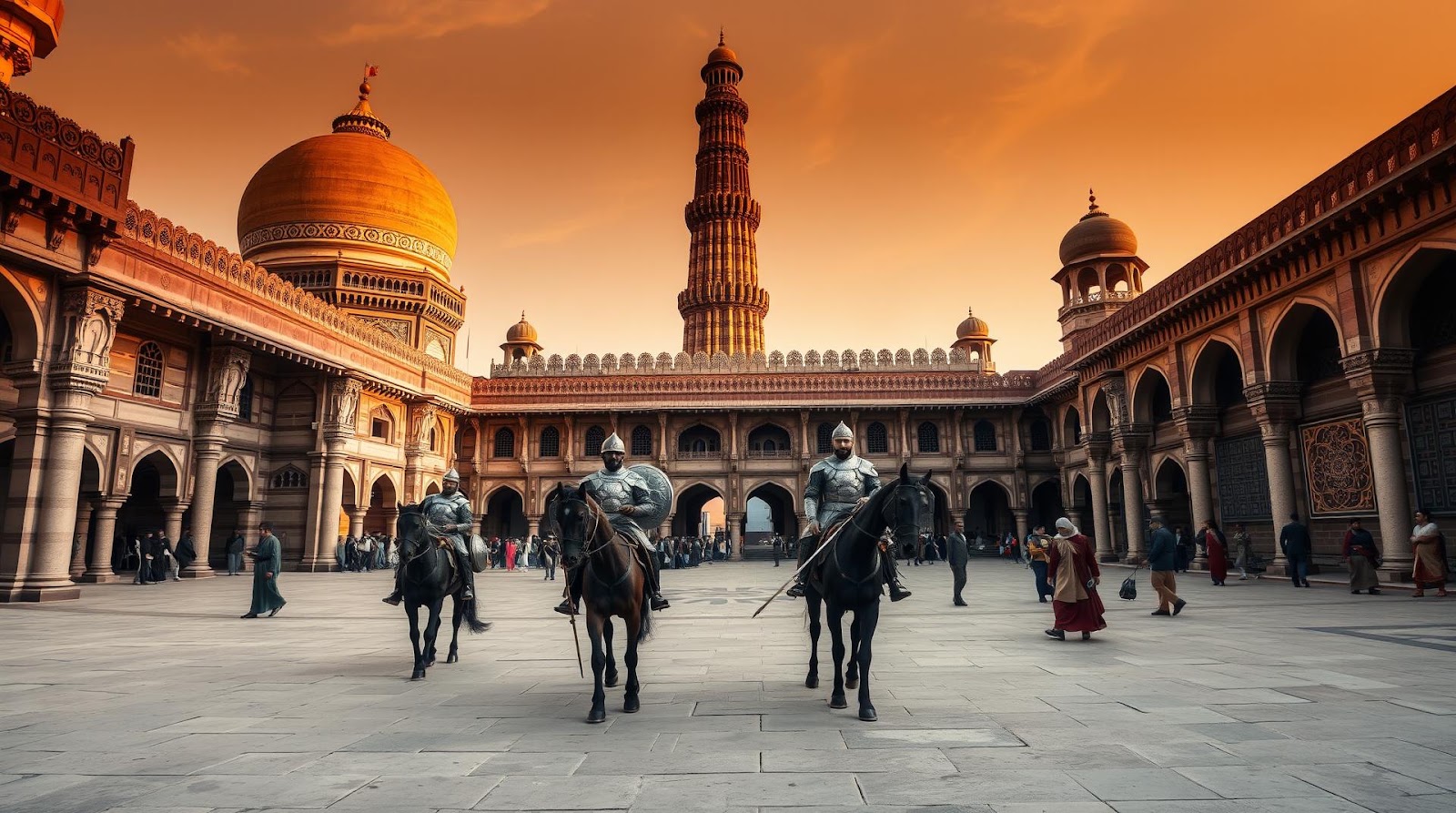
Let me take you back to 1192. You're standing on the plains of Delhi, and everything you know about India is about to change. A Turkish warrior named Muhammad of Ghor defeats Prithviraj Chauhan in the Second Battle of Tarain, and suddenly, the political map of India starts bleeding new colours. This is where the Delhi Sultanate begins — one of the most transformative, chaotic, and absolutely fascinating periods in our history.
I've been teaching this topic for over a decade, and honestly? Students either find it boring ("so many sultans, so many names!") or they get completely lost in the details. But here's what I've realized: the Delhi Sultanate isn't about memorizing a list of rulers. It's about understanding power, resistance, culture, and how an empire learns to survive by constantly reinventing itself. Think of it like a Hindi film franchise — five completely different directors (dynasties), each bringing their own vision, but all working with the same basic plot of controlling India.
By the end of this post, you'll not only understand why these sultans mattered, but you'll also see why questions about them keep appearing in SSC CGL, UPSC, and every major exam. Let's begin.
What Exactly Was the Delhi Sultanate?
First, let's get our definitions straight because I see students getting confused here all the time.
A sultanate is a state ruled by a sultan — an Islamic ruler. The Delhi Sultanate was a series of Muslim dynasties that ruled parts of the Indian subcontinent from 1206 to 1526. Notice I said "parts" — this is crucial. The Delhi Sultanate never controlled all of India. It was strong in the North and Central regions, but the South had its own kingdoms. Even within the North, power was constantly being challenged by regional rulers and Hindu kingdoms.
Now, here's something I want you to understand: the Delhi Sultanate wasn't one continuous empire with smooth power transfer. It was five different dynasties, each with different origins, different ambitions, and honestly, different levels of competence. Every time a dynasty weakened, regional governors broke away, and someone new had to fight their way to the top.
The Five Dynasties (Your Memory Aid)
Let me give you a trick I've used with thousands of students: S.L.K.T.L
S - Slave Dynasty (1206-1290)
L - Lodi Dynasty (1451-1526)
K - Khalji Dynasty (1290-1320)
T - Tughlaq Dynasty (1320-1412)
L - (Sayyid Dynasty - 1414-1451)
Wait, that doesn't work perfectly! Let me give you the real sequence in order: SKTSL (Slave, Khalji, Tughlaq, Sayyid, Lodi). I know it's not a perfect acronym, but here's how I remember it with my students: "Slave Khalji Tughlaq had to Say Lodi goodbye" — like they're at an airport! Silly? Yes. Memorable? Absolutely.
The Slave Dynasty: From Slaves to Sultans (1206-1290)
Alright, this is where I get genuinely excited because the story of the Slave Dynasty is basically a Bollywood underdog movie waiting to happen.
After Muhammad of Ghor defeated Prithviraj Chauhan, he returned to Afghanistan and left behind his trusted general Qutb-ud-Din Aibak to manage his Indian territories. Now, Aibak was originally a slave-soldier — he'd been captured, trained in warfare, and proved himself in battle. When Muhammad of Ghor died in 1206, Aibak declared himself the Sultan of Delhi. Imagine that: a former slave becoming one of the most powerful men in India.
Qutb-ud-Din Aibak (1206-1210) was the founder, but the real consolidation came under his successors, especially Iltutmish (1211-1236). Iltutmish was a powerhouse. He expanded the sultanate, standardized the currency, and created administrative systems that actually worked. He even had the boldness to appoint his daughter, Razia ul-Daulah, as his successor — the only female sultan of Delhi.
Razia: A Queen Among Sultans
Now, Razia is one of my favourite topics to teach because she completely shatters the "medieval women had no power" narrative. She ruled from 1236-1240, dressed in men's clothing to appear in public (because that's what sultans did), led military campaigns, and was genuinely competent. Her coin had her name, her name was in the Khutba (the sermon read in mosques), and she made decisions independently.
But here's the tragic part: the nobility and the army didn't accept a female ruler, no matter how capable. She fell in love with a former slave named Malik Jamal-ud-Din (some say he was of Ethiopian origin), and this personal decision cost her her throne. She was deposed in 1240, and her reign became a cautionary tale that kept subsequent sultanates from appointing female rulers.
The Slave Dynasty continued until 1290, when a general named Jalaluddin Khalji staged a coup. Why? The ruling sultan at the time was weak, and Khalji saw an opportunity. This is typical of the sultanate period — power shifted based on military strength and luck.
The Khalji Dynasty: Aggression and Expansion (1290-1320)
The Khalji Dynasty came from Central Asia and were known for being more aggressive and militaristic than their predecessors. The founder, Jalaluddin Khalji, was moderate and diplomatic. But his nephew, Ala-ud-Din Khalji (1296-1316), was a different animal altogether.
Ala-ud-Din was a military genius and arguably the most powerful sultan of the entire sultanate period. Here's what he did:
Military Expansion: He conquered Gujarat, Rajasthan, and even invaded the Deccan, reaching as far south as Warangal. For the first time, a Delhi sultanate had serious influence over much of India.
Administrative Reforms: He introduced a market control system called "Baizari" to regulate prices of essential goods. He kept salaries low for nobles and officials to prevent them from becoming too powerful and independent. He even introduced a system of spies to keep an eye on potential rebels.
Military Organization: He separated the soldiers' pay from land grants (which is called the "Iqta system"). This meant nobles couldn't easily rebel because their income was directly tied to the sultan's goodwill.
Ala-ud-Din never declared himself a caliph (unlike later sultans), which made him somewhat different. He saw himself purely as a military administrator, not a religious figurehead.
After Ala-ud-Din's death, the dynasty weakened rapidly. His successors were less capable, the nobles began rebelling again, and by 1320, Muhammad Tughlaq's father, Ghazi Malik, staged a coup and founded the Tughlaq Dynasty.
The Tughlaq Dynasty: Ambition Without Success (1320-1412)
Now, the Tughlaq Dynasty is fascinating because it represents a ruler with absolutely brilliant ideas that were terrible in execution. I'm talking about Muhammad Tughlaq, who ruled from 1325-1351.
Muhammad Tughlaq was educated, intelligent, and multi-lingual. But historians often call him "the wisest fool" because his plans were visionary but practically disastrous.
His Major Projects (and Why They Failed)
Token Currency (1330-1332): Muhammad Tughlaq introduced brass and copper tokens as currency instead of precious metals. His idea was genius: reduce the burden on precious metals and prevent hoarding. But implementation was a nightmare. People counterfeited the tokens freely. The economy crashed. He had to abandon the scheme after two years, but the damage to trust in the system was done.
Moving the Capital to Daulatabad (1327-1335): To control the Deccan better, Muhammad decided to move the entire capital from Delhi to Daulatabad (in present-day Maharashtra). He actually did it — forced migration of 100,000 people. It was a logistical nightmare, the new capital wasn't as strategically valuable as he thought, and within eight years, he moved the capital back. The cost? Massive resources, angry nobles, and lost administrative efficiency.
Taxation and Land Reforms: He tried to increase the tax rate on agricultural land from 20% to 50%. It sounds logical — more revenue for the state — but farmers simply abandoned their lands. Agricultural production dropped, and the state actually made less money.
Muhammad Tughlaq died in 1351, having spent his reign fighting rebellions and dealing with the consequences of his own policies. The sultanate never really recovered from this period.
Later Tughlaq sultans, particularly Firoz Shah Tughlaq (1351-1388), were somewhat better administrators. Firoz was more stable and focused on public works — he built roads, dams, and gardens. But the sultanate's military power had already declined by this point.
The Sayyid and Lodi Dynasties: Decline and Transition (1414-1526)
By the time the Sayyid Dynasty took power in 1414, the Delhi Sultanate was basically a fading power. The Sayyids were nobles who claimed descent from the Prophet Muhammad, and they tried to stabilize the empire. But honestly? They spent most of their time just maintaining what they had rather than expanding.
The regional kingdoms had become strong enough to challenge Delhi's authority. Gujarat, Malwa, Jaunpur, and Bengal had their own independent sultanates. The Bahmani Sultanate in the Deccan was a major power center. Delhi was increasingly becoming just one player among many.
Then came the Lodis (1451-1526), led by Bahlol Lodi, a former governor of Punjab. The Lodis tried to reorganize the sultanate and brought some stability for a few decades. But their rule was the last hurrah of the Delhi Sultanate. In 1526, at the First Battle of Panipat, the Lodi Sultan Ibrahim was defeated by Babur, the founder of the Mughal Empire.
And just like that, 320 years of sultanate rule came to an end.
Culture, Society, and Legacy of the Sultanate
Here's something that textbooks often skip, but I think it's crucial for understanding the period: the Delhi Sultanate fundamentally changed Indian culture and society.
Architecture and Urban Development
The sultans were major patrons of architecture. The Qutb Minar (built by Qutb-ud-Din Aibak), the Jama Masjid, the Lodhi Gardens — these weren't just monuments; they represented Islamic architectural styles meeting Indian conditions. The Indo-Islamic architecture that emerged during this period is still stunning today.
The sultans also built new cities and expanded urban centers. Delhi itself was transformed multiple times — new forts, new administrative centers, new mosques. This urban development created jobs, brought craftsmen together, and facilitated trade.
Social and Religious Impact
The sultanate period saw significant conversion to Islam, especially in Punjab and parts of North India. Some conversions were voluntary (attracted by Islamic teachings, social mobility, or intermarriage), while others were due to pressure. This demographic change reshaped the subcontinent.
At the same time, many sultans patronized Hindu temples and employed Hindu administrators. Firoz Shah Tughlaq employed Hindus in his court. There was tension, certainly, but also a degree of coexistence. Indian Hinduism evolved and adapted during this period too.
Language and Literature
This period saw the growth of Urdu as a language. Persian became the court language, and the fusion of Persian, Arabic, and Indian languages created something new. Literature flourished — histories, poetry, and administrative texts were written in Persian and Urdu-like languages.
| Dynasty | Period | Key Ruler | Known For |
|---|---|---|---|
| Slave | 1206-1290 | Iltutmish, Razia | Consolidation, Administration, Female Sultan |
| Khalji | 1290-1320 | Ala-ud-Din Khalji | Military Expansion, Market Control, Strong Administration |
| Tughlaq | 1320-1412 | Muhammad Tughlaq, Firoz Shah | Ambitious Reforms (Failed), Capital Shift, Public Works |
| Sayyid | 1414-1451 | Various | Maintenance, Stability Attempts, Loss of Power |
| Lodi | 1451-1526 | Bahlol Lodi, Ibrahim Lodi | Last Dynasty, Defeated at Panipat by Babur |
Why the Delhi Sultanate Collapsed
Students often ask me: "If the Sultanate was so powerful, why did it collapse?" Great question.
First, there was no real system of succession. When a sultan died, his sons (or sometimes nephews) fought each other for the throne. There was no "eldest son inherits everything" rule that might have provided stability. This created constant internal conflict.
Second, the sultanate became too decentralized over time. Regional governors became increasingly independent. By the 15th century, these governors had their own armies, their own resources, and their own ambitions. The central authority in Delhi couldn't really enforce compliance.
Third, the military system was based on personal loyalty to the current sultan. Once a sultan died, this loyalty often didn't transfer to his successor. This made it easy for rivals to attract soldiers away from the new sultan.
Finally, the rise of regional sultanates meant that there was no unified Islamic power in India anymore. Gujarat, Bengal, Malwa, the Deccan — all had their own sultanates. This fragmentation meant that when Babur arrived with superior military technology and tactics (particularly the use of firearms and artillery), the Delhi Sultanate couldn't muster unified opposition.
The First Battle of Panipat in 1526 essentially ended the era. Not because the sultanate was conquered overnight, but because the new Mughal Empire represented a different kind of Islamic rule in India — more centralized, more sophisticated, and ultimately more lasting.
Key Takeaways for Your Exams
Alright, let me give you what you actually need to remember for your exams:
1. Five dynasties, not one empire. They had different origins, different strengths, different weaknesses. Memorize the sequence and one key ruler from each.
2. Ala-ud-Din Khalji was the strongest. If you have to remember one sultan, remember him. Market control, military expansion, administrative reforms.
3. Muhammad Tughlaq represents the "visionary but disastrous" leader. Token currency, capital shift, high taxes — all failed.
4. The sultanate never controlled all of India. Regional kingdoms remained powerful, especially in the South.
5. Culture and architecture were legacies, but political fragmentation was the reason for collapse. No stable succession system + powerful regional governors = end of centralized power.
6. Razia is the only female sultan. She was competent but faced societal opposition. Perfect answer for any question about women in medieval India.
Now, let me give you something that'll actually stick in your head better than any lecture:
Picture the Delhi Sultanate as a cricket innings: The Slave Dynasty was the opening partnership — establishing the basics. The Khalji Dynasty was the aggressive middle order — scoring runs at a high rate. The Tughlaq Dynasty was that batsman who tried too many unnecessary shots and got out. The Sayyid Dynasty was barely holding on, and the Lodi Dynasty was the tail-ender waiting for the inevitable.
Practice Questions
A) Muhammad of Ghor in 1192 B) Qutb-ud-Din Aibak in 1206 C) Iltutmish in 1211 D) Jalaluddin Khalji in 1290
Answer: B) Qutb-ud-Din Aibak founded the sultanate in 1206. Muhammad of Ghor defeated Prithviraj in 1192, but Aibak declared himself independent sultan after Ghor's death.
A) Ala-ud-Din Khalji B) Muhammad Tughlaq C) Firoz Shah Tughlaq D) Bahlol Lodi
Answer: B) Muhammad Tughlaq introduced brass and copper tokens as currency from 1330-1332, but the experiment failed due to widespread counterfeiting.
A) Khalji Dynasty B) Tughlaq Dynasty C) Slave Dynasty D) Sayyid Dynasty
Answer: C) Slave Dynasty. She was appointed by her father Iltutmish and ruled from 1236-1240, making decisions independently and even dressing as a male sultan in public.
A) Munsabdari B) Baizari C) Iqta D) Jagirdari
Answer: B) Baizari was the system Ala-ud-Din introduced to regulate prices of essential commodities and prevent hoarding.
A) Muhammad Tughlaq B) Firoz Shah Tughlaq C) Ala-ud-Din Khalji D) Bahlol Lodi
Answer: A) Muhammad Tughlaq moved the capital to Daulatabad from 1327-1335 to better control the Deccan, but the move was disastrous and he had to shift back to Delhi.
Published by Dattatray Dagale • 26 June 2026
.jpg)
.png)



.png)



.png)


0 Comments