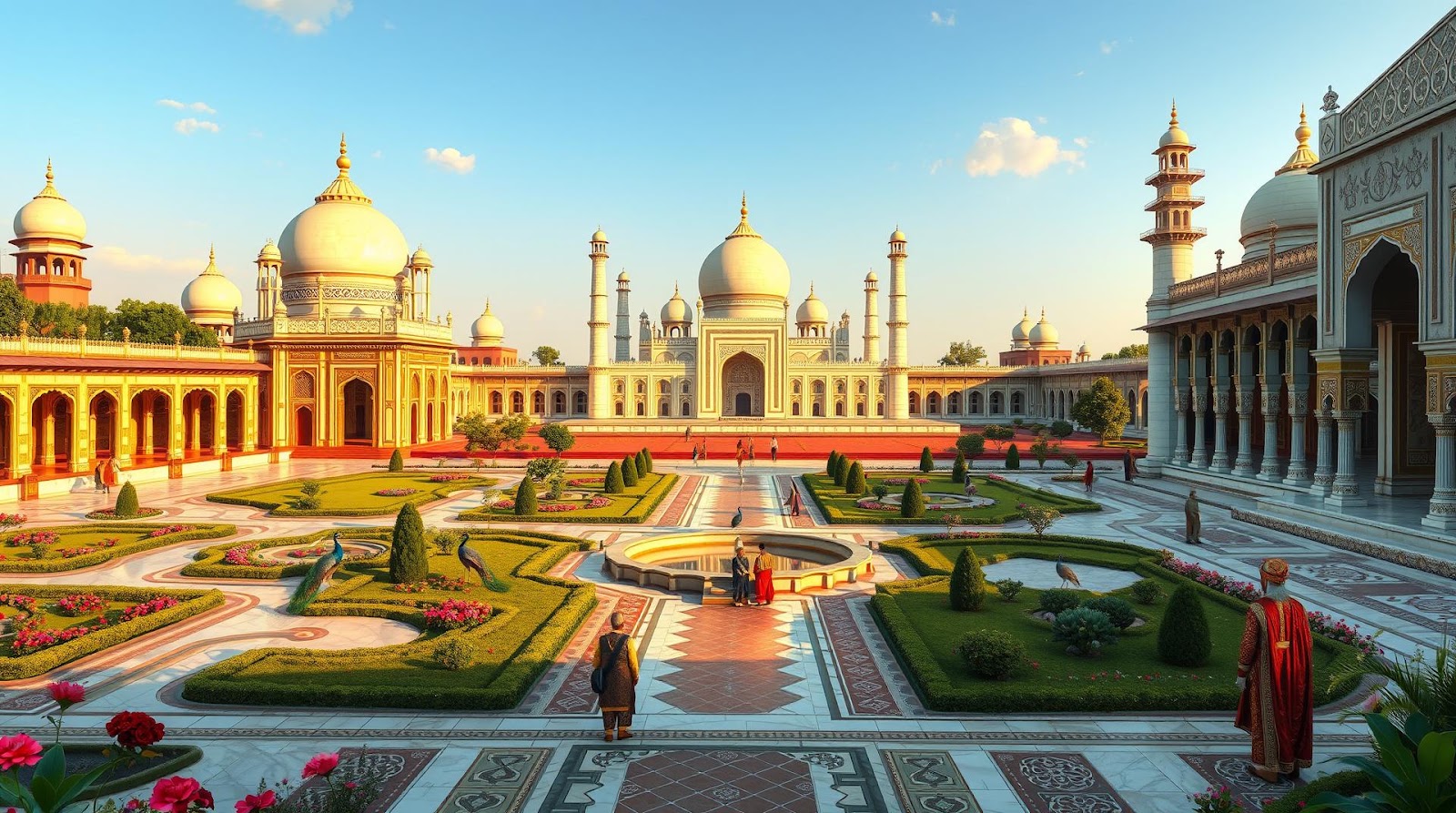
Introduction
Alright, let me start with something that always fascinates my students: imagine if someone told you that for nearly 200 years, one family ruled over almost the entire Indian subcontinent with such efficiency that even today, we're still studying their administrative systems. That's the Mughal Empire for you.
When I first started teaching this topic 10+ years ago, I realized most students saw the Mughals as just another invading force. But here's where it gets interesting—they were invaders who came, stayed, and fundamentally transformed India in ways that shaped everything from our food to our architecture to our languages. The Taj Mahal isn't just a beautiful building; it's a symbol of how deeply the Mughals became part of Indian civilization.
Now, for your SSC CGL or UPSC exam, understanding the Mughal Empire isn't about memorizing dates (though you'll need a few). It's about grasping the "why" behind the "what." Why did Akbar's administration work so brilliantly? Why did later emperors fail? How did this Persian-Central Asian dynasty become so Indian? That's what we're diving into today.
The Rise of the Mughals: From Babur to Akbar
Babur and the Foundation (1526-1530)
Picture this: it's 1526, and a guy named Zahir ud-Din Muhammad—we know him as Babur—storms into India with superior cavalry tactics and a desire to build something lasting. He defeats Ibrahim Lodi at the Battle of Panipat. Now, this wasn't the first invasion of India (far from it!), but here's what makes Babur different: he stayed. He actually cared about ruling India, not just raiding it.
Babur was a poet, a writer, and oddly enough, quite introspective for a military commander. He wrote his memoirs—the Baburnama—which give us incredible insights into his character and his vision. He faced constant rebellions, health issues, and the challenge of ruling a land where his soldiers were homesick for Central Asia. Yet he persisted. In just four years of rule, he laid groundwork that would last centuries.
Here's a memory trick I tell all my students: BABUR = Begin And Build, U Understand, Rule. He understood that conquest alone wasn't enough; you needed administrative structures. That's why Akbar would build on his foundation so successfully.
Akbar the Great: The Empire's Golden Age (1556-1605)
Now, if Babur was the founder, Akbar was the genius who made the Mughal Empire what it became. When Akbar took the throne at age 13, nobody expected him to become one of history's greatest administrators. His regent Bairam Khan helped initially, but it was Akbar's vision that transformed everything.
Let me tell you what impressed me most when I first studied Akbar: his religious policy. In an era when religious intolerance was the norm, Akbar practiced religious pluralism. He married Hindu princesses (like Jodha Bai), appointed Hindus to high positions (Birbal was his closest advisor), and even experimented with a new religion called Din-i-Ilahi, which tried to synthesize the best of Islam, Hinduism, and other faiths. Was it successful? Not really. Did it cause controversy? Absolutely. But the intent shows his progressive thinking.
Akbar reorganized the entire administrative system. He implemented the Mansabdari system—a military-cum-administrative hierarchy where officials received mansabs (ranks) that determined their salary, army size, and authority. Think of it like the civil service ladder we have today, but with a direct military component. This was revolutionary because it created a merit-based system (largely) and reduced feudal rivalries.
His tax reforms were equally impressive. He introduced the Todar Mal's revenue system, which standardized land measurements and tax collection across the empire. This wasn't just bureaucratic efficiency; it reduced corruption and gave farmers some predictability in their tax burden. Compare this to the chaos of the Delhi Sultanate before him, and you'll see why the empire thrived.
The Mughal Empire at Its Peak: Culture, Architecture, and Administration
Architecture That Still Takes Your Breath Away
You know what's fascinating? The Taj Mahal was built under Shah Jahan (1628-1658), and while it's the most famous, it's actually just one of hundreds of magnificent structures the Mughals created. The Red Fort in Delhi, the Fatehpur Sikri complex, the Jama Masjid—these weren't just buildings; they were statements of power and aesthetics.
Mughal architecture is this beautiful blend of Persian, Central Asian, and Indian styles. High domes, intricate inlays, calligraphy, gardens—all combining into something uniquely Indo-Islamic. The charbagh (four-part garden) design became iconic. If you've ever visited a Mughal monument, you'd notice the precision and the harmony. That didn't happen by accident. It required patronage, skilled craftsmen, and a vision that lasted generations.
The Intellectual and Artistic Flourishing
The Mughal court attracted scholars, poets, musicians, and artists from across the Islamic world and India. The court language was Persian, which became so prestigious that even Hindu courts adopted it. Persian literature, miniature painting, calligraphy, and Hindustani classical music all flourished. Akbar's court had the Navaratna (nine gems)—including Birbal, Faizi, Abul Fazl, and others—who contributed across different fields.
Here's something that amazes me: the Mughal emperors sponsored both Hindu temples and Islamic structures. Akbar donated to temples. Later emperors did too, to varying degrees. This wasn't about being "secular" in the modern sense (that term doesn't apply), but about pragmatism and genuine appreciation for Indian culture. They were becoming Indian, in a way.
The Mughals also encouraged Persian poetry and literature. Abul Fazl's Akbar Nama and Ain-i-Akbari are among the most important historical sources we have. These weren't dry administrative records; they were beautifully written chronicles that tell us about the empire's organization, the emperor's philosophy, and the society of the time.
The Decline: When Cracks Appeared in the Empire
Now here's where the story gets sad, and honestly, it's a crucial lesson about how empires fall—not with a bang, but often with a series of poor decisions.
After Shah Jahan (who gave us the Taj Mahal), his son Aurangzeb took the throne in 1658. Aurangzeb was orthodox in his Islamic faith—very different from Akbar. He reversed many of his ancestors' pluralistic policies. He reimposed the jizya tax on non-Muslims, destroyed temples, and appointed only orthodox Islamic advisors. Now, whether this was morally right or wrong isn't the point for your exam—what matters is that it destabilized the empire.
You might be wondering: didn't Aurangzeb also expand the empire territorially? Yes. He conquered the Deccan. But territorial expansion comes with administrative costs. The empire was spread too thin. Maintaining such a vast territory with long-distance communication challenges (remember, no telegrams or phones!) meant local governors became more autonomous. The center lost control.
Additionally, Aurangzeb's religious policies created resentment among the Hindu population. Rajput nobility, who had been integrated into the system under Akbar, started feeling marginalized. Regional powers like the Marathas, sensing weakness, began expanding their own territories. It's like watching a spider web—pull one thread too hard, and the whole thing starts unraveling.
By the 18th century, the Mughal Empire existed more in name than in reality. Weak emperors followed. Regional powers—the Marathas, the Nizam of Hyderabad, the Sikh Khalsa—carved out their own kingdoms. By the time the British arrived, the Mughal Emperor was just a figurehead living in Delhi with limited authority. The empire had fragmented into what was essentially a collection of semi-independent kingdoms.
Let me give you a memory framework for this: AKBAR-JAHAN-ZAMAN (Akbar, then Jahan, then times change). Akbar and Shah Jahan were the peak. Aurangzeb was the turning point. After him, the decline was inevitable.
| Emperor | Period | Key Contribution/Event | Impact |
|---|---|---|---|
| Babur | 1526-1530 | Founded Mughal Empire; Battle of Panipat | Established dynasty, ended Delhi Sultanate |
| Akbar | 1556-1605 | Mansabdari system; religious pluralism; Todar Mal's revenue reforms | Empire's greatest stability and expansion |
| Jahangir | 1605-1627 | Cultural patronage; Nur Jahan's influence | Consolidation; maintained Akbar's policies mostly |
| Shah Jahan | 1628-1658 | Taj Mahal; Red Fort; architectural splendor | Cultural peak but economic strain |
| Aurangzeb | 1658-1707 | Orthodox policies; Deccan expansion; jizya reimposed | Territorial peak but internal instability began |
Why the Mughal Empire Still Matters
Now, you might be thinking: "This is great for history, but why should I care for my exam?" Let me connect the dots.
First, understanding the Mughal Empire helps you understand modern India. Our language (Hindi has Persian loanwords), our cuisine (biryani, tandoor), our monuments, our administrative systems—all bear Mughal influence. The civil service structure, the importance of written examinations, merit-based appointments—these trace back to Mughal administrative innovations that we inherited and refined.
Second, the Mughal period raises fundamental questions about governance: How do you rule a diverse population? What's the relationship between religious policy and political stability? How does centralized power decline? These aren't just historical questions; they're relevant to understanding any state. Your exam makers love questions that test whether you understand these deeper themes, not just dates and names.
Third, comparing the Mughal Empire to other contemporary empires (Ottoman Empire, European powers, Chinese dynasties) gives you a 360-degree view of world history. This is what separates good history students from excellent ones.
Here's what I tell my students: "Don't memorize the Mughal Empire. Understand it. Walk through it like you're a traveler in Akbar's court, then in Shah Jahan's Delhi, then watching helplessly as Aurangzeb's policies create the conditions for the empire's decline. Then ask yourself: what would you have done differently?" That's when history becomes alive.
A) Babur B) Akbar C) Shah Jahan D) Aurangzeb
Answer: B) Akbar. The Mansabdari system was a military-cum-administrative hierarchy that created a merit-based system for appointments and ranks.
A) A tax introduced by Akbar B) A religion synthesizing Islam, Hinduism, and other faiths C) A military strategy D) An administrative division
Answer: B) A religion synthesizing Islam, Hinduism, and other faiths. Din-i-Ilahi was Akbar's attempt at religious synthesis, though it was not widely successful.
A) Akbar B) Jahangir C) Shah Jahan D) Aurangzeb
Answer: C) Shah Jahan. Built in memory of his wife Mumtaz Mahal, it stands as one of the finest examples of Mughal architecture.
A) Battle of Haldi Ghati B) First Battle of Panipat C) Battle of Tallikota D) Battle of Buxar
Answer: B) First Battle of Panipat (1526). Here, Babur defeated Ibrahim Lodi, establishing Mughal dominance in India.
A) British invasion B) Economic collapse alone C) Religious policies creating instability, regional fragmentation, and loss of central control D) Military defeats by Marathas only
Answer: C) Religious policies creating instability, regional fragmentation, and loss of central control. Aurangzeb's orthodox policies alienated Hindu nobility, and territorial overexpansion weakened central authority, leading regional powers like the Marathas to assert independence.
Published by Dattatray Dagale • 02 June 2026
.jpg)
.png)



.png)




.png)

0 Comments