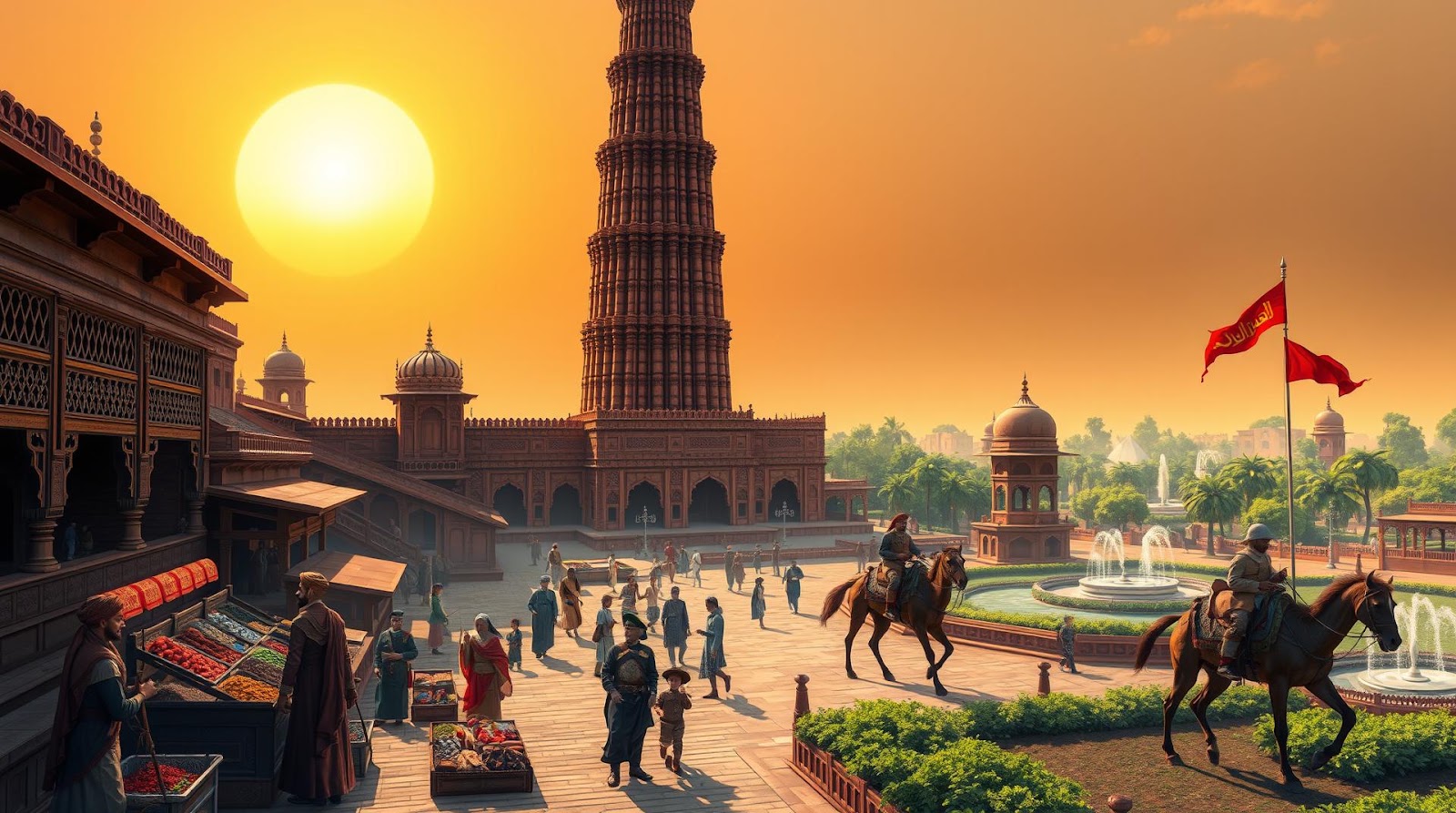
Introduction
You know, when I first started teaching medieval India, I realized most students treated the Delhi Sultanate like a boring list of names and dates. Sultan this, Sultanate that. No color, no drama, no life. Then one day, a student asked me: "Sir, these sultans — were they like our modern CEOs running different companies?" That question changed how I teach this entire period.
The Delhi Sultanate wasn't just a monolithic block of Islamic rule that suddenly appeared on the map. It was five completely different dynasties — five different management styles, five different visions — all fighting, falling, rebuilding, and reshaping India from 1206 to 1526. Some lasted barely a decade. Others changed India forever. Some were military geniuses. Others were administrative wizards. And yes, some were absolutely brutal.
Here's what makes this period so crucial for your exam: it's the bridge between Hindu kingdoms and the Mughal Empire. It's where Islamic culture and Indian traditions started the dance that would define the next 300 years. And unlike what many textbooks suggest, it's not a story of "invaders versus natives" — it's far more nuanced, far more interesting than that.
Let me walk you through this journey. By the time we finish, you'll understand not just the "what" and "when," but the "why" — and that's what makes the difference between 50 marks and 90 marks in your exams.
The Five Dynasties: Your Mental Framework
First, let me give you a memory trick that every student I've taught still uses. I call it the "STABB" rule:
S – Slave Dynasty
T – Tughlaq Dynasty
A – Afghan Dynasties (Sayyid & Lodi)
B – But wait, that's not five!
Okay, so STABB doesn't perfectly work (I'm honest about my mnemonics). Here's the real order:
1. Slave Dynasty (1206–1290)
2. Khilji Dynasty (1290–1320)
3. Tughlaq Dynasty (1320–1414)
4. Sayyid Dynasty (1414–1451)
5. Lodi Dynasty (1451–1526)
Now here's the trick I tell my students: think of these five dynasties like five cricket teams. The Slave Dynasty set up the field and rules. Khilji came in as aggressive batsmen. Tughlaq tried to be clever but made mistakes. Sayyid got tired and handed the bat over. Lodi played their last match before the Mughals took over the tournament entirely.
The Slave Dynasty (1206–1290): Building from Scratch
Muhammad of Ghor conquered Delhi and left his slave general, Qutb ud-Din Aibak, to rule. Yes, Aibak was technically enslaved, but he was a military commander — not someone doing household chores. This is important context.
Aibak and his successors (including the famous Iltutmish and Razia Sultan) did something remarkable: they built the administrative structure of the sultanate from zero. There was no template. They created Delhi as a capital, established a bureaucracy, built monuments like the Qutb Minar, and created the first stable Islamic kingdom in India.
Now here's where it gets interesting for your exam: Razia Sultan. She's the only female ruler of the Delhi Sultanate, and yes, she was talented. But she was also controversial because, well, medieval politics. She wore men's clothes, participated in hunts, and tried to rule on merit rather than traditional expectations. She lasted about 4 years before being deposed. Why? Because the male nobility wasn't ready. This teaches us something important about power structures in medieval India — they were rigid, even for the skilled.
The Slave Dynasty weakened after about 80 years because, ironically, slaves became sultans, and their children wanted power without being formally enslaved. This led to internal conflicts and set the stage for the Khilji takeover.
The Khilji Dynasty (1290–1320): Aggressive Expansion
If the Slave Dynasty was careful and cautious, Khilji was like a student who studied too hard and is now showing off. Alauddin Khilji was genuinely one of India's greatest military minds. He captured Gujarat, Rajasthan, the Deccan — his armies were everywhere.
Here's what makes Alauddin special: he tried market control. He introduced price controls on goods in Delhi so that his soldiers could be paid less but still afford to eat. Was it successful? Partially. Did his successors maintain it? No. But the ambition to use economics as a tool of statecraft? That was ahead of its time.
The Khilji dynasty lasted only 30 years because they were militarily strong but politically fragile. When strong sultans died, the system collapsed.
The Tughlaq Dynasty (1320–1414): Ambition Meets Reality
Muhammad bin Tughlaq is probably the most misunderstood ruler of the sultanate. He was incredibly intelligent — maybe too intelligent. His contemporaries called him "Ulugh Khan" (the great sultan) and also called him mad. Both were kind of true.
He moved the capital from Delhi to Daulatabad (in the Deccan) in 1327. His reasoning? Centralize power in the Deccan. The execution? Disaster. People died on the journey. The Deccan wasn't ready. Within a few years, he moved the capital back. It's like when a company suddenly changes its headquarters and realizes they didn't think it through.
But here's what matters for your exam: Tughlaq was also an innovative administrator. He tried token currency (replacing coins with tokens). It failed because people hoarded the real currency. He tried to tax agricultural produce at 50% — unsustainably high. His ideas were brilliant but disconnected from practical reality.
The Tughlaq dynasty lasted nearly a century, but its later rulers were weak. By the early 1400s, even the sultan's authority in Delhi was questionable.
The Later Sultanates: Decline and Fragmentation
Now here's something important that often gets glossed over in textbooks: the later dynasties (Sayyid and Lodi) weren't as powerful as their predecessors, but they were preparing something important — the conditions for the Mughal Empire.
Sayyid Dynasty (1414–1451) and Lodi Dynasty (1451–1526)
The Sayyid Dynasty was basically watching Delhi's power decline. Regional sultanates — Bengal, Gujarat, Malwa, the Bahmani Sultanate in the south — were becoming independent. The central authority was fragmenting. So what did Sayyid rulers do? They basically accepted it and focused on Delhi itself.
The Lodi Dynasty came next, led by Ibrahim Lodi. Ibrahim was tough, but here's the thing — his own nobles were dissatisfied. Daulat Khan Lodi (a provincial governor) actually invited Babur (from Afghanistan) to invade Delhi to remove Ibrahim. Babur came, defeated Ibrahim at the Battle of Panipat in 1526, and established the Mughal Empire.
So the Delhi Sultanate didn't fall to some overwhelming external force. It fell because internal factions were broken enough to invite external help. That's a crucial distinction.
Administration, Culture, and Society Under the Sultanate
Now let's talk about what actually mattered on the ground. Dynasties came and went, but institutions evolved.
Administrative Structure
The sultans created a hierarchical bureaucracy. At the top was the Sultan. Below him were key positions:
Vizier – Prime minister and chief administrator
Amir-i-Hajib – Chief of the internal administration
Dewan-i-Vizarat – Finance minister
Qazi – Chief judge (Islamic law)
Muhtasib – Market inspector
This structure was copied across all five dynasties with minor variations. It was effective because it was clear and hierarchical — every official knew their job.
Military System and the Iqta System
Here's something cool: the sultans couldn't pay standing armies year-round. So they used a system called "Iqta" (similar to feudal grants in Europe). A military noble would be given rights to collect taxes from a territory in exchange for providing soldiers when needed.
The problem? Over time, Iqta became hereditary. Nobles started thinking: "This is my land. Why should I listen to the Sultan?" This decentralization weakened the sultanate's military capacity by the 1400s.
Cultural Synthesis: Not Just "Islamic Rule"
This is where most textbooks get it wrong. The Delhi Sultanate wasn't Islam versus Hinduism. Yes, the sultans were Muslim and promoted Islamic culture. But they also:
– Employed Hindu administrators and nobles (many of the best officials were Hindu)
– Used Persian as the administrative language (not Arabic)
– Built monuments blending Islamic and Indian architectural styles (look at the Qutb Minar — it's Islamic architecture but built by Indian craftsmen)
– Adopted some Indian customs and festivals
– Patronized Urdu literature, which is a blend of Persian, Arabic, and Sanskrit/Hindi
I tell my students: think of it like this. When American companies set up offices in India, they don't stop being American, but they adapt. They hire local people, celebrate local festivals, eat local food sometimes. The Delhi Sultanate was similar — it was Islamic rule, but ruling over an Indian population meant synthesis was inevitable.
The Bhakti Movement gained traction during this period. Sufi saints came to Delhi and preached a more personal, emotional form of Islam. Poets like Amir Khusrau wrote in Hindustani and became part of Indian culture, not just Islamic culture. This cultural mixing would accelerate under the Mughals.
Key Monuments and Achievements
Qutb Minar (Delhi) – Built by Aibak, expanded by Iltutmish. It's 73 meters tall and stands today as a UNESCO World Heritage Site. It represents the strength and architectural ambition of the early sultanate.
Jama Masjid complexes – Built across cities. They served both religious and social functions — gatherings, announcements, community spaces.
Administrative innovations – The sultanate established a bureaucracy that would be copied by the Mughals. This administrative system was more sophisticated than what existed in many contemporary European kingdoms.
Literature and Learning – Persian became the court language. Amir Khusrau wrote hundreds of poems in Hindustani. This period created the foundation for Urdu literature.
Urban Development – Delhi became a major city. Markets, mosques, palaces, residential areas — the sultanate created the infrastructure of a capital. Some of these structures can still be visited in Old Delhi today.
| Dynasty | Period | Key Ruler | Notable Achievement |
|---|---|---|---|
| Slave Dynasty | 1206–1290 | Iltutmish, Razia Sultan | Established sultanate structure, Qutb Minar |
| Khilji Dynasty | 1290–1320 | Alauddin Khilji | Military expansion, market controls |
| Tughlaq Dynasty | 1320–1414 | Muhammad bin Tughlaq | Administrative experiments, territorial expansion |
| Sayyid Dynasty | 1414–1451 | Khizr Khan | Accepted regional decentralization |
| Lodi Dynasty | 1451–1526 | Ibrahim Lodi | Ended at Panipat 1526, Mughal rise |
Why This Period Still Matters (Beyond Just Exams)
Listen, I know you're studying this for your SSC CGL or UPSC exam. That's the immediate goal, and that's valid. But here's something I genuinely believe: understanding the Delhi Sultanate helps you understand India today.
The pluralism we celebrate in modern India — the mixing of cultures, languages, religions — it has roots here. The Sultanate period showed that Islamic and Indian cultures could coexist, influence each other, and create something new. That's not a weakness or a compromise. That's synthesis. That's how civilizations evolve.
Also, think about administrative systems. The civil service exams you're preparing for — the hierarchical structure, the merit-based selection (mostly), the different departments — these principles trace back to sultanate administration. It's not exactly the same, but the DNA is there.
And politically, the sultanate's fall teaches us about political fragmentation. When power becomes too decentralized, when different factions invite external powers to settle internal disputes, the system becomes vulnerable. These lessons apply to any political entity.
Quick Revision: The One-Line Summary of Each Dynasty
Slave Dynasty: Built the foundation; created the sultanate from scratch.
Khilji Dynasty: Aggressive expansion; military dominance; lasted only 30 years.
Tughlaq Dynasty: Ambitious but impractical; longest-lasting but ultimately weakened.
Sayyid Dynasty: Accepted decline; focused on Delhi only.
Lodi Dynasty: Last sultanate; fell to Babur in 1526.
One final trick I tell students: when you see Delhi Sultanate questions, always consider the "why" behind actions, not just the "what." Why did Muhammad bin Tughlaq move the capital? (Centralize Deccan power — good idea, bad execution.) Why did nobles invite Babur? (Internal power struggles.) Why did the Iqta system eventually weaken the sultanate? (Hereditary positions reduced central control.) This kind of thinking bumps you from 60 marks to 80 marks on history sections.
The Delhi Sultanate lasted 320 years. Five dynasties. Countless changes. But the pattern is clear: early strength, expansion, ambition, then gradual fragmentation. Understanding this pattern helps you answer not just sultanate questions, but broader questions about medieval India too.
---A) Khilji Dynasty B) Slave Dynasty C) Tughlaq Dynasty D) Lodi Dynasty
Answer: B) Slave Dynasty — Qutb ud-Din Aibak built it, and it was completed under Iltutmish.
A) Land tax reduction B) Increased trade tariffs C) Token currency D) Agricultural subsidies
Answer: C) Token currency — He replaced metal coins with tokens, which failed when people hoarded the real currency.
A) Timur B) Babur C) Muhammad of Ghor D) Akbar
Answer: B) Babur — Daulat Khan Lodi invited him to settle the power dispute with Ibrahim Lodi, and Babur defeated Ibrahim at Panipat in 1526.
A) Khilji Dynasty B) Tughlaq Dynasty C) Slave Dynasty D) Sayyid Dynasty
Answer: C) Slave Dynasty — She ruled for about 4 years and was known for her administrative abilities but faced resistance from the male nobility.
A) Iqtas were too small to be economically viable B) Iqtas became hereditary, reducing sultan's control C) Foreign powers seized Iqtas D) Indian subjects refused to pay Iqta taxes
Answer: B) Iqtas became hereditary, reducing sultan's control — Over time, military nobles viewed Iqtas as personal property, weakening the sultan's ability to command them.
Published by Dattatray Dagale • 01 June 2026
.jpg)
.png)



.png)




.png)


0 Comments