Introduction
Here's something I always tell my students: if you want to understand modern India's culture, politics, and diversity, you absolutely must understand the Delhi Sultanate. It's like learning the plot of a movie before watching the climax — without it, you're just confused.
The Delhi Sultanate ruled India from 1206 to 1526 CE, and honestly, this period is where Indian history gets *really* interesting. We're talking about Turkish, Afghan, and Indian rulers clashing, building magnificent mosques and tombs, minting coins, establishing bureaucracies, and — let's be honest — fighting a LOT. It's basically medieval Game of Thrones, but with better architecture.
Now, I've noticed that most students find this period overwhelming. Too many names, too many dynasties, and the dates blur together. So today, I'm going to break it down in a way that actually sticks. No memorising endlessly. Just understanding how things actually worked.
The Five Dynasties: Who Ruled and When
Let me start with the backbone of this period. The Delhi Sultanate wasn't one continuous rule — it was five different dynasties, each with its own flavor, policies, and drama. Think of it like how different movie studios dominated Bollywood in different decades.
The Slave Dynasty (1206–1290)
This is where everything begins. Muhammad of Ghor, a Turkish conqueror from Afghanistan, defeated the Rajputs and set up his empire in India. But here's the twist — he appointed his military slaves (called "Mamluks" or "Ghulams") to rule on his behalf. When Muhammad died in 1206, his slave Qutb-ud-Din Aibak took over and founded the Slave Dynasty.
Now, the name "Slave Dynasty" sounds weird, right? These weren't enslaved people in the harsh sense. They were military slaves who were trained from childhood as soldiers and administrators. It was actually a respected position in medieval Islamic kingdoms. Qutb-ud-Din and his successors ruled from Delhi and expanded the sultanate's territory significantly.
Key rulers: Qutb-ud-Din Aibak (1206–1210), Iltutmish (1211–1236), and Razia Sultan — yes, a female ruler in medieval India, which was incredibly rare. Razia was brilliant, educated, and militarily strong, but she faced opposition from her own nobles because of her gender. Such a shame, really.
The Khalji Dynasty (1290–1320)
Fast forward about 80 years. The Khaljis — a Turkish tribe with more Afghan influence — seized power. Now, here's where it gets spicy. The Khaljis were considered outsiders by the old Turkish nobility, which created tension. But they were *powerful*, especially under Alauddin Khalji.
Alauddin is one of the most interesting figures in Indian history. He was militarily brilliant, expanding the sultanate south into the Deccan — something previous rulers hadn't managed. He defeated Rani Padmini of Chittor (yes, that's the story behind the Padmavati legend). He also implemented economic reforms: fixed prices for goods, controlled the market, and even had spies reporting on merchants. The man ran Delhi like a tight ship.
But here's what I tell students: power without a plan doesn't last. After Alauddin, the dynasty weakened, and by 1320, they were overthrown.
The Tughlaq Dynasty (1320–1414)
Then came the Tughlaq dynasty — and let me tell you, this period is like reading a thriller. These were Indo-Turkish rulers, and they gave us some of the most interesting and bizarre policies in Indian history.
Muhammad bin Tughlaq is the standout figure here. Now, I don't want to sound dramatic, but this guy was genuinely unconventional — sometimes visionary, sometimes absolutely nuts. He moved the capital from Delhi to Daulatabad (in present-day Maharashtra) for a few years to control the Deccan better. The entire court, nobility, and common people had to migrate. Can you imagine the chaos? It was supposed to strengthen central control, but it pretty much bankrupted the sultanate.
He also minted token currency — coins made of bronze and copper to replace gold and silver. The idea was good (reduce precious metal shortages), but people just melted them down and forged counterfeit coins. The economy crashed. That's why I always say: good intentions without execution are just... well, expensive mistakes.
His successor, Firoz Shah Tughlaq (1351–1388), was much more pragmatic. He focused on consolidation, built infrastructure, and was actually quite popular. His reign is considered the sultanate's golden age. After him, though, the dynasty fractured.
The Sayyid Dynasty (1414–1451)
This dynasty is basically the "quiet years" of the sultanate. After the chaos of Tughlaq rule, the Sayyids took over but didn't have the strength to hold everything together. Regional powers in the Deccan and Bengal became independent. The sultanate was shrinking, slowly losing control.
It's like watching a company lose market share — you know the end is coming, but it takes time.
The Lodi Dynasty (1451–1526)
Finally, the Afghan Lodi dynasty took power. These were tough Afghan nobles who tried to recentralize authority. Ibrahim Lodi was the last sultan, and his reign ended with the Battle of Panipat in 1526, where Babur (the founder of the Mughal Empire) defeated him. That single battle changed the course of Indian history.
Administration, Society, and Culture
Now here's what really fascinates me about the sultanate — it wasn't just about conquering and ruling. The sultans actually built a functioning administrative system that kept a diverse population (mostly Hindus ruled by Muslim elites) relatively stable for three centuries.
How Government Actually Worked
The Sultan was the absolute head. Below him was the "Divan-i-Aala" (council of ministers) with four main departments:
Divan-i-Vizarat: Revenue and finance. These guys collected taxes, managed the royal treasury, and reported directly to the Sultan.
Divan-i-Istikhraj: Military affairs. This department recruited soldiers, managed forts, and handled military logistics.
Divan-i-Kaza: Justice. Islamic law (Sharia) was implemented by Qazis (judges), though local customary law was sometimes allowed for Hindu subjects.
Divan-i-Amir-i-Majlis: Royal household and ceremonies. These folks managed the Sultan's palace, court protocol, and ceremonies.
Let me give you a memory trick I teach my classes: **"VIIK"** — **V**izarat (Finance), **I**stikhraj (Military), **I**... okay, that doesn't work. Let me try again: **"VIK"** — **V**izarat, **I**stikhraj, **K**aza. That's better. Write it in your notebook!
Society: The Hindu-Muslim Divide
Here's something crucial that people often oversimplify: the sultanate didn't rule through constant persecution. That's the Bollywood version, not the historical one.
Yes, Hindus were taxed more heavily (the "Jizya" was a tax on non-Muslims), and Islamic law was the state law. But Hindu merchants, craftsmen, and even some nobles had significant roles. Hindu kings in peripheral regions maintained their authority as long as they paid tribute and didn't rebel.
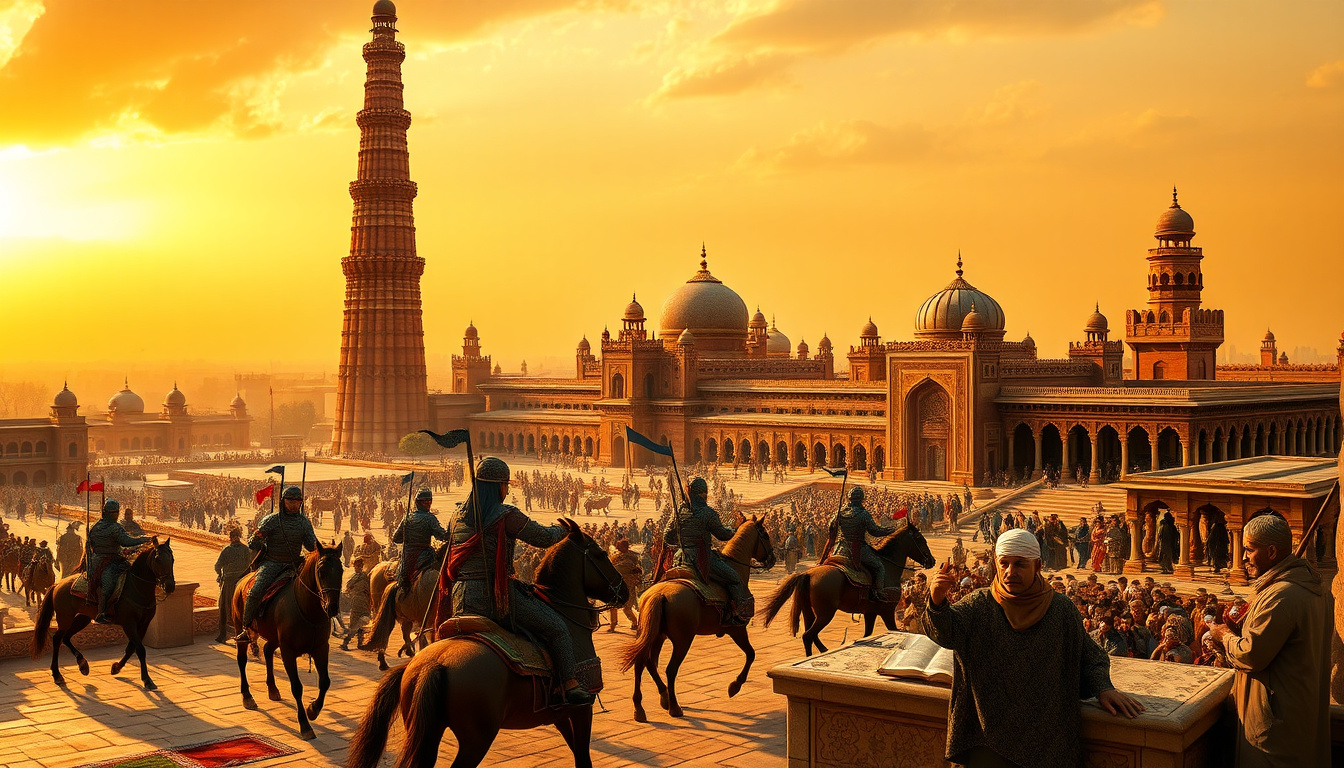
What really happened was a gradual cultural blending. Sanskrit literature was still patronized. Hindu temples were built in peripheral regions. And slowly, Persian-influenced Indo-Islamic architecture emerged — a fusion that's absolutely stunning. The Qutb Minar in Delhi? That's the symbol of this period, and it's a masterpiece.
Religious fundamentalism existed, yes, but it wasn't constant policy. It depended on the Sultan's temperament and political needs.
Art, Architecture, and Language
The sultanate period gave India some of its most iconic structures. The Qutb Minar (Delhi), the tombs of Humayun and Isa Khan, the mosques in Jaunpur — these aren't just buildings; they're statements of power and aesthetics combined.
Architecturally, we see the Indo-Islamic style developing. Unlike purely Islamic architecture (which avoided figurative art), Indo-Islamic style incorporated some Hindu design elements. Domes, arches, and minarets met the trabeate (beam-and-pillar) style of Hindu temples.
Linguistically, Urdu was born during this period. Persian was the court language, and when Persian mixed with local languages (especially around Delhi), Urdu emerged. By the time the Mughals arrived, Urdu was becoming the lingua franca of administration. Pretty cool, right?
| Dynasty | Period | Key Ruler(s) | Major Achievement |
|---|---|---|---|
| Slave Dynasty | 1206–1290 | Qutb-ud-Din Aibak, Iltutmish, Razia Sultan | Founded Delhi Sultanate, expanded territory, Qutb Minar |
| Khalji Dynasty | 1290–1320 | Alauddin Khalji | Southern expansion, economic reforms, defeated Rani Padmini |
| Tughlaq Dynasty | 1320–1414 | Muhammad bin Tughlaq, Firoz Shah Tughlaq | Capital shift to Daulatabad, golden age under Firoz Shah |
| Sayyid Dynasty | 1414–1451 | Muhammad I, Alam Shah | Administrative stability but declining territorial control |
| Lodi Dynasty | 1451–1526 | Ibrahim Lodi | Attempted recentralization, ended at Battle of Panipat (1526) |
Economy, Trade, and Military Innovation
One thing I've learned over 10+ years of teaching is that students often focus too much on rulers and battles, and not enough on the actual functioning of society. So let me talk about the practical stuff.
Agriculture and Revenue System
The sultanate's wealth came from agriculture. The main tax was the "Kharaj" (land tax), paid mostly by Hindu peasants. This could be anywhere from 1/4 to 1/2 of the harvest — harsh, but similar to other medieval kingdoms worldwide.
The government also collected taxes on trade, salt, and customs duties on goods passing through sultanate territories. The "Muhtasib" (market inspector) ensured fair prices and collected these taxes.
Under Alauddin Khalji, there was actual price control. The Sultan fixed maximum prices for essential commodities. Was it successful? Partially — it prevented hoarding but also discouraged production. It's actually a lesson in economics: when you control prices artificially, people find ways around it.
Military Strength and Innovation
The sultans had a well-organized military. The backbone was the cavalry (mounted archers), which was far superior to the Indian chariot-based warfare. The sultans also introduced siege warfare technology and used artillery (cannons) increasingly as the period progressed.
The Iqta system was used to compensate military nobles. A general would be granted land, collect taxes from it, and in return, maintain a certain number of soldiers ready for the Sultan's campaigns. It's not exactly feudalism (because the Sultan could take the land back), but it functioned similarly.
Why the Sultanate Fell (And What It Taught Us)
By the early 16th century, the Delhi Sultanate was fragmenting. Regional powers had become too strong. The Bahmani Sultanate in the Deccan, the Bengal Sultanate, and others were independent in everything but name.
The final blow came at the Battle of Panipat in 1526. Babur, a Central Asian conqueror with better artillery and tactics, defeated Ibrahim Lodi. It wasn't that the sultanate was weak — it was that a new power with newer military technology arrived.
But here's what's important: the Delhi Sultanate didn't just disappear. Its administrative structure, its architecture, its language innovations — all of these were absorbed by the Mughal Empire that followed. In many ways, the Mughals were just the continuation of the sultanate with a change of dynasty.
This period teaches us something crucial about Indian history: continuity matters more than rupture. Rulers changed, but the state machinery continued. Cultures merged, but that's how India has always evolved.
So, the next time someone asks you about the Delhi Sultanate, don't just rattle off dates and dynasty names. Tell them about Razia Sultan's struggle, Alauddin's economic policies, Muhammad bin Tughlaq's ambition, or how Indo-Islamic architecture blended two traditions. That's what makes history alive.
Quick Revision Summary
Time Period: 1206–1526 CE (320 years)
Five Dynasties: Slave → Khalji → Tughlaq → Sayyid → Lodi
Key Innovations: Indo-Islamic architecture, Urdu language, organized bureaucracy, token currency (Tughlaq)
Important Concepts: Divan system, Iqta system, Jizya tax, Qazi justice system
Most Important Rulers: Qutb-ud-Din Aibak, Alauddin Khalji, Muhammad bin Tughlaq, Firoz Shah Tughlaq, Ibrahim Lodi
Practice Questions
A) Qutb-ud-Din Aibak B) Alauddin Khalji C) Muhammad bin Tughlaq D) Firoz Shah Tughlaq
Answer: C) Muhammad bin Tughlaq — He minted token coins and implemented various economic reforms, though many were unsuccessful.
A) Razia Sultan B) Rani Padmini C) Rani Durgavati D) Iltutmish's mother
Answer: A) Razia Sultan — She ruled from 1236–1240 and was known for her military acumen and administrative skills.
A) Tughlaq Dynasty B) Sayyid Dynasty C) Khalji Dynasty D) Lodi Dynasty
Answer: D) Lodi Dynasty — Ibrahim Lodi was defeated by Babur, marking the end of the Delhi Sultanate and the beginning of the Mughal Empire.
A) Jizya B) Kharaj C) Abwab D) Iqta
Answer: B) Kharaj — This was the main agricultural tax, typically ranging from 1/4 to 1/2 of the harvest. Jizya was a tax on non-Muslims; Iqta was a land grant to nobles.
A) Slave Dynasty B) Khalji Dynasty C) Tughlaq Dynasty D) Sayyid Dynasty
Answer: B) Khalji Dynasty — Alauddin's military campaigns into the Deccan were some of the earliest successful southern expeditions by Delhi rulers.
Published by Dattatray Dagale • 15 August 2026
.jpg)
.png)



.png)




.png)

0 Comments