Why This Topic Matters More Than You Think
Listen, I've been teaching chemistry to SSC and UPSC aspirants for over a decade now, and I can tell you with absolute certainty: if you don't understand the difference between elements and compounds, you're going to struggle with nearly every chemistry topic that comes after. This isn't just about passing a single question on your exam—it's about building the foundation that makes everything else click into place.
I had a student once, Priya, who scored 95 in maths but kept flunking chemistry. When we sat down together, I realized her problem wasn't lack of intelligence. She simply didn't grasp that water is a compound, not a mixture. That one misunderstanding cascaded into confusion about reactions, properties, and everything else. Within a week of clearing this concept, her entire performance transformed. That's the power of truly understanding elements and compounds.
So let's make sure this sticks with you. No confusion. No gaps.
What Are Elements? The Pure Players of Chemistry
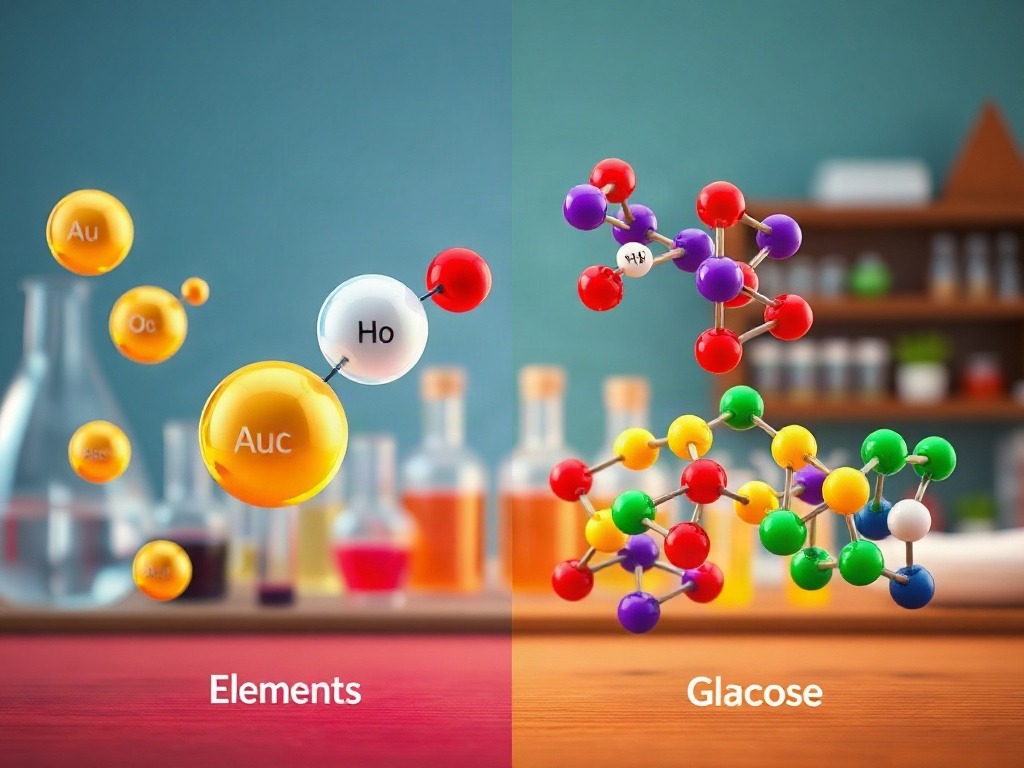
An element is the simplest form of matter that cannot be broken down further by chemical means. Think of it like this: if you take a brick wall and keep breaking it into smaller and smaller pieces, eventually you get to a single brick. You cannot break that brick further without changing what it is fundamentally. An element is chemistry's version of that brick.
Currently, we have 118 known elements on the periodic table. Each element is made up of only one type of atom. Pure gold is an element—every particle is a gold atom. Pure oxygen gas is an element—it's made entirely of oxygen atoms (technically O₂ molecules, but they're all oxygen). Hydrogen, carbon, nitrogen, sulfur—these are all elements.
Physical Properties of Elements
Now here's something interesting: elements can exist in different physical states. Iron is a solid element, mercury is a liquid element, and oxygen is a gaseous element. They can be metals, non-metals, or metalloids. They can conduct electricity or not conduct it. But regardless of their physical form or properties, if it's chemically one type of atom, it's an element.
I always tell my students: imagine elements as pure-bred dogs. A Labrador is a Labrador, no matter if it's brown, black, or golden. Similarly, gold is gold, whether it's in jewelry form or powdered form. The physical appearance or state might change, but the fundamental identity remains.
How Elements Are Represented
Every element has a chemical symbol. Some are intuitive—C for Carbon, O for Oxygen, H for Hydrogen. Others come from Latin names and can seem random—Au for gold (from "aurum"), Fe for iron (from "ferrum"), Ag for silver (from "argentum"). For your exams, knowing at least the common 30-40 element symbols is absolutely essential. There's no way around it.
Compounds: When Elements Join Forces
A compound is formed when two or more elements chemically bond together in a fixed ratio. And this is the key difference from just mixing things: the elements have chemically combined, which means their individual properties change completely.
Let me give you a vivid example. Hydrogen is a colorless gas that can explode. Oxygen is a colorless gas that supports combustion. Now, if I combine hydrogen and oxygen in a 2:1 ratio and let them chemically bond, what do I get? Water. H₂O. Water is a liquid at room temperature, it extinguishes fires, it doesn't explode—it has completely different properties from its constituent elements.
Or consider sodium. Sodium is a soft, silvery metal so reactive that it bursts into flames when exposed to water. Chlorine is a toxic yellow-green gas. But combine them chemically, and you get sodium chloride—table salt. Something you sprinkle on your food every day. Completely different properties.
This is what makes chemistry beautiful and sometimes confusing: the properties of a compound are NOT just an average of its constituent elements. They're entirely new. The atoms have rearranged, electrons have been shared or transferred, and something entirely different has emerged.
Types of Compounds: Ionic vs. Covalent
There are two main ways elements bond to form compounds. In ionic compounds, electrons are transferred from one atom to another. Sodium gives an electron to chlorine—sodium becomes positively charged (Na⁺), chlorine becomes negatively charged (Cl⁻), and they attract each other. This happens mostly between metals and non-metals.
In covalent compounds, electrons are shared between atoms. In a water molecule, oxygen and hydrogen share electrons. This typically happens between non-metals.
Here's a memory trick I tell all my students: "I-onIC = Ionic is about IONs (charged particles). Co-VALent = Co means TOGETHER, they share VALence electrons." Sounds silly, but it sticks in your head during the exam.
Fixed Composition: The DNA of Compounds
The crucial thing about compounds is that they always have a fixed composition. Every molecule of water is always H₂O—two hydrogen atoms, one oxygen atom. Every molecule of glucose is always C₆H₁₂O₆. You cannot have a molecule that's "kind of" water. Either it's water, or it's something else.
This is why compounds are different from mixtures. If I make lemonade by mixing lemon juice, water, and sugar, I can adjust the ratios. More sugar today, less sugar tomorrow. It's still lemonade, but the composition varies. A compound doesn't work that way. The composition is fixed at the molecular level.
The Critical Difference: A Comparison That Will Stick
| Property | Element | Compound |
|---|---|---|
| Definition | Pure substance made of one type of atom | Pure substance made of two or more elements chemically bonded |
| Number of Atoms | One type | Two or more types |
| Chemical Bonding | No bonding (it's the base unit) | Chemical bonding present (ionic or covalent) |
| Fixed Ratio | N/A (it's pure) | Yes, always fixed (e.g., H₂O is always 2:1) |
| Properties | Specific to that element | Often completely different from constituent elements |
| Can be separated? | No (only by nuclear means) | Yes (by chemical reactions or electrolysis) |
| Examples | Gold (Au), Oxygen (O₂), Carbon (C) | Water (H₂O), Salt (NaCl), Sugar (C₆H₁₂O₆) |
I remember one of my students asking me, "Sir, is air an element or a compound?" Great question! Air is actually neither—it's a mixture. It contains nitrogen, oxygen, argon, and trace gases, but they're not chemically bonded. They're just... mixed. You can separate them (though it's technically complex). This is why understanding these definitions matters: they're not just academic. They have real implications for how substances behave.
Practical Exam Tips and Common Confusion Points
After marking hundreds of answer sheets, I've noticed the same mistakes repeated. Let me save you from these pitfalls.
Mistake 1: Confusing O₂ with two oxygen atoms. O₂ is still an element—it's oxygen in its molecular form. It's two oxygen atoms bonded together, but there's still only one type of element present.
Mistake 2: Thinking that allotropes are different substances. Diamond and graphite are both pure carbon (elements), just in different forms. They're not different elements or compounds.
Mistake 3: Not recognizing that when you see a chemical formula like NaCl or H₂SO₄, you're looking at a compound. The subscripts tell you the ratio in which elements have combined.
Here's my best memory trick for exam day: "Elements = One-dimensional (one type of atom). Compounds = Married (two or more types bonded together for life)." Sounds cheesy, but when you're under pressure in an exam, these silly associations save you.
One more thing—when exam questions ask about "pure substances," remember: both elements and compounds are pure substances. The difference between them is what they're made of, not whether they're pure. A mixture (like saltwater) is not a pure substance because the composition can vary.
Why These Concepts Build Your Chemistry Foundation
I want to be honest with you: this topic might feel basic, even boring, compared to flashy topics like organic chemistry or redox reactions. But that's exactly why it matters. If you skip this and move ahead, you'll be building a house on sand.
Every reaction you study, every property you learn, every mechanism you understand—it all flows from this foundation. When you study acids and bases, you're studying compounds. When you study reactions, you're seeing how elements and compounds transform. When you study electrochemistry, you're dealing with electron transfer in compounds. This is the bedrock.
So invest the time now. Truly understand. Not just to pass the exam, but to build lasting chemistry knowledge that will serve you throughout your career, whether you pursue IIT, UPSC, or any other competitive exam. I've seen students ace every topic after they solidified this foundation. You can be one of them.
Quick Revision Points to Remember
Elements: Pure substance, one type of atom, represented by chemical symbols, cannot be broken down chemically, 118 known elements.
Compounds: Pure substance, two or more elements chemically bonded, fixed composition, properties differ from constituent elements, can be broken down chemically.
The Real Difference: When hydrogen and oxygen are separate, they have their own properties. When they chemically bond to form water, something entirely new emerges. That transformation—that's the essence of a compound.
---Practice Questions to Test Your Understanding
A) Water B) Oxygen gas (O₂) C) Sodium chloride D) Glucose
Answer: B) Oxygen gas (O₂) — It's a pure substance containing only one type of atom. Even though it exists as O₂, it's still the element oxygen.
A) Variable composition B) Fixed composition C) Only metallic atoms D) Only non-metallic atoms
Answer: B) Fixed composition — Every molecule of a compound has the same ratio of atoms. H₂O is always H₂O, never H₂O₂.
A) Compounds have the same properties as their elements B) Compounds have completely different properties from their constituent elements C) Elements cannot react D) Compounds are not pure substances
Answer: B) Compounds have completely different properties from their constituent elements — This is a fundamental principle. The properties of a compound are unique and cannot be predicted from its elements.
A) Compound B) Mixture C) Element D) Alloy
Answer: C) Element — Elements are the simplest form of pure substance and cannot be broken down further by chemical reactions. Compounds can be broken down into elements through chemical reactions.
A) Isotopes B) Allotropes C) Compounds D) Mixtures
Answer: B) Allotropes — Different forms of the same element in the same physical state are called allotropes. Both are pure carbon (elements), just arranged differently.
Published by Dattatray Dagale • 31 August 2026
.jpg)
.png)



.png)




.png)

0 Comments