Introduction
Let me start with a confession—when I first taught chemistry, I made it unnecessarily complicated. I'd stand in front of the class and throw definitions around like cricket commentators throwing jargon, and half my students would zone out completely. Then one day, a student asked me: "Sir, if salt is made of sodium and chlorine, why can't I taste the poison in my food?"
That question changed everything for me. Because suddenly, I realized that chemistry isn't about memorizing—it's about understanding how the world actually works. And there's no better place to start than with elements and compounds.
See, here's the thing: you interact with hundreds of compounds every single day. The water you drink. The sugar in your tea. The rust on your old bicycle. The oxygen you breathe. All of these are compounds made from simpler building blocks called elements. And if you understand how elements combine to form compounds, you've basically unlocked one of nature's greatest secrets.
In the next few minutes, I'm going to walk you through this exactly as I'd explain it during a tutorial session—clear, practical, and without any unnecessary jargon. Let's begin.
What Are Elements? The Building Blocks of Everything
An element is the simplest form of matter that cannot be broken down further through chemical reactions. Think of it as the ultimate LEGO brick—you can't make it smaller and have it still be the same thing.
The Definition That Actually Makes Sense
An element is a pure substance made of only one type of atom. That's it. One type of atom. Not two, not three—just one. Hydrogen is an element because every hydrogen atom has the same properties. Oxygen is an element. Carbon is an element. Gold is an element.
Now, I want you to remember this—and I'll give you a trick I tell all my students: Elements = Same Atoms = Pure Substance. If you see the words "pure substance" in an exam question, there's a good chance they're talking about an element (or a compound, but we'll get to that).
There are 118 known elements on the periodic table. You don't need to memorize all of them for SSC or UPSC—thank god for that—but you do need to know the common ones: hydrogen (H), oxygen (O), nitrogen (N), carbon (C), sodium (Na), chlorine (Cl), iron (Fe), copper (Cu), and so on.
Why Elements Matter in Your Exam
Here's what examiners love to ask: "Which of the following is an element?" and then they give you tricky options like water, salt, sugar, and oxygen. Water? Compound. Salt? Compound. Sugar? Compound. Oxygen? Element. The difference matters because elements have specific atomic numbers, specific properties, and they combine with other elements in predictable ways.
Let me give you a practical example. Gold is an element. It's shiny, it's dense, it doesn't rust. These properties come from the gold atoms themselves. Now, if I tell you that gold can be melted and reshaped, that's still gold—because I haven't changed the atoms. But if I combine gold with copper to make an alloy? Well, that's a different beast entirely, and we'll talk about that soon.
Understanding Compounds: When Elements Hold Hands
Now here's the interesting part—elements don't like to stay alone. They want to bond with other elements. And when they do, they form compounds.
The Real Definition of a Compound
A compound is a pure substance made of two or more elements chemically bonded together in a fixed ratio. The key word here is chemically bonded. This isn't just mixing—this is a proper commitment. The atoms share electrons, they stick together, and they form something entirely new with completely different properties.
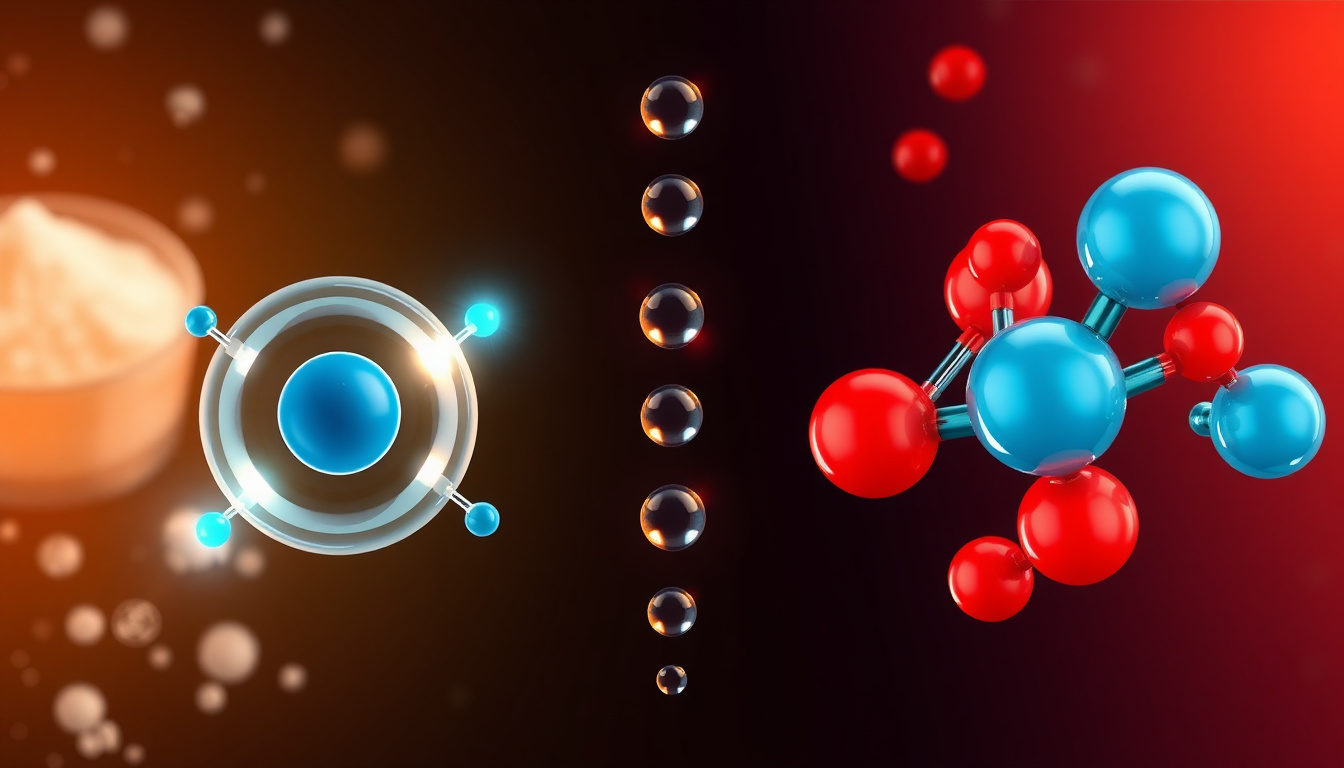
Let me give you the classic example that changed my understanding completely. Sodium is a shiny metal that reacts violently with water—honestly, it's terrifying. Chlorine is a toxic green gas that smells awful and can kill you. But put them together? Boom. You get sodium chloride. Salt. The stuff on your dinner table. The same salt that makes your food taste good and keeps you hydrated.
This is mind-blowing, right? Two dangerous substances become safe, essential, delicious. And it's because of the chemical bond between them. The properties of a compound are completely different from the properties of its elements. That's the defining characteristic.
Types of Compounds You Need to Know
For your exam, you need to know two main types:
Ionic Compounds: These form when atoms transfer electrons from one to another. Sodium gives an electron to chlorine. Calcium gives two electrons to oxygen. The atom that loses electrons becomes positively charged (cation), and the atom that gains electrons becomes negatively charged (anion). They attract each other like opposite poles of a magnet. Salt (NaCl), calcium carbonate (CaCO₃, the stuff in chalk), and iron oxide (Fe₂O₃, rust)—these are all ionic compounds.
Covalent Compounds: Here, atoms share electrons instead of transferring them. Water (H₂O) is the perfect example—the hydrogen and oxygen atoms share electrons and stick together. Methane, ammonia, sugar—these are all covalent compounds. They tend to be softer than ionic compounds and often have lower melting points.
Here's a memory trick I use: Ionic = Transfer (like handing money), Covalent = Share (like splitting the bill). Works every time.
| Property | Elements | Compounds |
|---|---|---|
| Definition | One type of atom only | Two or more elements bonded chemically |
| Can be broken down? | Only by nuclear reaction | Yes, through chemical reaction |
| Fixed ratio? | N/A (single element) | Yes, always the same |
| Properties | Same as the pure atom | Different from component elements |
| Examples | Oxygen (O), Iron (Fe), Gold (Au) | Water (H₂O), Salt (NaCl), Sugar (C₆H₁₂O₆) |
The Key Differences: Why This Matters for Your Exam
I want to spend a moment here on the differences because this is where most students get confused, and it's also where examiners love to set traps.
Composition and Structure
Elements have a fixed atomic structure. Carbon atom is always carbon—same number of protons, same number of electrons (usually). But compounds have a specific ratio of elements. Water is always H₂O. Two hydrogen atoms, one oxygen atom. If you add another hydrogen, it's not water anymore—it's hydrogen peroxide (H₂O₂), a completely different compound with completely different properties. Hydrogen peroxide is a bleaching agent. Water, well... you drink it.
Breaking Them Down
This is crucial. You cannot break an element down through ordinary chemical reactions. You can burn it, freeze it, melt it, dissolve it—but it remains an element. Only nuclear reactions can change an element into another element. Compounds, on the other hand, can be broken down through chemical reactions. Heat water to 2000°C, and it breaks down into hydrogen and oxygen. React salt with concentrated sulfuric acid, and it breaks down into sodium and chlorine.
Here's the exam trick: if a question asks "Which can be broken down through a chemical reaction?" the answer is always compound.
Properties: The Ultimate Giveaway
This is the most important difference, and honestly, it's the most interesting one too. The properties of a compound are completely different from the properties of its constituent elements. Remember that sodium and chlorine example? This principle applies universally. Carbon (element) is black. Oxygen (element) is a colorless gas. Carbon dioxide (compound) is also colorless and is what you breathe out. Hydrogen is explosive. Oxygen helps things burn. Water (made from hydrogen and oxygen) extinguishes fires. It's almost like magic, but it's just chemistry.
Practical Examples from Your Daily Life
Let me make this real for you. I always believe that chemistry should feel alive, not like something trapped in a textbook.
Your Cup of Tea: You're probably drinking water (H₂O, a compound) with tea leaves (which contain various compounds like catechins and polyphenols). If you add sugar (C₆H₁₂O₆, a compound) and milk (which is itself a mixture of compounds), you're combining different compounds. But here's the thing—the sugar remains sugar even though it's in the tea. It's a mixture, not a new compound.
Cooking and Chemistry: When you fry an egg, you're not just heating it—you're breaking down proteins through denaturation, which is a physical change, not a chemical one. But when you cook meat over charcoal and it turns brown, that's the Maillard reaction—a chemical reaction creating new compounds responsible for the flavor and color. That's why fried chicken tastes different from boiled chicken.
Rust on Your Iron Railing: This is iron oxide (Fe₂O₃ or Fe₃O₄), a compound formed when iron (element) reacts with oxygen (element). The rust has completely different properties—it's crumbly, it's orange-red, it's weaker than the original iron. The original metal is gone; a new compound has formed.
These aren't just examples—they're proof that chemistry is everywhere, and understanding elements and compounds helps you understand the world.
Quick Revision Summary
Alright, let me summarize this quickly before we move to practice questions:
Elements: Made of one type of atom. Cannot be broken down through chemical reactions. Have fixed atomic structure. Examples: O₂, N₂, Fe, Cu, Au.
Compounds: Made of two or more elements in fixed ratio. Can be broken down through chemical reactions. Properties are different from component elements. Examples: H₂O, NaCl, CO₂, C₆H₁₂O₆.
The Golden Rule: If something is made of more than one type of element chemically bonded together, it's a compound. If it's just one type of atom, it's an element.
The last thing I want to tell you is this: don't just memorize these definitions. Understand them. Because once you understand the difference between elements and compounds, so many other chemistry topics become easier. Redox reactions? It's about elements changing oxidation states. Balancing equations? You're rearranging elements in compounds. It all connects.
Practice Questions to Test Your Understanding
A) Water B) Salt C) Oxygen D) Sugar
Answer: C) Oxygen — It's a pure substance made of only one type of atom. All other options are compounds made of two or more elements.
A) Because it's a mixture B) Because electrons are transferred, forming ionic bonds C) Because it's heated D) Because the elements remain unchanged
Answer: B) Because electrons are transferred, forming ionic bonds — When sodium and chlorine combine chemically, they form a compound with completely new properties due to the chemical bonding between them.
A) It contains only one type of atom B) It cannot be broken down by chemical reactions C) It has a fixed ratio of elements chemically bonded D) It has the same properties as its elements
Answer: C) It has a fixed ratio of elements chemically bonded — This is the defining characteristic of a compound.
A) A new element B) A compound C) A mixture D) Pure iron
Answer: B) A compound — Rust (iron oxide) is a new compound formed when iron and oxygen chemically bond. It has properties completely different from both iron and oxygen.
A) Elements are solids; compounds can be any state B) Elements contain one type of atom; compounds contain two or more types C) Compounds are always toxic D) Elements have fixed melting points; compounds don't
Answer: B) Elements contain one type of atom; compounds contain two or more types — This is the fundamental distinction between elements and compounds.
Published by Dattatray Dagale • 06 August 2026
.jpg)
.png)



.png)




.png)

0 Comments