Introduction
Listen, I've been teaching this stuff for over a decade now, and I can tell you with absolute certainty: students either love or hate the "Modern India – Acts and Reforms" section. There's rarely a middle ground. But here's what I've figured out — the confusion usually happens because we treat these acts like isolated facts floating in a vacuum. They're not. Every single act we study was a response to something real, something urgent, something that India was struggling with.
Think of it this way: if you understand why an act was passed, the what and when practically stick to your brain like chewing gum on your shoe. And that's exactly what we're going to do today. We're going to understand the story behind these reforms — the heartbeat, not just the skeleton.
For SSC CGL, UPSC, and competitive exams in general, questions on acts and reforms are bread and butter. But they're not just factual questions anymore — examiners want you to understand impact, chronology, and interconnections. So let's dive deep.
The Foundation Era: Acts That Shaped Modern India's Skeleton (1858-1947)
The Indian Councils Act Series (1861, 1892, 1909)
Okay, here's where I tell students to stop memorizing and start visualizing. After the 1857 Revolt, the British were nervous. They couldn't rule India with an iron fist alone anymore — they needed Indians to feel like they had some say in governance. Enter the councils acts.
The 1861 Indian Councils Act was basically saying, "Alright, we'll let Indians sit on the council, but only to advise us." Picture it like this: the Viceroy is the boss, and now there are a few Indians sitting at the table, but their chairs are shorter. Get it? They could speak, but nobody had to listen.
Then came the 1892 Act, which expanded representation slightly and introduced something called the "elective principle" — but it was so limited that Indians had to laugh. You couldn't directly vote; you had to vote through some weird indirect method. It's like asking someone to order pizza but not letting them pick the toppings.
Fast forward to 1909 (also called the Morley-Minto Reforms), and we see something more interesting: direct elections were introduced! But here's the catch — there was something called "communal electorates," which meant Muslims voted only for Muslim representatives and Hindus for Hindu representatives. This was actually a seed that would grow into massive problems later. Many historians argue the 1909 Act planted the roots of communal politics in India.
My trick for remembering these three: "6-9-9" — 1861, 1892, 1909. The numbers go up because Indian representation was slowly (very slowly) increasing. It's like watching water boil on low heat — technically it's getting warmer, but you're going to get tired waiting.
The Government of India Acts (1919 and 1935)
Now here's where things got real. After World War I and the Khilafat Movement, the independence movement was on fire. The British couldn't ignore Indians anymore. So they threw us a bigger bone.
The Government of India Act, 1919 (also known as the Montagu-Chelmsford Reforms) introduced "dyarchy" — which is a fancy word for "two-headed government." Some subjects went to Indian ministers, and some stayed with the British. Like, Indians could handle local issues, but foreign policy? Healthcare? Forget it. The British kept the important stuff.
But the 1919 Act also did something that genuinely angered people: it came with the Rowlatt Act attached to it — basically martial law that could arrest anyone without trial. This directly led to the Jallianwala Bagh massacre just a few weeks later. So 1919 was both a step forward and a brutal step backward.
Then came the Government of India Act, 1935. This was the granddaddy of all reforms before independence. It introduced a federal structure, provincial autonomy, and expanded the franchise (voting rights). For the first time, India got a constitutional framework that looked somewhat modern. The 1935 Act became the basis for our 1950 Constitution — huge chunks were actually copied! If you read our Constitution, you'll find 1935 Act DNA all over it.
Independent India's Big Makeover: The First Wave of Reforms (1947-1970)
Land Reforms and Zamindari Abolition
Here's something I've observed teaching students for years: they often overlook land reforms because they think it's "boring" compared to acts about voting rights. But let me tell you, if you lived in a village in 1947, land reform was everything. Your entire economic life depended on it.
The Zamindari Abolition Act (which was different in different states, so I call it the "Land Reform Series" rather than one act) was revolutionary. Zamindars were basically feudal landlords who owned massive tracts of land and extracted taxes from farmers. They were often called "parasites" because they didn't actually do any farming — they just collected money.
When India became independent, Ambedkar and Nehru both pushed hard for this. By the 1950s, most states passed laws to abolish the zamindari system. Overnight (well, on paper at least), farmers became owners instead of tenants. It was supposed to free millions of people from feudal oppression.
Now here's the complicated part — did it work perfectly? No. Many landless laborers didn't get land because they had no formal claim. But it was still one of the most transformative reforms independent India undertook. It addressed centuries of injustice.
The Hindu Code Bill and Family Law Reforms
You want to know one of the most controversial reforms independent India passed? The Hindu Code Bill (1956). And I say controversial because it genuinely was. Ambedkar, who was the first Law Minister, pushed this through like a man possessed.
What did it do? It reformed Hindu personal law — marriage, succession, adoption, guardianship. Before this, Hindu women had almost no inheritance rights, no grounds for divorce, and limited guardianship over children. The Code changed that. Women could own property, file for divorce, and have guardianship rights.
Here's the kicker: this happened in 1956! While many Western countries were still grappling with women's rights, independent India was legislating equality into its laws. Ambedkar actually left his position after the Constituent Assembly because he felt his draft Constitution wasn't secular enough, but the Hindu Code Bill was his second victory — his way of saying, "I told you women deserve equal rights."
Conservative forces were furious. There were protests, street demonstrations. But Nehru's government held firm. This is why I tell students: modern India's journey to gender equality didn't start in the 2000s — it started in the 1950s, in the vision of one man called Ambedkar who refused to compromise on fundamental rights.
The States Reorganisation Act, 1956
Quick question: why is India divided into states like Maharashtra, Gujarat, Kerala, and so on? Why not just keep the colonial provincial boundaries? Because of the States Reorganisation Act!
This act reorganised India's states based on linguistic boundaries rather than colonial ones. So you got separate states for Tamil-speaking people, Marathi-speaking people, and so forth. It was an ingenious way to balance national unity with regional identity. Some states were formed, some merged, some were split.
This sounds administrative, but think about it: it was actually saying, "Your language, your culture, your identity matters. We respect that within the framework of India." That's pretty revolutionary for a new nation that could have easily said, "Everyone is Indian now — forget your regional identity."
The Transformative Era: Big-Picture Reforms (1970-2000)
The 73rd and 74th Constitutional Amendments (1992)
These two amendments together are like the most underrated superheroes in India's governance story. Honestly, I've seen thousands of students skip these in exam prep, and it's a huge mistake because questions on these appear frequently.
The 73rd Amendment devolved power to Panchayati Raj institutions (village councils) and mandated that one-third of positions be reserved for women. This was decentralisation at its best. Instead of all power staying with the state government, villages got to decide their own development.
The 74th Amendment did the same for urban areas — it empowered Municipal Corporations and mandated similar reservations.
Now here's why this matters: these amendments, passed in 1992, transformed how local governance works in India. Women's representation jumped dramatically. Villages that had been neglected by state governments could now plan their own development. It's not perfect — corruption and inefficiency still exist — but the intention and structure are genuinely progressive.
I teach students this mnemonic: "73 and 74 came in '92, gave power to Panchayat and Municipal crew, and reserved seats for women too." Cheesy? Yes. Memorable? Absolutely.
The Right to Information Act, 2005
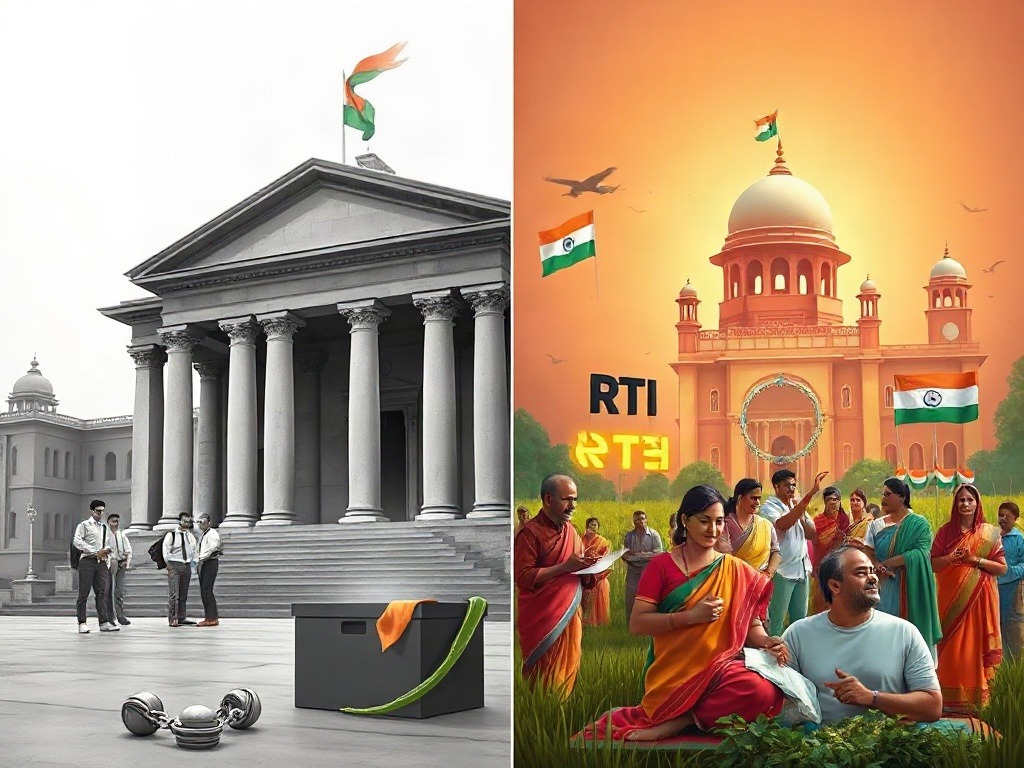
This one's beautiful in its simplicity but revolutionary in its impact. The Right to Information (RTI) Act gave every Indian citizen the right to ask for information from any government body. And the government had to respond within 30 days (extended to 45 days in some cases).
Before RTI, government transparency was basically fiction. Officials could hide whatever they wanted. Post-RTI, a farmer in Bihar could demand to know what happened to the village development fund. A citizen could ask why their application was rejected.
Has it solved corruption? No. But it's put sunlight on a lot of murky stuff. RTI has become a weapon in the hands of activists, journalists, and common citizens. I'd argue it's one of independent India's best-designed legislations.
Quick Reference: Major Acts at a Glance
| Act/Reform | Year | Key Feature | Impact |
|---|---|---|---|
| Indian Councils Act | 1861, 1892, 1909 | Gradual Indian representation | Set stage for electoral politics |
| Government of India Act | 1919, 1935 | Dyarchy (1919); Federal structure (1935) | Blueprint for Constitution |
| Zamindari Abolition | 1950s (varies by state) | Ended feudal landlord system | Land to peasants; ended feudalism |
| Hindu Code Bill | 1956 | Equal rights for women in personal law | Women's property rights, divorce rights |
| States Reorganisation Act | 1956 | States by language, not colonial lines | Regional autonomy within unity |
| 73rd & 74th Amendments | 1992 | Power to Panchayats & Municipalities | Decentralisation, women's representation |
| Right to Information Act | 2005 | Government transparency | Citizens can demand govt. info |
The Bigger Picture: Why These Acts Matter for Your Exam
You know what examiners love? They love when students connect the dots. They don't just want you to say, "The 73rd Amendment happened in 1992." They want you to understand why decentralisation was necessary, how it relates to India's federal structure, and what problems it tried to solve.
Here's my advice: as you study each act, ask yourself three questions:
1) What problem did it solve? (The "why" question)
2) Who benefited and who resisted? (The "impact" question)
3) How does it connect to other acts or principles? (The "interconnection" question)
When you can answer these three for any act, you've moved beyond memorisation into genuine understanding. And that's when exam questions become easy instead of terrifying.
Also, notice a pattern: independent India's reforms have progressively moved toward democratisation and devolution of power. From centralised British rule → to more representative institutions (post-1919) → to genuine federalism (1935) → to land reforms that gave power to peasants → to local governance reforms that gave power to villages and cities. It's not a straight line — there are plenty of reversals and compromises — but the overall direction has been toward letting people have more say in decisions that affect them.
That's the real story of modern India's acts and reforms. It's the story of a nation gradually figuring out how to be truly democratic, how to balance unity with diversity, and how to give power to people who'd never had it before.
Practice Questions to Test Your Understanding
A) Indian Councils Act, 1861 B) Indian Councils Act, 1892 C) Indian Councils Act, 1909 D) Government of India Act, 1919
Answer: C) Indian Councils Act, 1909. The Morley-Minto Reforms introduced separate electorates for Muslims and Hindus, a decision many historians believe contributed to later communal divisions.
A) Abolished the zamindari system B) Reformed Hindu personal law and granted women equal rights in property and divorce C) Established the federal structure of India D) Extended voting rights to all citizens
Answer: B) Reformed Hindu personal law and granted women equal rights in property and divorce. This was Ambedkar's major legislative achievement as Law Minister.
A) It granted complete independence to India B) It introduced dyarchy for the first time C) Its provisions formed the basis for India's 1950 Constitution D) It abolished the British monarchy in India
Answer: C) Its provisions formed the basis for India's 1950 Constitution. Large sections of the 1935 Act were incorporated into the Constitution drafted by the Constituent Assembly.
A) 71st and 72nd Amendments B) 73rd and 74th Amendments C) 75th and 76th Amendments D) 69th and 70th Amendments
Answer: B) 73rd and 74th Amendments (passed in 1992). These devolved power to Panchayati Raj and Municipal institutions and mandated reservations for women at local levels.
A) Colonial administrative divisions B) Linguistic boundaries C) Religious majorities D) Economic potential
Answer: B) Linguistic boundaries. This act replaced colonial-era provincial boundaries with states organised around language groups, balancing regional identity with national unity.
Published by Dattatray Dagale • 12 September 2026
.jpg)
.png)



.png)




.png)


0 Comments